RVE 5306 Questions and Answers
Graded A
While observing a student reading, the teacher notices that the student does not match letters with
their correct sounds. The student is most likely having problems with
A) com
...
RVE 5306 Questions and Answers
Graded A
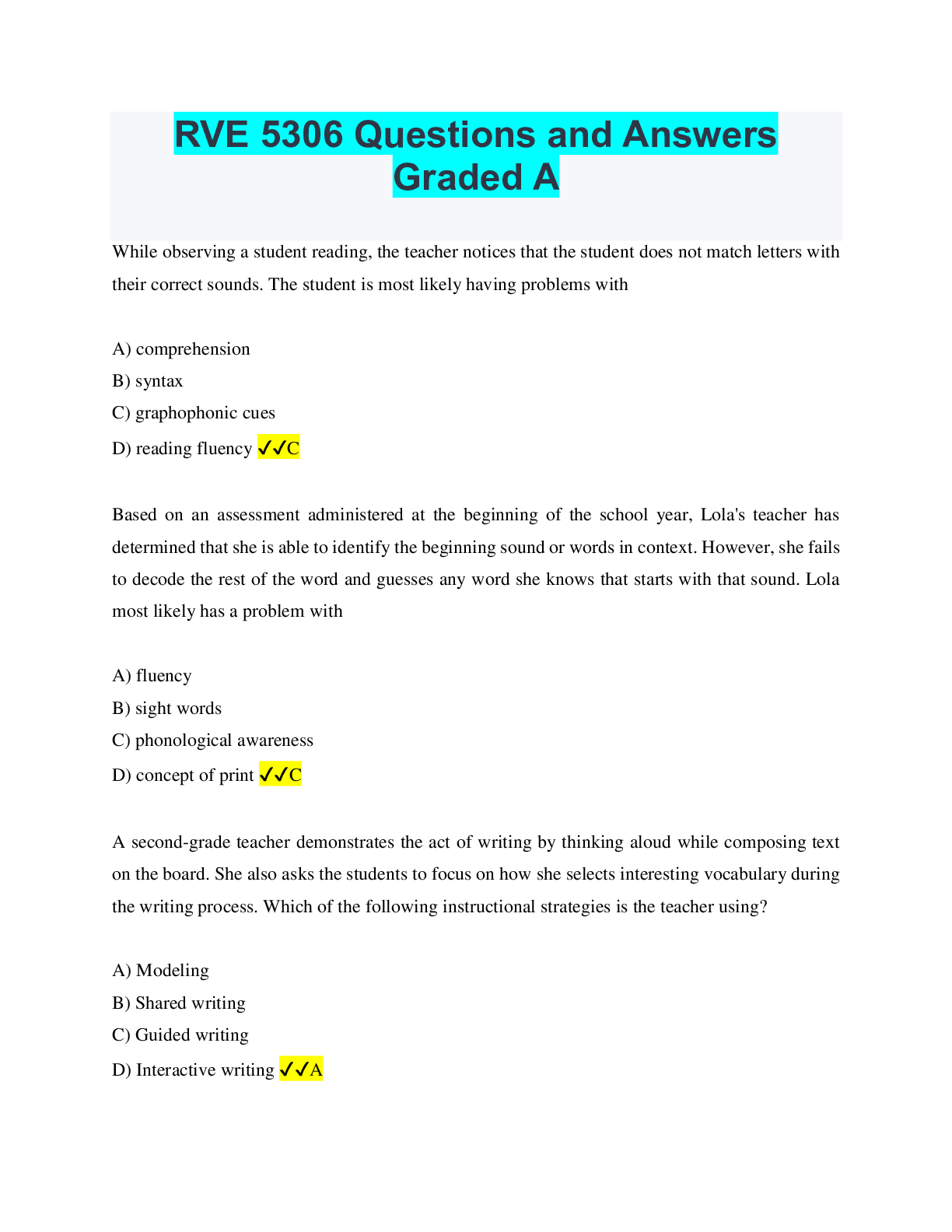
While observing a student reading, the teacher notices that the student does not match letters with
their correct sounds. The student is most likely having problems with
A) comprehension
B) syntax
C) graphophonic cues
D) reading fluency ✔✔C
Based on an assessment administered at the beginning of the school year, Lola's teacher has
determined that she is able to identify the beginning sound or words in context. However, she fails
to decode the rest of the word and guesses any word she knows that starts with that sound. Lola
most likely has a problem with
A) fluency
B) sight words
C) phonological awareness
D) concept of print ✔✔C
A second-grade teacher demonstrates the act of writing by thinking aloud while composing text
on the board. She also asks the students to focus on how she selects interesting vocabulary during
the writing process. Which of the following instructional strategies is the teacher using?
A) Modeling
B) Shared writing
C) Guided writing
D) Interactive writing ✔✔AWhich of the following pair of words would a student need to use context clues to derive their
connotation?
A) Said and task
B) Brush and ruler
C) Apples and grapes
D) Rug and ready ✔✔B
Several fourth-grade students are having trouble focusing on what they read. They report that their
minds wander and cannot remember what they have just read. Which of the following strategies
would help the students use metacognitive awareness to improve their comprehension.
A) Identifying important details about the story on a graphic organizer
B) Locate and define unfamiliar words
C) Select reading material that is easier for the student
D) Record questions, thoughts, ideas on sticky notes as he is reading ✔✔D
- I reread the paper carefully for all errors.
- I checked the paper for complete sentences.
- I double-checked for correct spelling.
- I capitalized all proper nouns.
At which stage of the writing process would the above checklist be most helpful for third-grade
students?
A) Rewriting
B) Editing
C) Revising
D) Drafting ✔✔BWhich of the following is an advantage of utilizing flexible grouping for guided reading
instruction?
A) A teacher can collect as much assessment data on students as possible.
B) A teacher is permitted to teach what students need to know.
C) A teacher can increase academic accountability of her students.
D) A teacher develops a better grasp on classroom management. ✔✔B
Mr. James, a kindergarten teacher, was reading a story to his students. During his read aloud, he
asked the students to identify which sound was the same in the words pig, pumpkin, and pail, three
objects mentioned int he book. Which phonemic awareness skill was he practicing with his
students?
A) Phoneme segmentation
B) Phoneme blending
C) Phoneme identity
D) Phoneme categorization ✔✔C
A second-grade student wrote the following:
"We hav a hamstr. His name iz merfy."
(We have a hamster. His name is Murphy.)
Which of the following strategies would be most helpful in helping this student develop his
spelling skills?
A) Expose children to word families, spelling patterns, word structure.
B) Study affixes, root words, and homophones.
C) Develop proofreading skills.
D) Teach letter names with letter forms. ✔✔AMr. Ramirez administers an informal reading inventory to each of the fifth grade students. What
information is he not likely to gather from the assessment?
A) Information about the student's attitude toward reading
B) Information about decoding and word analysis strategies the student uses
C) Information about whether the student is monitoring
D) Information about the student's comprehension ✔✔A
Which of the following phonemic awareness activities would be considered the lowest level of
difficulty?
A) Segmentation
B) Blending
C) Rhyming
D) Substitutions/additions/deletions ✔✔C
Which of the following would not be an effective strategy for increasing fluency?
A) Participating in daily independent reading
B) Participating in repeated readings
C) Prompting students to point to each word as they read
D) Participating in readers theater ✔✔C
To effectively promote family involvement in literacy activities, teachers can encourage parents
to
A) buy comics and story books
B) get their child a library card
C) discuss stories and experiences at home
D) volunteer in the school's media center ✔✔CWhich of the following should be the primary focus when using a holistic rubric to score a writing
assignment?
A) The overall structure and quality
B) The appropriate use of vocabulary
C) The student's performance on a specific criterion
D) The levels of performance for each criteria ✔✔A
Which of the following strategies will be most beneficial for students during the revising stage of
the writing process?
A) Using a graphic organizer
B) Brainstorming ideas as a class
C) Holding peer conferences
D) Typing their work on the computer ✔✔C
Which of the following activities involves structural analysis?
A) Students identify the beginning, middle, and end sounds in words
B) Students use individual sounds to blend the letters that make up a word
C) Students identify the number of syllables that make up different words
D) Students unlock the meaning of a word by considering the word parts ✔✔D
A teacher asks a student to break a word into its individual sounds by moving a marker for each
sound. This is an example of which type of phonemic awareness task?
A) Deleting phonemes
B) Adding phonemes
C) Substituting phonemes
D) Segmenting phonemes ✔✔DA student is actively engaged in reading a book and makes judgments and decisions beyond what
is stated in the text. Which of the following comprehension methods is the student using?
A) Inferential
B) Literal
C) Vocabulary
D) Internal ✔✔A
Which of the following best describes the use of reading response journals?
A) Students choose books that appeal to them and are at their own instructional level.
B) Students demonstrate skills such as careful observation, critical reasoning, critical thinking, and
the ability to justify or contest existing knowledge.
C) Students express their thoughts, feelings, reactions, and questions about a book they are reading.
D) Students identify the characters, setting, conflict and resolution of the story they are reading.
✔✔C
Syllabification can be used to help emergent student readers by supporting the students' ability to
A) decode words into units of sound
B) determine letter sounds
C) identify prefixes and suffixes easily
D) recognize the rhythm of a story ✔✔A
Words that cannot be sounded out according to regular pronunciation rules are called irregular
words. Which list below contains irregular words?
A) Man, came, well, in
B) We, him, get, so
C) Do, said, was, of
D) How, had, make, not ✔✔CDuring a writing workshop, Marc, a fourth-grade student, has difficulty developing and organizing
his ideas for an essay about his favorite baseball team. With the help of his teacher, Marc uses a
cluster diagram to identify smaller topics and to write details he could use in his writing. At which
stage of the writing process is Marc?
A) Revising
B) Drafting
C) Prewriting
D) Editing ✔✔C
A first-grade student shows evidence of phonological awareness but has difficulty segmenting
words into phonemes. Which of the below questions is likely to be the most challenging for the
student to answer?
A) Listen to these word parts: /p/.../i/.../ck/. What is the word?
B) Which two words rhyme: fun, sun, tan?
C) Listen to this word: sad. How many sounds do you hear?
D) Which two words have the same medial sound: fit, bin, can? ✔✔C
Which of the following is a strategy that makes use of organizational features in a textbook to aid
students in setting a purpose for their reading?
A) Using a glossary to define unfamiliar terms
B) Generating questions from the subheads
C) Using the index to locate information
D) Preview charts and other graphics ✔✔B
Which of the following is an element of phonemic awareness?
A) ProsodyB) Decoding a word
C) Chunking words
D) Counting phonemes in a word ✔✔D
Which of the following strategies is appropriate for teaching students to automatically recognize
sight words, also known as high frequency words?
A) Encouraging students to sound out the word when it is encountered
B) Asking students to make a picture dictionary using those words
C) Inviting students to create new words by adding or deleting sounds
D) Presenting the word visually and asking students to say the words ✔✔D
When "a" and "i" appear together in a syllable, they usually represent the same sound as
A) the "i" in kite
B) the "a" in car
C) the "a" in case
D) the "a" in cat ✔✔C
To promote family involvement in literacy activities, teachers can encourage parents to
A) buy comic books
B) get their child a library card
C) discuss stories and experiences at home
D) volunteer in the school's media center ✔✔C
Mrs. Richards had the students identify
- Writing audience
- Purpose
- A list of writing topicsWhich of the writing stages in Mrs. Richards' class currently working on?
A) Publishing
B) Editing
C) Drafting
D) Prewriting ✔✔D
Students in a sixth-grade class are preparing to give an oral report on a famous writer they have
researched. Which of the following strategies would be most effective in helping the student
prepare for speaking before an audience?
A) Providing a copy of the report to all the students in the classroom
B) Writing key words on note cards and referring to the cards during the presentation
C) Memorizing the entire report before the presentation
D) Creating a media based presentation to read the report directly from ✔✔B
During a writing class, the teacher asks the students to identify the purpose of their wring, select
an audience, and outline the main ideas of the topic. The students are most likely at which stage
of writing?
A) Publishing
B) Editing
C) Drafting
D) Prewriting ✔✔D
Which of the following is the primary purpose of asking a student to retell a story?
A) To measure the student's level of comprehension
B) To measure the student's vocabulary development
C) To determine the student's fluency rateD) To determine the student's oral reading progress ✔✔A
- Sending classroom newsletters
- Requesting classroom volunteers
- Making regular phone calls
- Establishing a book loan program
All of the above mentioned practices how a teacher's support of
A) lesson planning
B) cooperative learning
C) homework
D) parental involvement ✔✔D
Which of the following terms describes the understanding that spoken words consist of a sequence
of individual sounds?
A) Morphology
B) Phonemic awareness
C) Graphophonic cues
D) Syntax ✔✔B
Mr. Jones has a new student in his class and he would like to use assessment data to inform his
instruction and his selection of instructional reading materials. He could best determine the
student's independent, instructional, and frustration reading levels by:
A) Administering a norm-referenced reading test.
B) Having students complete a CLOZE assessment.
C) Conducting an Informal Reading Inventory.
D) Reviewing the previous year's SOL scores in reading. ✔✔CWhich of the following processes can a teacher use before a reading activity, to activate the
students' prior knowledge?
A) Literacy circles
B) Structural analysis
C) Semantic mapping
D) Word creation ✔✔C
A beneficial strategy for students during the revising stage of the wri
[Show More]

.png)
.png)
 Block 1 to 7.png)


.png)