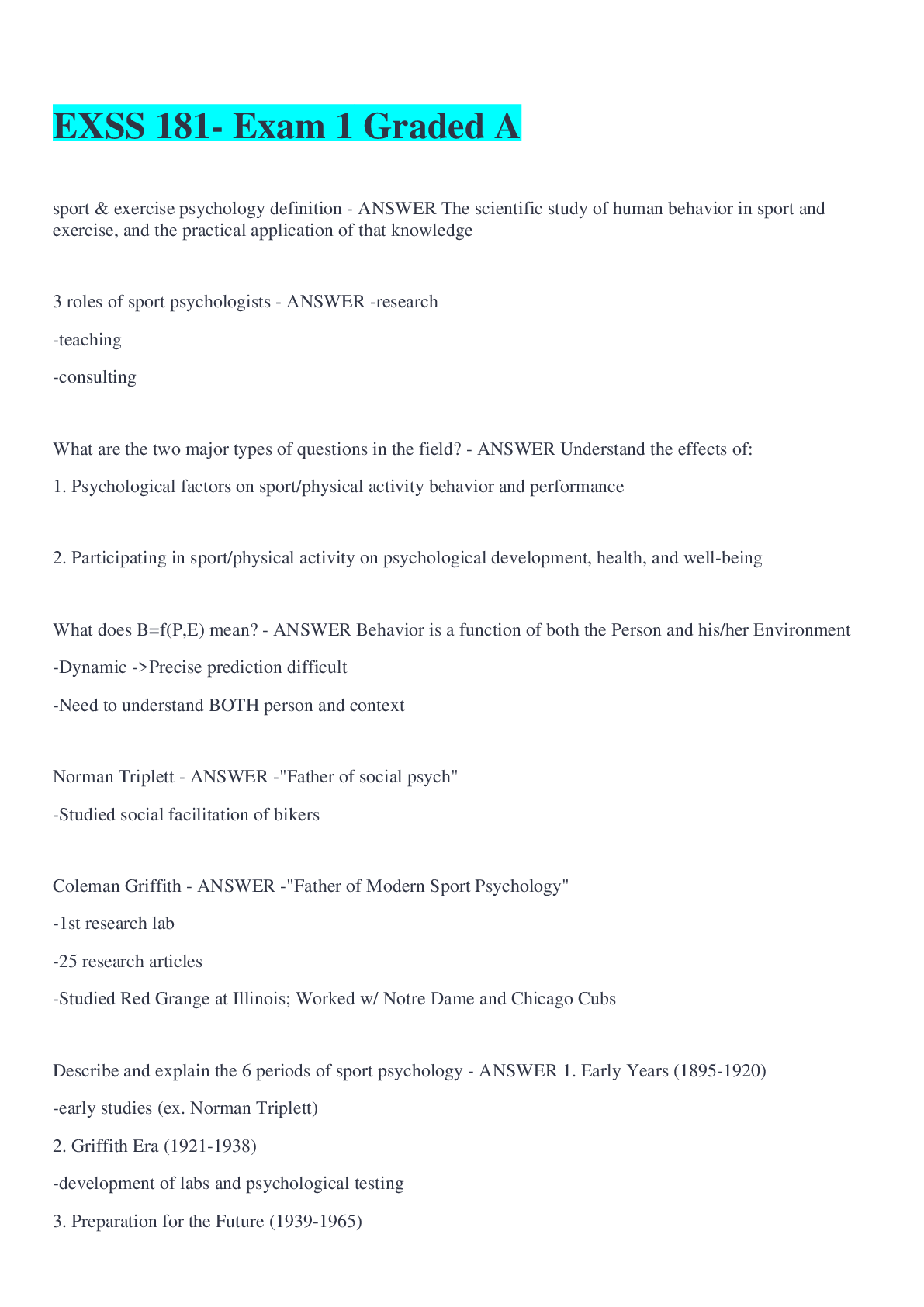
Sport and Exercise Psychology - ANSWER The scientific study of human behavior in sport and exercise, and the practical application of that knowledge
3 roles of sport psychologists - ANSWER -Research (plan, design, imp
...
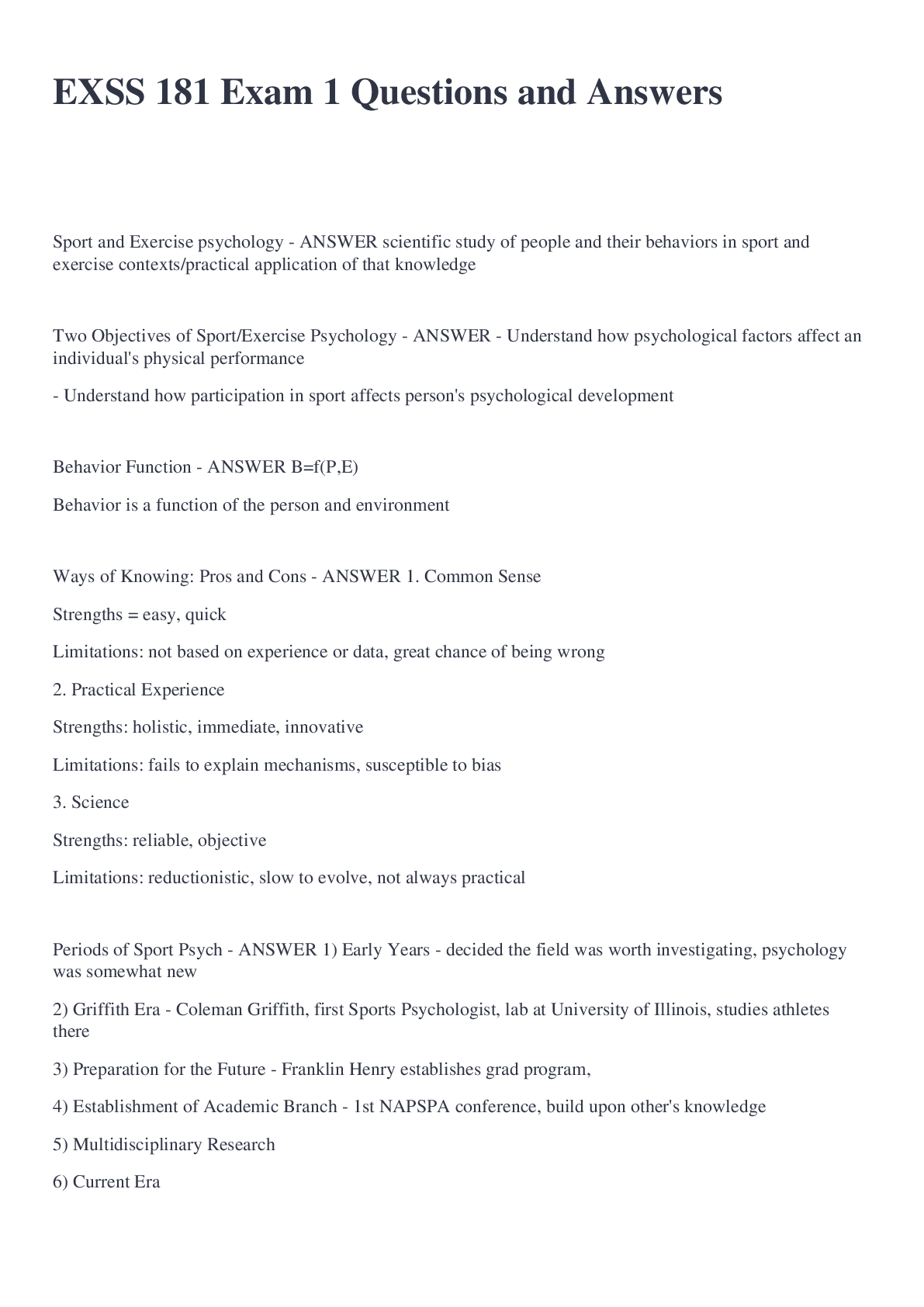
Sport and Exercise Psychology - ANSWER The scientific study of human behavior in sport and exercise, and the practical application of that knowledge
3 roles of sport psychologists - ANSWER -Research (plan, design, implement, and evaluate research);
-Teaching (university courses);
-Consulting (help individuals and teams improve performance)
2 major types of questions in the field? - ANSWER -Understanding the effects of psychological factors on sport/physical activity behavior and performance
-Understanding the effects of participating in sport/physical activity on psychological development, health, and well-being
What does B= f(P,E) mean? - ANSWER Behavior is a function of both the person and his/her environment
-Is dynamic; precise prediction difficult; need to understand both person and context
Who are the main historical figures? What did they do? - ANSWER --Norman Triplett: key figure in history of social, sport, and exercise psychology; studied social facilitation of bikers; tested whether bikers rode faster when in groups than alone
--Coleman Griffith: "Father of Modern Sport Psychology"; first research lab; 25 research articles
6 periods of sports psychology - ANSWER --Early years(1895-1920): characterized by isolated studies
--Griffith Era(1921-1938): sport psychology labs and psychological testing took place; Coleman Griffith became the first American to specialize in the area; lab at University of Illinois
--Preparation for Future(1939-1965): characterized by the field's scientific development attributable to the educational efforts of Franklin Henry
--Establishment of Academic Branch(1966-1977): sport and exercise psychology became a valued component of the academic discipline of physical education
--Multidisciplinary Research(1978-2000): multidisciplinary science and practice, characterized by tremendous growth as the field became more accepted and respected by the public
--Contemporary(2000-present): distinguished by continued growth worldwide, considerable diverse research, and interest in application and consulting
Identify and explain 3 ways of knowing. Advantages/disadvantages of each? - ANSWER -Common sense (intuition, speculation); strength= easy and quick; limitations= not based on experience or data
-Practical experience (observations, case studies); strengths= immediate, innovative; limitations= fails to explain mechanisms, susceptible to bias
-Science (controlled, empirical investigations); strengths= reliable, objective; limitations= reductionistic, slow to evolve
4 steps of scientific method? - ANSWER -Develop the problem (what is the purpose; independent/dependent variables)
-Formulate hypotheses (must be testable)
-Gather data
-Analyze and interpret results
Identify the IV and DV in the following statement: do 8 year old gymnasts learn new vaults faster if they are exposed to mastery versus coping models? - ANSWER IV: Mastery vs. coping models
DV: speed of learning
What is a theory? - ANSWER a supposition or a system of ideas intended to explain something, especially one based on general principles independent of the thing to be explained
What is personality? - ANSWER That pattern of characteristics thoughts, feelings, and behaviors that distinguishes one person from another and that persists over time and situations
Explain the difference b/t internal psychological core, typical responses, and role-related behavior in Hollander's model of personality - ANSWER --Internal psychological core: basic level, values, interests, motives, etc.
--Typical responses: ways we learn to adjust to the environment, how we usually respond to the world around us
--Role-related behavior: most changeable aspect of personality; different situations elicit different behaviors
Name the 5 big traits. What is the iceberg profile? - ANSWER --Openness to experience
--Conscientiousness
--Extraversion/Introversion
--Agreeableness
--Neuroticism (emotionality)
--Iceberg profile= a visual representation of desirable emotional health status characterized by low raw scores on the tension, depression, anger, fatigue, and confusion.
Describe the trait approach to personality. Why are traits a poor predictor of behavior on their own? - ANSWER Traits are:
--Consistent= therefore we expect behavior (and thoughts and emotions) to be similar from one situation to the next
--Generalizable= therefore we expect people to behave similarly across contexts
--Traits are weak predictors of behavior on their own b/c predispositions do not mean an individual will act on them in every situation; sport may be a context in which traits are suppressed exaggerated; don't take into account the environment
There are 2 theories that suggest that the situation influences personality development. Name them, and explain the basic premise of each. - ANSWER --Behaviorism: people learn behaviors for specific situations via rewards and punishments
--Social Learning Theory: people learn behaviors for certain situations via observational learning/modeling
What does the interactionist approach to personality suggest about how personality develops? - ANSWER --Person factors (traits) and situation factors interact to determine behavior
--B=f(P,E)
--combo of trait and situation theories
--concept of state vs trait characteristics
Should personality testing be used in athlete selection processes? Why or why not? - ANSWER Problems with using personality tests: not sufficient evidence of reliability and validity; social desirability can be learned; doesn't account for non-psychological factors
--not recommended
Definition of motivation (2 parts) - ANSWER the direction and intensity of effort
--direction= approach/avoid or attraction
--intensity=how much effort, persistence
What is/are attributions? How do they relate to success and failure? - ANSWER Interpretations or explanations individuals give for success or failure; they are why you think you were successful or unsuccessful
What are the 2 key assumptions of attribution theory (Weiner, 1979, 1985)? - ANSWER --motivation is influenced by attributions
--Commonly cited reasons for perceived success and failure: personal ability, personal effort, opponent's ability/effort, luck, refs, weather
What are the 3 characteristics of attributions? Example of each? - ANSWER --Stability:stable/unstable (stable=your talent, unstable=good luck)
--Locus of causality: internal/external (internal= your tremendous effort, external= easy competition)
--Locus of control: in one's control/ out of one's control (in=strategy/plan, out=opponent's lack of physical conditioning)
What do the stability, causality, and controllability of attributions mean in terms of psychological outcomes when the athlete wins/succeeds? Loses/fails? - ANSWER --Stable: greater expectation of the same outcome happening again
--Unstable: lower expectation of the same outcome happening again
--Internal: greater pride for success, or greater shame for failure
--External: lower pride for success, lower shame for failure
--In control: greater motivation
--out control: lower motivation
Describe the self-serving bias and learned helplessness. - ANSWER --Self-serving bias: making attributions that help you increase or maintain your self-esteem and confidence (for success=internal and stable; for failure=external and unstable)
--Learned helplessness: a psychological state where people have learned that failure is inevitable and out of their control (tend to attribute failure to uncontrollable, stable causes)
What are the 2 assumptions of the Achievement goal theory? - ANSWER --People are motivated to demonstrate competence
--Motivation is influenced by the personal meaning one assigns to perceived success and failure
Define the task and ego achievement perspectives. What are the key differences b/t these perspectives? - ANSWER --Task(mastery): possible for all participants to be successful; success more in participant's control; relative to your own past performance (personal best time/performance, learning or improve)
--Ego(outcome): a limited number of people can be successful; success less in participant's hand; relative to other people (winning, beating a rival)
What are the 4 possible combinations of goal orientations? - ANSWER --High task, low ego
--High task, high ego
--Low task, low ego
--Low task, high ego
What are the common motivated/behavioral outcomes of task and ego involvement? - ANSWER --Task: choose learning opportunities at risk of displaying mistakes; high effort; persist in face of failure; continue to problem solve when encountering failure
--Ego: avoid learning opportunities that have risk of displaying error; put in just enough effort to socially compare well, or disguise poor ability; give up in face of failure
What are the 3 predictors of goal involvement (state) from achievement goal theory? Which one might be the most easily influenced by a practitioner? - ANSWER --Goal orientation(dispositional): how does the individual typically define success/failure? (task/ego)
--concept of ability: undifferentiated/differentiated
--Motivational climate: mastery,performance
What are the 2 conceptions of ability and what outcomes might they influence? - ANSWER --Undifferentiated concept of ability: an inability or a choice not to differentiate b/t ability and effort (working hard=ability)
--Differentiated concept of ability: a person is able to, and choose to, differentiate b/t ability and effort
What are the 2 types of motivational climate? What individuals in the achievement goal environment may influence these goals? - ANSWER --Mastery: emphasis on learning, effort, individual improvement, and cooperation tend to evoke task involvement
--Performance: emphasis on competition, winning, and social comparison tend to evoke ego involvement
What is the TARGET acronym and how might it be used to influence motivational climate? - ANSWER Task, Authority, Recognition(reward), grouping, evaluation, timing
--conditions to promote mastery climate
Define and explain the differences b/t intrinsic and extrinsic motivation. - ANSWER --Intrinsic: behaviors demonstrated voluntarily, in the absence of constraints imposed by others; performing an activity for its own sake
--Extrinsic: behaviors displayed for the purpose of achieving some end and not for its own sake
Be able to describe the motivational continuum and each type of motivation on it. - ANSWER --Amotivation: see no link b/t actions and outcomes
--External regulation: performing an activity to receive a reward or avoid a punishment
--Introjected regulation: performing a behavior to avoid guilt and anxiety (sources are internalized)
--Identified regulation: performing the behavior to achieve some valued, extrinsic outcome
--Integrated regulation: performing a behavior b/c it is part of your sense of self
--Intrinsic motivation: performing an activity for its own sake (gain knowledge, master task, experience pleasure)
What are the 3 psychological needs and how do they influence more intrinsic/self-determined motivation? - ANSWER --Autonomy: need to perceive that one has a choice and are in control of one's behavior
--Competence: need to feel effective at achieving desired outcomes
--Relatedness: need to authentically connect with others and feel involved in social context
What are the 2 aspects from Cognitive Evaluation Theory that affect an individual's interpretation of a reward? - ANSWER --Controlling: more controlling=undermine self-determination; affects autonomy perceptions
--Informational aspect: more informational=enhance self-determination; affects competence perceptions
Explain the findings of the Ryan (1977, 1980) scholarship studies? - ANSWER --Study 1: scholarship athletes were less intrinsically motivated than non-scholarship athletes
--Study 2: scholarship football athletes were less intrinsically motivated than non-scholarship athletes
--Study 3: scholarship athletes were more intrinsically motivated than non-scholarship athletes in wrestling and female athletes
How can SDT be used to inform coaching/teaching practice to enhance self-determined motivation for athletes/exercisers? - ANSWER --provide participants some choice
--Use small rewards as symbols of achievement, not to coerce or control
--Help all participants feel included by the group
Describe the competence motivation model. What are its 3 key assumptions? - ANSWER --Perceptions of control (over whether one can learn and perform skills) work along with self-worth and competence evaluations to influence motivation
--Perceptions of control, competence, self-esteem do not influence motivation directly
--Rather, these perceptions influence affective or emotional states (enjoyment, anxiety, pride, shame) that in turn influence motivation
What are the importance of emotional states (enjoyment, anxiety, pride, shame) to this model? - ANSWER They influence motivation
Be able to describe how individual factors in this model influence competence motivation. - ANSWER
What are the 3 stages of children's competence motivation? Why are they important? - ANSWER --Autonomous Competence: (occurs roughly before age 4) children focus on mastering their environment through self-testing their abilities; children rarely compare themselves with others
--Social Comparison: (begins at 5 years old) children focus on comparing their performance with others
--Integrated stage: (no typical age) involves both social comparison and autonomous achievement strategies
Define and differentiate b/t arousal and anxiety. - ANSWER --Arousal: a general state of activation from deep sleep to extreme excitement; an intensity dimension of motivation at a particular moment; neither positive or negative; includes physiological, cognitive, and behavioral dimensions; marked by higher heart rate, respiration, sweating.
--Anxiety: a negative emotional state characterized by nervousness, worry, apprehension, and increased physiological activation
Stress - ANSWER a relationship b/t the person and the environment that is appraised as taxing or exceeding the resources of the person and endangers his/her well being
--a product of the dynamic and transactional relationship b/t the person and environment
What is the difference b/t state and trait anxiety? Common signs of state anxiety? - ANSWER --State: the actual apprehension and tension felt at a given time (a changing mood state)
--Trait: the tendency to become anxious in stressful situations (an acquired behavioral tendency that is part of one's personality)
--common signs of state: cold, clammy hands, profuse sweating, negative self-talk, dazed look in eyes, cotton mouth
Difference b/t cognitive and somatic anxiety? - ANSWER --Cognitive: mental component (worrying, distraction)
--somatic: physiological component (changes in heart rate, muscle tension)
In what 2 key ways is anxiety described to affect performance? - ANSWER --Increased muscle tension and coordination difficulties
--Attention and concentration changes (narrowing of attention, attending to inappropriate cues)
Drive theory - ANSWER the idea that the relationship b/t anxiety and performance is direct and linear
Inverted-U Hypothesis - ANSWER --dissatisfied with Drive theory, many sport psychologists posited a different relationship b/t anxiety and performance
--Argued performance is optimal at a moderate level of arousal and falls off if athletes are not aroused or too aroused
Individualized Zones of Optimal Functioning - ANSWER --The optimal level of arousal doesn't always occur at the midpoint
--One's optimal level of state anxiety rests not at a single point, but a bandwidth
Multidimensional Theory - ANSWER --Took issue with the assumption of IZOF that the components of anxiety affect performance in the same way
--Somatic and cognitive anxiety influence performance differently
--Cognitive=negative linear relationship with performance
--Somatic=inverted-U relationship with performance
Catastrophe Theory - ANSWER --explains the interaction of cognitive and somatic anxiety and the combined relationship on athletic performance
--as arousal increases, performance increases to a point but if it goes beyond an optimal level, performance drops off sharply
--returning to an optimal level after a catastrophe requires dramatically reducing anxiety below the normal optimal level then working back up
Reversal theory - ANSWER --arousal effects performance based on interpretation
As a coach, what can you deal to prevent and/or help your athletes or exercisers manage performance anxiety? - ANSWER --Tailor coaching strategies to individuals; understand which athletes' arousal needs to be enhanced, reduced, or maintained
--Develop performers' confidence
--For athletes: train yourself to cope with stress and manage psychological arousal
Drive Theory - ANSWER
Inverted-U Hypothesis - ANSWER
[Show More]



.png)



.png)