Lifeguard Test: Red Cross
How can you best protect yourself from possible bloodborne pathogen transmission when
providing care?
a. Ask the victim first if they have any communicable diseases.
b. Thoroughly wash your
...
Lifeguard Test: Red Cross
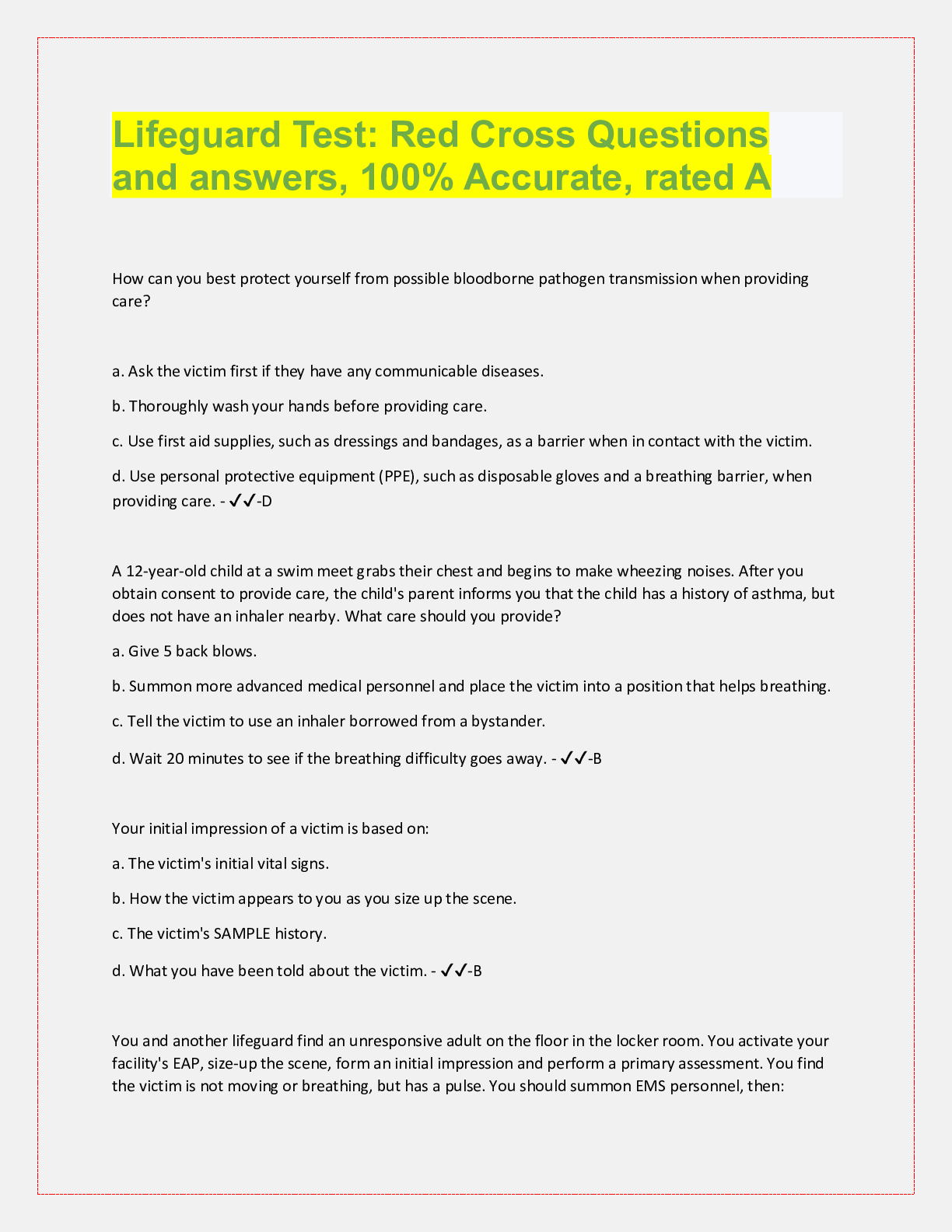
How can you best protect yourself from possible bloodborne pathogen transmission when
providing care?
a. Ask the victim first if they have any communicable diseases.
b. Thoroughly wash your hands before providing care.
c. Use first aid supplies, such as dressings and bandages, as a barrier when in contact with the
victim.
d. Use personal protective equipment (PPE), such as disposable gloves and a breathing barrier,
when providing care. - ANS - D
A 12-year-old child at a swim meet grabs their chest and begins to make wheezing noises. After
you obtain consent to provide care, the child's parent informs you that the child has a history of
asthma, but does not have an inhaler nearby. What care should you provide?
a. Give 5 back blows.
b. Summon more advanced medical personnel and place the victim into a position that helps
breathing.
c. Tell the victim to use an inhaler borrowed from a bystander.
d. Wait 20 minutes to see if the breathing difficulty goes away. - ANS - B
Your initial impression of a victim is based on:
a. The victim's initial vital signs.
b. How the victim appears to you as you size up the scene.
c. The victim's SAMPLE history.
d. What you have been told about the victim. - ANS - B
You and another lifeguard find an unresponsive adult on the floor in the locker room. You
activate your facility's EAP, size-up the scene, form an initial impression and perform a primary
assessment. You find the victim is not moving or breathing, but has a pulse. You should summon
EMS personnel, then:
a. Give ventilations at a rate of 1about every 5-6 seconds.
b. Give back blows and chest thrusts.
c. Give quick breaths at the rate of 20 to 40 a minute.
d. Perform CPR. - ANS - A
You arrive on the scene where a patron appears to be injured. Before approaching the victim,
which of the following will you NOT do as you size-up the scene?
a. Begin performing the primary assessment.
b. Use all your senses to determine if the scene is safe.
c. Form an initial impression.
d. Put on appropriate PPE. - ANS - A
When providing care during an emergency, which of the following should you do first?
a. Size-up the scene while forming an initial impression.
b. Check for responsiveness.
c. Perform a primary assessment.
d. Summon more advanced medical personnel. - ANS - A
As the first rescuer on the scene, you are performing CPR on an adult. When performing chest
compressions, how deeply should you compress the chest?
a. About 2 inches
b. At least 2 inches but no more than 2.4 inches
c. About 1½ inches
d. At least 1 inch but no more than 2 inches - ANS - B
CPR should be performed on which of the following victims?
a. One who is in cardiac arrest
b. One who is conscious and is choking
c. One who is experiencing difficulty breathing
d. One who responds to painful stimuli - ANS - A
What is the first step of the Adult Cardiac Chain of Survival?
a. Early CPR to keep oxygen-rich blood flowing and to help delay brain damage and death.
b. Early defibrillation to help restore an effective heart rhythm and significantly increase the
Vitim's chance for survival.
c. Advanced life support using advanced medical personnel who can provide the proper tools and
medication needed to continue the lifesaving care.
d. Recognition of a cardiac emergency and activation of the emergency response system. - ANS -
D
You are providing care to a victim suspected of having a heart attack. Which of the following
would you do first?
a. Summon EMS personnel.
b. Loosen any tight clothing.
c. Monitor the victim's appearance.
d. Provide comfort to the victim. - ANS - A
Once you have turned on the automated external defibrillator (AED), you should:
a. Check for breathing.
b. Give abdominal thrusts.
c. Apply the pads and allow the AED to analyze the heart rhythm.
d. Give chest compressions. - ANS - C
To ensure high-quality CPR and high-quality chest compressions, you should:
a. Keep your shoulders directly over your hands and bend your elbows.
b. Compress the victim's chest to a shallow depth
c. Expose the victim's chest to ensure proper hand placement and full chest recoil.
d. Place the victim on a soft, flat surface - ANS - C
You are performing CPR on a victim and an assisting responder arrives. Which of the following
is most appropriate for the assisting responder to do first?
a. Begin giving ventilations to the victim.
b. Call for a change in position to assist with CPR.
c. Check to see whether EMS personnel have been called.
d. Have the first lifeguard stop CPR to allow for victim reassessment. - ANS - C
14. Which of the following is most essential to use when giving ventilations to protect you and
the victim from disease transmission? a. Resuscitation masks
b. Protective clothing
c. Gowns
d. Protective eye wear - ANS - A
You are providing care to a facility maintenance worker who has fallen off the top of a ladder.
The victim is responsive. Which of the following should you do first?
a. Ask the victim what happened when they fell.
b. Obtain consent from the victim to provide care.
c. Check the victim's pulse.
d. Question the victim about any complaints of pain. - ANS - B
16. For which of the following should you summon EMS personnel?
a. A victim with a minor cut on the forearm that is lightly bleeding
b. A victim with an airway obstruction w
[Show More]


.png)
.png)
.png)
.png)
.png)
.png)
.png)

.png)

.png)