PHARM NCLEX RN QUESTIONS AND ANSWERS WITH RATIONALES 2022
A nurse should advise a client who is receiving lorazepam (Ativan) about the
adverse effects of this medication which include:
1. tachypnea
2. astigmatism
3
...
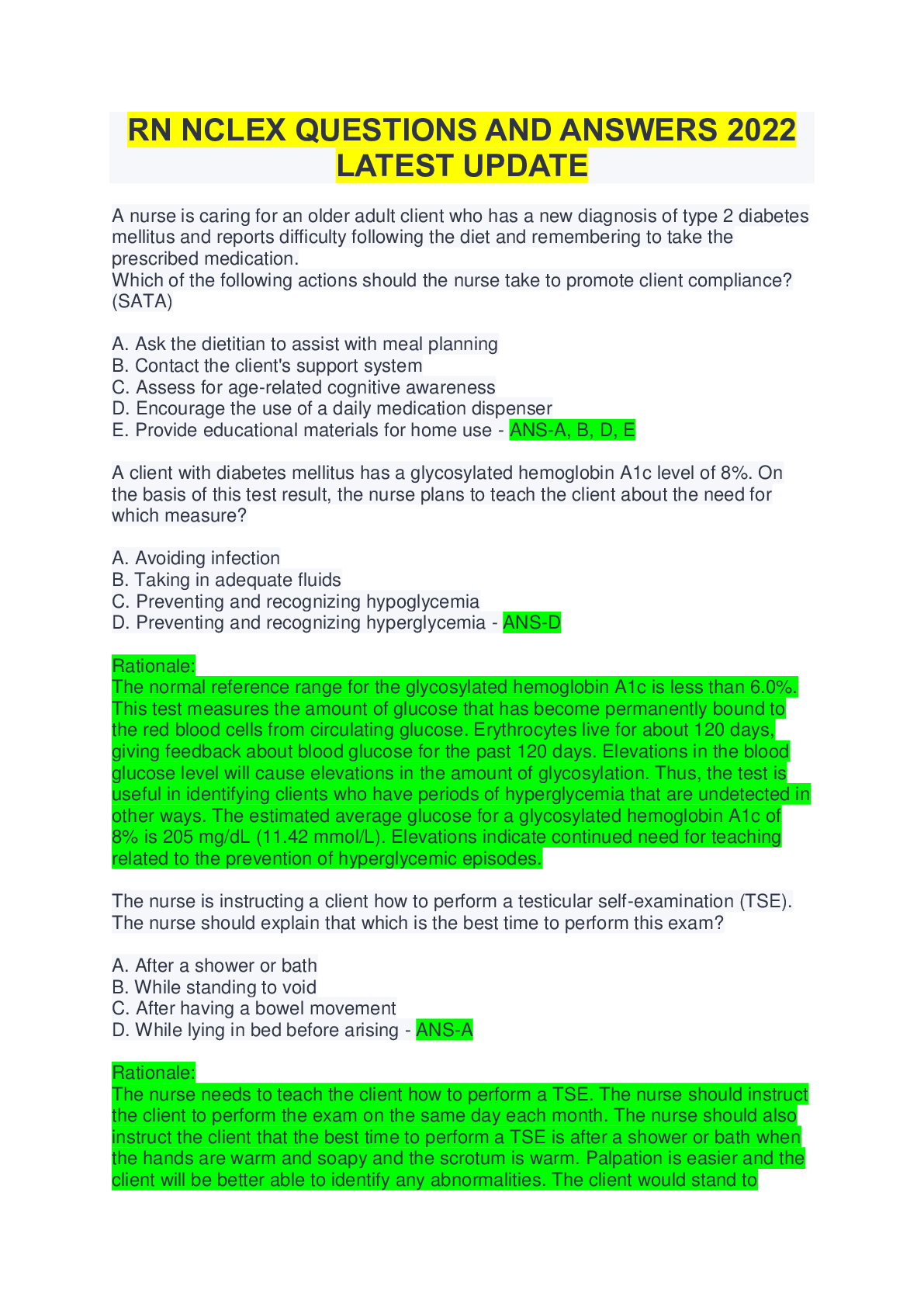
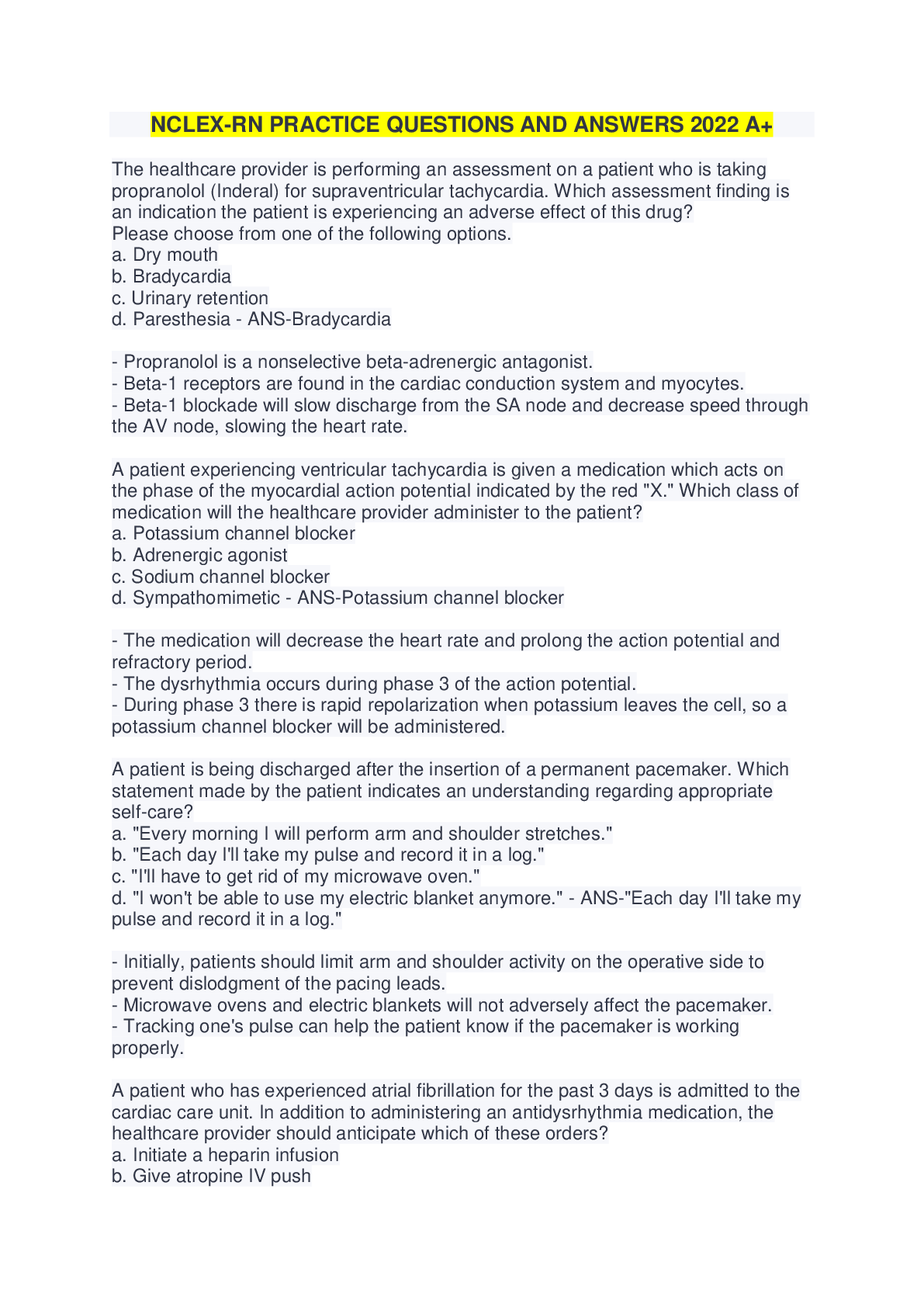
PHARM NCLEX RN QUESTIONS AND ANSWERS WITH RATIONALES 2022
A nurse should advise a client who is receiving lorazepam (Ativan) about the
adverse effects of this medication which include:
1. tachypnea
2. astigmatism
3. ataxia
4. euphoria - ANS-Ataxia.
Rationale: Ataxia, weakness, restlessness, dizziness, or other motor problems can
occur with lorazepam. Options 1, 2, and 4 are incorrect. These are not adverse
effects associated with lorazepam.
The client with insomnia is being treated with temazepam (Restoril). The nurse
monitors for therapeutic effectiveness by noting which of the following?
1. sleeping in 3-hour intervals, awaking for a short time, and then returning to sleep
2.feeling less anxiety during activities of daily living
3. having fewer episodes of panic attacks when stressed
4. sleeping 7 hours without awakening - ANS-Sleeping 7 hours without awakening
Rationale: Sleeping for 7 hours is the desired effect of temazepam. Options 1, 2, and
3 are incorrect. The client should experience periods of sleep lasting longer than 3
hours and should obtain a full night's sleep. The client will be taking temazepam to
assist with insomnia, not to treat anxiety related to everyday stress or to help control
panic attacks.
The nurse is teaching a client about a new eyedrop prescription for timolol (Timoptic)
for treatment of open-angle glaucoma. The client has a history of seasonal allergies
and hypertension. What is an important administration technique to stress for this
client?
a. Take any eyedrops for allergies 5 minutes before administering the timolol drops
b. Do not use the timolol drops while concurrently taking allergy medication.
c. The timolol drops may temporarily worsen seasonal allergies.
d. Gently put pressure on the inner canthus (tear duct) for 1 minute after instilling the
timolol drop. - ANS-Gently put pressure on the inner canthus (tear duct) for 1 minute
after instilling the timolol drop.
Rationale: Timolol is a beta-adrenergic blocker. To prevent swallowing and systemic
absorption, pressure should be applied to the inner canthus of the eye for 1 minute
after instilling the drop. Options 1, 2, and 3 are incorrect. No other eyedrops or
ointments should be used when taking timolol or other drops for glaucoma without
the approval of the provider. Eye solutions for allergies may contain adrenergic drugs
that may worsen glaucoma. Timolol is not contraindicated during seasonal allergies.
It is not known to worsen seasonal allergies, although it may cause
bronchoconstriction in the sensitive individual or if swallowed and systemic effects
occur.
Cognitive Level: Applying; Client Need: Physiological Integrity; Nursing Process:
Planning
The nurse is providing health teaching to a client who has been prescribed
latanoprost (Xalatan) for open-angle glaucoma. While harmless, the nurse would
caution the patient about which potential nonocular effects of the drug? Select all
that apply.
a. Darkening and thickening of the upper eyelid
b. Darkening and thickening of eyelashes
c. A lightening of iris color and a slight darkening of the sclera
d. A slight darkening of the iris color
e. A permanent bluish tint to the conjunctiva - ANS-Darkening and thickening of the
upper eyelid
Darkening and thickening of eyelashes
A slight darkening of the iris color
Rationale: Latanoprost (Xalatan) may cause thickening and darkening of the
eyelashes and upper eyelid and may cause darkening of the iris, especially
noticeable in clients with light eye colors. Options 3 and 5 are incorrect. Latanoprost
will not cause lightening of the iris, darkening of the sclera, or a permanent bluish tint
to the conjunctiva.
Cognitive Level: Applying; Client Need: Health Promotion and Maintenance; Nursing
Process: Implementation
The nurse is teaching a client with otitis about a prescription for polymyxin B,
neomycin, with hydrocortisone (Cortisporin). The client should be instructed to report
which symptom immediately?
a. Mild itching in the outer ear canal
b. Gradually decreasing pain
c. Slight dizziness after instilling the eardrop
d. Increasing pain, particularly in the area around the ear - ANS-Increasing pain,
particularly in the area around the ear
Rationale: Increasing ear pain, particularly around the ear area, may indicate
worsening infection or mastoiditis and should be immediately reported. Options 1, 2,
and 3 are incorrect. Mild itching and irritation may occur, but severe itching or
swelling should be reported. Gradually decreasing pain is a therapeutic effect as the
infection clears. Dizziness may occur if the eardrop is instilled directly onto the
tympanic membrane.
The nurse is instilling drops of phenylephrine (Neo-Synephrine) into the client's eye
before cataract surgery. Phenylephrine is used prior to cataract surgery because it
causes _________ , allowing visualization of the operative area. - ANS-Mydriasis
Phenylephrine causes mydriasis, allowing better visualization of the area of the lens
during cataract surgery.
Which instruction should the nurse include in the teaching plan for the client who is
receiving timolol (Betimol, Timoptic, others) for the treatment of glaucoma?
a. Monitor your weight daily and report gain of over 2 lb per week.
b. Monitor your body temperature for late afternoon onset of fever.
c. Assess your blood pressure once weekly and report any reading less than 90/60.
d. Monitor your breathing for any periods of shortness of breath. - ANS-Assess your
blood pressure once weekly and report any reading less than 90/60.
Rationale: Systemic side effects of beta-adrenergic agents may include
bronchoconstriction, dysrhythmias, and hypotension. Because of the potential for
systemic side effects, these drugs should be used with caution in clients with
asthma, bradycardia, or heart failure. Clients and their families should be taught to
monitor their pulse and blood pressure. Option 1, 2, and 4 are incorrect. Daily
weight, temperature, and potential for shortness of breath would not need to be
stressed in the teaching plan.
A client has developed glaucoma. The nurse reviewing this client's medication
history would identify long-term use of which drug as a potential contributor to
glaucoma?
a. Corticosteroids
b. Beta blockers
c. Calcium channel blockers
d. Insulin - ANS-Corticosteroids
Rationale: The long-term use of corticosteroids may contribute to the development of
glaucoma. Options 2, 3, and 4 are incorrect. Beta blockers are used for the treatment
of glaucoma; they do not cause it. Calcium channel blockers and insulin play no role
in the development of glaucoma.
The nurse plans care for a client who is receiving an ophthalmic anesthetic agent
based on which priority for nursing care?
a. Measures to increase tear secretion
b. Measures to protect the eye
c. Monitoring for conjunctivitis
d. Assessing for level of consciousness - ANS-Measures to protect the eye
Rationale. Protecting the client's eye from injury is a priority of care when a topical
eye anesthetic agent is administered, as the corneal reflex is lost when it is given.
Options 1, 3, and 4 are incorrect. Measures to increase tear secretion are
unnecessary. The nurse will monitor for the local effect of conjunctivitis, but this is
not the priority of care. Since the medication is local and not general, there should be
no need to monitor the client's level of consciousness.
Which of the following agents would the nurse anticipate administering to the client
for a recurrent episode of impacted earwax?
a. Cerumenex
b. Ciprofloxacin (Cipro otic)
c. Cortisporin
d. Chloramphenicol (Chloromycetin) - ANS-...
The nursing is providing health teaching to a client with open-angle glaucoma. Which
of the following types of ocular medications is contraindicated for this client?
a. antibiotic drops
b. fluorescein sodium
c. proparacaine (Alcaine)
d. Mydriatic drops - ANS-...
The nurse who is reviewing the medical history of a client prescribed timolol
(Timoptic) recognizes that of the following conditions, which may have been risk
factors contributing to the client's glaucoma? Select all that apply.
a. hypertension
b. migraine headaches
c. epilepsy
d. cataracts
e. Cushing's syndrome - ANS-...
The nurse teaches the client with glaucoma that latanoprost (Xalatan) will work to
decrease the intraocular pressure by:
a. decreasing the production of aqueous humor
b. causing permanent constriction of the pupil
c. increasing the outflow of aqueous humor
d. decreasing the plasma volume - ANS-ch77 q4
A 67-year-old client experienced a severe back strain while lifting groceries from his
car. He is given a prescription for cyclobenzaprine (Flexeril). The nurse will include
what precautions in the teaching plan for this patient? Select all that apply.
a. Report any palpitations or rapid pulse rate immediately.
b. Take frequent walks throughout the day to relieve soreness.
c. Rinse the mouth frequently with an alcohol-based mouthwash to relieve excess
secretions.
d. Be cautious with driving or other activities requiring alertness.
e. Immediately report any facial or tongue swelling. - ANS-Report any palpitations or
rapid pulse rate immediately.
Be cautious with driving or other activities requiring alertness.
Immediately report any facial or tongue swelling.
Rationale: Cyclobenzaprine may cause tachycardia, and any palpitations or rapid
heart rate should be reported. Drowsiness also may occur, and driving or other
hazardous activities should be avoided until the effects of the drug are known.
Swelling of the face or tongue may occur and must be reported immediately to the
provider. Options 2 and 3 are incorrect. Clients with severe muscle spasms are
encouraged to rest affected muscle groups until acute spasms subside.
A client with spastic cerebral palsy is being treated with oral baclofen (Lioresal).
Which client statement indicates the need for more teaching?
a. "I will be cautious about activities because I may feel weak."
b. "It may take several months before I experience full effects of the drug."
c. "If I experience unpleasant side effects, I can stop taking the drug."
d. "I will be sure to get enough fluid and fiber in my diet." - ANS-"If I experience
unpleasant side effects, I can stop taking the drug."
Rationale: Abruptly discontinuing baclofen may result in fever, seizures, rebound
spasticity, and hallucinations. Options 1, 2, and 4 are incorrect. Baclofen may cause
weakness and, like other muscle relaxants and antispasmodics, may cause
constipation. Being cautious with activities and increasing fluid and fiber intake will
help to limit the adverse effects caused by baclofen. It may take several months
before the full effects of baclofen are reached.
A client has been taught to apply capsaicin to increase mobility and relieve pain.
Which educational intervention is most important for the client to learn?
a. Apply the medication liberally above and below the site of pain.
b. Apply with a gloved hand only to the site of pain.
c. Apply to areas of redness and irritation.
d. Apply liberally with a bare hand. - ANS-Apply with a gloved hand only to the site of
pain.
Rationale: Capsaicin should be applied to the site of pain with a gloved hand to avoid
introducing the capsaicin to the eyes or other parts of the body not under treatment.
Options 1, 3, and 4 are incorrect. Capsaicin should only be applied to the site of
pain, not proximal or distal to the pain. If capsaicin begins to irritate and cause
redness, it should be discontinued. Capsaicin should not be applied with a bare
hand.
A client has been treated for cervical dystonia with an injection of botulinum toxin
type A (Botox). Which of the following will the nurse teach the client to report
immediately?
a. Fever, aches, or chills
b. Difficulty swallowing, blurred vision, or ptosis
c. Moderate levels of muscle weakness on the affected side
d. Continuous spasms and pain on the affected side - ANS-Difficulty swallowing,
blurred vision, or ptosis
Rationale: Dysphagia (difficulty swallowing), blurred vision, and ptosis are all
symptoms of possible botulism toxicity and should be reported immediately. Options
1, 3, and 4 are incorrect. Fever, aches, and chills are not anticipated adverse effects
of this drug. Moderate levels of muscle weakness may occur after the drug is
administered, and strengthening exercises may be needed on the affected side.
Continuous muscle spasms and pain should not occur, because the drug blocks
muscle contraction.
A client has been taking cyclobenzaprine (Amrix, Flexeril) for muscle spasms. The
client is admitted to the emergency department with severe central nervous system
depression. Which medication will the nurse expect to be ordered and administered?
a. Naloxone (Narcan)
b. Meperidine (Demerol)
c. Diazepam (Valium)
d. Physostigmine (Antilirium) - ANS-Physostigmine (Antilirium)
Rationale: Physostigmine may be administered to reverse serious anticholinergic
adverse effects. Options 1, 2, and 3 are incorrect. Naloxone is often used to
decrease the effects of opioids on the CNS but is not the drug of choice in the
treatment of CNS depression with cyclobenzaprine. Meperidine is a CNS depressant
and should not be administered with cyclobenzaprine. Diazepam is also a skeletal
muscle relaxant and should not be administered with cyclobenzaprine
A female client, age 45, is receiving dantrolene sodium (Dantrium) for treatment of
painful muscle spasms associated with multiple sclerosis. What will the nurse teach
the client? Select all that apply.
a. Increase fluid and fiber intake to prevent constipation.
b. Inform the health care provider if she is taking estrogen products.
c. Sip water or suck on ice or hard candy to relieve xerostomia.
d. Be sure to obtain 20 minutes of sun exposure per day to boost vitamin D levels.
e. Return periodically to the provider to monitor the client's liver function. - ANS�Inform the health care provider if she is taking estrogen products.
Sip water or suck on ice or hard candy to relieve xerostomia.
Return periodically to the provider to monitor the client's liver function.
Rationale: Dantrolene may cause hepatotoxicity, with the greatest risk occurring for
women over age 35. Estrogen taken concurrently with dantrolene may increase this
risk. The drug may cause xerostomia (dry mouth), and sucking on hard candy or
sipping water or ice chips may relieve the dryness. Options 1 and 4 are incorrect.
Fluids and fiber also may help diarrhea, but dantrolene may cause diarrhea, not
constipation. Dantrolene may cause photosensitivity, so clients taking the drug
should avoid direct exposure to the sun.
A client is very conscious of heavy perspiration. Because of this, the client limits
activities with friends and stays isolated during the warm months of the year. The
nurse's best intervention is to:
a. Inform of support groups that could assist in decreasing isolation.
b. Instruct on the benefits of botulinum toxin type A therapy.
c. Visit a plastic surgeon to discuss surgical intervention for the perspiring.
d. Instruct on limiting certain foods in her diet. - ANS-Instruct on the benefits of
botulinum toxin type A therapy.
Rationale: Botulinum toxin type A is a treatment of choice for excessive perspiration.
Options 1, 3, and 4 are incorrect. Although support groups can be helpful,
pharmacological intervention is primary in the treatment of excessive perspiration.
Surgical intervention is not a treatment of choice for perspiration. The consumption
of foods affects metabolism but is not primary to the treatment of excessive
perspiration.
Which interventions will assist in reducing the client's pain related to muscle
spasms? Select all that apply.
a. Unsupervised exercise
b. Protein drinks
c. Ice packs to the affected area
d. Massage
e. Application of heat - ANS-Ice packs to the affected area
Massage
Application of heat
Rationale: Many individuals who suffer from painful muscle spasms find relief with
the use of ice packs applied to the affected area. A nonpharmacological intervention
that may be ordered by the health care provider or physical therapist is massage.
Another nonpharmacological intervention that may be ordered by the health care
provider or physical therapist is the application of heat. Options 1 and 2 are incorrect.
The client should exercise only under the supervision of a physical therapist. Protein
drinks may be acceptable for some clients who have debilitation, but will have no
effect on the muscle spasms.
A client taking kava orally to provide anxiety relief is started on cyclobenzaprine
(Amrix, Flexeril) to reduce low-back muscle spasms. Which safety factor is most
important to instruct the client ingesting kava with cyclobenzaprine (Amrix, Flexeril)?
a. Change positions cautiously.
b. Chew gum to prevent thirst.
c. Increase dose if pain persists.
d. Kava will not affect cyclobenzaprine - ANS-Change positions cautiously.
Rationale: The client should use caution when changing positions, due to the
depression of the CNS. Options 2, 3, and 4 are incorrect. When combining kava with
cyclobenzaprine, the client may experience dry mouth, for which chewing gum will
assist in the provision of comfort, but it will have no effect on client safety. The
patient should never increase the dosage without the health care provider's approval.
The client who takes kava and cyclobenzaprine together will experience increased
CNS depression.
Which of these statements by a client would indicate that further instruction is
needed about alprazolam (Xanax)?...
[Show More]




.png)



![Preview of [eBook] [PDF] Clinical Nursing Calculations 3rd Edition By Susan Sienkiewicz, Sandra Meg](https://browseimages.nyc3.digitaloceanspaces.com/paper-images/2025/Jul/04/4jF14r9I2025-07-04-05-586867ec3011731.png)