NCLEX-RN PRACTICE QUESTIONS AND ANSWERS WITH RATIONALES 2022
A client is referred to a surgeon by the general practitioner. After meeting the
surgeon, the client decides to find a different surgeon to continue treatme
...
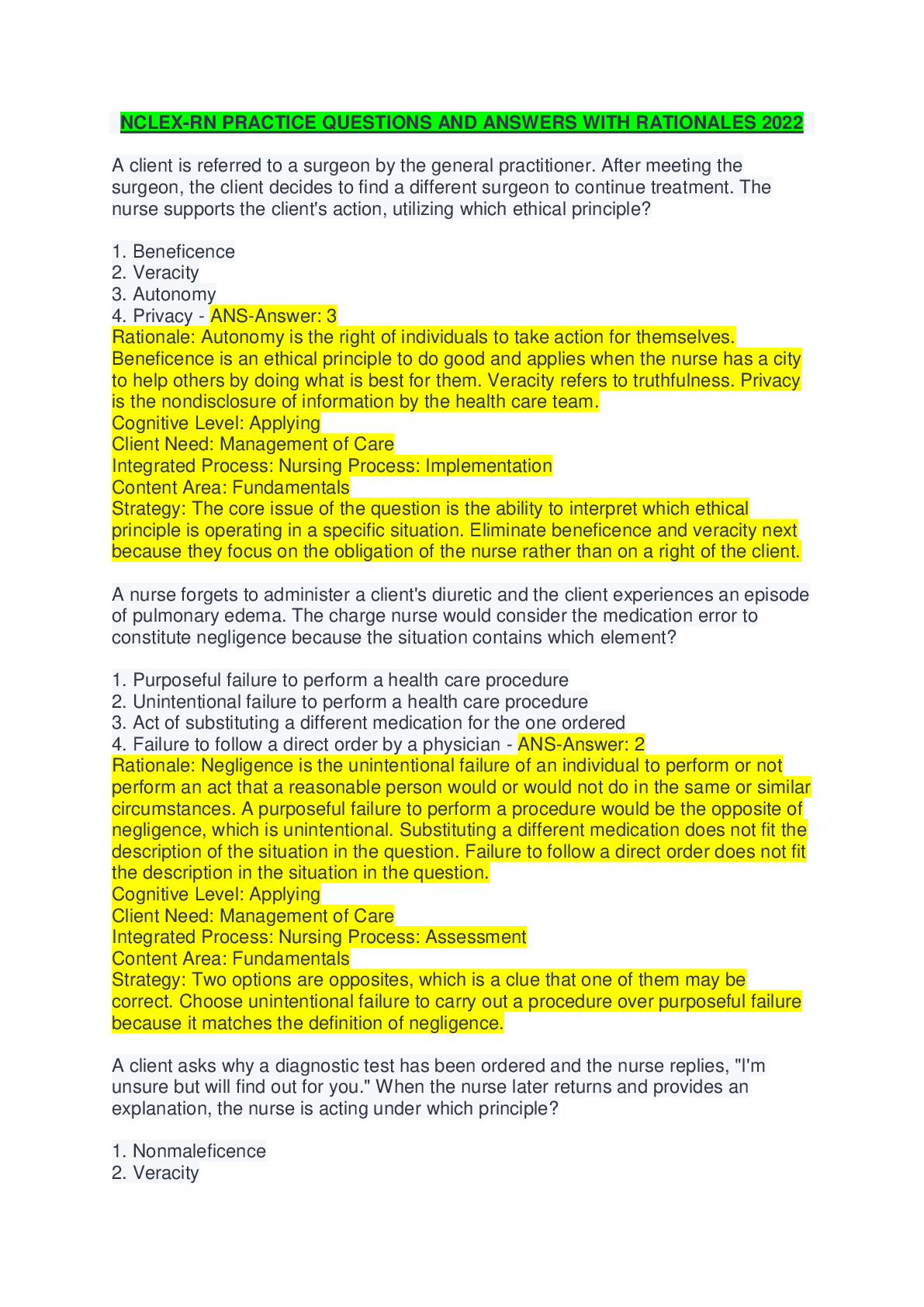
NCLEX-RN PRACTICE QUESTIONS AND ANSWERS WITH RATIONALES 2022
A client is referred to a surgeon by the general practitioner. After meeting the
surgeon, the client decides to find a different surgeon to continue treatment. The
nurse supports the client's action, utilizing which ethical principle?
1. Beneficence
2. Veracity
3. Autonomy
4. Privacy - ANS-Answer: 3
Rationale: Autonomy is the right of individuals to take action for themselves.
Beneficence is an ethical principle to do good and applies when the nurse has a city
to help others by doing what is best for them. Veracity refers to truthfulness. Privacy
is the nondisclosure of information by the health care team.
Cognitive Level: Applying
Client Need: Management of Care
Integrated Process: Nursing Process: Implementation
Content Area: Fundamentals
Strategy: The core issue of the question is the ability to interpret which ethical
principle is operating in a specific situation. Eliminate beneficence and veracity next
because they focus on the obligation of the nurse rather than on a right of the client.
A nurse forgets to administer a client's diuretic and the client experiences an episode
of pulmonary edema. The charge nurse would consider the medication error to
constitute negligence because the situation contains which element?
1. Purposeful failure to perform a health care procedure
2. Unintentional failure to perform a health care procedure
3. Act of substituting a different medication for the one ordered
4. Failure to follow a direct order by a physician - ANS-Answer: 2
Rationale: Negligence is the unintentional failure of an individual to perform or not
perform an act that a reasonable person would or would not do in the same or similar
circumstances. A purposeful failure to perform a procedure would be the opposite of
negligence, which is unintentional. Substituting a different medication does not fit the
description of the situation in the question. Failure to follow a direct order does not fit
the description in the situation in the question.
Cognitive Level: Applying
Client Need: Management of Care
Integrated Process: Nursing Process: Assessment
Content Area: Fundamentals
Strategy: Two options are opposites, which is a clue that one of them may be
correct. Choose unintentional failure to carry out a procedure over purposeful failure
because it matches the definition of negligence.
A client asks why a diagnostic test has been ordered and the nurse replies, "I'm
unsure but will find out for you." When the nurse later returns and provides an
explanation, the nurse is acting under which principle?
1. Nonmaleficence
2. Veracity
3. Beneficence
4. Fidelity - ANS-Answer: 4
Rationale: Fidelity means being faithful to agreements and promises. This nurse is
acting on the client's behalf to obtain needed information and report it back to the
client. Nonmaleficence is the duty to do no harm. Veracity refers to telling the truth
for example, not lying to a client about a serious prognosis. Beneficence means
doing good, such as by implementing actions (e.g. keeping a salt shaker out of sight)
that benefit a client (heart condition requiring sodium-restricted diet).
Cognitive Level: Understanding
Client Need: Management of Care
Integrated Process: Nursing Process: Implementation
Content Area: Fundamentals
Strategy: Use the process of elimination. The correct answer is the one that matches
the description in the stem; that is, the nurse made a promise to a client and kept it,
which constitutes fidelity.
An individual has a seizure while walking down the street. During the seizure, a
nurse from a physician's office is noticed driving past without stopping to assist. The
individual sues the nurse for negligence but fails to win a judgement for which
reason?
1. The nurse had no duty to the individual.
2. The nurse did what most nurses would do in the same circumstance.
3. The nurse did not cause the client's injuries.
4. The nurse was off-duty at the time. - ANS-Answer: 1
Rationale: To be guilty of negligence, the nurse must have a relationship with the
client that involves a duty to provide care. The relationship is usually a component of
employment. The nurse did not necessarily do what others would do in this situation.
Although the nurse did not cause the client's injuries, it does not prevent the nurse
from assisting in this situation. Although the nurse was off-duty, the nurse could have
assisted if motivated to do so.
Cognitive Level: Understanding
Client Need: Management of Care
Integrated Process: Nursing Process: Implementation
Content Area: Fundamentals
Strategy: Use the process of elimination and nursing knowledge. The correct answer
is the one that recognizes that the nurse was not in the role of employee at the time
of the incident, removing the requirement of acting on the client's behalf.
An adult female ambulatory care client receiving an oral anticoagulant is given
aspirin for a headache while visiting a neighbor, who is a nurse. The client
subsequently has a bleeding episode because of a drug interaction. The legal nurse
consultant interprets that which necessary elements of malpractice are missing from
this case? Select all that apply.
1. Breech of duty
2. Duty owed
3. Injury experienced
4. Causation between nurse's action and injury
5. Intent to cause harm or injury - ANS-Answer: 2, 5
Rationale: There was no nurse-client relationship because the nurse was acting as a
neighbor and not in an employment capacity. Thus, there can be no duty owed.
Intent is not a necessary element of malpractice, because malpractice can occur
because of unintended actions as well. There was no breach of duty because there
was no official nurse-client relationship, which accompanies an employment
situation. There was injury experiences because of this event. The bleeding was
caused by the interaction of the aspirin with the anticoagulant.
Cognitive Level: Analyzing
Client Need: Management of Care
Integrated Process: Nursing Process: Evaluation
Content Area: Fundamentals
Strategy: Use the process of elimination. The wording of the question indicates more
than one option is correct, and the focus is on necessary elements that must be
present. First eliminate the intent to cause harm or injury, since this is not necessary
to a charge of malpractice. Next note that there is no duty owed, and because of this,
there can be no breach of duty, to choose these two options as the necessary
missing elements.
A client with cancer has decided to discontinue further treatment. Although the nurse
would like the client to continue treatment, the nurse recognizes the client is
competent and supports the client's decision using which ethical principle?
1. Justice
2. Fidelity
3. Autonomy
4. Confidentiality - ANS-Answer: 3
Rationale: Autonomy refers to the right make one's own decisions, which is the
principle supported in this situation. Justice refers to fairness. Fidelity refers to trust
and loyalty. Confidentiality refers to the right to privacy of personal health
information.
Cognitive Level: Understanding
Client Need: Management of Care
Integrated Process: Nursing Process: Implementation
Content Area: Fundamentals
Strategy: Use the process of elimination. The wording of the question indicates that
only one option is correct and that you need to select the principle that is consistent
with the circumstances in the question.
The health care provider orders a medication in a dose that is considered toxic. The
nurse administers the medication to the client, who later suffers a cardiac arrest and
dies. What consequence can the nurse expect from this situation? Select all that
apply.
1. The health care provider can be charged with negligence, being the person who
ordered the dose.
2. As the employing agency, only the hospital can be charged with negligence.
3. The nurse and physician may be terminated from employment to prevent a charge
of negligence to the hospital.
4. Negligence will not be charged, as this event could happen to any reasonable
person.
5. The nurse can be charged with negligence for administering the toxic dose. -
ANS-Answer: 1, 5
Rationale: Health care providers who prescribe incorrect dosages of medications are
liable for their errors. The nurse is open to a charge of negligence for failing to verify
and question the incorrect dose. The hospital can be sued as the responsible
employing agency, but the health care provider and the nurse can also be charged
with negligence. Terminating the health care provider and nurse from employment
would not stop a lawsuit charging negligence for employee actions that have already
taken place. Prescribing and administering incorrect doses are not considered
events that routinely happen to "reasonable person."
Cognitive Level: Applying
Client Need: Management of Care
Integrated Process: Nursing Process: Implementation
Content Area: Fundamentals
Strategy: The wording of the question indicates that more than one option is correct.
Choose the response that holds both individuals accountable, since the nurse failed
to question an incorrect dose and the health care provider ordered the incorrect
dose.
A nurse and teacher are discussing legal issues related to the practice of their
professions. The teacher asks what the functions are of the Nurse Practice Act
(NPA) in that state. The nurse would include which thoughts in a response? Select
all that apply.
1. Accredit schools of nursing
2. Enforce ethical standards of behavior
3. Protect the public
4. Define the scope of nursing practice
5. Determine liability insurance rates - ANS-Answer: 3, 4
Rationale: A state's NPA serves to protect the public by setting minimum
qualifications for nursing in relation to skills and competencies. One way it fulfills
responsibility to protect the public is by defining the scope of nursing practice in that
state. The state board of nursing approves schools to operate but does not enforce
ethical standards. A state NPA has no role in setting liability insurance rates for
nurses.
Cognitive Level: Applying
Client Need: Management of Care
Integrated Process: Nursing Process: Implementation
Content Area: Fundamentals
Strategy: Use the process of elimination and basic nursing knowledge to answer the
question. The wording of the question indicates that more than one option is correct
and that the correct responses are worded as true statements.
A staff nurse concerned about maintaining client confidentiality would take which
action while carrying out assigned duties?
1. Read the records of clients not assigned to the nurse to become familiar with
disease processes.
2. Share information about a client with nurses from the unit to which the client may
eventually be transferred.
3. Allow the client's family to review the medical record to obtain answers to their
questions.
4. Share information about the client with those involved in planning nursing care. -
ANS-Answer: 4
Rationale: Client confidentiality is maintained when the nurse shares client
information only with those currently involved in the plan of care. Staff should only
access information about clients currently assigned to their care and should not
access information about other clients on the unit not assigned to them. Client
information should not be shared with nurses who are not currently working with the
client. Family members would need approval from the client and the health care
provider prior to reviewing a medical record.
Cognitive Level: Applying
Client Need: Management of Care
Integrated Process: Communication and Documentation
Content Area: Fundamentals
Strategy: Select the response that protects the client's information, but allows
communication necessary for the delivery of quality care.
The nurse working in an acute care environment would utilize which strategies to
reduce the risk of malpractice litigation? Select all that apply.
1. Discuss any errors with the client and family in detail.
2. Keep incident reports on file.
3. Maintain expertise in practice.
4. Offer opinions to clients when the situation warrants.
5. Report unsafe staffing levels to supervisor. - ANS-Answer: 3, 5
Rationale: Maintaining expertise in practice by keeping up to date in knowledge and
skills aids in reducing the risk of malpractice claims by fostering continued
competence in practice. Unsafe staffing levels can result in a higher incidence rate of
errors, which could later lead to charges of malpractice. Thus, reporting such
situations so they can be prevented should be beneficial. Discussing errors in detail
with the client and family does not reduce the risk of malpractice claim. Incident
reports should be kept on file but do not decrease the risk of malpractice litigation.
The nurse should not offer opinions at any time as this not part of therapeutic
communication.
Cognitive Level: Applying
Client Need: Management of Care
Integrated Process: Nursing Process: Implementation
Content Area: Fundamentals
Strategy: Focus on malpractice as the concept being tested. Recall that maintaining
expertise is the best way to reduce personal risk and that reporting unsafe staffing
situations may help reduce personal risk and that reporting unsafe staffing situations
may help reduce general agency risk by preventing omissions or errors due to
insufficient numbers of caregivers to do the work required during the shift.
The registered nurse (RN) must delegate care of an assigned client to an unlicensed
assistive person (UAP) for the shift. Which client would be best to delegate to the
UAP?
1. A client who would benefit from talking about the recent death of her husband.
2. A client with a urinary drainage catheter and nasogastric feedings who is on
bedrest.
3. A client with an osmotic who has persistent problems with leakage.
4. A client who was transferred from the critical care unit 3 days ago is ambulatory -
ANS-Answer: 4
Rationale: Factors to consider when delegating care include complexity of task,
problem-solving innovation required, unpredictability, and level of client interaction.
The ambulatory client is best to delegate because this client in likely to be stable with
a low level of unpredictability. The client who recently lost her husband would benefit
from professional communication with the RN and requires a high level of client
interaction. The client receiving enteral feedings and is immobilized represents a
more complex client, who is better assigned to a licensed nurse. The client with a
leaking osmotic would benefit from problem-solving innovation and is best cared for
by the RN.
Cognitive Level: Analyzing
Client Need: Management of Care
Integrated Process: Nursing Process: Planning
Content Area: Leadership and Management
Strategy: The core issue of the question is basic concepts that are useful when
considering delegation to a UAP. Use this knowledge and the process of elimination
to make selection.
Which task would not be appropriate for the registered nurse (RN) to delegate to a
licensed practical nurse (LPN) or unlicensed assistive personnel (UAP)?...
[Show More]

.png)