LITHIUM RN NCLEX QUESTIONS AND ANSWERS 2022
1. A 9-year-old child has been prescribed with lithium as a mood stabilizer. His lab
results shows his lithium level of 1.5 mmol/L. The priority nursing diagnosis for this
...
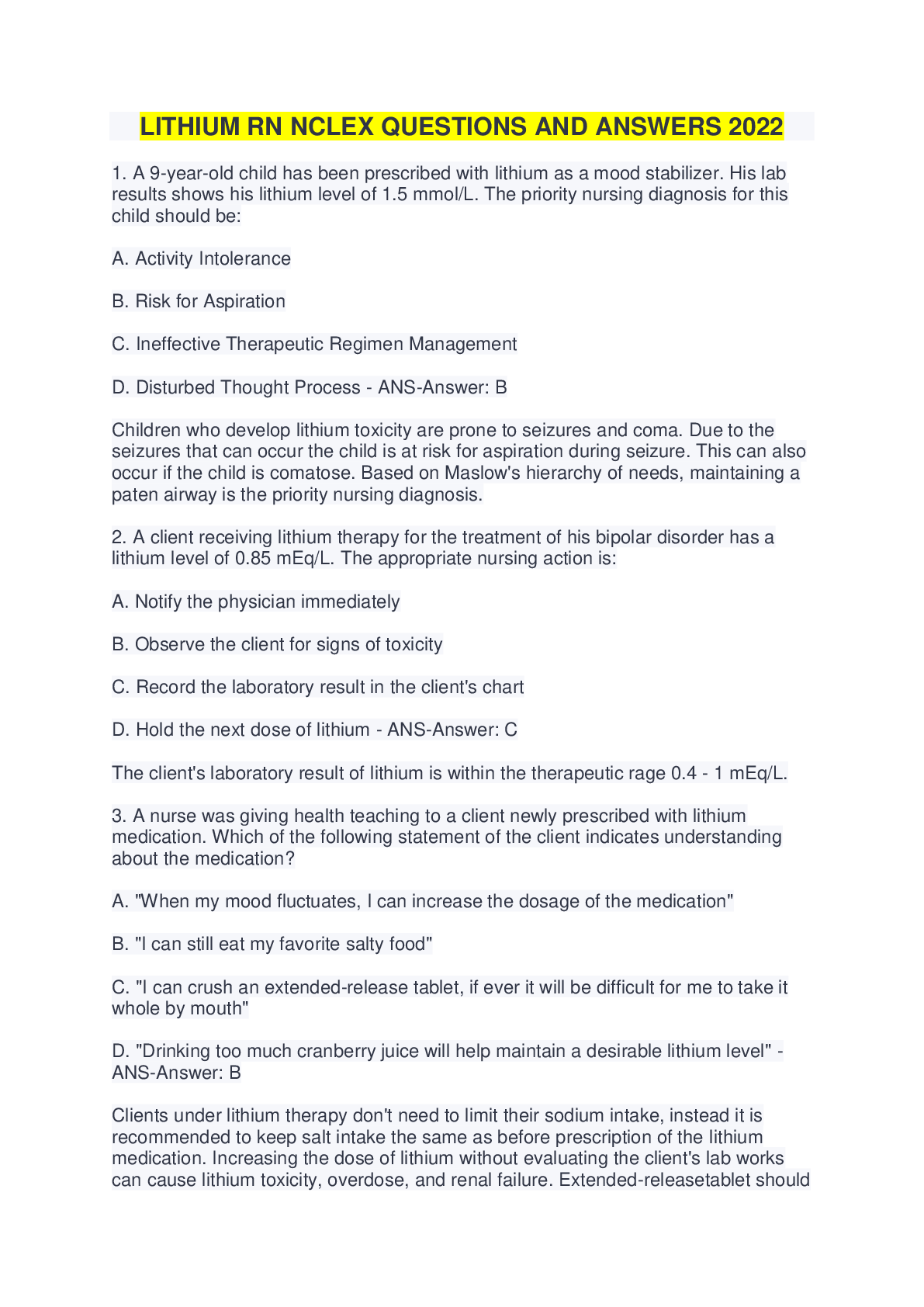
LITHIUM RN NCLEX QUESTIONS AND ANSWERS 2022
1. A 9-year-old child has been prescribed with lithium as a mood stabilizer. His lab
results shows his lithium level of 1.5 mmol/L. The priority nursing diagnosis for this
child should be:
A. Activity Intolerance
B. Risk for Aspiration
C. Ineffective Therapeutic Regimen Management
D. Disturbed Thought Process - ANS-Answer: B
Children who develop lithium toxicity are prone to seizures and coma. Due to the
seizures that can occur the child is at risk for aspiration during seizure. This can also
occur if the child is comatose. Based on Maslow's hierarchy of needs, maintaining a
paten airway is the priority nursing diagnosis.
2. A client receiving lithium therapy for the treatment of his bipolar disorder has a
lithium level of 0.85 mEq/L. The appropriate nursing action is:
A. Notify the physician immediately
B. Observe the client for signs of toxicity
C. Record the laboratory result in the client's chart
D. Hold the next dose of lithium - ANS-Answer: C
The client's laboratory result of lithium is within the therapeutic rage 0.4 - 1 mEq/L.
3. A nurse was giving health teaching to a client newly prescribed with lithium
medication. Which of the following statement of the client indicates understanding
about the medication?
A. "When my mood fluctuates, I can increase the dosage of the medication"
B. "I can still eat my favorite salty food"
C. "I can crush an extended-release tablet, if ever it will be difficult for me to take it
whole by mouth"
D. "Drinking too much cranberry juice will help maintain a desirable lithium level" -
ANS-Answer: B
Clients under lithium therapy don't need to limit their sodium intake, instead it is
recommended to keep salt intake the same as before prescription of the lithium
medication. Increasing the dose of lithium without evaluating the client's lab works
can cause lithium toxicity, overdose, and renal failure. Extended-releasetablet should
be taken whole, it is uniquely made to release the medication slowly in the body,
breaking the pill would cause the drug to be release at one time. Watermelon,
cantaloupe, grapefruit juice, and cranberry juice will not therapeutically help in
maintaining desirable lithium level because of its diuretic effect.
4. A client diagnosed with bipolar disorder has been prescribed with lithium
(carbonate) by his physician. Which question will help the nurse identify signs of
early lithium toxicity?
A. Have you been experiencing any nausea, vomiting or diarrhea?
B. Do you have frequent headache?
C. Have you been urinating excessively/frequently?
D. Do you experience leg aches over the past few days? - ANS-Answer: A
The most common early signs of lithium toxicity is gastrointestinal (GI) disturbance
including nausea,vomiting, or diarrhea. B, C, D assessment question is unrelated to
lithium toxicity.
5. A client who has been taking lithium medication for the past few years, recently
got pregnant, and she is so concerned of the effects of the medication to her child.
Which of the following statement is true that would address the client's concern?
A. Lithium does not cross the placental barrier and poses no risk for the fetus
B. Pregnant woman with diagnosed with bipolar disorder should not take lithium
meds
C. Oral contraceptive and lithium medication may result to a false-positive pregnancy
test.
D. Lithium should be avoided during the latter part of the first trimester if possible. -
ANS-Answer: D
Lithium crosses placental barrier and poses the risk for developing birth defects to a
fetus. To minimize any risk to the fetus, lithium should be avoided in the latter part of
the first trimester if possible. Option B is incorrect because it can help control the
mother's manic symptoms with little risk to the fetus in the second and third trimester.
Option C is also incorrect because it is only true with carbamazepine (Tegretol).
6. A client newly diagnosed with bipolar disorder was prescribed with lithium meds.
While giving the health teaching the client keeps asking about why there is a need
for frequent blood works. Which of the following statement of the nurse addressing
the client's question is true:
A. "It will help determine if the medication dosage is still within the therapeutic level"
B. "Frequent blood works is unnecessary once medication is taken as ordered"
C. "It will help identify if the liver has been working properly"
D. "It will monitor if the medication already pass the blood brain barrier" - ANS�Answer: A
Lithium levels determine whether an effective dose of lithium is being given to
maintain a therapeutic level of the drug. Lithium blood work aren't drawn for the
reason of figuring out whether the drug pass through the blood brain barrier or if the
liver is working properly. Taking the medication as ordered doesn't kill the
requirement for blood work.
7. A client under lithium medication reduce his dietary salt intake. Which of the
following is expected to show in his blood work?
A. Decreased lithium level
B. Increased lithium level
C. Increased then decrease in the next result of the lithium blood work
D. No significant changes - ANS-Answer: B
There is a direct relationship between the amount of salt and the plasma levels of
lithium. Lithium plasma levels increase when there is a decrease in dietary salt.
Increase in dietary salt causes the opposite effect of decreasing lithium plasma.
That's why it is important that the nurse monitor dietary sodium intake.
8. A female client was prescribed with lithium carbonate 600 mg p.o t.i.d to manage
her bipolar disorder. The nurse would be aware that the teaching given to the client
with regards to the medication side effects was understood when the client make
which of the following statement? "I will call my doctor immediately once I notice any:
A. Sensitivity to bright light or sun
B. Fine hand tremors or slurred speech
C. Sexual dysfunction or breast enlargement
D. Inability to urinate or difficulty when urinating - ANS-Answer: B
These are the common adverse effects of lithium carbonate
9. A client receiving lithium carbonate has a lithium level of 2.3 mEq/L. The nurse will
immediately assess the client for which of the following symptoms?
A. Weakness
B. Diarrhea
C. Blurred Vision
D. Fecal incontinence - ANS-Answer: C
At lithium levels of 2 -2.5 mEq/L the client will experience blurred vision, muscle
twitching, severe hypotension, and persistent nausea and vomiting. With levels
between 1.5 and 2 mEq/L the client experiencing vomiting, diarrhea, muscle
weakness, ataxia, dizziness, slurred speech, and confusion. At lithium levels of 2.5
to 3 mEq/L or higher, urinary and fecal incontinence occurs, as well as seizures,
cardiac dysrhythmias, peripheral vascular collapse, and death.
10. A client under lithium medication suffered from diarrhea and vomiting. Which of
the following nursing intervention should the nurse in charge do first?
A. Recognize this as a drug interaction
B. Give the client Cogentin
C. Reassure the client that these are common side effects of lithium therapy
D. Hold the next dose and obtain an order for a stat serum lithium level - ANS�Answer: D
Diarrhea and vomiting are manifestations of Lithium toxicity. The next dose of lithium
should be withheld and test is done to validate the observation. A. The
manifestations are not due to drug interaction. B. Cogentin is used to manage the
extrapyramidal symptom side effects of antipsychotics. C. The common side effects
of Lithium are fine hand tremors, nausea, polyuria and polydipsia.
11. A client's latest lab result shows her plasma lithium level is 0.2 mEq/L. The nurse
can expect to implement which of the following nursing interventions?
A. Administer an additional oral dose of lithium
B. Infuse 1 L of 0.9% sodium chloride over 4 hr
C. Prepare to give emergency resuscitation
D. Prepare the client immediate for another laboratory draw - ANS-Answer: A
This plasma level is subtherapeutic and the client should be given an additional
dose. Emergency resuscitation may be indicated if the client's laboratory value
indicates toxicity. There is no indication that the client need supplemental fluids.
There is no reason to question the laboratory results.
12. A client under your care as a nurse was newly prescribed with lithium carbonate.
To prevent lithium toxicity, the nurse should advise the client to do which of the
following?
A. Avoid the use of acetaminophen for headaches
B. Decrease fluid intake to less than 1,500 mL daily
C. Restrict intake of foods rich in sodium
D. Limit aerobic activity in hot weather - ANS-Answer: D
Activities that could cause sodium/water depletion should be avoided in order to
prevent lithium carbonate toxicity. Acetaminophen, rather than NSAIDs such as
ibuprofen, should be used for headaches because NSAIDs interact with lithium and
could cause increased blood levels of lithium. The client should make sure to take in
enough sodium and increase, rather than decrease fluid intake to prevent toxicity
13. Which of the following is an adverse effect of lithium carbonate taken by a client
with bipolar disorder.
A. Alopecia
B. Tremors
C. Urinary retention
D. Constipation - ANS-Answer: B
Fine hand tremors are a common adverse effect in clients who take lithium. Alopecia
is not an adverse effect of lithium. Diarrhea and polyuria are side effects of lithium.
14. A client has been taking lithium carbonate for the management of bipolar
disorder. Which of the following adverse reaction does the client need to report?...
[Show More]


.png)