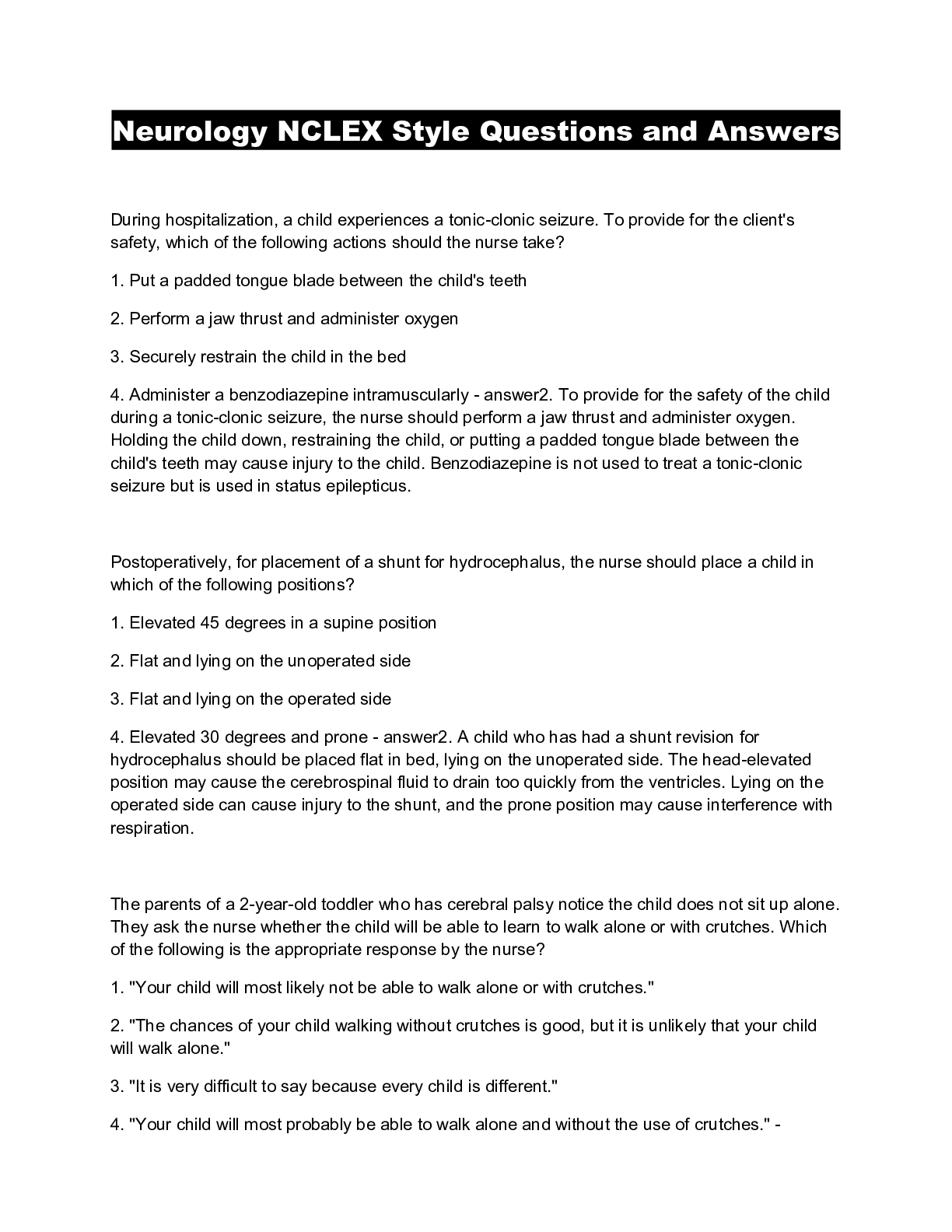
NEUROLOGY NCLEX STYLE QUESTIONS AND ANSWERS
2022
During hospitalization, a child experiences a tonic-clonic seizure. To provide for the
client's safety, which of the following actions should the nurse take?
1. Put
...
NEUROLOGY NCLEX STYLE QUESTIONS AND ANSWERS
2022
During hospitalization, a child experiences a tonic-clonic seizure. To provide for the
client's safety, which of the following actions should the nurse take?
1. Put a padded tongue blade between the child's teeth
2. Perform a jaw thrust and administer oxygen
3. Securely restrain the child in the bed
4. Administer a benzodiazepine intramuscularly - ANS-2. To provide for the safety of
the child during a tonic-clonic seizure, the nurse should perform a jaw thrust and
administer oxygen. Holding the child down, restraining the child, or putting a padded
tongue blade between the child's teeth may cause injury to the child. Benzodiazepine
is not used to treat a tonic-clonic seizure but is used in status epilepticus.
Postoperatively, for placement of a shunt for hydrocephalus, the nurse should place
a child in which of the following positions?
1. Elevated 45 degrees in a supine position
2. Flat and lying on the unoperated side
3. Flat and lying on the operated side
4. Elevated 30 degrees and prone - ANS-2. A child who has had a shunt revision for
hydrocephalus should be placed flat in bed, lying on the unoperated side. The headelevated position may cause the cerebrospinal fluid to drain too quickly from the
ventricles. Lying on the operated side can cause injury to the shunt, and the prone
position may cause interference with respiration.
The parents of a 2-year-old toddler who has cerebral palsy notice the child does not
sit up alone. They ask the nurse whether the child will be able to learn to walk alone
or with crutches. Which of the following is the appropriate response by the nurse?
1. "Your child will most likely not be able to walk alone or with crutches."
2. "The chances of your child walking without crutches is good, but it is unlikely that
your child will walk alone."
3. "It is very difficult to say because every child is different."
4. "Your child will most probably be able to walk alone and without the use of
crutches." - ANS-1. If a child cannot sit up by the age of 2, there is every indication
that the child has cerebral palsyaffecting voluntary motor control. As a result, the
child will not be able to walk with or without crutches.
The parents of a child with cerebral palsy ask the nurse what the most common
cause of cerebral palsy is. The most appropriate response by the nurse is which of
the following?
1. "It results when the cord gets wrapped around the neck in the birth canal."
2. "It is the result of a forceps delivery."
3. "It is the result of a premature birth or very low birth weight."
4. "It is the result of preeclampsia in the mother." - ANS-3. Although the cord getting
wrapped around the neck in the birth canal, a forceps delivery, andpreeclampsia in
the mother all place a child at risk for cerebral palsy, children born prematurely or
those who have very low birth weights are the most at risk.
When caring for a child with meningitis, it is essential that the nurse evaluate for a
positive Brudzinski's sign, which would indicate
1. increased intracranial pressure.
2. meningeal irritation.
3. encephalitis.
4. intraventricular hemorrhage. - ANS-2. Brudzinski's sign, when the legs flex at both
hips and knees in response to flexing the head and neck, indicates meningeal
irritation.
A nurse is providing discharge instructions to the parents of a child who suffered a
head injury 6 hours ago. Which statement by the parents indicates additional
teaching is needed?
1. "We will call the doctor immediately if vomiting occurs."
2. "We won't give anything stronger than Tylenol for headache."
3. "We will provide for uninterrupted sleep when we get home."
4. "We know continued amnesia regarding the events of the injury is expected." -
ANS-3. Waking children to check neurological status following a head injury is
important, no matter the time of day. Vomiting could indicate increased intracranial
pressure requiring further evaluation. Narcotics should be avoided after a head
injury. Amnesia following a head injury is not uncommon.
The nurse is assigned to administer bismuth subsalicylate (Pepto-Bismol) to a 10-
year-old child who has Reye'ssyndrome and is experiencing gastrointestinal clinical
manifestations. Which of the following is the priority action for the nurse to take?
1. Administer the prescribed dose of 1 tablet
2. Inform the child and parents that stools will be dark in appearance
3. Instruct the child to chew the tablet thoroughly
4. Question the physician's order - ANS-4. Bismuth subsalicylate (Pepto-Bismol)
contains aspirin, and there is a suspected link between aspirinand the etiology of
Reye's syndrome. It is a priority to question the order for Pepto-Bismol to be given to
this child. One tablet is appropriate for a child 10 years of age. Chewing the tablet
and informing the child and parents that the stool will be dark in appearance are all
appropriate interventions in the plan of care for a child taking Pepto-Bismol, but not
for a child with Reye's syndrome.
The nurse identifies which of the following as warning signs in a 12-month-old with
cerebral palsy?
Select all that apply:
• [ ] 1. Weak or absent sucking
• [ ] 2. Hypotonia
• [ ] 3. Toe walking but unable to stand alone
• [ ] 4. Absent or weak primitive reflex responses
• [ ] 5. Toe walking while held, but unable to stand alone
• [ ] 6. Athetoid (irregular, twisting) movement - ANS-3. 5. 6. Warning signs for
cerebral palsy in a 12-month-old include toe walking while being held because the
child is unable to stand alone. When crawling occurs, it is abnormal because only the
arms may be used and it may be athetoid, which refers to irregular, twisting
movements. Weak or absent sucking reflex and absent or weak primitive reflex
responses are present in the neonate. Hypertonia is present in a 6-month-old.
The nurse assesses cranial nerve VII in a pediatric client by which of the following
techniques?
1. Gently swab the cornea with a sterile cotton-tipped applicator
2. Hold the eyes open and turn the head from side to side
3. Place the child's head in the midline position with the head elevated and inject ice
water into the ear canal
4. Irritate the pharynx with a tongue depressor or cotton swab - ANS-1. Gently
swabbing the cornea with a sterile cotton-tipped applicator assesses cranial nerve
VII, which evaluates the corneal reflex. Holding the eyes open and turning the head
from side to side evaluates cranial nerves II, IV, and VI and the oculocephalic reflex.
Placing the child's head in a midline position with the head elevated prior to injecting
ice water into the ear canal evaluates cranial nerves III and VIII, or the
oculovestibular reflex. Irritating the pharynx with a tongue depressor or cotton swab
evaluates cranial nerves IX and X, or the gag reflex.
A nurse is caring for a client who is receiving IV heparin after suffering a stroke.
Which of the following laboratory results indicates that the client is receiving a
therapeutic dosage?...
[Show More]