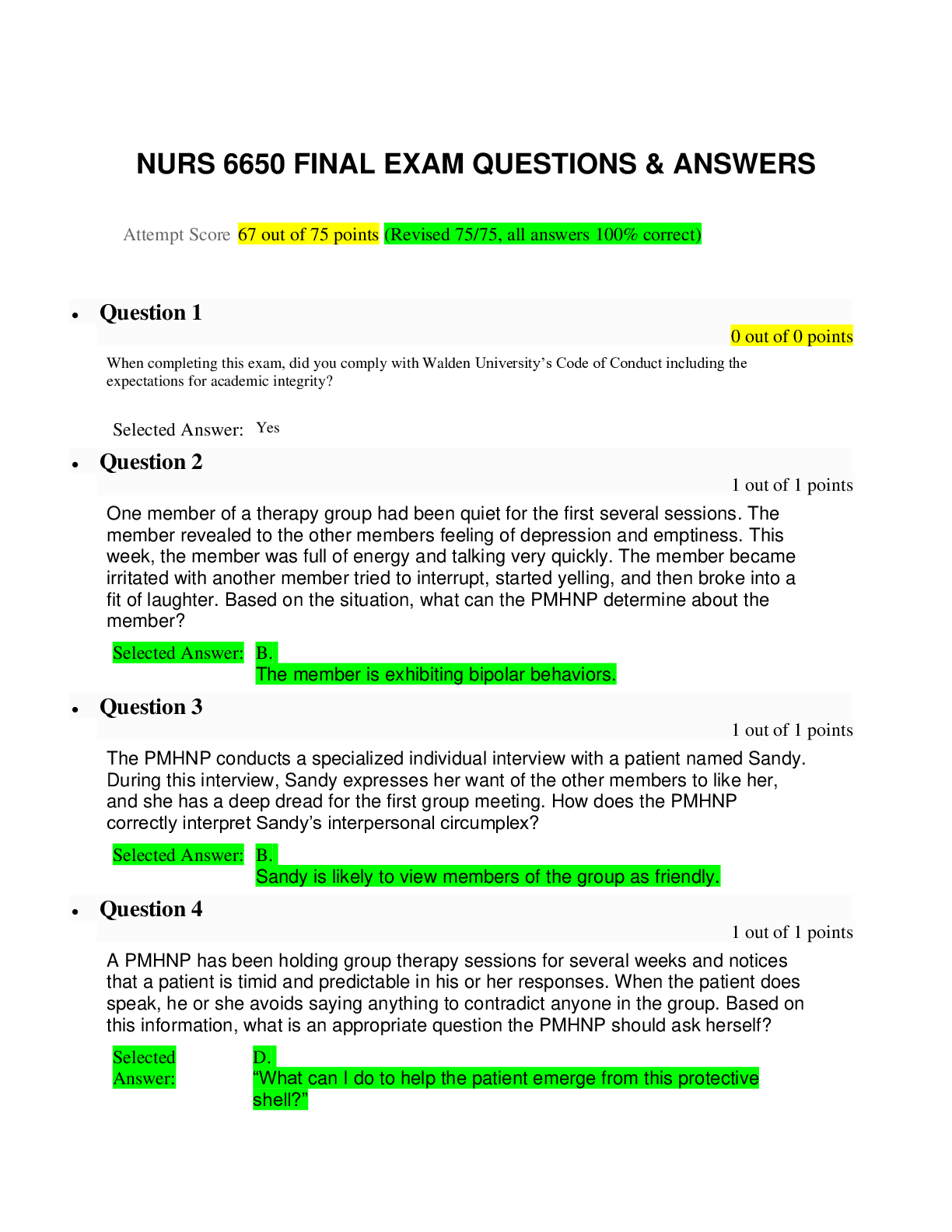
Nurs 6650 Final
Group participation is an important aspect of how successful group therapy will be. The PMHNP
recognizes that the gender of group participants can play a role in the likelihood of group
participation.
...
Nurs 6650 Final
Group participation is an important aspect of how successful group therapy will be. The PMHNP
recognizes that the gender of group participants can play a role in the likelihood of group
participation. Which statement about gender and group composition does the PMHNP take into
account?
A. Men display more intimacy and less competition in all-male groups.
B. Women display less intimacy and more competition in all-female groups.
C. Men in evenly mixed groups are more self-disclosing and less aggressive.
D. Women in evenly mixed groups are equally as active as they are in all-female groups
During his second group therapy session, a member, who was quiet the previous week, becomes
very judgmental. He criticizes another member by saying, “Mary, you are always late because
you don’t respect our group.” Then he adds, “In fact, all of you are disrespectful and uncaring.”
What is an appropriate step by the PMHNP?
A. To learn the underlying meaning of the statements
B. To ask about his actual motivations and aspirations
C. To help reveal the impact of the behavior on others
D. All of the above
PMHNP is putting together a heterogeneous, interactional therapy group. During an initial
screening, a patient explains that he is unemployed because he keeps getting fired from new jobs
after several months. The therapist asks, “Why do you think those companies let you go?” The
patient’s reply is, “Those companies are all terrible. They don’t know how to treat employees.”
After asking the patient if he thought about his role in getting fired, the patient says, “Why
should I? I am not part of the problem.” Based on this information, what is an appropriate
observation by the PMHNP?
A. The patient is able to participate in the group task and would benefit from it.
B. The patient is able to participate in the group task but may be harmed by it.
C. The patient should decide if he would feel comfortable joining group
therapy.
D. The patient will likely not benefit from group therapy and should not join.
The PMHNP
recognizes that hostility
is unavoidable in a
group and
acknowledges that a
frequent source of
hostility can be
parataxic distortions.
Which situation islikely to present a
parataxic distortion
within the group?
A. Peggy, a 54-
year-old
woman,
acting as a
surrogate to
Susan, who is
a younger and
newer
member of
the group
B. Jerry, a
Mexican
medical
doctor who
denies his
heritage and
Carlos, a
proud
Mexican
warehouse
employee
C. Spencer, a
Caucasian
politician
with a history
of substance
abuse, and a
Caucasian
therapist
D. A successful
entrepreneur
and an
aspiring
spoken-word
poet
During a first group
therapy session, a
member is outgoing
and participates
actively. Based on this
information, what is an
appropriate predictionabout this group
member by the
PMHNP?
The member may be
influential
A patient in group
therapy named Ted
shares personal
information for the first
time. He seems nervous
but continues to talk.
How might the
PMHNP use nonverbal
positive reinforcement
to support Ted’s feeling
more comfortable?
A. Staring
intently at
Ted while
raising an
eyebrow
B. Looking at
other
members
rather than
directly at
Ted
C. Leaning
forward and
nodding as
Ted shares his
story
D. Ignoring any
members who
are not
listening to
Ted
A PMHNP is treating a 7-year-old child exhibiting signs of aggression and attention problems.
Before suggesting an intervention using a common elements approach, what may the PMHNP
consider?
A. The therapist’s own
characteristics
B. The child’s goals for
treatmentC. How willing the child is
to change
D. None of the above
When forming a group for therapy, which action would the PMHNP
likely take as a predictor for group behavior?
A. Completing standardized testing such as the Minnesota
Multiphasic Personality Inventory (MMPI)
B. Conducting individual therapy sessions to assess each patient’s
personality style and flaws
C. Inviting members that the PMHNP knows and keeping the group
to one gender
D. Developing a pretherapy waiting list group to be conducted four
weeks prior to beginning the group
During an initial screening session, the PMHNP is considering a patient for group therapy. The
patient is recently divorced and says he is lonely and depressed. What is the best referral by the
PMHNP?
A. A long-term
heterogeneous
interactional group
B. Inpatient cognitive
analytic group therapy
C. Brief, problemoriented group therapy
D. A short-term group for
chronic depression
The homogenous mode of composition involves a theory that relates
to group composition. When applying this theory, the PMHNP is
aware that the group will most likely consist of which of the
following?
A. Males and females of different ages, education levels,
socioeconomic statuses, and professions
B. Males and females of similar ages, backgrounds, diagnoses, and
social status
C. Males and females with an attraction to the group, aiming for a
cohesive and socially compatible group
D. Males and females with an ability to offer consistent self-reflection
and group interactions
A client is observed discussing many problems and complaints during group therapy. However,
when other group members attempt to offer advice, the client does not accept it. Based on this
observation, what can the PMHNP determine about the client?
A. The client believes they are all there to get help and cannot accept advice from someone who
the client believes is just like him or her.B. The client does not really have these problems or complaints; he or she is doing this in an
attempt to get attention.
C. The client is a help-rejecting client and will continue to present problems and then refuse the
help of others.
D. The client has so many problems and complaints that he or she is unable to focus on just one
to address.
In a group therapy session for patients with anxiety problems, a patient named Eve was afraid to
disclose to the other members that she was a victim of sexual abuse. She kept the secret for
months, although she hinted at it to other members. During a meeting, another member tried to
pressure Eve to disclose her secret, but she was flustered and not ready to share. What is an
appropriate response by the PMHNP?
A. Encourage Eve to share her secret by showing authority and empathy
B. Remain quiet and allow the group to take charge of the meeting
C. Have group members conduct a role play to get Eve to self-disclose
D. Tell the group it is OK that Eve does not yet feel safe enough to share
During an initial meeting, a patient who has been discussing suicide says to the PMHNP, “I’m so
depressed that I don’t want to leave my house. All I want to do is stay in bed.” What type of
therapy would the PMHNP most likely recommend to this patient?
A. An interactionally focused heterogeneous therapy group
B. A structured homogeneous group for chronic suicidality
C. A short-term cognitive therapy addiction group
D. None of the above
Following the PMHNP’s cancellation of a group session, he or she notices a decrease in
compliance and attendance within the group. What does the PMHNP identify as the group’s
reason for noncompliance?
A. The group did not expect to have time off, so it may take up to a month to get back into a
routine.
B. The group members may believe that the group is not important to the PMHNP.
C. The PMHNP’s absence gave the members a reason to also be absent.
D. The group members feel let down, because the PMHNP cancelled a meeting.
The PMHNP understands that conflicts within the psychotherapy group can be troublesome for
clients and have the potential to reduce the effectiveness of the group process. As it pertains to
group meetings, the PMHNP understands which statement to be true about conflict?
A. Conflict exists when there is a lack of mutual respect.
B. To eliminate conflict, it must be recognized and addressed immediately.
C. Conflict within the group indicates a lack of growth amongst the group members.
D. Conflict exists in every group and is expected to reoccur throughout the group meetings.
A patient in group therapy discloses her concern about feeling suicidal again in the future.Using the principle of universality, what is an appropriate step by the PMHNP?
A. Encourage other members who have similar concerns to share their feelings
B. Tell the patient to believe that she will continue to make progress in the future
C. Explain to the patient the mental health benefits of group therapy
D. Have the patient work to correctively relive early familial conflicts
According to Dr. Carlson, since Adler talked about how the social setting in which we
live influences our lives, the best way parents can change their children’s behavior is to
change:
A. What is happening in the home environment.
B. The discipline techniques used at home.
C. The expectations for the child at home and school.
D. How extended family members behave toward the children.
In the parent consultation session, the parent discusses her son “Blake” who has changed since
his 13th birthday. Dr. Carlson discusses the power conflict that the parent appears to be getting
into with her son. When they discuss approaches they can use to help Blake experience increased
responsibility, Dr. Carlson explains that the parent must make a commitment with her son by
agreeing to:
A. “Think through”
B. “Do it”
C. “Weigh options”
D. “Try again”
The anticipation of the first meeting among psychotherapy group attendees may cause feelings of
dread and uneasiness among clients. How does the PMHNP demonstrate awareness and promote
the success of this first psychotherapy meeting?
A. By conducting a standardized evaluation for the clients participating in this group
B. By assigning roles for each member at the beginning of the first meeting
C. By calling clients who will be attending to remind them of the group a week prior
D. By asking each member what his or her fears are as he or she joins the group
The PMHNP is meeting with a married couple. The husband is 81 years old, and the wife is 78
years old. They tell the PMHNP that many of their friends have passed away over the last couple
of years, and it’s making them feel sentimental about their lives and the fact that they are getting
older. Hearing this, the PMHNP uses a life review approach with the couple. What action will
the PMHNP employ?
A. Looking for patterns of distraction between the husband and wife
B. Educating the husband and wife about communicating their feelings to one another
C. Having the husband and wife recall the happy and sad times they had in their lifetime
D. All of the above
For several months, a patient in group therapy always participated in conversation but only
shared positive stories about her own life. During the next session, she finally confessed thatshe has been depressed and cutting herself. What is the best response by the PMHNP?
A. “Why did you hide this important disclosure from the group for so long?”
B. “Thank you. Remember that everyone needs to share personal information.”
C. “You must feel comfortable with the group now to share this with us.”
D. “Excellent. It wasn’t that difficult to share this with the group, was it?”
Peter, a successful businessman, is introduced to the group during the twelfth week. Following
Peter’s introduction, Joseph, a long-term member in the group, begins to lead the group and
discuss all of the things that he has personally accomplished. In what way does the PMHNP
correctly interpret Joseph’s behavior?
Joseph is attention
seeking and wants to
show Peter that he is just
as successful as he is.
Joseph wants to show
Peter how much he has
grown since joining the
group.
Joseph is at risk for
leaving the group,
because a new client has
been added.
Joseph reveals his
accomplishments,
because he feels that his
position in the group is
being challenged.
A PMHNP is evaluating a patient who has problems with
authority and has trouble accepting criticism. The patient is aware
of these problems and wants to change. Based on this, what is an
appropriate action by the PMHNP?
A. Treat the patient in individual therapy rather than in group
therapy
B. Accept the patient for inclusion as a group therapy member
C. Have the patient start group therapy if he or she can resolve
problems with authority
D. Ask the patient to start group therapy if he or she takes fullresponsibility for the problems
Question 24
A PMHNP is leading a group therapy session for patients with substance abuse problems. After a
productive session in which all members participated, the following week was not as productive.
In order to help the group members assume responsibility for evaluating the meeting, what is an
appropriate comment for the PMHNP to make?
A. “How would you
compare today’s
meeting with last
week’s?”
B. “Can you see that
today’s meeting was
not that productive?”
C. “I wonder why
everyone was so
reluctant to work hard
today.”
D. “Next week, we will
try to have a more
intensive interaction.”
Question 25
A PMHNP is leading a group therapy session for patients with
substance abuse problems. After one member shares a problem, other
members offer support, concern, and observations. The PMHNP points
out that the group is offering many truthful reactions and helpful
feedback. Which principle does this illustrate?
A. Direct advice
B. Imitative behavior
C. Installation of hope
D. Altruism
Question 26
The PMHNP provides cognitive behavioral therapy (CBT) to an older adult patient with
depression. The patient’s 41-year-old daughter and 32-year-old son attend one of his sessions
with the PMHNP so that they can learn more about how to help their father. What does the
PMHNP say to the daughter and son about the goals of their father’s CBT?
A. “We are trying to reduce some of the symptoms your father experiences.”
B. “We are trying to teach your father about skills for daily living.”
C. “We are trying to cure your father so that he does not have depression.”
D. None of the above.Question 27
A client has attended five group therapy sessions yet has not engaged verbally with others in the
group. The PMHNP has identified the client as a “silent member.” Which statement is true about
silent members as related to group therapy?
A. Silent members can progress as much as others in the group if they are able to process
vicariously through other members in the group.
B. Silent members are silent because they have attended group therapy before and most likely
have lost trust in self-disclosure to others.
C. Silent members have learned to observe the behaviors of others; this allows them to make
effective contributions and promote growth within the group.
D. Silent members usually will hinder the group while hindering their own growth within the
group.
Question 28
A PMHNP is meeting with the mother of a 10-year-old boy named Malik, who has been
depressed since his parents’ divorce. The mother explains that her goal for treatment is to help
Malik feel better so he can become his “usual outgoing self.” She insists that she does not
want him on medication. Which is the best response by the PMHNP?
A. “We will come up with a treatment plan that takes into account your goals and
preferences.”
B. “I have a treatment plan that has worked successfully for children going through divorce.”
C. “Because Malik is depressed, I think we might want to try to see if medication works.”
D. “Tell me your treatment ideas, and that will be the plan we use to reach your goals.”
Question 29
The PMHNP is meeting with an adult woman and her father, who is 85 years old. The
father stays quiet most of the session. The daughter explains he is mad at her for “bringing
him to a see a shrink.” The daughter reports that things have been tense in the house since
her father moved in. The father has a history of depression, though he does not take any
medication for it. In addition, lately the father seems to never sleep. “I hear him
rummaging around in the kitchen, the garage, the living room, at all hours of the night.
Sometimes he’ll nap during the day, but not much. This is putting a strain on my marriage,
because my husband can’t sleep with all of this going on.” Which therapeutic approach
does the PMHNP identify as most appropriate for the 85-year-old father?
A. Cognitive behavioral therapy
B. Complementary and alternative therapies
C. Reminiscence and life review therapy
D. Interpersonal psychotherapy
Question 30
The PMHNP recognizes that extragroup behavior involves behavior that occurs outside
of the group or during subgrouping. Which statement best describes extragroup
behavior as it pertains to group therapy?
A. Extragroup therapy should be addressed before it occurs, to prevent it.
B. Extragroup behavior that is discussed in group therapy can encourage groupresistance.
C. Extragroup behavior discussed in group therapy can be therapeutic.
D. Extragroup behavior can occur in all levels of group therapy.
Question 31
The leader begins a group meeting by doing the “names activity.” At the completion of the
activity, the leader explains that the activity is useful for all of the following reasons, except:
A. To help individuals see how unique they are and how they “personalize” themselves through
unique variations of their name.
B. To help groups members stay connected to one another while remaining their own unique
people.
C. To help members see how connected they are to their parents by understanding how their
names came about.
D. To provide at least one explanation for one of the things members would like to achieve in
group.
Question 32
During the first group meeting, a client states, “I am here because I am very shy. I don’t mesh
well with others and I rarely get invitations to go anywhere.” Which statement about the client’s
reason for seeking help and treatment best applies?
A. The client is using the ego defense mechanism of “projection,” which must be addressed to
get to the root of the problem.
B. The client may benefit from individual therapy, because he or she is shy and this could hinder
group therapy.
C. The client is aware of his or her current issue and will do very well in group therapy.
D. The client suffers from boredom, which is a serious condition that must be addressed and
treated.
Question 33
A 14-year-old girl named Laura and her parents are meeting with a PMHNP. The parents
explain why they are there by saying, “Laura has been unhappy since she moved to a new
school. She has been moody and often talks back to us.” Laura sits quietly and looks
uncomfortable. Which is the best response by the PMHNP?
A. “Can you elaborate on
why Laura is unhappy
at her new school?”
B. “Please step out for a
moment, Laura, so I
can talk to your
parents.”
C. “Laura, can you
explain from your
perspective why you
are here?”
D. “If Laura isuncomfortable being
here, it’s OK if she
doesn’t join in today.”
Question 34
Gregory is a middle-aged veteran participant in a group led by the
PMHNP. Since Gregory has been attending group, he frequently
interrupts others and seems to take much of the group time for
himself. The PMHNP identifies Gregory as a monopolist and
confronts him. She explains that she does not want him to talk
less; instead, she actually encourages him to talk more. What is the
likely cause of the PMHNP’s explanation?
A. Gregory is not yet in a stage where he is able to cope with
disappointment, so the PMHNP had to retract her statement
and will revisit the situation at a later time.
B. The PMHNP wants Gregory to think about why he fears the
thought of silence, and she encourages him to talk more to the
people who have prompted that fear.
C. Though Gregory talks a lot, his conversation is rarely
meaningful. The PMHNP encourages Gregory to talk for more
than the purpose of entertainment and/or attention.
D. Though Gregory talks a lot, his conversation is rarely
meaningful. The PMHNP encourages Gregory to talk for more
than the purpose of entertainment and/or attention.
Question 36
A PMHNP is treating an 8-year-old child who was at a cousin’s house during a domestic
violence situation. Using a common factors model, the PMHNP wants to pay attention to
cultivating the relationship with the parents and child. After the child talks about how nervous he
or she has been since witnessing the trauma, what is an appropriate response by the PMHNP?
A. “That must have been very scary for you to witness.”
B. “You are doing a great job at explaining how you feel.”
C. “I will do my best to help you so you feel better.”
D. All of the above
Question 37
A group member who suffers from depression and anxiety says during
the session, “I don’t see how any of this is going to help. I am still too
anxious to leave the house and do the things I want to do.” What is an
appropriate response by the PMHNP?
A. “Don’t forget about the progress you made last week by joining a
yoga class.”
B. “We just heard from another member about his improvement from
being in the group.”
C. “Remember the power of positive expectations to help you deal
with your goals.”D. All of the above
Question 38
A PMHNP has a therapy group in which many members have been
dropping out over the past several weeks. Members have
complained that they do not feel part of the group. What is an
appropriate step for the PMHNP to take?
A. Wait for a new member to join before holding the next session
B. Suggest the remaining members switch to individual therapy
C. Allow group cohesiveness to naturally evolve on its own
D. Explore the problems the group is having with cohesion
Question 39
During a group session, a member turns to the PMHNP and
says, “I need some advice. My manager asked me to take on an
extra project, and now I’m overwhelmed. I don’t want to seem
incompetent, so I agreed to the extra work. What do you
recommend I do?” What is the best response by the PMHNP in
order to shape group behavior?
A.“I am sorry to hear you feel overwhelmed, and I have
several suggestions that you might find helpful.”
B. “Let’s ask the group what they think. Does anyone have
feedback about this situation?”
C. “Before I give recommendations, please explain why
turning down the project might make you seem
incompetent.”
D.All of the above
Question 40
During a group therapy session, a member comments that another
member named Ted had no compassion. Ted replies, “Why does it
matter if I care one way or another. I can’t solve their problems.” The
other member starts crying and blames Ted for this. He shrugs and
answers, “I don’t understand why you are crying.” Based on this
information, what is the most likely determination the PMHNP can
make about Ted?
A. He is a help-rejecting complainer.
B. He suffers from depression.
C. He is protecting himself from group behaviors/emotions.
D. He has borderline personality disorder.
Question 41
A PMHNP has been holding group therapy sessions for
several weeks and notices that a patient is timid and
predictable in his or her responses. When the patient
does speak, he or she avoids saying anything tocontradict anyone in the group. Based on this
information, what is an appropriate question the PMHNP
should ask herself?
A. “How can I help the other members tolerate this
patient?”
B. “Are other group members also bored by this
patient?”
C. “How can I inspire this patient to become lively and
spontaneous?”
D. “What can I do to help the patient emerge from this
protective shell?”
Question 42
Self-disclosure is a
very important part of
group therapy. Which
of the following
conditions does the
PMHNP identify in his
or her own life as a
possible hindrance to
self-disclosure?
A. The PMHNP has a
5-year-old
daughter, and the
client is a
convicted
pedophile.
B. The PMHNP has
been employed in
this field for less
than a year.
C. The PMHNP had
to cancel a meeting
two months ago.
D. The PMHNP
monitors what is
disclosed to ensure
that too much is
not disclosed.
Question 43
Jane has beenattending group
therapy for the past
year; she and the
therapist have
determined that she
has met her goals.
Jane has been
arriving to group
late or not coming
to group at all.
How does the
PMHNP correctly
interpret Jane’s
behavior?
A. Jane is
depressed and
could benefit
from individual
therapy.
B. Jane is being
rebellious,
because she no
longer needs
help from the
group.
C. Jane is showing
signs of
independence,
because she will
no longer be
attending group
soon.
D. Jane is showing
signs of
regression due
to the
termination
phase.
Question 44
During an initial meeting, a PMHNP spends time speaking with a patient who suffers from social
anxiety. The therapist finds the patient extremely loud and overbearing. The PMHNP’s negative
feelings continue no matter how hard he or she tries to feel differently toward the patient. What
is the most appropriate next step by the PMHNP?
A. Recommend the patient join the PMHNP’s therapy group for anxiety disorders
B. Suggest the patient see the PMHNP for individual therapy before group therapyC. Refer the patient to another therapist who has a suitable therapy group
D. Ask another therapist for impartial advice regarding treating the patient
Question 45
The PMHNP is working with an older adult woman and her adult children. The children
report that the mother was diagnosed with dementia, and they are all concerned about her
welfare. The plan is for the mother to move in with one of the children, but they are still
worried about how the mother will manage during the day when she is left alone. What does
the PMHNP identify as the focus of the family therapy?
A. Helping the patient and children understand the skills for daily living
B. Educating the patient and children about how to maintain a meaningful relationship
C. Teaching the patient and children concrete suggestions for managing anxiety related to
dementia
D. A and B
Question 46
During a group therapy session, a member shares that she often feels lonely and
depressed. She has been turning down invitations to spend time with friends lately,
because she does not want to leave the house. What is an appropriate step for the PMHNP
to take?
A. Assign homework to have the patient work on improving interpersonal communication
B. Translate depression into interpersonal issues, and then treat the underlying issues
C. Focus and treat the patient’s depression before examining interpersonal relationships
D. All of the above
A patient has had a problem with substance use and has been receiving treatment for
addiction. Which additional step might the PMHMP suggest to help the patient
maintain abstinence from drugs during and after treatment?
A. Narcotics
Anonymous
B. Primary care
monitoring
C. Inpatient
hospital
services
D. Workplace
screenings
Question 48
Members of a therapy group have been meeting for several months.
During group therapy, a patient is bossy and controlling. During this
week’s session, she is confronted by another group member about her
behavior and replies, “This is not how I normally act. You are not my
family and friends. I don’t act the same way around them.” What can
the PMHNP deduce from her behavior?
A. She is only bossy
and controllingwith the group.
B. She is displaying
her true
interpersonal
behavior.
C. Her mother or
father is bossy
and controlling.
D. She is actually
shy and meek
outside of the
group.
Question 49
A narcissistic patient was unhappy that other
members did not seem concerned about his or
her dating problems, which the patient spent
half the session talking about. The patient
confronted the group by saying, “All of you are
rude and uncaring!” When group members
ignored this comment, the patient said, “And no
one said anything nice about my new haircut
either!” What is an appropriate response by the
PMHNP?
A. Assuring the patient that the group is
concerned and complimenting the haircut
B. Encouraging other group members to tell the
patient how this behavior makes them feel
C. Asking members to spend the rest of the
session helping the patient with his or her
problems
D. Allowing group members to continue to
ignore the patient’s rant, because it is
inappropriate
Question 50
A 36-year-old client attends group therapy regularly but is consistently tardy. The client explains
that job and family obligations interfere with attendance to the group. What is the most
appropriate intervention by the PMHNP?
A. Use group pressure by not beginning the meeting until the client arrives
B. Explain to the client that he or she has been referred to individual therapy
C. Allow members to express how the client’s interruptions interfere with group progress
D. Encourage the client to take a break from group therapy to get his or her affairs in order
Question 51A 21-year-old client with narcissistic traits is noted to continuously disrupt the group by
speaking while others are speaking. It becomes evident that the client is purposely disrupting the
group and decreasing the group’s productivity. What does the PMHNP identify as a cause of the
client’s behavior?
A. The client has a fear of losing his or her identity.
B. The client prefers one-to-one interactions.
C. The client wants to be the leader of the group.
D. The client lacks effective communication skills.
Question 52
In a group therapy session for adolescents, a 15-year-old patient says he has trouble making
conversation with people he does not know well. Based on the principle of development of
socializing techniques, what explicit approach might the PMHNP take?
A. Encourage other members to give him feedback about his problem
B. Ask him if he can trace the social problem to his primary family group
C. Have group members conduct a role play to practice making conversation
D. Give the group an assignment to investigate their roles in relationships
Question 53
Members of a therapy group have been meeting for several weeks. While a member named
Margaret is talking about how her spouse ignores her when she tries to tell him what to do,
another member named Nicole interrupts and says, “Maybe he thinks you are being bossy.”
Margaret replies by saying, “At least I’m not an alcoholic like you are!” What is an appropriate
response by the PMHNP?
A. Stop the conversation and intervene
B. Ask Nicole how she feels about the incident
C. Remind members about important group norms
D. All of the above
Question 54
A patient who has been depressed is seeing a PMHNP for individual therapy. The patient
explains that he has been avoiding most social activities for the past few months. He is
divorced and has joint custody of his 10-year-old daughter. Based on this information, what
recommendation by the PMHNP would most benefit the patient?
A. Couples
therapy
B. Group
therapy
C. Family
therapy
D. None of
the above
The PMHNP is meeting with an older married couple. The couple reports
having concerns about becoming dependent on their adult children someday,since several of their other friends have had to move in with their kids. They
make it clear to the PMHNP that they aren’t keen on therapy or taking medicine
but would be willing to try some alternative therapies. What does the PMHNP
suggest for evidence-based CAM modalities?
A. Going into a relaxed state of mind in which the couple imagine certain
scenes
B. Practicing yoga or deep breathing techniques
C. Putting lavender oil on pillows or in a diffuser
D. All of the above
Question 56
Two PMHNPs are in charge of a therapy group that has experienced several maladaptive
interpersonal dramas lately. One of the patients has been described by other members as
argumentative. After a particularly awkward session, one of the therapists feels that his own
interpersonal distortion of the session may be clouding his observation. What is an
appropriate step by that PMHNP?
A. Be candid with
members of the group
about his personal
dilemma
B. Take a leave from the
co-therapy group until
the problem is resolved
C. Compare his reaction
to the session with the
other therapist’s
reaction
D. Suggest that the
argumentative group
member come to
individual therapy
Question 57
Harold Wyman is a 74-year-old man who is trying to mend a
relationship with his adult daughter. Based on his intake
assessment, the PMHNP believes that the father has depression.
The daughter and Harold meet with the PMNHP, and the daughter
explains that her father always appears mopey and withdrawn and
refuses to do anything about it. When asked, the father reports
feeling sad all the time. Which action will the PMNHP employ
with Harold using the interpersonal psychotherapy approach
throughout the various sessions?
A. Asking Harold to quantify his feelings of sadness on a scale
from 1 to 10
B. Teaching Harold about more effective ways to communicatewith his daughter
C. Having Harold think about the link between his sadness and
other areas in his life
D. All of the above
Question 58
Members of group therapy have been meeting for several weeks. The PMHNP often starts
sentences with a thank you or compliment such as, “Good observation.” The PMHNP notices
that some of the group members having been starting their statements with compliments. To
which principle can the PMHNP attribute this process?
A. Altruism
B. Universality
C. Existential
factors
D. Imitative
behavior
Question 59
The PMHNP conducts a specialized individual interview with a patient named Sandy. During
this interview, Sandy expresses her want of the other members to like her, and she has a deep
dread for the first group meeting. How does the PMHNP correctly interpret Sandy’s
interpersonal circumplex?
A. Sandy is likely to resist
engagement and
devalue the group.
B. Sandy is likely to view
members of the group
as friendly.
C. Sandy is likely to be
passive aggressive
during group.
D. Sandy is likely to
prematurely view
members of the group
as hostile.
During therapy, a patient named Maria states she is unhappy that other
members did not express missing her while she was away the previous
week. She confronted the PMHNP by saying, “Nobody here cares about
this stupid group!” What might the PMHNP say to increase group
cohesiveness?
A. “Everyone cares
about the group
except for you.”B. “That is
insulting to
everyone,
including
myself.”
C. “I believe you
owe us all an
apology, Maria.”
D. “This group is
important to
many people
here.”
Question 61
A patient in group therapy for people dealing with
panic disorder is describing a recent panic attack.
He says, “During this attack, I felt like I was
dying.” What is an appropriate response by the
PMHNP using didactic instruction?
A. “Would other members please share your
experiences?”
B. “I’m going to discuss the physiological cause of
panic attacks.”
C. “I would like to ask everyone to keep a journal
of their panic attacks.”
D. All of the above
Question 62
When discussing the role of the consultant in the parenting group session, Dr. Carlson explains
that the consultant should use several skills in order to help keep the group going and should
enable group members to become very engaged with one another. The consultant should use all
of the following skills to achieve this, except:
A. Addressing structure by being clear about what the group will and will not do
B. Establishing links with the commonalities shared by group members
C. Achieving the pre-determined agenda by manipulating questions and session content
D. Helping others see that they are not alone and that others may share their concerns
Question 63
A 9-year-old child who witnessed a fatal car accident has come to therapy with her parents to
get treatment. The child has been irritable since the event and has not wanted to talk about it.
Utilizing a trauma-focused cognitive behavior therapy (TF-CBT) approach, the PMHNP has
reviewed skills that the parents may use to help their child at home. Based on the PMHNP’s
suggestion, which is a statement the parents might make after the child has a temper
tantrum?
A. “You were not behaving well earlier today. That is not how we expect you to act.”
B. “We are impressed with how quickly you calmed yourself after you were upset.”C. “It is fine that you had a temper tantrum. We know you are having a hard time.”
D. All of the above
Question 64
A PMHNP notices that adolescents in a therapy group have not been getting along. They are
divided into two main groups and each automatically dislikes members of the other group. What
is an appropriate step for the PMHNP to take?
A. Remind the group
about the
importance of
being supportive
B. Give the group an
activity to
complete as a
whole group
C. Have a cotherapist join the
group to help
resolve the
problems
D. Suggest that the
leaders of each
clique come to
individual therapy
Question 65
When the counselor discussed assertiveness with the group members, she
began the session by providing definitions and asking group members to
line up consistent with where they feel they are currently in terms of
assertiveness. Why did she do this?
A. To encourage individuals to adjust where they are in terms of
assertiveness by having less assertive people change their spot in line
B. To permit those with similar levels of assertiveness to identify one
another for group cohesion
C. To enable those with more aggressive styles to identify more passive
individuals with whom they could engage in dialogue to change
assertiveness levels
D. To allow the participants to demonstrate self-assessment of their
assertiveness levels to begin dialogue about assertiveness
A member in group therapy named Tom asked others for suggestions to a
problem he was having. He did not think a suggestion by a member named
Steve would work, and for the rest of session, the group took sides arguing
why the idea would work or would not work. The session ended with Tom
agreeing to try the suggestion and report back to the group the following
week. Based on this session, what is an appropriate step by the PMHNP?
A. Help the group reduce conflict and disagreementB. Have a structured intervention to improve cohesiveness
C. Praise the group for their open expression and supportiveness
D. All of the above
Question 67
One member of a therapy group had been quiet for the first several
sessions. The member revealed to the other members feeling of
depression and emptiness. This week, the member was full of energy
and talking very quickly. The member became irritated with another
member tried to interrupt, started yelling, and then broke into a fit of
laughter. Based on the situation, what can the PMHNP determine about
the member?
A. The member is
simply having
a bad day.
B. The member is
exhibiting
bipolar
behaviors.
C. The member is
a habitual
monopolist.
D. The member
has narcissistic
tendencies.
Question 68
The PMHNP explains during a discussion that
subgrouping has the potential to make group therapy
more complicated and less rewarding. Tara, a
member of the group, angrily states, “Well, Jack and
I have been meeting outside of the group for weeks
now.” What is the PMHNP’s most appropriate
response?
A. “I understand, Tara. If you two have not had any
problems, and group therapy has been effective
for you, it’s possible that you are an exception to
the rule.”
B. “Tara, you and Jack have to be very careful not to
get involved sexually. In group, you both should
only focus on yourselves.”
C. “Subgrouping can cause issues with loyalty. For
example, what if Jack told you something that
made you feel uncomfortable. Would you be able
to address that in group?”D. “I apologize if my statement upset you. Who
initiated your and Jack’s subgroup?”
Question 69
A PMHNP is meeting with parents and their 10-year-old child. The child is having trouble
paying attention at school and has been getting easily frustrated at home when doing homework,
which often results in everyone arguing. What step might the PMHNP take as part of a familycentered, solution-oriented approach?
A. Listen carefully and elicit each family member to tell their narrative
B. Ask the family for their ideas in bringing about a change to the problem
C. Have the family draw pictures of their lives after they reach their goal
D. All of the above
Question 70
During the “mid-group debrief” the clinical supervisor focused on the following areas with the
two counselors except:
A. What they did well in engaging the group members.
B. The mistakes that they made in the group and how they can fix them.
C. Observations on how the group members overcame uncertainty with activities.
D. Feedback from each of the counselors who participated in the group.
Question 71
A patient in group therapy, Monique, describes another member, Anna, as bossy and selfish;
however, the PMHNP does not notice this behavior at all. In addition, other members have
expressed how thoughtful and caring Anna is to them. Based on this information, what is an
appropriate observation by the PMHNP?
A. Monique has interpersonal distortions of Anna.
B. Monique is uncomfortable in large social situations.
C. Anna is not showing her true personality to the group.
D. The therapist has a distorted perception of Anna.
Question 72
The social microcosm theory is a theory that relates to group composition. In accordance with
this theory, the PMHNP is aware that the group must consist of which of the following?
A. Males and females of different ages, education levels, socioeconomic statuses, and
professions
B. Males and females of similar ages, backgrounds, diagnoses, and social status
C. Males and females with an attraction to the group, aiming for a cohesive and socially
compatible group
D. All males or all females with an ability to offer consistent group interactions
Question 73
A PMHNP is creating a therapy group and is including a patient with borderline
personality disorder. Which action would most likely reduce the patient’s chance ofseparation anxiety?
A. Partnering with another PMHNP to create a co-therapy group
B. Making sure other group members are not absent or tardy
C. Including another borderline patient in the therapy group
D. All of the above
Question 74
A client diagnosed with depression has begun to feel despair and expresses a desire to leave the
group because he or she does not believe it is helpful. Which action by the PMHNP will most
likely contribute to the client staying in the group?
A. Encouraging the client to attend one more group meeting to see how much he or she is needed
B. Conducting an individual interview to discuss stressors within the group
C. Telling the client that everyone has those feelings and must “stick it out” for things to get
better
D. Referring the client to a different group because he or she obviously will not do well within
this one
Question 75
One group member is identified by the PMHNP as the monopolist of the group. Which
behavior does the PMHNP believe this member is most likely to display?
A. Avoiding certain discussions that bring back painful memories, because the client prefers
to process these thoughts alone
B. Talking excessively and inserting him- or herself into conversations even when they do
not involve him or her
C. Participating in several different groups due to the belief that one group will be ineffective
D. Engaging in therapeutic communication with individuals who the client perceives to be
just like him or her because they are able to relate to each oth
[Show More]