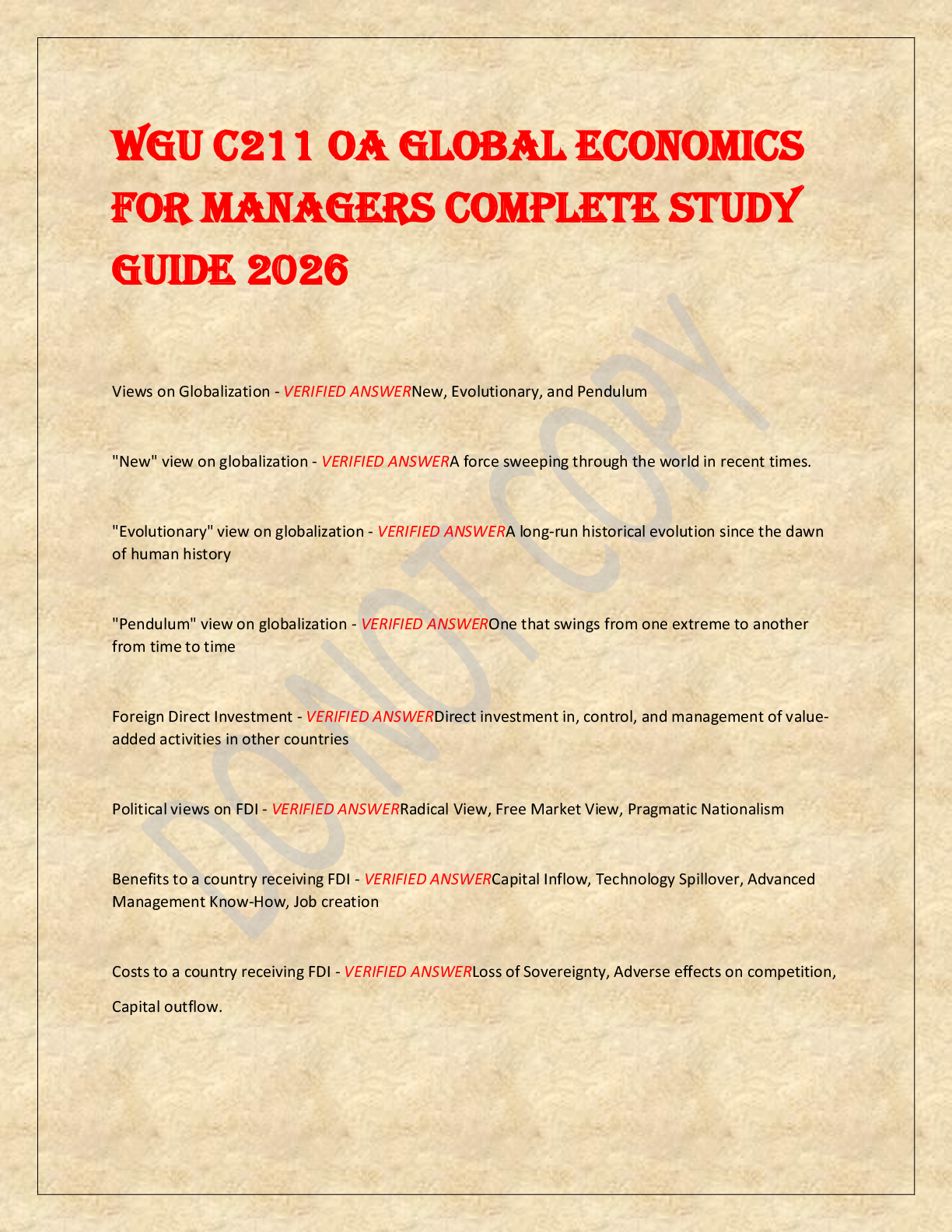
C211 Global Economics for Managers
Just passed C211 Global Economics after psyching myself out, taking way too much time on it and creating way
too much anxiety for myself. This class is a beast because there is so muc
...
C211 Global Economics for Managers
Just passed C211 Global Economics after psyching myself out, taking way too much time on it and creating way
too much anxiety for myself. This class is a beast because there is so much information…. But it is VERY doable. I
thought C215 was way harder than this one. The questions are very simple, at least the version I had, and most
of the questions had clues that lead you to the answer. Do not overthink the answer, look for clues. Remember
keywords in the definition and concept and look for those in the questions and answers. (Similar to prepping for
Accting for decision makers – associate key words to the concepts).
That being said, do not underestimate this exam either. There are questions from nearly every concept. I’m not
saying you don’t need to study, you SO do!! Use the resources provided here as a **MAKE SURE TO KNOW** but
do not use it in place of the study guide and studying/reading some of the concepts. This document alone will not
get you a passing score. I know a lot of people say they didn’t read the text at all… I skimmed over certain
concepts that I knew I needed more information about. I read ONLY about those concepts in the study guide /
in Karen’s brain dump. I think the OA uses the book and terminology from the book, i.e. the outcome of a
prisoner’s dilemma. I think it is important to read about certain concepts and write notes to help you remember
that concept, rather than reading word for word. This helped me. Also, at the bottom of this I will include the
tables from the book that helped me!
Karen Johnson’s brain dump was SO extremely helpful. This is the reason I’m writing this post. Her post truly
helped me and she was spot on! Her brain dump was one of the only things I found in this class that actually
gives you true direction as to what is on the test, which I needed.
Utilize the SEARCH option in this group and search brain dump. Everything she points out is on the test. I feel
like we had the same test. I’ve included her brain dump at the bottom of this page, just so there is a resource
with everything that I’ve found that truly HELPED with C211 in one spot, in addition to the text. Honestly I spent
weeks and weeks and weeks trying to understand all of the concepts, etc and I wasn’t retaining any of it. I fully
dove in studying after trying for weeks to feel confident in the concepts for one day, and took the test that
evening and passed.. the exam only took me 26 minutes. I did not get a 100% on the test, but I was not on the
line of failing either.
I want to pay it forward and put out information as to what I remember about the test, because Karen’s brain
dump is truly what helped me the most! I feel like this is one of the only classes in the MBA where they don’t
give you a clear understanding of what is ACTUALLY on the test, other than the study guide. The study guide
questions are almost a bit misleading, because yes you need to know the concept that is being asked in the
question on the study guide.. but the OA questions are not worded similar to the study guide at all.
**This may have duplicates to what she put but use this IN ADDITION to hers as I tried to remember
information that wasn’t included in her brain dump but everything she said in hers was spot on**
Know what trading currencies is called
Know Product Life Cycle: the stages and product growth during those stages
Know non-equity/equity
Know Consumer/Producer Surplus – where to find it on a graph and be able to specifically FIND it on an
actual graph
Know Formal & Informal Intuitions – what each consist of
Know demand curves for Perfectly Competitive and Monopoly
Downloaded by merchant billy (
[email protected])
lOMoARcPSD|15946012
Know GDP -- More specifically: know examples of each factor of GDP. Mine was select examples under
Investment GDP
Know monetary policy & fiscal policy.
Know what the Federal Reserve does to Increase/Decrease Money Supply --- Know what buying and
selling bonds does
Know what kind of role the Fed Reserve is utilizing by being a loan of last resort .. the question was
something like the fed reserve is using it’s role as a ……
Know which kinds of goods are most protected under property rights
Know property rights fully. Multiple questions about this and they were not worded anything like the
text, etc.
Know how emerging firms are affected by MNE’s
Know cross price elasticity and what it does
Know what an indifference curve is and what it is used for
Know all elasticity equations and what they are doing. No need to get buried in the concept, just stay on
the surface and know what they are, what they do, and their equations to help you understand. (No
math)
Know NAFTA. Just simply what it is, when it came about… There is a “NOTE:” under business decision
making in the global environment in the course of study, under the instructions for chapter 5. That
“note:” is all you need to know about it
Know Civil, Common & Theocratic law. My question had religion in it..
Know 4.4b table. Memorize it. I’m not sure if all the questions are the same but mine was what happens
when supply increases & demand stays the same, but I memorized this table in case they were different.
Know the role of institution based view.. its main purpose
Know what a firm should do if AVC is above price
Know the market models in respect to entry mode/barriers, advertising, product type, how many sellers
& demand curves
Know the Prisoner’s Dilemma and truly understand it. There were at least 3 questions on this
specifically. Some of the questions were only slightly different. Know the outcome of a prisoner’s
dilemma game and what it can tell you about business etc.
Know budget constraints and how/why it shifts inward/outward
Know two types of trade barriers
Know First Mover Advantages/Late Mover Advantages
Know what 2 things impact rivalry
Know how international rates are set.. know the difference between fixed and floating
Review the study guide
Review end of chapter quizzes
Know VRIO
Know Location-Liability/Advantage Capital-Liability/Advantage etc.
Listed below was forwarded to me in an e-mail from someone in this group (thank you so much).. this may be a
different version of the test because hers wasn’t aligned as much with mine as Karen’s brain dump! I didn’t
watch any of the videos, but I have heard there are clues in them. I think they would be super helpful if you are
having trouble grasping any of the concepts. I know a lot of people have asked to have Wade Robert’s videos
forwarded to them so I’ve put the links in here as well.
Advice from students:
Downloaded by merchant billy (
[email protected])
lOMoARcPSD|15946012
They focused more on tariffs and international trade than I originally thought they would. Make sure to
know the difference between fiscal and monetary policy. Also a lot of questions regarding monopoly,
pure competition, monopolistic, oligopoly. Had a couple of questions regarding the prisoner's dilemma
too!
The review slide deck / pdfs for each chapter definitely hit the highlights of the test. I would say if there
is anything you don't understand from the chapter 2, and 5,7,10 reviews you really need to look it up
and understand it. This was my weaker area, and I swear, I answered 30 questions about all this stuff
before I got to the last 20 about demand curves, fiscal policy, elasticity stuff that I felt I knew better. I
would tell people to make sure they LISTEN to the recording, not just review the slide deck because he
tells you key things that aren't on the slide. Like he tells you to make sure you know some examples of
countries that are common law, civil law etc and that is a question of the test verbatim.
Be able to make connections between classic and modern international trade- ie:infant industry
protection was born out of protectionism that started with mercantilism. The porter diamond pulls in
the concept of comparative advantage.
VRIO- know this concept- not covered in the review slides, but there were two questions on the test
about it. One was about Imitability and one was about Rarity in the context of rare resources.
P>AVC-- Be sure to work look at this from all different angles. The same question is on the test asked
different three different times and it all centers around this concept, but it is written in different ways.
You only see P>AVC once, the other two times, it expresses as TR in relation to cost.
have a decent understanding of GDP vs. GNP- ie: American working in China and producing goods in
China. How does this factor in to or not factor in to China/US GDP and China/US GNP.
Really know Fiscal vs Monetary policy. There are at least 3 questions on this centering around trying to
trick you in to answering Fiscal policy with monetary policy answers and vice versa. Make sure you
understand what all these policies do to aggregate demand.
Listen to Wade’s 3 webinar recordings and Poo

.png)
.png)
.png)


.png)