PADI Open Water Diver Final
Assessment
If an object is neutrally buoyant in fresh water, the same object placed into salt water would... -
ANS - Float
I blow up a balloon, tie it off, and take it to the bottom of the
...
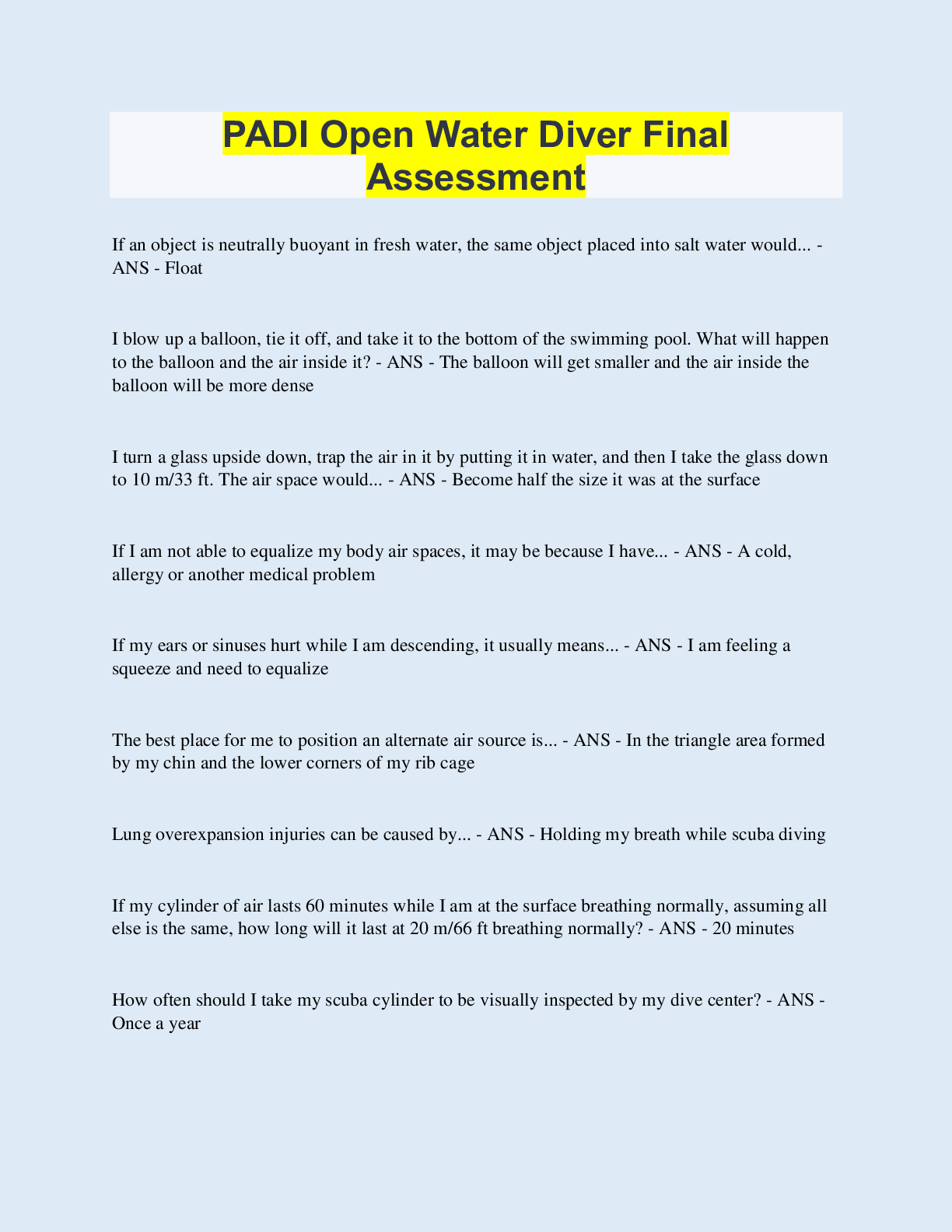
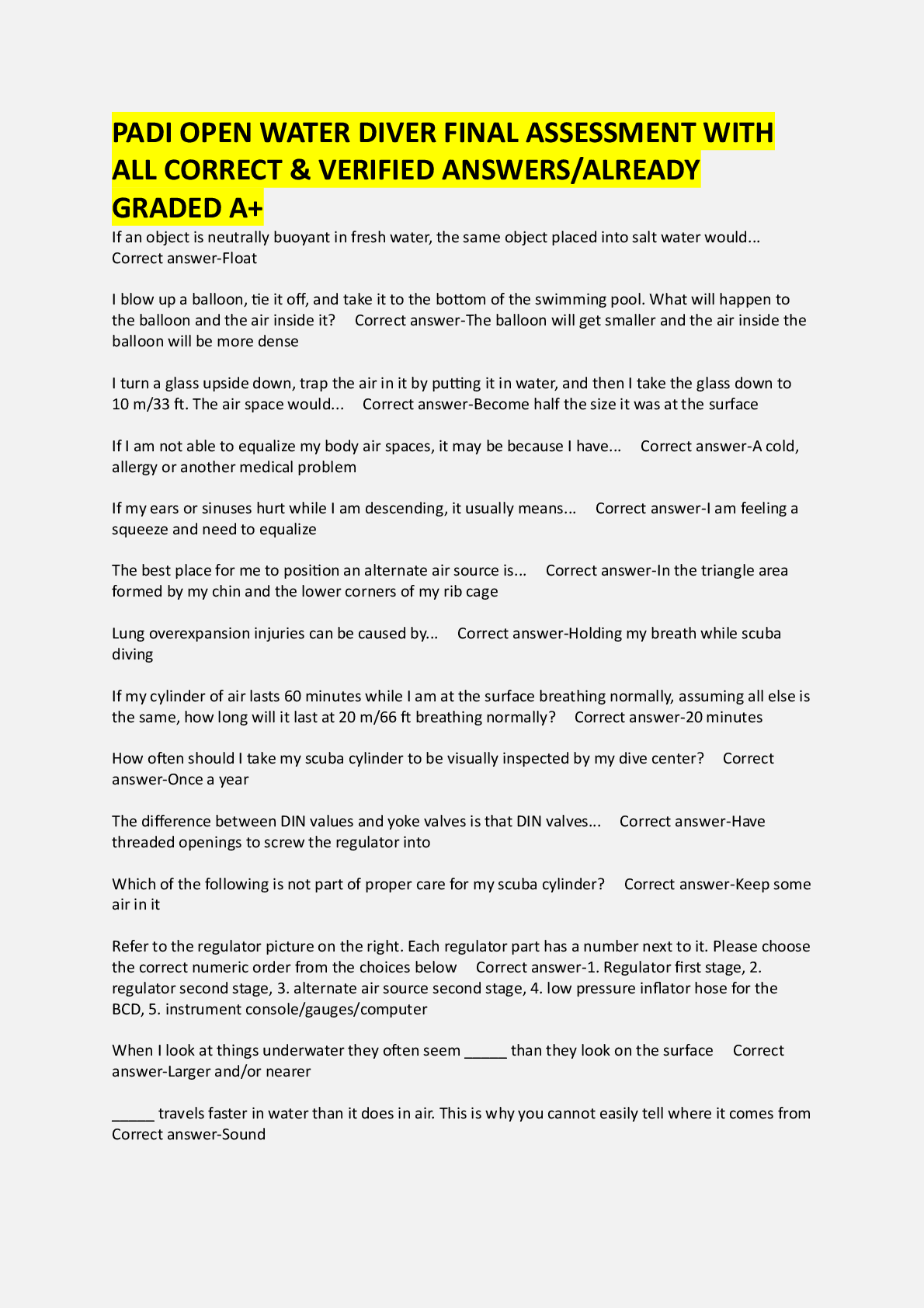
PADI Open Water Diver Final
Assessment
If an object is neutrally buoyant in fresh water, the same object placed into salt water would... -
ANS - Float
I blow up a balloon, tie it off, and take it to the bottom of the swimming pool. What will happen
to the balloon and the air inside it? - ANS - The balloon will get smaller and the air inside the
balloon will be more dense
I turn a glass upside down, trap the air in it by putting it in water, and then I take the glass down
to 10 m/33 ft. The air space would... - ANS - Become half the size it was at the surface
If I am not able to equalize my body air spaces, it may be because I have... - ANS - A cold,
allergy or another medical problem
If my ears or sinuses hurt while I am descending, it usually means... - ANS - I am feeling a
squeeze and need to equalize
The best place for me to position an alternate air source is... - ANS - In the triangle area formed
by my chin and the lower corners of my rib cage
Lung overexpansion injuries can be caused by... - ANS - Holding my breath while scuba diving
If my cylinder of air lasts 60 minutes while I am at the surface breathing normally, assuming all
else is the same, how long will it last at 20 m/66 ft breathing normally? - ANS - 20 minutes
How often should I take my scuba cylinder to be visually inspected by my dive center? - ANS -
Once a year
The difference between DIN values and yoke valves is that DIN valves... - ANS - Have threaded
openings to screw the regulator into
Which of the following is not part of proper care for my scuba cylinder? - ANS - Keep some air
in it
Refer to the regulator picture on the right. Each regulator part has a number next to it. Please
choose the correct numeric order from the choices below - ANS - 1. Regulator first stage, 2.
regulator second stage, 3. alternate air source second stage, 4. low pressure inflator hose for the
BCD, 5. instrument console/gauges/computer
When I look at things underwater they often seem _____ than they look on the surface - ANS -
Larger and/or nearer
_____ travels faster in water than it does in air. This is why you cannot easily tell where it comes
from - ANS - Sound
Unless there are laws that say differently, I should stay within _____ of my dive flag - ANS - 15
m/50 ft
If I work too hard and find it difficult to breathe underwater, I should... - ANS - Stop all activity
and rest, holding onto something for support if possible
As I descend, my wet suit will... - ANS - Compress from water pressure, and I will lose
buoyancy and warmth
I know I am properly weighted for diving if I... - ANS - Float at eye level while holding a normal
breath of air and with an empty BCD
Choose the best answer for the signal shown from the choices provided - ANS - Stop, hold it,
stay there
Choose the best answer for the signal shown from the choices provided - ANS - Something is
wrong
Choose the best answer for the signal shown from the choices provided - ANS - Okay? Okay
Choose the best answer for the signal shown from the choices provided - ANS - Okay? Okay
Choose the best answer for the signal shown from the choices provided - ANS - Low on air
Choose the best answer for the signal shown from the choices provided - ANS - Share air
If I were separated from my buddy, the general procedure is to... - ANS - Search for a minute
and then go up to reunite with my buddy at the surface
I am most likely to become confused about which way is up or down... - ANS - In midwater
I feel a mild current at the start of my dive. How should I begin this dive? - ANS - Dive against
or into the current
What the bottom is made of can cause big changes in... - ANS - Visibility
Most injuries caused by aquatic animals happen because the animals are... - ANS - Trying to
defend themselves
A diver at the surface is moving quickly and jerkily, has the mask off the face, the
regulator/snorkel is out of the mouth, and the diver does not respond to directions. The diver is...
- ANS - Showing signs of distress (trouble)
I am close to my buddy and realize I am out of air. The best response is to... - ANS - Switch to
my buddy's alternate air source
If my regulator begins to free flow while underwater, I should... - ANS - Hold the regulator
without sealing my mouth around the mouthpiece and "sip" the air I need as I ascend
Although it shouldn't have happened, on a dive I fail to watch my SPG and run out of air. If my
buddy is close by, my best option is to _____. Another option is to _____, if I'm in shallow water
and the surface is closer than my buddy - ANS - Ascend using my buddy's alternate air
source/make a controlled emergency swimming ascent
There is an injured diver who is out of the water and is not responding to touch or my voice. The
first thing to do would be... - ANS - To check if the diver is breathing
I should have cylinders filled at a dive center I trust, not use air that tastes or smalls bad, nor use
air from a compressor designed to fill car tires. This is important to... - ANS - Reduce the risk of
breathing contaminated air
Divers who act foolishly at depth due to gas narcosis may start acting normally again if they... -
ANS - Ascend to a shallower depth
I am likely to increase the risk of decompression sickness (DCS) if I... - ANS - Dive while tired,
cold, sick, thirsty or injured
If I think I have decompression sickness I should... - ANS - Breathe 100% Oxygen and contact
emergency medical care
The first step I using my dive computer is... - ANS - Reading the manufacturer's instructions
When planning a diver with a computer, I use the "plan" or "no-stop scroll" mode to determine...
- ANS - The maximum allowable time limits for depths in 10' increments
When making computer assisted dives... - ANS - Each diver needs a personal computer
It's important that I do not turn off a dive computer between dives because... - ANS - It would
lose memory of the previous dive and not calculate repetitive dives correctly
If I accidently exceed my computers no stop limits, I should... - ANS - Follow the computer's
instructions for decompression
If I'm diving in cold water or under strenuous conditions... - ANS - I should add an extra safety
margin and stay will within my computers limits
If my computer fails during a dive, I can use my backup computer to continue the dive. If I'm not
wearing a backup I should... - ANS - Ascend , make a safety stop, and end the dive
I make two dives in one day and am flying home on a commercial plane. I should wait until my
computer says I can fly or _____ hours, whichever is longer - ANS - 18
As a new PADI Open Water Diver, the recommended maximum depth is _____, or the actual
depth I reach in training, If shallower. The maximum depth for all recreational scuba divers, even
experienced divers is _____ - ANS - 18 m/60 ft // 40 m/130 ft
When diving at an altitude above 1000 feet... - ANS - I need to follow special procedures and
may need to set my computer for the altitude
I dive to 18 m/60 ft for 33 minutes. After a 30-minute surface interval, I plan to dive to 17 m/58
ft. What is the maximum allowable time for the second dive? - ANS - 32 minutes
I am planning to make 2 dives. The first dive is to 18 m/60 ft for 24 minutes. How long would I
have to stay on the surface to do these 2 dives safely? - ANS - 32 minutes
I dive to 17 metres/56 feet for 47 minutes. After a 30-minute surface interval I do a second dive
to 17 metres/56 feet. Losing track of time, I notice my bottom time is now 25 minutes.
According to the General Rules, what should I do? - ANS - Ascend (go up) right away to 5
metres/15 feet and stay there for at least 8 minutes before going to the surface, and not dive for
six hours
A group of Advanced Open Water Divers plans to make two dives. The first dive is on a reef in
22 metres/80 feet of water for 20 minutes. The group then remains on the surface for 1 hour. The
second dive is on a wreck in 18 metres/60 feet of water, with a planned bottom time of 30
minutes. What will be the ending pressure group after the second dive? - ANS - R
My buddy and I are planning to dive at a site where the water and air temperature are near
freezing. We plan to dive to 18 metres/60 for 30 minutes. What dive profile would we use when
planning our dive? - ANS - 22 metres/70 feet for 30 minutes
I am an Advanced Open Water Diver. I plan to do three dives. The first dive is a 25-metre/80-
foot dive for 22 minutes followed by a 52-minute surface interval. The second dive is to 20
metres/70 feet for 27 minutes followed by a surface interval of 62 minutes. My third dive is to 18
metres/60 feet. What would be my maximum allowable bottom time for this third dive? - ANS -
34 minutes
[Show More]