WGU C211 CH 13-17 QUESTIONS AND
ANSWERS WITH COMPLETE
SOLUTIONS
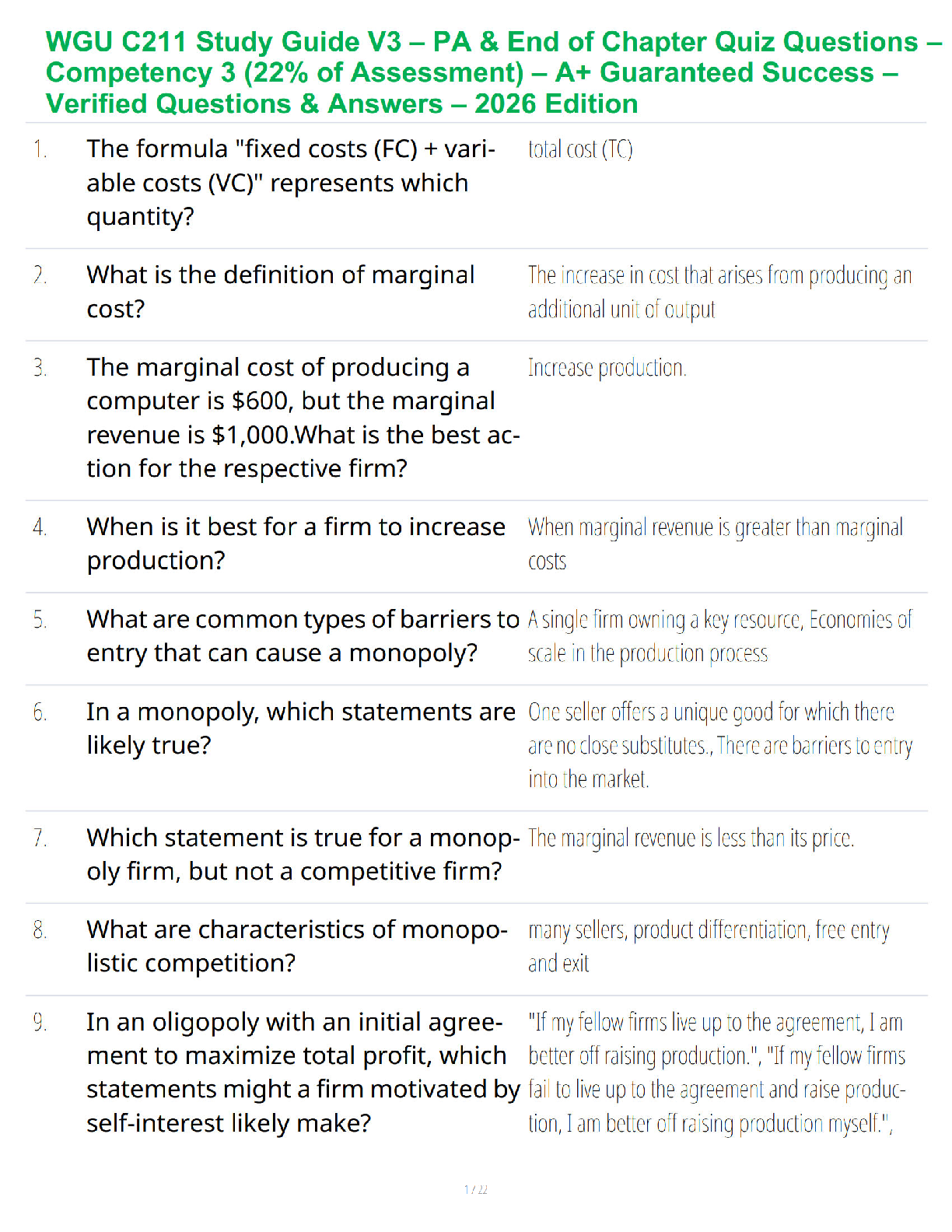
What is the change in total cost equal to in the marginal cost equation? ✔✔Marginal cost
multiplied by change in quantity.
Fixed costs equal: ✔✔Total c
...
WGU C211 CH 13-17 QUESTIONS AND
ANSWERS WITH COMPLETE
SOLUTIONS
What is the change in total cost equal to in the marginal cost equation? ✔✔Marginal cost
multiplied by change in quantity.
Fixed costs equal: ✔✔Total costs minus variable costs
Economic profit is distinct from accounting profit because: ✔✔Economic profit incorporates both
explicit and implicit costs.
Total costs include: ✔✔Variable costs plus fixed costs.
Marginal costs consider: ✔✔The increase in total cost arising from an extra unit of production.
What response best describes the relationship between marginal costs and total costs?
✔✔Whenever marginal cost is less than average total cost, average total cost is falling.
Which statement is true about productivity? ✔✔The value of marginal product of labor equals
wage in a competitive firm.
A production function expresses the relationship between: ✔✔Quantity of resource inputs and
product/service outputs.
Opportunity costs include: ✔✔The income the entrepreneur could have earned working for an
employer.
Economists and decision makers study and then make decisions or judgments based on
✔✔Marginal analysis.
The primary reason that the marginal cost curve declines and then increases is: ✔✔Firms
experience increasing marginal product, then diminishing marginal product.
Which of the following statements is accurate? ✔✔Marginal costs eventually rise with the quantity
of output.
perfectly competitive firm finds that at current production levels marginal cost is greater than
marginal revenue. What action should this firm take in order to pursue the maximization of profit?
✔✔Decrease the target output.
A competitive firm is characterized by ✔✔Trading of identical products.
Competitive firms experience marginal revenue that is: ✔✔Equal to price
n the short-run, a competitive firm would continue to produce under the following circumstance:
✔✔Total revenue exceeds total variable costs.
What fundamental shape does a demand curve take in a competitive market? ✔✔Horizontal
For a perfectly competitive firm which condition is true? ✔✔The demand curve is the same as the
marginal revenue curve.
Which condition is true for perfectly competitive firms in the long-run? ✔✔They will exit the
market if total revenue is less than total costs.
Which statement is true concerning marginal costs? ✔✔Marginal costs typically decline and then
increase with the quantity of output.
What rule is used by perfectly competitive firms to determine shut-down in the short-run? ✔✔Price
is less than average variable costs.
What is true of perfectly competitive firms in the long-run? ✔✔Economic profits will not be
achievable.
What two market structures have common profit characteristics in the long run? ✔✔Perfect
competition and monopolistic competition.
In what way does a monopoly's demand curve differ from a perfectly competitive firm's demand
curve? ✔✔The monopoly's demand curve is downward sloping and the competitive firm's demand
curve is horizontal.
Monopolistic firms seek to maximize profit. What condition allows them to achieve this goal?
✔✔When marginal revenue equals marginal cost.
In pursuing the maximization of profit, monopolies set price at a point that is: ✔✔Above marginal
cost.
How does a monopoly's demand curve compare to the demand curve for a perfectly competitive
firm? ✔✔It is less elastic.
A monopoly's demand curve is: ✔✔The same as the market demand curve.
What is a key characteristic of the demand curve for a monopoly? ✔✔It is the same as the market
demand curve.
Which condition is NOT true of monopolies? ✔✔They are welfare optimizing
What is a key characteristic of a monopoly? ✔✔One seller.
What is the profit maximizing condition for a monopolist? ✔✔Marginal revenue equals marginal
cost.
What statement is true about a monopolist's price? ✔✔Price is above marginal cost.
Monopolistic competition is characterized by: ✔✔Ease of market entry and exit.
An incentive to advertise exists for monopolistically competitive firms because: ✔✔The products
they sell are differentiated.
Monopolistic competition is characterized by: ✔✔Many firms selling differentiated products.
How does a monopolistically competitive firm achieve some degree of control over its price?
✔✔Advertising and a differentiated product
In the long-run, how do monopolistically competitive firms garner economic profits? ✔✔They
earn zero economic profits in the long-run.
What is true of a monopolistically competitive firm's demand curve? ✔✔It is less elastic than a
perfectly competitive firm.
What characteristic does a monopolistically competitive firm have in common with a perfectly
competitive firm? ✔✔Cannot earn economic profits in the long-run.
What is the primary goal of a firm in monopolistic competition? ✔✔Profit maximization.
Consider the choice that an oligopolistic firm has to either compete or to cooperate, collude and
form a cartel with the only other existing firm in the market. What do game theory and the
prisoner's dilemma teach regarding this firm's choice? ✔✔It is difficult to maintain cooperation.
In what way are an oligopoly and the prisoner's dilemma similar in nature? ✔✔Both depict the
difficulty of maintaining cooperative agreements.
Why is studying the prisoner's dilemma applicable to business? ✔✔It demonstrates the value of
mapping out a potential strategy given the actions of rivals.
In what way does self-interest influence each prisoner's decision in the prisoner's dilemma?
✔✔Both prisoners will likely confess.
How do self-interest and rivalry in an oligopoly affect each firm's market decisions? ✔✔Collusion
will fail and self-interest will prevail in the long-run.
In the prisoner's dilemma, what is the likely outcome? ✔✔Both prisoners will confess.
What can we learn from game theory and the prisoner's dilemma about oligopolies? ✔✔Strategy
is affected by rivalries.
[Show More]
.png)
.png)

.png)
.png)
.png)

.png)


.png)