FTCE K-6 Elementary Education
Questions and Answers 100% Pass
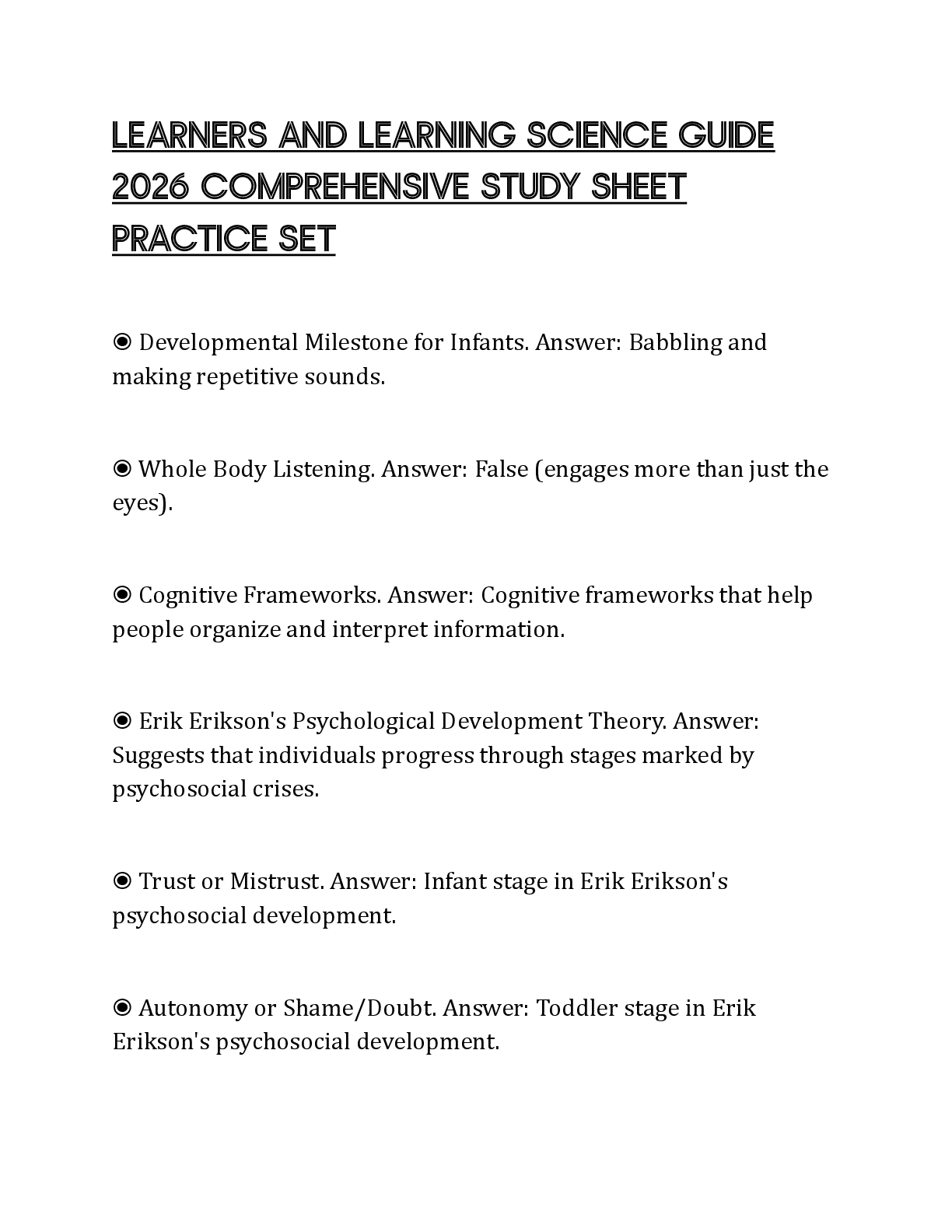
Developmental Stages of Writing ✔✔Pre-writing, drafting, revising, editing, publishing
Diagnostic Assessment ✔✔Standardized tests (assessments) that aim to
...
FTCE K-6 Elementary Education
Questions and Answers 100% Pass
Developmental Stages of Writing ✔✔Pre-writing, drafting, revising, editing, publishing
Diagnostic Assessment ✔✔Standardized tests (assessments) that aim to determine a student's
strengths and weaknesses
Semantic Cuing System ✔✔focuses on any meaning a student derives from a sentence based on
prior knowledge (does this sentence make sense or not?)
Editing ✔✔Proofreading the draft for misspelled words, grammatical & mechanical errors. Focus
is on mechanics.
Publishing ✔✔Sharing the final product with an audience
Talking to the text ✔✔Strategy known as "a think aloud"
Historical Fiction ✔✔Realistic stories that are set in the past
Print ✔✔Conveys meaning
Informal Assessment ✔✔Assessments include but are not limited to: cloze tests, running records,
anecdotal notes, rubrics, portfolios, informal reading inventories
Biography ✔✔Stories that tell about a person's life
Aesthetic Listening ✔✔Listening that is performed for enjoyment and pleasure
Partial Alphabetic ✔✔Letter is associated with sound at this stage
Pre-Alphabetic ✔✔Relies on visual cues to help read words. Usually pre-k stage. (ex.- knowing
McDonald's b/c of the golden arches)
Fantasy ✔✔Stories that cannot happen in the real world
Fluency ✔✔Ability to read quickly, accurately and with proper expression
Graphophonemic Cuing System ✔✔Focuses on various visual cues & knowledge about the
relationship between sounds & symbols. "Does this look right?" Hint: "graphic"
Primary Sources ✔✔A document or piece of work that was written, recorded or created during a
particular time period. Examples: photos, speeches, interviews, diaries, videos, audio
Visual Media ✔✔Also known as print media. Examples: video, t.v., radio
Artifacts ✔✔Real objects, usually representative of a particular culture or event
Visual ✔✔Is related to the "look" of the letter in a word and the word itself. Used by a reader when
he studies the beginning sound, word length, word chunks, etc. Part of the graphophonemic cuing
system.
Phonological Awareness ✔✔Includes ability of a student to identify & manipulate large parts of
spoken language & awareness of other aspects of sound in language. Examples: alliteration,
intonation, rhyming.
Concepts of Print ✔✔Examples of letters, words, directionality, punctuation
[Show More]
.png)


![Preview of THE TEFL ACADEMY LEVEL 5 - ASSIGNMENT C - AUTHENTIC MATERIAL [2026]](https://browseimages.nyc3.digitaloceanspaces.com/paper-images/2026/04/10/HpVkRcWV2026-04-10-11-5769d96426bd64f.png)