MCAT General Chemistry Questions and
Answers with Verified Solutions
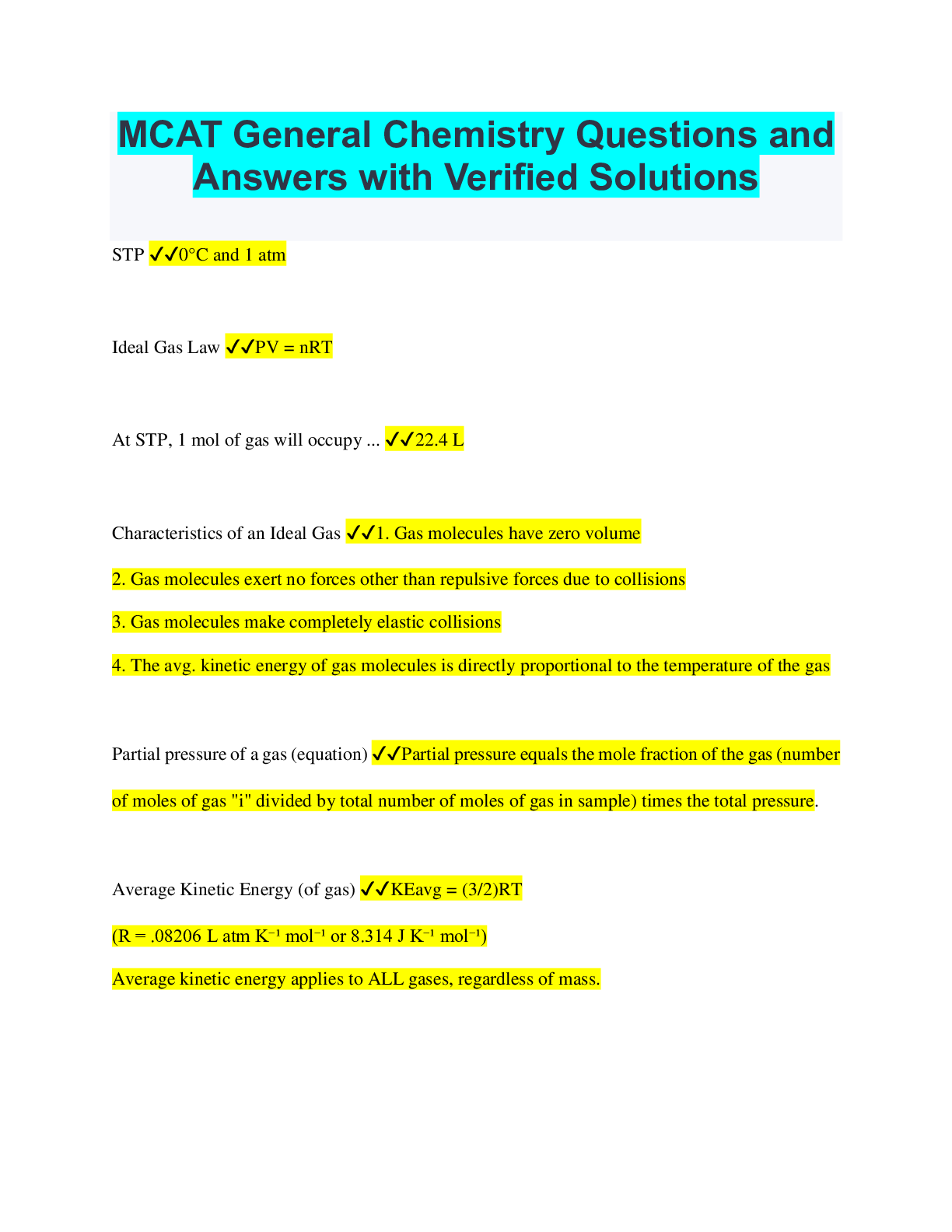
STP ✔✔0°C and 1 atm
Ideal Gas Law ✔✔PV = nRT
At STP, 1 mol of gas will occupy ... ✔✔22.4 L
Characteristics of an Ideal Gas ✔✔1. Gas molecules have
...
MCAT General Chemistry Questions and
Answers with Verified Solutions
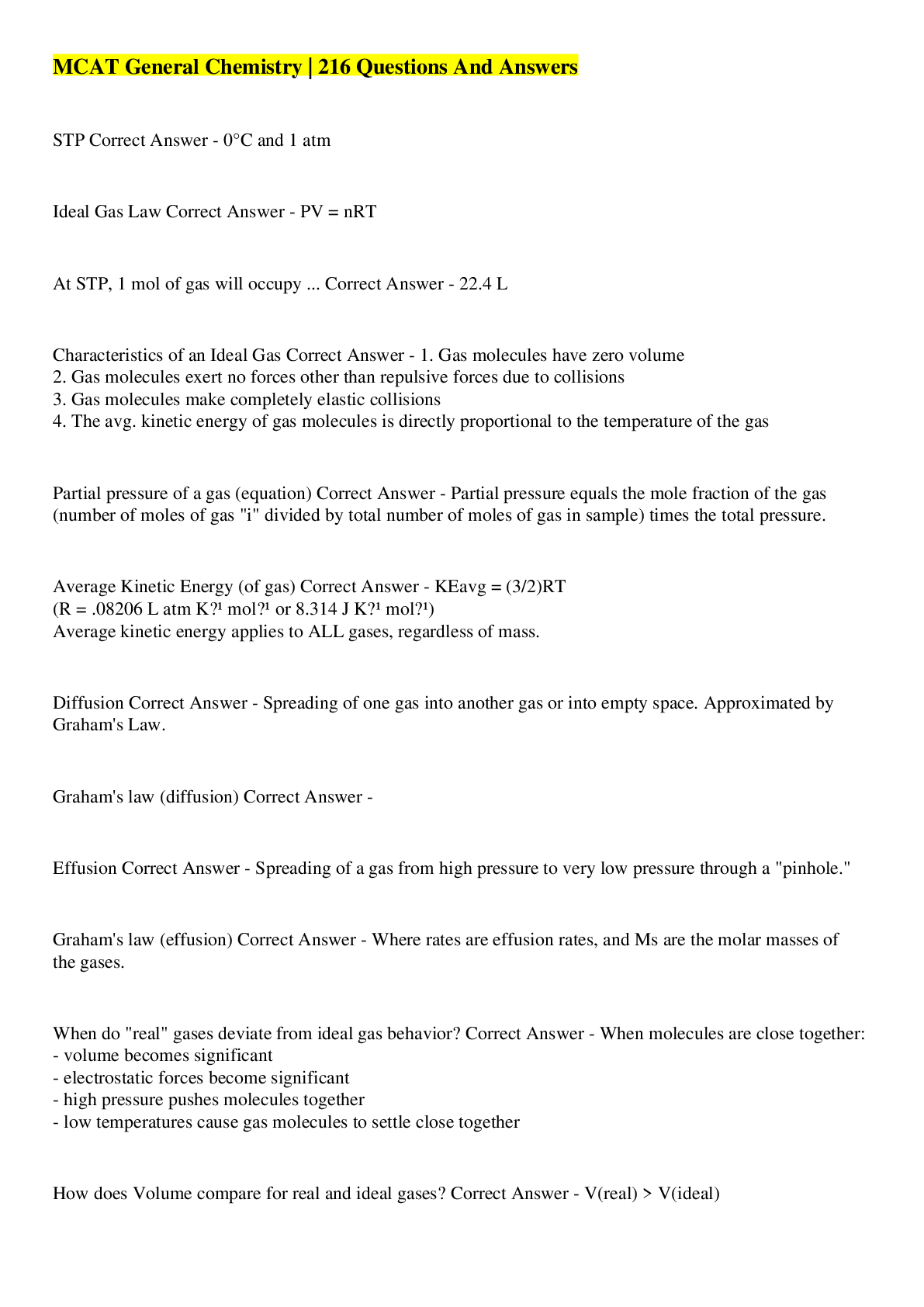
STP ✔✔0°C and 1 atm
Ideal Gas Law ✔✔PV = nRT
At STP, 1 mol of gas will occupy ... ✔✔22.4 L
Characteristics of an Ideal Gas ✔✔1. Gas molecules have zero volume
2. Gas molecules exert no forces other than repulsive forces due to collisions
3. Gas molecules make completely elastic collisions
4. The avg. kinetic energy of gas molecules is directly proportional to the temperature of the gas
Partial pressure of a gas (equation) ✔✔Partial pressure equals the mole fraction of the gas (number
of moles of gas "i" divided by total number of moles of gas in sample) times the total pressure.
Average Kinetic Energy (of gas) ✔✔KEavg = (3/2)RT
(R = .08206 L atm K⁻¹ mol⁻¹ or 8.314 J K⁻¹ mol⁻¹)
Average kinetic energy applies to ALL gases, regardless of mass.
Diffusion ✔✔Spreading of one gas into another gas or into empty space. Approximated by
Graham's Law.
Graham's law (diffusion) ✔✔
Effusion ✔✔Spreading of a gas from high pressure to very low pressure through a "pinhole."
Graham's law (effusion) ✔✔Where rates are effusion rates, and Ms are the molar masses of the
gases.
When do "real" gases deviate from ideal gas behavior? ✔✔When molecules are close together:
- volume becomes significant
- electrostatic forces become significant
- high pressure pushes molecules together
- low temperatures cause gas molecules to settle close together
How does Volume compare for real and ideal gases? ✔✔V(real) > V(ideal)
How does Pressure compare for real and ideal gases? ✔✔P(real) < P(ideal)
(PV)/(RT) Graph: Real vs. Ideal gas
- What is the cause of POSITIVE deviation?
- What is the cause of NEGATIVE deviation? ✔✔- Positive deviation cause: molecular volume
- Negative deviation cause: attractive intramolecular forces
Kinetics vs. Thermodynamics ✔✔Kinetics: deals with rate of reaction; how fast equilibrium is
achieved
Thermodynamics: deals with balance of reactants/products after equilibrium reached; what
equilibrium looks like
According to the Collision Model, two conditions must be met for a collision to lead to a reaction:
✔✔1. Colliding molecules must reach a threshold energy called "activation energy."
2. Colliding molecules must have proper spatial orientation.
Effect of temperature on reaction rate ✔✔Rate increases with temperature increase because more
collisions with adequate kinetic energy occur each second.
Factors affecting rate of reaction ✔✔1. Temperature
2. Pressure
3. Concentration of certain substances
Rate Law (fwd) ✔✔Rate(fwd) = k [A]ⁿ¹[B]ⁿ²
(where n1 and n2 are the order of each respective reactant and n1 + n2 = overall order of reaction)
How do you determine the rate law? ✔✔Experimentally - NOT using the coefficients in the
balanced chemical equation!!!
Zero order rxn graph
- what do you plot?
- shape of graph?
- what does slope equal? ✔✔Plot: concentration vs. time
Shape: straight line
Slope = -k
First order rxn graph
- what do you plot?
- shape of graph?
- what does slope equal? ✔✔Plot: ln[A] vs. time
Shape: straight line
slope = -k
Second order rxn graph ✔✔Plot: 1/[A] vs. time
Shape: straight line
slope = +k
Third order rxn graph ✔✔Plot: 1/(2[A]²)
Shape: straight line
slope: +k
Catalyst ✔✔Lowers act
[Show More]