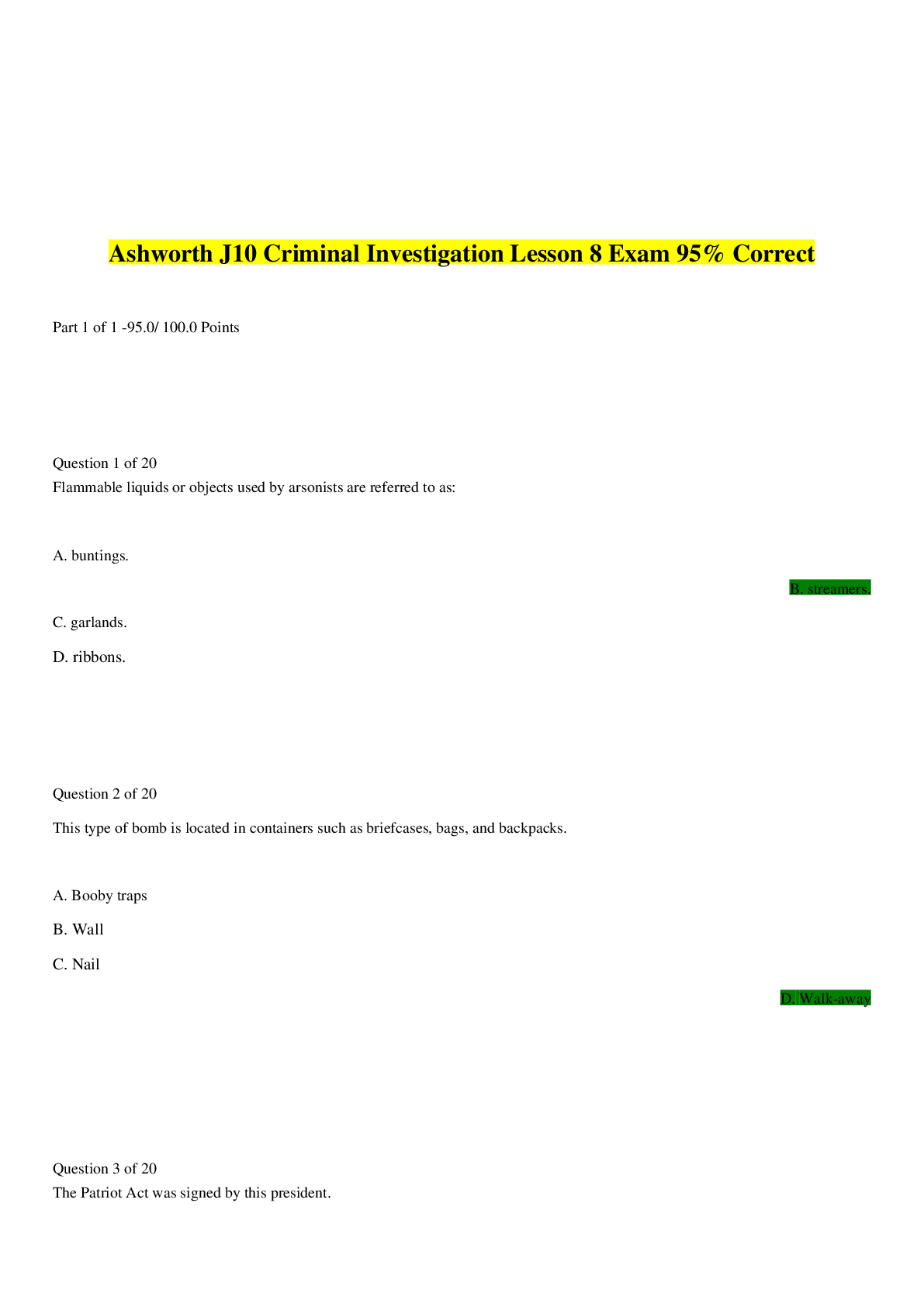
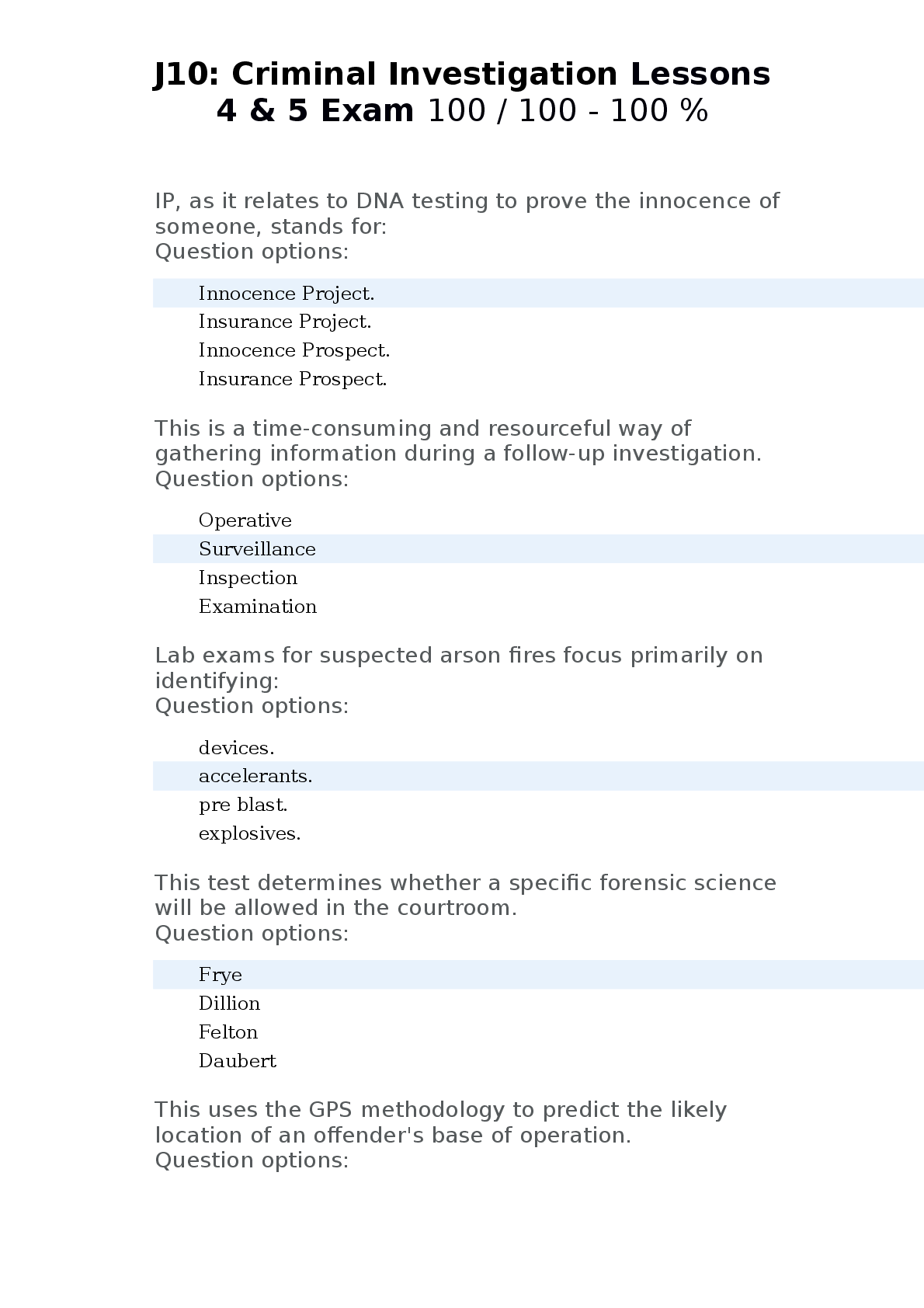
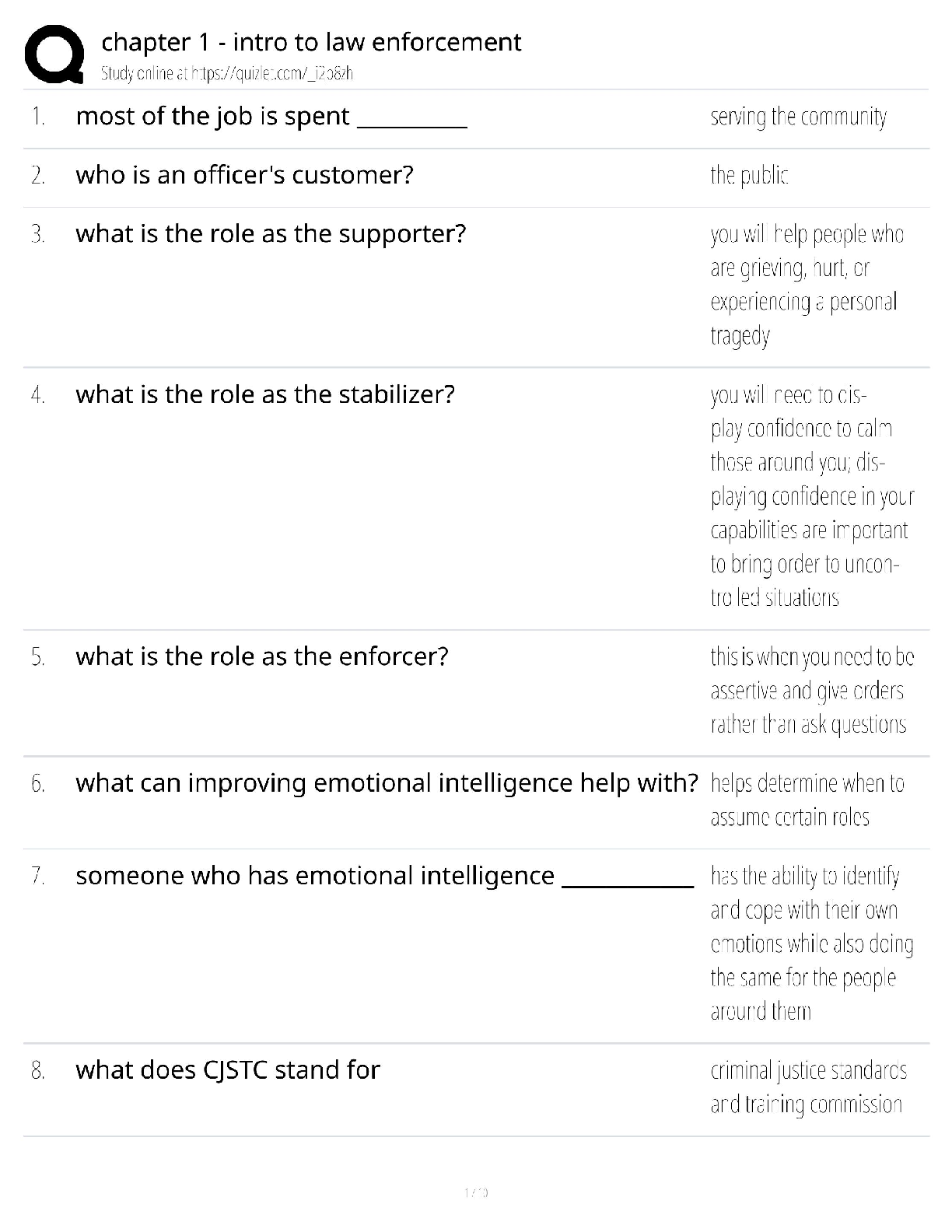
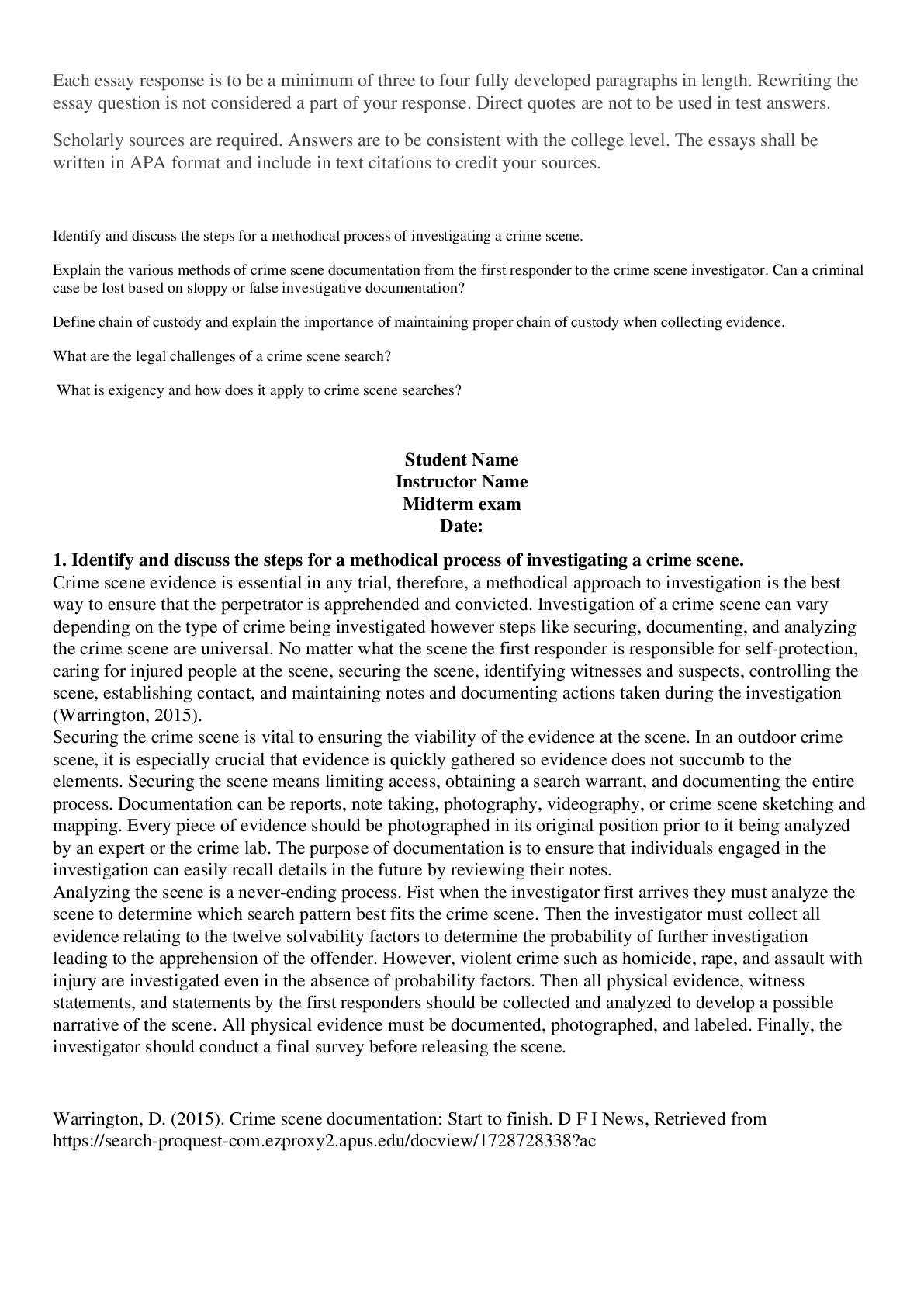
Ashworth J10 Criminal Investigation Lesson 2 Exam
Quiz Submissions - \[02\] Lesson 2 Exam
Question 1 5 / 5 points
Crime scene photography is also known as
...
Ashworth J10 Criminal Investigation Lesson 2 Exam
Quiz Submissions - \[02\] Lesson 2 Exam
Question 1 5 / 5 points
Crime scene photography is also known as: Question options:
methodological photography. scientific photography.
technical photography.
Question 2
The acronym C.I.A. stands for crime, identification, and: Question options:
acquisition.
5 / 5 points
Question 3
adaptation. acquiring.
5 / 5 points
The second stage in the investigative process is: Question options:
case preparation/prosecution. follow-up investigation.
Question 4
crime detection.
5 / 5 points
Statements are considered this type of evidence. Question options:
Documentary evidence. Tangible evidence.
Question 5
Physical evidence.
5 / 5 points
Blood, fingerprints, soil, and firearms are examples of: Question options:
tangible evidence.
documentary evidence.
Question 6
testimonial evidence.
5 / 5 points
The most important aspect for the responding officer is the preservation of: Question options:
Question 7
life.
criminal activity. response time.
0 / 5 points
A bullet involved in a crime scene is normally tested in a(n): Question options:
indoor shooting simulator.
Question 8
outdoor shooting range. recovery tank.
5 / 5 points
Of greatest value to investigators, unique impressions are called: Question options:
Question 9
brushing ridges. rasping ridges. resistance ridges.
5 / 5 points
This type of evidence is easily perishable or destroyed: Question options:
temporary evidence.
Question 10
soluble evidence. ephemeral evidence.
5 / 5 points
A whorl is recognized by:
Question options:
a series of straight lines leading to a circular center.
well-defined center or core formed by friction ridges of tightly wound loops.
Question 11
friction ridges that resemble rolling hills, without defining the center.
5 / 5 points
A written record that documents the handling of any physical evidence is called:
Question options:
chain of evidence.
Question 12
chain of command. chain of record.
5 / 5 points
The location in which investigators can store equipment or gather to avoid disrupting evidence is considered the:
Question options:
safe area.
confined area.
contaminated area.
Question
13
5 / 5 points
Blood that is projected from wounds where bullets exit the body produce this type of spatter.
Question options:
Backward
Question 14
Horizontal Vertical
5 / 5 points
The inner area of a crime scene is also known as the: Question options:
marginal.
Question 15
fringe. bordering.
5 / 5 points
This type of evidence includes objects that are undetectable with the unaided eye.
Question options:
Question 16
Biological evidence Impression evidence Tangible evidence
0 / 5 points
When investigators arrive at a crime scene, their first step should be to: Question options:
contact their supervisor.
Question 17
contaminate the crime scene. look at the evidence.
5 / 5 points
An arch is recognized by:
Question options:
a series of round friction ridges, graduating from small to large.
Question 18
well-defined center or core formed by friction ridges of tightly wound loops. a series of straight lines leading to a circular center.
5 / 5 points
Maps, notes, and sketches are example of this type of evidence. Question options:
Tangible evidence. Physical evidence.
Question 19
Testimonial evidence.
5 / 5 points
Two separate investigative roles can take place. One is the principal investigator, and the other is the:
Question options:
Question 20
second investigator. assigned investigator. backup investigator.
5 / 5 points
Patterns of blood stains are known as: Question options:
splashes. spray.
splotches.
90 / 100 - 90 %
90 / 100 - 90
Bottom of Form
Attempt Score: Overall Grade (highest attempt):
[Show More]