1. The objective of an audit of financial statements is
a. To assist an entity in the preparation of financial statements.
b. To express an opinion whether the financial statements are prepared, in all
material respe
...
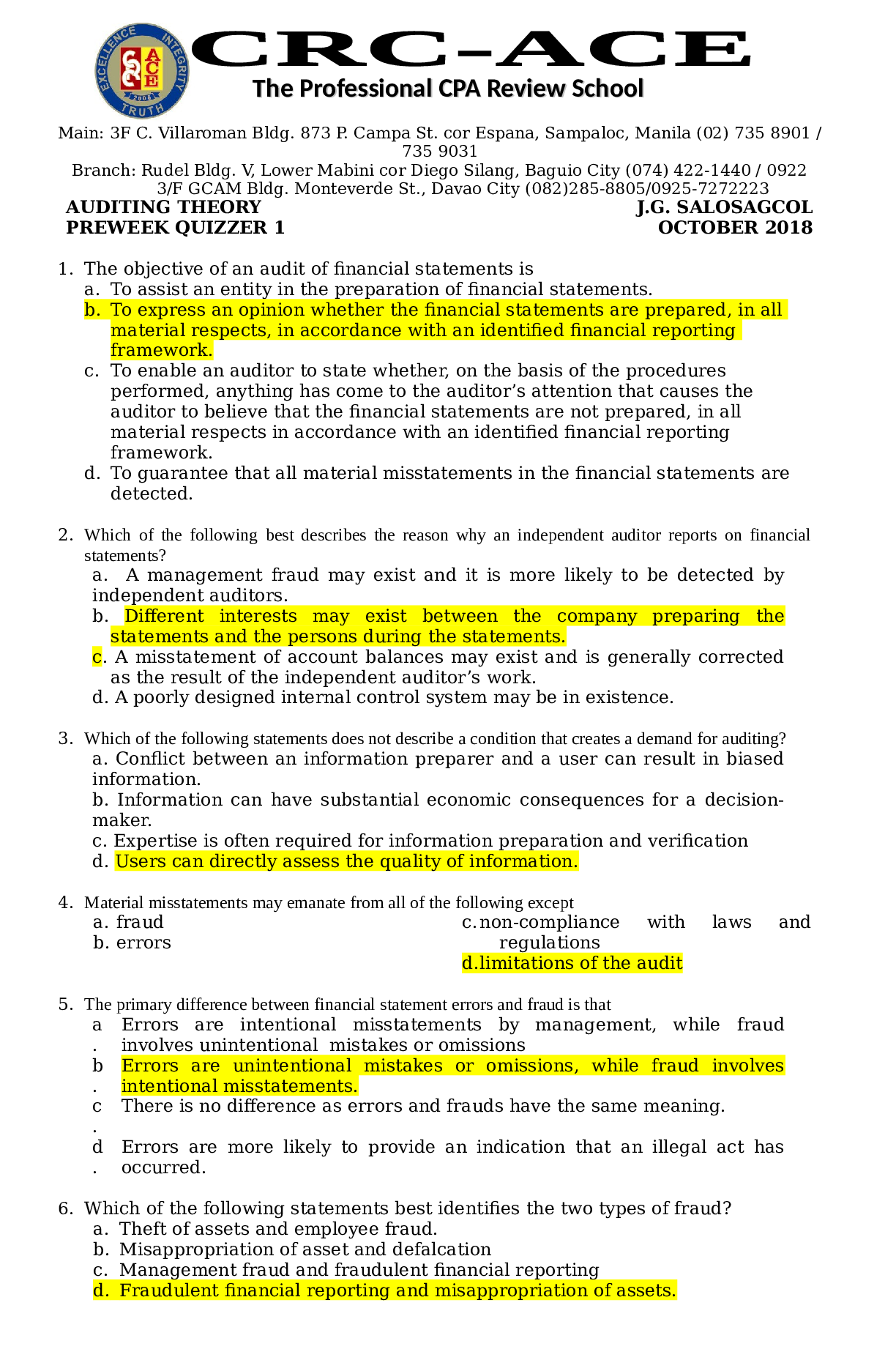
1. The objective of an audit of financial statements is
a. To assist an entity in the preparation of financial statements.
b. To express an opinion whether the financial statements are prepared, in all
material respects, in accordance with an identified financial reporting
framework.
c. To enable an auditor to state whether, on the basis of the procedures
performed, anything has come to the auditor’s attention that causes the
auditor to believe that the financial statements are not prepared, in all
material respects in accordance with an identified financial reporting
framework.
d. To guarantee that all material misstatements in the financial statements are
detected.
2. Which of the following best describes the reason why an independent auditor reports on financial
statements?
a. A management fraud may exist and it is more likely to be detected by
independent auditors.
b. Different interests may exist between the company preparing the
statements and the persons during the statements.
c. A misstatement of account balances may exist and is generally corrected
as the result of the independent auditor’s work.
d. A poorly designed internal control system may be in existence.
3. Which of the following statements does not describe a condition that creates a demand for auditing?
a. Conflict between an information preparer and a user can result in biased
information.
b. Information can have substantial economic consequences for a decision�maker.
c. Expertise is often required for information preparation and verification
d. Users can directly assess the quality of information.
4. Material misstatements may emanate from all of the following except
a. fraud
b. errors
c.non-compliance with laws and
regulations
d.limitations of the audit
5. The primary difference between financial statement errors and fraud is that
a
.
Errors are intentional misstatements by management, while fraud
involves unintentional mistakes or omissions
b
.
Errors are unintentional mistakes or omissions, while fraud involves
intentional misstatements.
c
.
There is no difference as errors and frauds have the same meaning.
d
.
Errors are more likely to provide an indication that an illegal act has
occurred.
6. Which of the following statements best identifies the two types of fraud?
a. Theft of assets and employee fraud.
b. Misappropriation of asset and defalcation
c. Management fraud and fraudulent financial reporting
d. Fraudulent financial reporting and misappropriation of assets.
[Show More]