NR 565 NR565 WEEK 2 Midterm review Completed A++++
WEEK 2 Midterm review
Know how to treat
o Different types of Tinea
Tinea pedis.
Tinea pedis, the most common fungal infection, generally responds well to
topical t
...
NR 565 NR565 WEEK 2 Midterm review Completed A++++
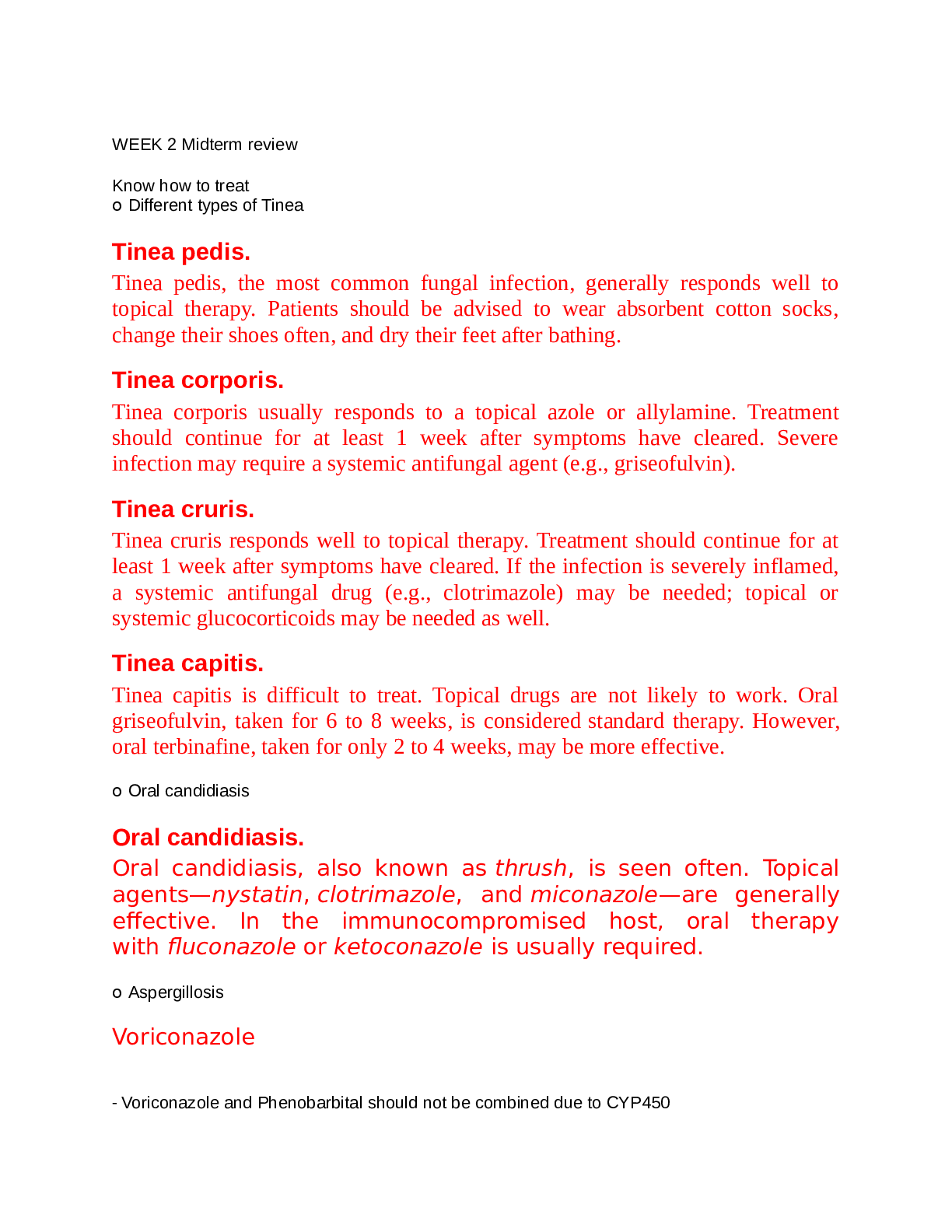
WEEK 2 Midterm review
Know how to treat
o Different types of Tinea
Tinea pedis.
Tinea pedis, the most common fungal infection, generally responds well to
topical therapy. Patients should be advised to wear absorbent cotton socks,
change their shoes often, and dry their feet after bathing.
Tinea corporis.
Tinea corporis usually responds to a topical azole or allylamine. Treatment
should continue for at least 1 week after symptoms have cleared. Severe
infection may require a systemic antifungal agent (e.g., griseofulvin).
Tinea cruris.
Tinea cruris responds well to topical therapy. Treatment should continue for at
least 1 week after symptoms have cleared. If the infection is severely inflamed,
a systemic antifungal drug (e.g., clotrimazole) may be needed; topical or
systemic glucocorticoids may be needed as well.
Tinea capitis.
Tinea capitis is difficult to treat. Topical drugs are not likely to work. Oral
griseofulvin, taken for 6 to 8 weeks, is considered standard therapy. However,
oral terbinafine, taken for only 2 to 4 weeks, may be more effective.
o Oral candidiasis
Oral candidiasis.
Oral candidiasis, also known as thrush, is seen often. Topical
agents—nystatin, clotrimazole, and miconazole—are generally
effective. In the immunocompromised host, oral therapy
with fluconazole or ketoconazole is usually required.
o Aspergillosis
Voriconazole
- Voriconazole and Phenobarbital should not be combined due to CYP450O Phenobarbital is a CYP450 inhibitors which can reduce the levels of drugs like
voriconazole.
- Adverse reactions/Patient Teaching
o Itraconazole
Adverse effects.
Itraconazole is well tolerated in usual doses. Gastrointestinal reactions (nausea,
vomiting, diarrhea) are most common. Other reactions include rash, headache,
abdominal pain, and edema. Itraconazole may also cause two potentially serious
effects: cardiac suppression and liver injury.
Cardiac suppression.
Itraconazole has negative inotropic actions that can cause a
transient decrease in ventricular ejection fraction. Cardiac
function returns to normal by 12 hours after dosing. The drug
may still be used to treat serious fungal infections in patients
with heart failure but only with careful monitoring and only if
the benefts clearly outweigh the risks. If signs and symptoms
of heart failure worsen, itraconazole should be stopped.
Black Box Warning
Negative Inotropic Actions With Itraconazole
Because of its negative inotropic actions, itraconazole should
not be used for superfcial fungal infections (dermatomycoses,
onychomycosis) in patients with heart failure, a history of heart
failure, or other indications of ventricular dysfunction.
Summary of Key Prescribing
Considerations
Azoles
Therapeutic Goal: Treatment of systemic and
superfcial mycoses.
Baseline Data: Baseline tests of liver function.Monitoring: No recommended monitoring.
Identifying High-Risk Patients: Use with great caution
in patient with liver disease.
Evaluating Therapeutic Effects: Monitor for
indications of antifungal effects—reduction in fever, pain,
or inflammation.
Minimizing Adverse Effects: Instruct patients to report
signs of liver dysfunction. Avoid use with drugs
metabolized by CYP3A4 (warfarin, cyclosporine, digoxin,
quinidine).
o Nucleotide Reverse Transcriptase Inhibitors (NRTIs)
Adverse Effects
The NRTIs share a core of adverse effects associated with mitochondrial
toxicity. Recall that mitochondria are cellular organelles that take in nutrients
and convert them into adenosine triphosphate (ATP) for energy. NRTIs can
disrupt synthesis of mitochondrial DNA and can thereby impair mitochondrial
function.
Lactic acidosis.
A major consequence of mitochondrial impairment is lactic acidosis. Lactic acid
accumulates because dysfunctional mitochondria cannot break down lactic acid.
Symptoms include nausea, malaise, fatigue, anorexia, and hyperventilation
(blowing off carbon dioxide can reduce acidosis). Left untreated, the syndrome
can be fatal. Diagnosis is based on lactic acid measurement in arterial blood.
The United States Food and Drug Administration (FDA) requires all NRTIs to
carry black box warnings about this possibility, even though it is rare for most.
Those for which this is most likely to occur are didanosine and stavudine.
Hepatic steatosis.
Hepatic steatosis (fatty degeneration of the liver) and hepatomegaly are also
adverse effects of NRTIs. This is also associated with mitochondrial impairment
because there is decreased breakdown of fatty acids by mitochondria leading to
fatty deposits in the liver.
Other adverse effects.NRTIs may also cause pancreatitis and myopathies, which are likely tied to
lactic acidosis. Adverse effects of individual NRTIs are discussed separately.
▪ Example drugs of NRTIs
At this time, seven NRTIs are available: abacavir [Ziagen],
didanosine [Videx], emtricitabine [Emtriva], lamivudine [Epivir],
stavudine [Zerit], tenofovir [Viread], and zidovudine [Retrovir].
They are commonly identifed by assigned abbreviations:
abacavir (ABC), didanosine (ddI), emtricitabine (FTC),
lamivudine (3TC), stavudine (d4T), tenofovir (TDF), and
zidovudine (ZDV).
- Diagnostics & Monitoring for anthelmintics
Summary of Key Prescribing
Considerations
Anthelmintic Drugsa
Therapeutic Goal: To eradicate parasitic worm
infestation
Baseline Data: Confrmation of infestation. Pregnancy
test. Drugs requiring additional baseline data are
albendazole (liver function and complete blood count
[CBC] with differential); mebendazole (liver function, CBC
with differential, and renal function); praziquantel (liver
function); and ivermectin and moxidectin
(ophthalmologic exam for evidence of eye infestation).
Monitoring: Drugs requiring monitoring (other than
confrmation of a cure, if needed) are: albendazole (liver
function and CBC with differential); mebendazole (liver
function, CBC with differential, and renal function);
praziquantel (liver function); and ivermectin andmoxidectin (ophthalmologic exam if abnormal at
baseline).
Identifying High-Risk Patients:
o• Albendazole – Because bone marrow
suppression, impaired liver function, and possibly
renal function may occur, patients with liver or
kidney disease, anemia, bleeding disorders, and
infections are at increased risk.
o• Mebendazole – Because bone marrow
suppression and liver impairment may occur,
patients with liver disease, anemia, bleeding
disorders, and infections are at increased risk.
o• Pyrantel pamoate – Patients with liver
impairment are at a higher risk for adverse
effects. Neonates should not be prescribed
formulations containing benzyl alcohol or its
derivatives.
o• Praziquantel – Patients with cardiac disease,
liver impairment, or seizure disorders are at
increased risk for complications.
o• Ivermectin and Moxidectin – Patients with
hypotension or taking antihypertensive drugs
may be at risk for increased hypotension and
falls.
Evaluating Therapeutic Effects: Follow-up testing
confrms cure.
Minimizing Adverse Effects: For most of these drugs,
adverse reactions do not require special treatment.
Mazzoti reactions can be treated with antihistamines and
NSAIDs. Rarely, glucocorticoids are needed. Ensuring
adequate hydration is important.
- Identifying High-Risk Patients with the following drugs
o Albendazole:
Albendazole
o Target Organismso Albendazole (Albenza) is active against many cestode
and nematode parasites, including larval forms
of Taenia solium and Echinococcus granulosus. In the
United States, the drug is approved only for (1)
parenchymal neurocysticercosis caused by larval
forms of the pork tapeworm, T. solium; and (2) cystic
hydatid disease of the liver, lung, and peritoneum
caused by larval forms of the dog tapeworm, E.
granulosus. However, despite lack of FDA
approval, albendazole is considered a drug of choice
for infestation with hookworms, pinworms,
whipworms, Chinese liver flukes, giant roundworms,
and pork roundworms, the cause of trichinosis.
o Mechanism of Action
o Albendazole inhibits polymerization of tubulin and hence prevents
the formation of cytoplasmic microtubules. As a result,
microtubule-dependent uptake of glucose is prevented.
o Adverse Effects
o Albendazole is generally well tolerated. Mild to moderate liver
impairment has occurred in 16% of patients, as indicated by
elevation of liver transaminases in plasma. Liver function should be
assessed before each cycle of treatment and 14 days later.
o Albendazole suppresses bone marrow function and can, hence,
cause granulocytopenia, agranulocytosis, and even pancytopenia.
Liver impairment may increase risk. Blood cell counts should be
obtained before each cycle of treatment and 14 days later. In postmarketing studies, some patients developed renal failure. This
occurred rarely and the association with albendazole has not been
established.
o Albendazole is teratogenic in animals and hence should not be used
during pregnancy. If pregnancy occurs, the drug should be
discontinued immediately.
o Mebendazole:Mebendazole
Target Organisms
Mebendazole (Emverm and Vermox) is a drug of choice for most intestinal
roundworms. This agent clears infestation with pinworms, hookworms, and
giant roundworms. Because of its relatively broad spectrum of action,
mebendazole is especially useful for treatment of mixed infestations.
Mechanism of Action
Mebendazole prevents uptake of glucose by susceptible intestinal worms.
Glucose deprivation results in immobilization followed by slow death. Because
the worms die slowly, up to 3 days may elapse between treatment onset and
complete clearance of parasites. Mebendazole does not influence glucose uptake
or utilization by humans.
Adverse Effects
Systemic effects are rare at usual doses, perhaps because the
drug is so poorly absorbed. The most concerning are bone
marrow suppression and liver impairment; however, these are
typically only a problem with high doses or prolonged
treatment. In patients with massive parasitic infestations,
transient abdominal pain and diarrhea may occur.
o Pyrantel pamoate:
Pyrantel Pamoate
Target Organisms
Pyrantel pamoate (Reese's Pinworm Medicine, Combantrin ) is active against
intestinal nematodes. The drug is an alternative to mebendazole or albendazole
for infestations with hookworms or pinworms.
Mechanism of Action
Pyrantel is a depolarizing neuromuscular blocking agent that causes spastic
paralysis of intestinal parasites. The paralyzed worms are cleared in the feces.Adverse Effects
Neonates given formulations with benzyl alcohol or its derivatives had
developed a potentially fatal “gasping syndrome” with complications that
include respiratory distress, cardiovascular collapse, seizures, and metabolic
acidosis. Otherwise, serious reactions are rare. The most common effects are GI
reactions (nausea, vomiting, diarrhea, stomach pain, and cramps). Possible
central nervous system effects include dizziness, drowsiness, headache, and
insomnia.
[Show More]