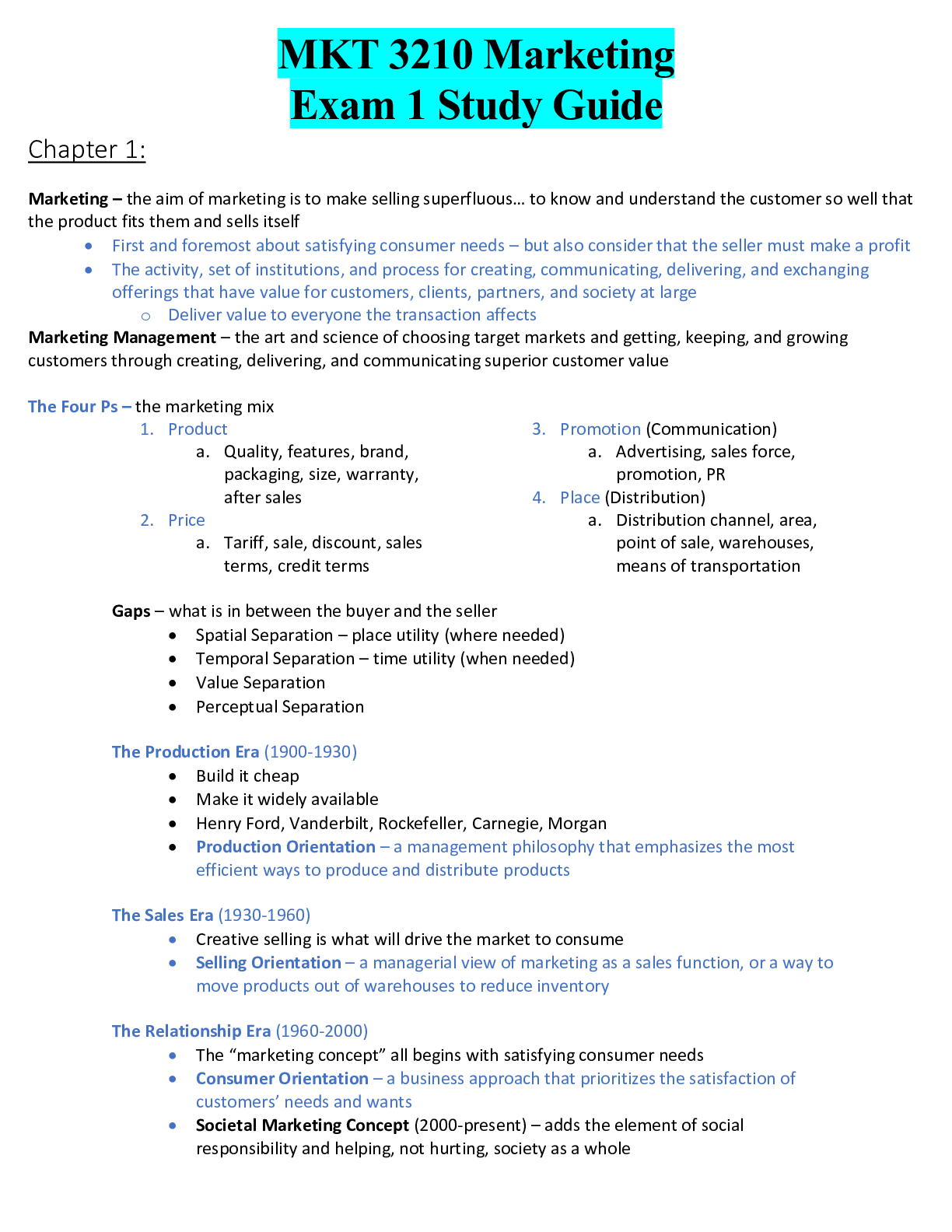
MKT 3210 Marketing
Exam 1 Study Guide
Chapter 1:
Marketing – the aim of marketing is to make selling superfluous… to know and understand the customer so well that
the product fits them and sells itself
First and f
...
MKT 3210 Marketing
Exam 1 Study Guide
Chapter 1:
Marketing – the aim of marketing is to make selling superfluous… to know and understand the customer so well that
the product fits them and sells itself
First and foremost about satisfying consumer needs – but also consider that the seller must make a profit
The activity, set of institutions, and process for creating, communicating, delivering, and exchanging
offerings that have value for customers, clients, partners, and society at large
o Deliver value to everyone the transaction affects
Marketing Management – the art and science of choosing target markets and getting, keeping, and growing
customers through creating, delivering, and communicating superior customer value
The Four Ps – the marketing mix
1. Product
a. Quality, features, brand,
packaging, size, warranty,
after sales
2. Price
a. Tariff, sale, discount, sales
terms, credit terms
3. Promotion (Communication)
a. Advertising, sales force,
promotion, PR
4. Place (Distribution)
a. Distribution channel, area,
point of sale, warehouses,
means of transportation
Gaps – what is in between the buyer and the seller
Spatial Separation – place utility (where needed)
Temporal Separation – time utility (when needed)
Value Separation
Perceptual Separation
The Production Era (1900-1930)
Build it cheap
Make it widely available
Henry Ford, Vanderbilt, Rockefeller, Carnegie, Morgan
Production Orientation – a management philosophy that emphasizes the most
efficient ways to produce and distribute products
The Sales Era (1930-1960)
Creative selling is what will drive the market to consume
Selling Orientation – a managerial view of marketing as a sales function, or a way to
move products out of warehouses to reduce inventory
The Relationship Era (1960-2000)
The “marketing concept” all begins with satisfying consumer needs
Consumer Orientation – a business approach that prioritizes the satisfaction of
customers’ needs and wants
Societal Marketing Concept (2000-present) – adds the element of social
responsibility and helping, not hurting, society as a wholeTriple Bottom Line Orientation
A business orientation that looks at financial profits, the community in
which the organization operates, and creating sustainable business
practices
Still emerging; the newer way of looking at business by combining
performance across the three dimensions (financial, social,
environmental)
Industry – a collection of sellers
Market – a collection of buyers/consumers
Challenges and Opportunities of Marketing Today:
Power shift to consumers
Increase in product selection
Changing value propositions
Shifting demand patterns
Privacy, security, and ethical
concerns
Chapter 2:
Environmental Scanning
Technology (1920s)
Demographic (1950s)
Social-Cultural (1980s)
Competitive (1990s)
Global (2000s)
Marketing organizations are “open systems” – the one prevailing constant is CHANGE
Ignoring change leads to failure
Control what you can – always understand what is happening
Seeking information that helps:
Better understand current customers
Understand how consumer decisions are made
Understand the most valuable customers and understand their needs
Understand the competition
Analyze the macroenvironment
Fads – unpredictable, short-lived, without significance
Trends – direction, sequence of events with momentum
o Megatrends
Aging Boobers
Delayed retirement
Changing nature of
work
Greater educational
attainment
Labor shortages
Increased
immigration
Rising Hispanic
influence
Shifting birth trends
Environmental Sectors – helps divide and organizeo Demographic (1)
Population characteristics
Age
Education
Ethnicity
Household
structure
Geographical
residence
Combinations
o Economic (2)
Markets require people and money
Tracking income, debit/credit, interest rates, savings,
outsourcing, etc.
Recognition of economic “cycles”
Prosperity
Recession
Recovery
o Social-culture (3)
Impact of societal views and norms on consumer tastes and preferences
How do we as consumers view:
Ourselves
Others
Organizations
Society
Nature
The universe
American Values
Self-sufficiency
Upward mobility
Work ethic
Equality
Individualism
Achievement
orientation
o Natural (4)
The newest addition to the sectors
How are we running out of ingredients?
Cost and sources of energy
Concerns over pollution
o Technological (5)
“innovation:
Technology is simply a learned way of doing something
More than just “high tech”
Marketing Manager’s Role”
Monitor technological changes and utilize to improve the firm’s
offerings
o Doesn’t have to be within the industry
Persuade consumers that improvements make for a better
product
o Political-legal (6)
Laws, government agencies, and pressure groups Purpose:
Ensure competition
Protect consumers
Preserve business property
Trends
Decrease in business legislation
Increase in special-interest groups
o Competitive (7)
Was hottest are of the 90s – still very active
Reduction in trade barriers
Decreased population but growth in online retailers
“generic competition”
Chapter 3:
Business Planning – An ongoing process of making decisions that guides the firm both in the
short and long terms
Simply going through the planning process better prepares an organization for
decision making even though the plan itself may change over time
o Encourages management to think ahead systematically
o Improves (forces) interaction between company managers
o Helps organization sharper its objectives and policies
o Provides for better coordination between functional areas
o Provides clearer performance standards for controls
Three levels of planning:
1. Strategic Planning – the managerial decision process that matches the firm’s resources
and capabilities to its market opportunities for long-term growth
2. Functional Planning – a decision process that concentrates on developing detailed plans
for strategies and tactics for the short term, supporting an organization’s long-term
strategic plan
3. Operation Planning – a decision process that focuses on developing detailed plans for
the day-to-day activities that carry out an organization’s functional plans
Strategic Marketing Management – answers three main questions:
1. Who are we?
2. Where are we going?
3. How do I get there from here?
Two major components of the process:
o Planning
o Execution
The Marketing Plan:1. The Situation Analysis
a. Internal Constraints
i. Objectives of the
organization
ii. Financial resources
iii. Strengths and
weaknesses
iv. Cost structure of the
industry
b. External Constraints
i. Political-Legal
ii. Economic
iii. Social/Demographic
iv. Technological
v. Natural
vi. Geographical
2. Problems and Opportunities
3. Strategy and Tactics
a. What is our business definition?
i. Should be:
1. Broad enough so that new market opportunities are not missed
2. Narrow enough that one doesn’t over extend the organization
beyond its capabilities
3. Focused on a market need, NOT a product
b. Where are we going?
i. Good objectives should be:
1. Specific – state exactly what is to be accomplished
2. Measurable – designate a quantitative level of achievement
3. Time-based – place a limit on when the specified level is to be
achieved
c. Objectives
i. Organizations typically distinguish between:
1. Financial Objectives
2. Marketing Objectives
d. A strategy is what will be done (long-term)
e. A tactic defines how it will be done (short-term) Product-Market Growth Matrix
Boston Consulting Group Portfolio Matrix
4. Implement and Control the Market Plan
a. Outlines the plans for monitoring and adjusting implementation of the plan
[Show More]