NR 565 NR565 Week 7 Exam review Completed A+++
Week 7 review
Management of Bipolar Disorder (BPD)
o Drugs from other classes that can be used to treat BPD
BPD is treated with three major groups of drugs: mood sta
...
NR 565 NR565 Week 7 Exam review Completed A+++
Week 7 review
Management of Bipolar Disorder (BPD)
o Drugs from other classes that can be used to treat BPD
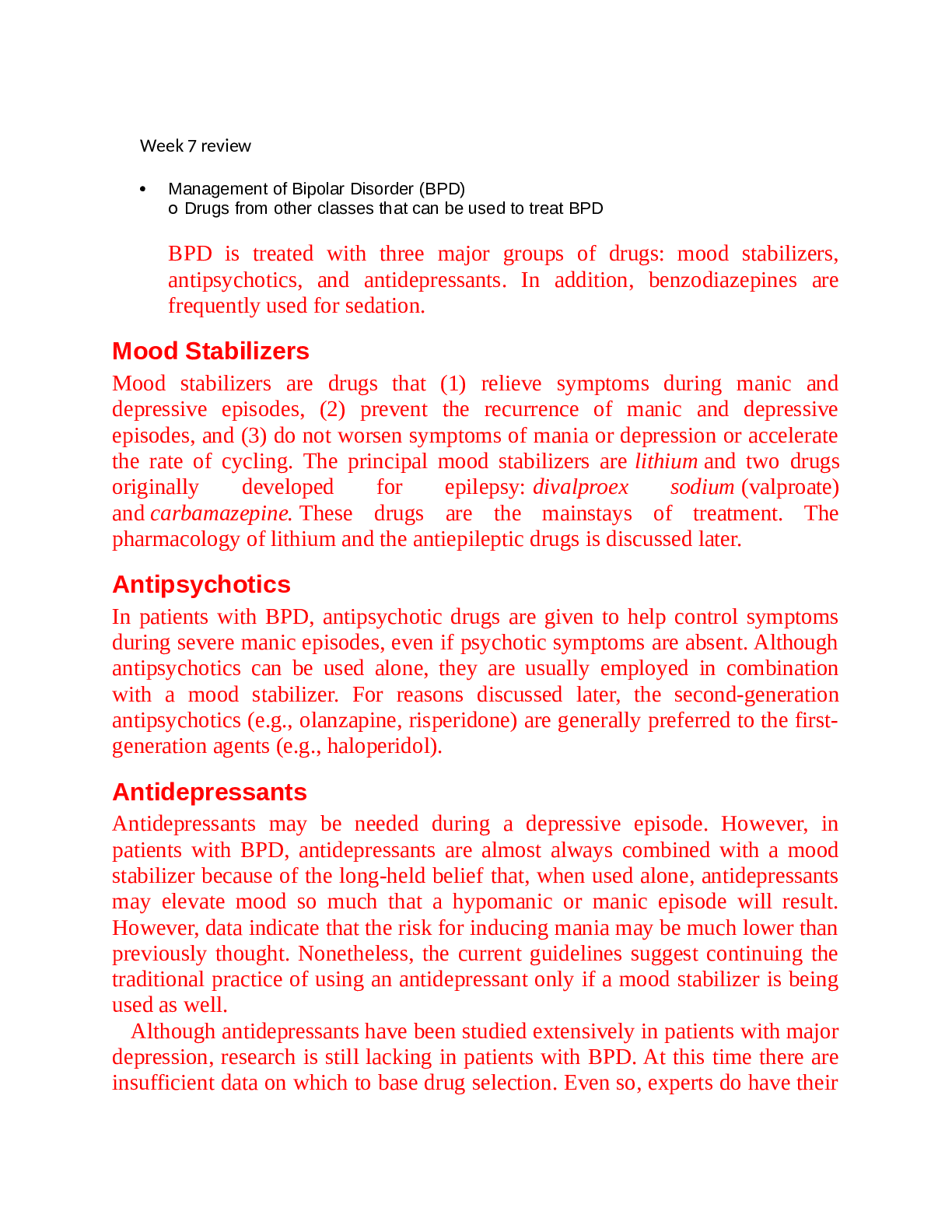
BPD is treated with three major groups of drugs: mood stabilizers,
antipsychotics, and antidepressants. In addition, benzodiazepines are
frequently used for sedation.
Mood Stabilizers
Mood stabilizers are drugs that (1) relieve symptoms during manic and
depressive episodes, (2) prevent the recurrence of manic and depressive
episodes, and (3) do not worsen symptoms of mania or depression or accelerate
the rate of cycling. The principal mood stabilizers are lithium and two drugs
originally developed for epilepsy: divalproex sodium (valproate)
and carbamazepine. These drugs are the mainstays of treatment. The
pharmacology of lithium and the antiepileptic drugs is discussed later.
Antipsychotics
In patients with BPD, antipsychotic drugs are given to help control symptoms
during severe manic episodes, even if psychotic symptoms are absent. Although
antipsychotics can be used alone, they are usually employed in combination
with a mood stabilizer. For reasons discussed later, the second-generation
antipsychotics (e.g., olanzapine, risperidone) are generally preferred to the firstgeneration agents (e.g., haloperidol).
Antidepressants
Antidepressants may be needed during a depressive episode. However, in
patients with BPD, antidepressants are almost always combined with a mood
stabilizer because of the long-held belief that, when used alone, antidepressants
may elevate mood so much that a hypomanic or manic episode will result.
However, data indicate that the risk for inducing mania may be much lower than
previously thought. Nonetheless, the current guidelines suggest continuing the
traditional practice of using an antidepressant only if a mood stabilizer is being
used as well.
Although antidepressants have been studied extensively in patients with major
depression, research is still lacking in patients with BPD. At this time there are
insufficient data on which to base drug selection. Even so, experts do have theirpreferences. Among clinicians with extensive experience in BPD, the following
are considered antidepressants of
choice: bupropion (Wellbutrin), venlafaxine (Effexor XR), and the selective
serotonin reuptake inhibitors (SSRIs) such as fluoxetine (Prozac) and sertraline
(Zoloft). One thing we do know is that the use of tricyclic antidepressants
(TCAs) appears to promote more incidents of mania; therefore TCAs are not
recommended in the treatment of BPD.
o Drug Interactions
▪ Lithium
Drug Interactions
Diuretics.
Diuretics promote sodium loss and can thereby increase the
risk for lithium toxicity. Toxicity can occur because renal
excretion of lithium is reduced in the presence of low sodium,
causing lithium levels to rise.
Nonsteroidal antiinflammatory drugs.
Nonsteroidal antiinflammatory drugs (NSAIDs) can increase lithium levels by
as much as 60%. By suppressing prostaglandin synthesis in the kidney, NSAIDs
can increase renal reabsorption of lithium (and also sodium), causing lithium
levels to rise. NSAIDs known to increase lithium levels include ibuprofen
(Motrin, others), naproxen (Naprosyn), piroxicam (Feldene), indomethacin
(Indocin), and celecoxib (Celebrex). Interestingly, aspirin (the prototype
NSAID) and sulindac (Clinoril) do notincrease lithium levels. Accordingly, if a
mild analgesic is needed, aspirin or sulindac would be a good choice.
Anticholinergics
o Monitoring
▪ Lithium
Monitoring plasma lithium levels.
Measurement of plasma lithium levels is an essential
component of treatment. Lithium levels must be kept below1.5 mEq/L; levels greater than this can produce signifcant
toxicity. Lithum levels should range from 0.4 to 1 mEq/L.
Generally levels should be between 0.6 and 0.8 mEq/L. Levels of
0.8 to 1mEq/L may be more effective but carry a greater risk of
adverse effects. Blood for lithium determinations should be
drawn in the morning, 12 hours after the evening dose. During
maintenance therapy, lithium levels should be measured every
3 to 6 months.
- Management of Major Depressive Disorder
o Know example drugs
▪ SSRIs
Citalopram (Celexa)
Escitalopram (lexapro, cipralex)
Fluoxetine (Prozac, Sarafem)
Fluvoxamine (Luvox)
Paroxetine (Paxil, Pexeva)
Sertraline (Zoloft)
Vortioxetine (Trintellix)
o Adverse Effects
▪ Venlafaxine
Venlafaxine
Venlafaxine (Effexor XR), the first SNRI available, is approved for major
depression, generalized anxiety disorder, social anxiety disorder, and panic
disorder. The drug produces powerful blockade of NE and 5-HT reuptake and
weak blockade of dopamine reuptake. The relationship of these actions to
therapeutic effects is uncertain. Venlafaxine does not block cholinergic,
histaminergic, or α1-adrenergic receptors. Despite impressions that venlafaxine
may be superior to SSRIs, when compared directly in clinical trials, the drugs
were about equally effective—and SSRIs are probably safer.Venlafaxine is well absorbed after oral administration, in both the presence
and absence of food. In the liver, much of each dose is converted to
desvenlafaxine, an active metabolite. The half-life is 5 hours for the parent drug
and 11 hours for the active metabolite.
Venlafaxine can cause a variety of adverse effects. The most common is
nausea (37% to 58%), followed by headache, anorexia, nervousness, sweating,
somnolence, and insomnia. Dose-dependent weight loss may occur secondary to
anorexia. Venlafaxine can also cause dose-related sustained diastolic
hypertension; blood pressure should be monitored. Sexual dysfunction may
occur too. Some patients experience sustained mydriasis, which can increase the
risk for eye injury in those with elevated intraocular pressure or glaucoma. Like
the SSRIs, venlafaxine can cause hyponatremia, especially in older adult
patients taking diuretics. Like all other antidepressants, venlafaxine may
increase the risk for suicide, especially in children and young adults.
The combined use of venlafaxine with MAOIs and other serotonergic drugs
(see Table 27.3) increases the risk for serotonin syndrome, a potentially fatal
reaction. If the clinical situation demands, venlafaxine may be cautiously
combined with an SSRI or another SNRI. However, combined use with an
MAOI is contraindicated. Accordingly, MAOIs should be withdrawn at least 14
days before starting venlafaxine. When switching from venlafaxine to an
MAOI, venlafaxine should be discontinued 7 days before starting the MAOI.
As with the SSRIs, the use of venlafaxine late in pregnancy can result in a
neonatal withdrawal syndrome, characterized by irritability, abnormal crying,
tremor, respiratory distress, and possibly seizures. Symptoms, which can be
managed with supportive care, generally abate within a few days.
Abrupt discontinuation can cause an intense withdrawal syndrome. Symptoms
include anxiety, agitation, tremors, headache, vertigo, nausea, tachycardia, and
tinnitus. Worsening of pretreatment symptoms may also occur. Withdrawal
symptoms can be minimized by tapering the dosage over 2 to 4 weeks. Warn
patients not to stop venlafaxine abruptly.
▪ Monoamine Oxidase InhibitorsAdverse effects
Central nervous system stimulation.
MAOIs cause direct CNS stimulation (in addition to exerting antidepressant
effects). Excessive stimulation can produce anxiety, insomnia, agitation,
hypomania, and even mania.
Orthostatic hypotension.
Despite their ability to increase the NE content of peripheral sympathetic
neurons, the MAOIs reduce blood pressure when administered in usual
therapeutic doses. Patients should be informed about signs of hypotension
(dizziness, lightheadedness) and advised to sit or lie down if these occur. Also,
they should be informed that hypotension can be minimized by moving slowly
when assuming an erect posture.
MAOIs reduce blood pressure through actions in the CNS. The following
sequence has been proposed: (1) Inhibition of MAO increases the NE content of
neurons within the vasomotor center. (2) When NE is released, it binds to
postsynaptic α receptors on neurons within the vasomotor center, thereby
decreasing the firing rate of sympathetic nerves that control vascular tone. (3)
This reduction in sympathetic activity results in vasodilation, causing blood
pressure to fall.
Hypertensive crisis from dietary tyramine.
Although the MAOIs normally produce hypotension, they can be
the cause of severe hypertension if the patient eats food that is
rich in tyramine, a substance that promotes the release of NE
from sympathetic neurons. Hypertensive crisis is characterized
by severe headache, tachycardia, hypertension, nausea,
vomiting, confusion, and profuse sweating—possibly leading to
stroke and death.
Before considering the mechanism by which hypertensive
crisis is produced, let's consider the effect of dietary tyramine
under drug-free conditions. In the absence of MAO inhibition,
dietary tyramine is not a threat. Much of the tyramine in food is
metabolized by MAO in the intestinal wall. Furthermore, as
shown in Fig. 27.3A, any dietary tyramine that gets through the
intestinal wall intact will then pass directly to the liver through
the hepatic portal circulation. When in the liver, tyramine isimmediately inactivated by MAO there. Hence, as long as
intestinal and hepatic MAO is functioning, dietary tyramine is
prevented from reaching the general circulation and therefore
is devoid of adverse effects.
o Food & Drug Interactions
Monoamine Oxidase Inhibitors (MAOIs)
Foods That Can Interact With Monoamine Oxidase Inhibitors
Foods That Contain Tyramine
Category Foods With High Tyramine
Content
Foods With Little or No Tyramine
Vegetables Avocados, especially if overripe;
fermented bean curd; fermented
soybean; soybean paste
Most vegetables
Fruits Figs, especially if overripe;
bananas, in large amounts
Most fruits
Meats Meats that are fermented, smoked,
or otherwise aged; spoiled
meats; liver, unless very fresh
Meats that are known to be fresh
(exercise caution in restaurants;
meat may not be fresh)Sausages Fermented varieties: bologna,
pepperoni, salami, others
Nonfermented varieties
Fish Dried or cured fish; fish that is
fermented, smoked, or
otherwise aged; spoiled fish
Fish that is known to be fresh;
vacuum-packed fish, if eaten
promptly or refrigerated only
briefly after opening
Milk, milk
products
Practically all cheeses Milk, yogurt, cottage cheese, cream
cheese
Foods with
yeast
Yeast extract (e.g., Marmite,
Bovril)
Baked goods that contain yeast
Beer, wine Some imported beers, Chianti wine Major domestic brands of beer, most
wines
[Show More]