NR 565 NR565 WEEK 5 Endocrine Case study Exam Questions with Answers.
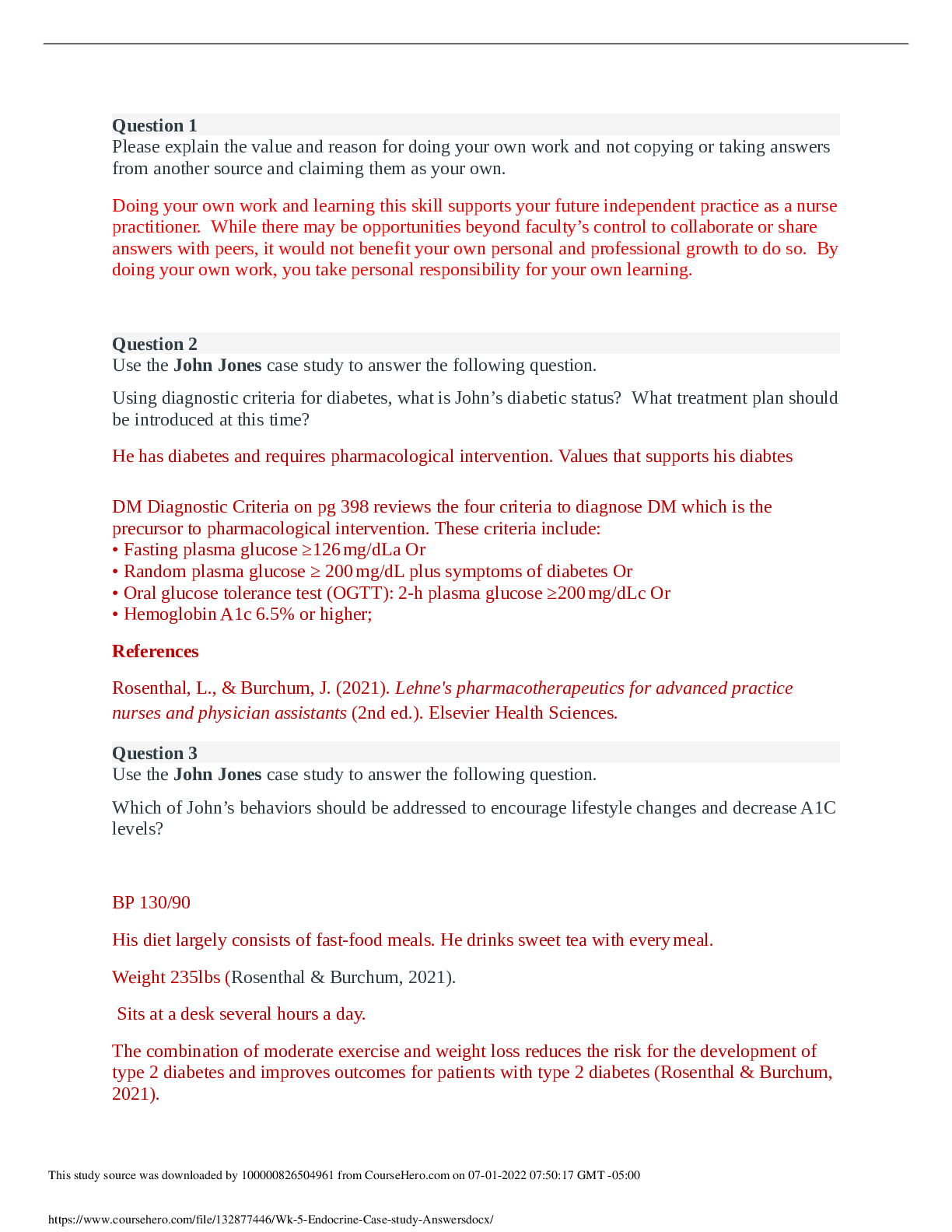
Question 1
Please explain the value and reason for doing your own work and not copying or taking answers
from another source and claiming them as y
...
NR 565 NR565 WEEK 5 Endocrine Case study Exam Questions with Answers.
Question 1
Please explain the value and reason for doing your own work and not copying or taking answers
from another source and claiming them as your own.
Doing your own work and learning this skill supports your future independent practice as a nurse
practitioner. While there may be opportunities beyond faculty’s control to collaborate or share
answers with peers, it would not benefit your own personal and professional growth to do so. By
doing your own work, you take personal responsibility for your own learning.
Question 2
Use the John Jones case study to answer the following question.
Using diagnostic criteria for diabetes, what is John’s diabetic status? What treatment plan should
be introduced at this time?
He has diabetes and requires pharmacological intervention. Values that supports his diabtes
DM Diagnostic Criteria on pg 398 reviews the four criteria to diagnose DM which is the
precursor to pharmacological intervention. These criteria include:
• Fasting plasma glucose ≥126 mg/dLa Or
• Random plasma glucose ≥ 200 mg/dL plus symptoms of diabetes Or
• Oral glucose tolerance test (OGTT): 2-h plasma glucose ≥200 mg/dLc Or
• Hemoglobin A1c 6.5% or higher;
References
Rosenthal, L., & Burchum, J. (2021). Lehne's pharmacotherapeutics for advanced practice
nurses and physician assistants (2nd ed.). Elsevier Health Sciences.
Question 3
Use the John Jones case study to answer the following question.
Which of John’s behaviors should be addressed to encourage lifestyle changes and decrease A1C
levels?
BP 130/90
His diet largely consists of fast-food meals. He drinks sweet tea with every meal.
Weight 235lbs (Rosenthal & Burchum, 2021).
Sits at a desk several hours a day.
The combination of moderate exercise and weight loss reduces the risk for the development of
type 2 diabetes and improves outcomes for patients with type 2 diabetes (Rosenthal & Burchum,
2021).
This study source was downloaded by 100000826504961 from CourseHero.com on 07-01-2022 07:50:17 GMT -05:00
https://www.coursehero.com/file/132877446/Wk-5-Endocrine-Case-study-Answersdocx/References
Rosenthal, L., & Burchum, J. (2021). Lehne's pharmacotherapeutics for advanced practice
nurses and physician assistants (2nd ed.). Elsevier Health Sciences.
Question 4
Use the John Jones case study to answer the following question.
Which behavior in John’s social history poses a potential concern with first line pharmacological
treatment for diabetes and why?
He reports drinking “a few beers on the weekend during football season”.
Metformin is contraindicated in alcoholics. Although it does not sound as if John is an alcoholic,
further questioning is needed, and the discussion should be documented. Metformin taken by
alcoholics increases the risk of lactic acidosis so John should be educated on this risk along with
signs and symptoms of lactic acidosis (Rosenthal & Burchum, 2021).
References
Rosenthal, L., & Burchum, J. (2021). Lehne's pharmacotherapeutics for advanced practice
nurses and physician assistants (2nd ed.). Elsevier Health Sciences.
Question 5
Use the John Jones case study to answer the following question.
Name the specific names of labs you would order and the intervals at which you would order
them to monitor the safety and efficacy of metformin.
Lab work related to both hepatic function, renal function, and blood sugar all need to be
monitored both before and during treatment.
Question 6
Use the Alfonso Giuliani case study to answer the following question.
Atherosclerotic cardiovascular disease (ASCVD) risk factors include age, gender, race, blood
pressure, cholesterol values, history of diabetes, tobacco use, treatment of hypertension, statin
therapy, and aspirin therapy.
Look at Alfonson’s ASCVD risk factors. Should Alfonso be taking something for
hyperlipidemia? If so, what would you recommend?
Arnett, D. K., Blumenthal, R. S., Albert, M. A., Buroker, A. B., Goldberger, Z. D., Hahn, E. J., ...
& Ziaeian, B. (2019). 2019 ACC/AHA guideline on the primary prevention of cardiovascular
disease: executive summary: a report of the American College of Cardiology/American Heart
Association Task Force on Clinical Practice Guidelines. Journal of the American College of
Cardiology, 74(10), 1376-
1414. https://www.ahajournals.org/doi/full/10.1161/CIR.0000000000000677 (Links to an
external site.)
This study source was downloaded by 100000826504961 from CourseHero.com on 07-01-2022 07:50:17 GMT -05:00
https://www.coursehero.com/file/132877446/Wk-5-Endocrine-Case-study-Answersdocx/Alfonso should be started on statin therapy, preferably, High-intensity statin
References
American Diabetes Association. (2020). Figure 9.1 [Graph]. Standards of Medical Care in
Diabetes—2020 Abridged for Primary Care
Question 7
Use the Alfonso Giuliani case study to answer the following question.
Which diabetic drug classes should be considered in addition to metformin to prescribe for
Alfonso and why?
GLP-1 and SGLT2i
According to the ADA Standards of Medical Care in Diabetes-2020, GLP-1 and SGLT2i drugs
are recommended in conjunction with metformin . secondly, in Alfonso, ASCVD risk
predominates and has a ASCVD risk score more than 40%.
References
American Diabetes Association. (2020). Figure 9.1 [Graph]. Standards of Medical Care in
Diabetes—2020 Abridged for Primary Care Providers.
[Show More]