Nursing MISC Hesi Fundamentals Exam Completed and Aced...2022/2023
1
Nursing MISC Hesi
Fundamentals Exam
Which drug does a nurse anticipate may be prescribed to produce diuresis and inhibit
formation of aqueous hu
...
Nursing MISC Hesi Fundamentals Exam Completed and Aced...2022/2023
1
Nursing MISC Hesi
Fundamentals Exam
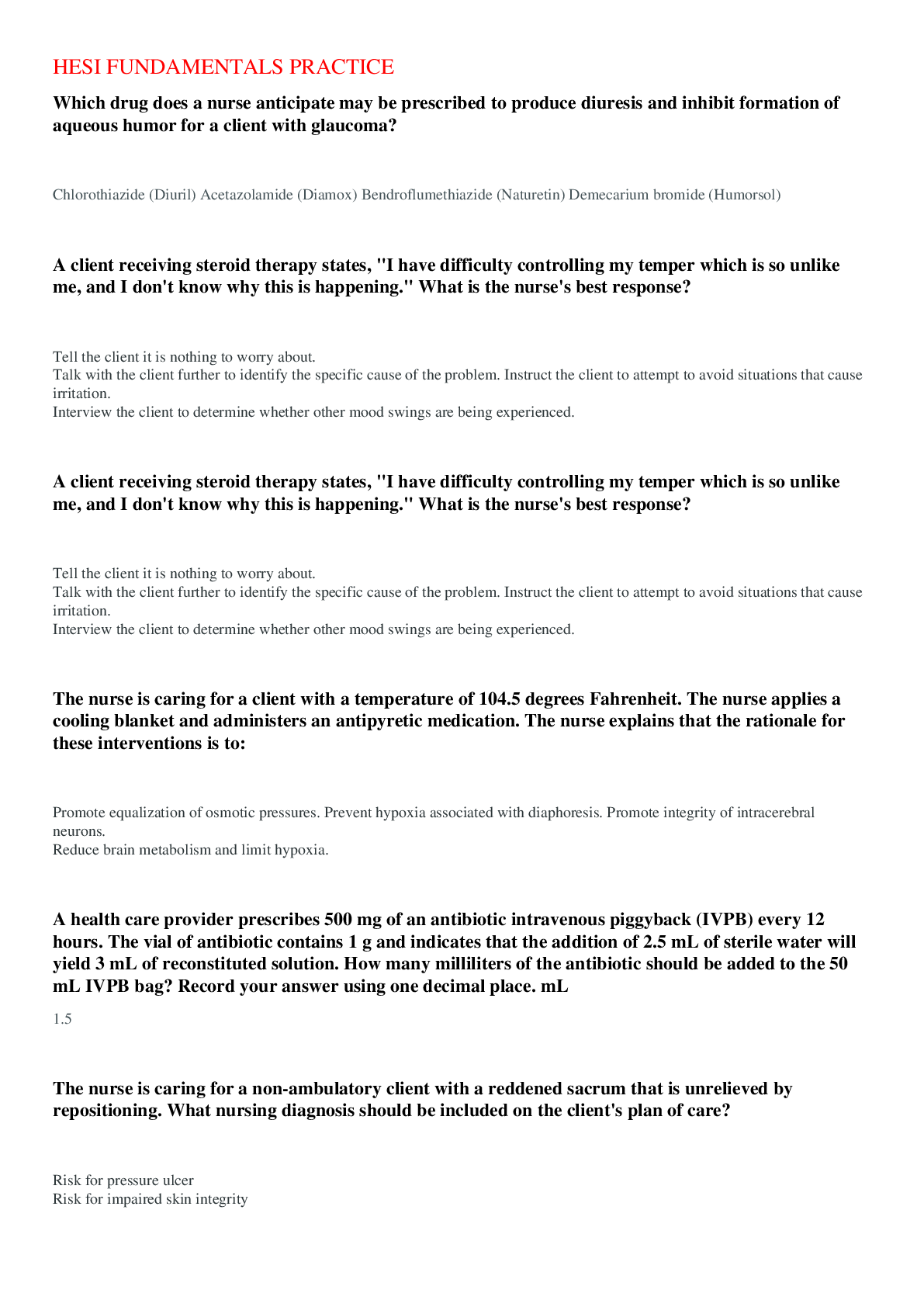
Which drug does a nurse anticipate may be prescribed to produce diuresis and inhibit
formation of aqueous humor for a client with glaucoma?
Chlorothiazide (Diuril)
Acetazolamide (Diamox)
Bendroflumethiazide (Naturetin)
Demecarium bromide (Humorsol)
A client receiving steroid therapy states, "I have difficulty controlling my temper which is so
unlike me, and I don't know why this is happening." What is the nurse's best response?
Tell the client it is nothing to worry about.
Talk with the client further to identify the specific cause of the problem.
Instruct the client to attempt to avoid situations that cause irritation.
Interview the client to determine whether other mood swings are being experienced.
A client receiving steroid therapy states, "I have difficulty controlling my temper which is so
unlike me, and I don't know why this is happening." What is the nurse's best response?
Tell the client it is nothing to worry about.
Talk with the client further to identify the specific cause of the problem.
Instruct the client to attempt to avoid situations that cause irritation.
Interview the client to determine whether other mood swings are being experienced.
The nurse is caring for a client with a temperature of 104.5 degrees Fahrenheit. The nurse
applies a cooling blanket and administers an antipyretic medication. The nurse explains that
the rationale for these interventions is to:
Promote equalization of osmotic pressures.
Prevent hypoxia associated with diaphoresis.
Promote integrity of intracerebral neurons.
Reduce brain metabolism and limit hypoxia.
A health care provider prescribes 500 mg of an antibiotic intravenous piggyback (IVPB) every
12 hours. The vial of antibiotic contains 1 g and indicates that the addition of 2.5 mL of sterile
water will yield 3 mL of reconstituted solution. How many milliliters of the antibiotic should be
added to the 50 mL IVPB bag? Record your answer using one decimal place. mL
1.5
The nurse is caring for a non-ambulatory client with a reddened sacrum that is unrelieved by
repositioning. What nursing diagnosis should be included on the client's plan of care?
Risk for pressure ulcer
Risk for impaired skin integrity
Impaired skin integrity, related to infrequent turning and repositioning
Impaired skin integrity, related to the effects of pressure and shearing force2
A client has a pressure ulcer that is full thickness with necrosis into the subcutaneous tissue
down to the underlying fascia. The nurse should document the assessment finding as which
stage of pressure ulcer?
Stage I
Stage II
Stage III
Unstageable
A pressure ulcer with necrotic tissue is unstageable. The necrotic tissue must be removed before the
wound can be staged. A stage I pressure ulcer is defined as an area of persistent redness with no
break in skin integrity. A stage II pressure ulcer is a partial-thickness wound with skin loss involving
the epidermis, dermis, or both; the ulcer is superficial and may present as an abrasion, blister, or
shallow crater. A stage III pressure ulcer involves full thickness tissue loss with visible subcutaneous
fat. Bone, tendon, and muscle are not exposed.
A client is being admitted for a total hip replacement. When is it necessary for the nurse to
ensure that a medication reconciliation is completed? Select all that apply.
After reporting severe pain
On admission to the hospital
Upon entering the operating room
Before transfer to a rehabilitation facility
At time of scheduling for the surgical procedure
Medication reconciliation involves the creation of a list of all medications the client is taking and
comparing it to the health care provider's prescriptions on admission or when there is a transfer to a
different setting or service, or discharge. A change in status does not require medication
reconciliation. A medication reconciliation should be completed long before entering the operating
room. Total hip replacement is elective surgery, and scheduling takes place before admission;
medication reconciliation takes place when the client is admitted.
A client is taking lithium sodium (Lithium). The nurse should notify the health care provider for
which of the following laboratory values?
White blood cell (WBC) count of 15,000 mm3
Negative protein in the urine
Blood urea nitrogen (BUN) of 20 mg/dL
Prothrombin of 12.0 seconds
White cell counts can increase with this drug. The expected range of the WBC count is 5000 to
10,000 mm3 for a healthy adult. Urinalysis, BUN, and prothrombin are not necessary and these are
normal values.
Often when a family member is dying, the client and the family are at different stages of
grieving. During which stage of a client's grieving is the family likely to require more
emotional nursing care than the client?
Anger
Denial3
Depression
Acceptance
In the stage of acceptance, the client frequently detaches from the environment and may become
indifferent to family members. In addition, the family may take longer to accept the inevitable death
than does the client. Although the family may not understand the anger, dealing with the resultant
behavior may serve as a diversion. Denial often is exhibited by the client and family members at the
same time. During depression, the family often is able to offer emotional support, which meets their
needs.
The client asks the nurse to recommend foods that might be included in a diet for diverticular
disease. Which foods would be appropriate to include in the teaching plan? Select all that
apply.
Whole grains
Cooked fruit and vegetables
Nuts and seeds
Lean red meats
Milk and eggs
With diverticular disease the patient should avoid foods that may obstruct the diverticuli. Therefore
the fiber should be digestible, such as whole grains, and cooked fruits and vegetables. Milk and eggs
have no fiber content but are good sources of protein. In clients with diverticular disease, nuts and
seeds are contraindicated as they may be retained and cause inflammation and infection, which is
known as diverticulitis. The client should also decrease intake of fats and red meats.
A nurse is obtaining a health history from the newly admitted client who has chronic pain in
the knee. What should the nurse include in the pain assessment? Select all that apply.
Pain history, including location, intensity, and quality of pain
Client's purposeful body movement in arranging the papers on the bedside table
Pain pattern, including precipitating and alleviating factors
Vital signs such as increased blood pressure and heart rate
The client's family statement about increases in pain with ambulation
Accurate pain assessment includes pain history with the client's identification of pain location,
intensity, and quality and helps the nurse to identify what pain means to the client. The pattern of pain
includes time of onset, duration, and recurrence of pain and its assessment helps the nurse anticipate
and meet the needs of the client. Assessment of the precipitating factors helps the nurse prevent the
pain and determine it cause. Purposeless movements such as tossing and turning or involuntary
movements such as a reflexive jerking may indicate pain. Physiological responses such as elevated
blood pressure and heart rate are most likely to be absent in the client with chronic pain. Pain is a
subjective experience and therefore the nurse has to ask the client directly instead of accepting
statement of the family members.
While undergoing a soapsuds enema, the client reports abdominal cramping. What action
should the nurse take?4
Immediately stop the infusion.
Lower the height of the enema bag.
Advance the enema tubing 2 to 3 inches.
Clamp the tube for 2 minutes, then restart the infusion.
Abdominal cramping during a soapsuds enema may be due to too rapid administration of the enema
solution. Lowering the height of the enema bag slows the flow and allows the bowel time to adapt to
the distention without causing excessive discomfort. Stopping the infusion is not necessary.
Advancing the enema tubing is not appropriate. Clamping the tube for several minutes then restarting
the infusion may be attempted if slowing the infusion does not relieve the cramps.
During the initial physical assessment of a newly admitted client with a pressure ulcer, a nurse
observes that the client's skin is dry and scaly. The nurse applies emollients and reinforces
the dressing on the pressure ulcer. Legally, were the nurse's actions adequate?
The nurse also should have instituted a plan to increase activity.
The nurse provided supportive nursing care for the well-being of the client.
Debridement of the pressure ulcer should have been done before the dressing was applied
Treatment should not have been instituted until the health care provider's prescriptions were received.
According to the Nurse Practice Act, a nurse may independently treat human responses to actual or
potential health problems. An activity level is prescribed by a health care provider; this is a dependent
function of the nurse. There is not enough information to come to the conclusion that debridement
should have been done before the dressing was applied. Application of an emollient and reinforcing a
dressing are independent nursing functions.
A visitor comes to the nursing station and tells the nurse that a client and his relative had a
fight and that the client is now lying unconscious on the floor. What is the most important
action the nurse needs to take?
Ask the client if he is okay.
Call security from the room.
Find out if there is anyone else in the room.
Ask security to make sure the room is safe
Safety is the first priority when responding to a presumably violent situation. The nurse needs to have
security enter the room to ensure it is safe. Then it can be determined if the client is okay and make
sure that any other people in the room are safe
To ensure the safety of a client who is receiving a continuous intravenous normal saline
infusion, the nurse should change the administration set every:
4 to 8 hours
12 to 24 hours
24 to 48 hours
72 to 96 hours
Best practice guidelines recommend replacing administration sets no more frequently than 72 to 965
hours after initiation of use in patients not receiving blood, blood products, or fat emulsions. This
evidence-based practice is safe and cost effective. Changing the administration set every 4 to 48
hours is not a cost-effective practice
A nurse is taking care of a client who has severe back pain as a result of a work injury. What
nursing considerations should be made when determining the client's plan of care? Select all
that apply.
Ask the client what is the client's acceptable level of pain.
Eliminate all activities that precipitate the pain.
Administer the pain medications regularly around the clock.
Use a different pain scale each time to promote patient education.
Assess the client's pain every 15 minutes
The nurse works together with the client in order to determine the tolerable level of pain. Considering
that the client has chronic, not acute pain, the goal of the pain management is to decrease pain to the
tolerable level instead of eliminating pain completely. Administration of pain medications around the
clock will provide the stable level of pain medication in the blood and relieve the pain. Elimination of
all activities that precipitate the client's pain is not possible even though the nurse will try to minimize
such activities.
The same pain scale should be used for assessment of the client's pain level helps to ensure
consistency and accuracy in the pain assessment. Only management of acute pain such as
postoperative pain requires the pain assessment at frequent intervals.
The nurse is preparing to administer eardrops to a client that has impacted cerumen. Before
administering the drops, the nurse will assess the client for which contraindications? Select
all that apply.
Allergy to the medication
Itching in the ear canal
Drainage from the ear canal
Tympanic membrane rupture
Partial hearing loss in the affected ear
Contraindications to eardrops include allergy to the medication, drainage from the ear canal, and
tympanic membrane rupture. Partial hearing loss may occur with impacted cerumen and is not a
contraindication to the use of eardrops. Itching may occur with some ear conditions and is not a
contraindication to the use of eardrops.
What clinical indicators should the nurse expect a client with hyperkalemia to exhibit? Select
all that apply.
Tetany
Seizures
Diarrhea
Weakness
Dysrhythmias
Tetany is caused by hypocalcemia. Seizures caused by electrolyte imbalances are associated with6
low calcium or sodium levels. Because of potassium's role in the sodium/potassium pump,
hyperkalemia will cause diarrhea, weakness, and cardiac dysrhythmias.
A health care provider has prescribed isoniazid (Laniazid) for a client. Which instruction
should the nurse give the client about this medication?
Prolonged use can cause dark concentrated urine.
The medication is best absorbed when taken on an empty stomach.
Take the medication with aluminum hydroxide to minimize GI upset.
Drinking alcohol daily can cause drug-induced hepatitis
Daily alcohol intake can cause drug induced hepatitis. Prolonged use does not cause dark
concentrated urine. The client should take isoniazid with meals to decrease GI upset. Clients should
avoid taking aluminum antacids at the same time as this medication because it impairs absorption.
To minimize the side effects of the vincristine (Oncovin) that a client is receiving, what does
the nurse expect the dietary plan to include?
Low in fat
High in iron
High in fluids
Low in residue
A common side effect of vincristine is a paralytic ileus that results in constipation. Preventative
measures include high-fiber foods and fluids that exceed minimum requirements. These will keep the
stool bulky and soft, thereby promoting evacuation. Low in fat, high in iron, and low in residue dietary
plans will not provide the roughage and fluids needed to minimize the constipation associated with
vincristine.
A postoperative client says to the nurse, "My neighbor, I mean the person in the next room,
sings all night and keeps me awake." The neighboring client has dementia and is awaiting
transfer to a nursing home. How can the nurse best handle this situation?
Tell the neighboring client to stop singing.
Close the doors to both clients' rooms at night.
Give the complaining client the prescribed as needed sedative.
Move the neighboring client to a room at the end of the hall
Moving the client who is singing away from the other clients diminishes the disturbance. A client with
dementia will not remember instructions. It is unsafe to close the doors of clients' rooms because they
need to be monitored. The use of a sedative should not be the initial intervention
The nurse is providing postoperative care to a client who had a submucosal resection (SMR)
for a deviated septum. The nurse should monitor for what complication associated with this
type of surgery?
Occipital headache
Periorbital crepitus
Expectoration of blood
Changes in vocalization7
After an SMR, hemorrhage from the area should be suspected if the client is swallowing frequently or
expelling blood with saliva. A headache in the back of the head is not a complication of a submucosal
resection. Crepitus is caused by leakage of air into tissue spaces; it is not an expected complication
of SMR. The nerves and structures involved with speech are not within the operative area. However,
the sound of the voice is altered temporarily by the presence of nasal packing and edema.
A nurse is reviewing a plan of care for a client who was admitted with dehydration as a result
of prolonged watery diarrhea. Which prescription should the nurse question?
Oral psyllium (Metamucil)
Oral potassium supplement
Parenteral half normal saline
Parenteral albumin (Albuminar)
Albumin is hypertonic and will draw additional fluid from the tissues into the intravascular space. Oral
psyllium will absorb the watery diarrhea, giving more bulk to the stool. An oral potassium supplement
is appropriate because diarrhea causes potassium loss. Parenteral half normal saline is a hypotonic
solution, which can correct dehydration.
A client is to have mafenide (Sulfamylon) cream applied to burned areas. For which serious
side effect of mafenide therapy should the nurse monitor this client?
Curling ulcer
Renal shutdown
Metabolic acidosis
Hemolysis of red blood cells
Mafenide interferes with the kidneys' role in hydrogen ion excretion, resulting in metabolic acidosis.
Curling ulcer, renal shutdown, and hemolysis of red blood cells are not adverse effects of the drugs.
A nurse is preparing to administer an ophthalmic medication to a client. What techniques
should the nurse use for this procedure? Select all that apply.
Clean the eyelid and eyelashes.
Place the dropper against the eyelid.
Apply clean gloves before beginning of procedure.
Instill the solution directly onto cornea.
Press on the nasolacrimal duct after instilling the solution.
Cleaning of the eyelids and eyelashes helps to prevent contamination of the other eye and lacrimal
duct. Application of gloves helps to prevent direct contact of the nurse with the client's body fluids.
Applying pressure to the nasolacrimal duct prevents the medication from running out of the eye. The
dropper should not touch the eyelids or eyelashes in order to prevent contamination of the medication
in the dropper. The medication should not be instilled directly onto the cornea because cornea has
many pain fibers and is therefore very sensitive. The medication is to be instilled into the lower
conjunctival sac.
The nurse recognizes that which are important components of a neurovascular assessment?
Select all that apply.8
Orientation
Capillary refill
Pupillary response
Respiratory rate
Pulse and skin temperature
Movement and sensation
A neurovascular assessment involves evaluation of nerve and blood supply to an extremity involved
in an injury. The area involved may include an orthopedic and/or soft tissue injury. A correct
neurovascular assessment should include evaluation of capillary refill, pulses, warmth and
paresthesias, and movement and sensation. Orientation, pupillary response, and respiratory rate are
components of a neurological assessment.
A client reaches the point of acceptance during the stages of dying. What response should the
nurse expect the client to exhibit?
Apathy
Euphoria
Detachment
Emotionalism
When an individual reaches the point of being intellectually and psychologically able to accept death,
anxiety is reduced and the individual becomes detached from the environment. Although detached,
the client is not apathetic but still may be concerned and use time constructively. Although resigned to
death, the individual is not euphoric. In the stage of acceptance, the client is no longer angry or
depressed.
A dying client is coping with feelings regarding impending death. The nurse bases care on the
theory of death and dying by Kübler-Ross. During which stage of grieving should the nurse
primarily use nonverbal interventions?
Anger
Denial
Bargaining
Acceptance
Communication and interventions during the acceptance stage are mainly nonverbal (e.g., holding the
client's hand). The nurse should be quiet but available. During the anger stage the nurse should
accept that the client is angry. The anger stage requires verbal communication. During the denial
stage the nurse should accept the client's behavior but not reinforce the denial. The denial stage
requires verbal communication. During the bargaining stage the nurse should listen intently but not
provide false reassurance. The bargaining stage requires verbal communication.
When a client files a lawsuit against a nurse for malpractice, the client must prove that there is
a link between the harm suffered and actions performed by the nurse that were negligent. This
is known as:
Evidence
Tort discovery9
Proximate cause
Common cause
Proximate cause is the legal concept meaning that the client must prove that the nurse's actions
contributed to or caused the client's injury. Evidence is data presented in proof of the facts, which may
include witness testimony, records, documents, or objects. A tort is a wrongful act, not including a
breach of contract of trust that results in injury to another person. Common cause means to unite
one's interest with another's.
Following a surgery on the neck, the client asks the nurse why the head of the bed is up so
high. The nurse should tell the client that the high-Fowler position is preferred for what
reason?
To avoid strain on the incision
To promote drainage of the wound
To provide stimulation for the client
To reduce edema at the operative site
This position prevents fluid accumulation in the tissue, thereby minimizing edema. This position will
neither increase nor decrease strain on the suture line. Drainage from the wound will not be affected
by this position. This position will not affect the degree of stimulation.
The nurse is preparing discharge instructions for a client who has begun to demonstrate
signs of early Alzheimer dementia. The client lives alone. The client's adult children live
nearby. According to the prescribed medication regimen the client is to take medications six
times throughout the day. What is the priority nursing intervention to assist the client with
taking the medication?
Contact the client's children and ask them to hire a private duty aide who will provide round-the-clock
care.
Develop a chart for the client, listing the times the medication should be taken.
Contact the primary health care provider and discuss the possibility of simplifying the medication
regimen.
Instruct the client and client's children to put medications in a weekly pill organizer
Contacting a medical care provider and discussing the possibility of simplifying the client's medication
regimen will make it possible to use a weekly pill organizer : an empty pill box will remind the client
who has a short-term memory deficit due to Alzheimer dementia that medication was taken and will
prevent medication being taken multiple times. The client does not require 24-hour supervision
because the client is in the outset of the Alzheimer dementia and the major issue is a short-term
memory loss. A chart may be complex and difficult to understand for the client and will require the
client to perform cognitive tasks multiple times on daily basis that may be beyond the client's ability.
Use of the weekly pill organizers will be difficult with the current medication regimen when the client
has to take medications six times a day; the medication regimen has to be simplified first.
The nurse expects a client with an elevated temperature to exhibit what indicators of pyrexia?
Select all that apply.
Dyspnea
Flushed face10
Precordial pain
Increased pulse rate
Increased blood pressure
Increased body heat dilates blood vessels, causing a flushed face. The pulse rate increases to meet
increased tissue demands for oxygen in the febrile state. Fever may not cause difficult breathing.
Pain is not related to fever. Blood pressure is not expected to increase with fever.
The nurse should instruct a client with an ileal conduit to empty the collection device
frequently because a full urine collection bag may:
Force urine to back up into the kidneys.
Suppress production of urine.
Cause the device to pull away from the skin.
Tear the ileal conduit
If the device becomes full and is not emptied, it may pull away from the skin and leak urine. Urine in
contact with unprotected skin will irritate and cause skin breakdown. A full urine collection bag will not
cause urine to back up into the kidneys, suppress the production of urine, or tear the ileal conduit.
The triage nurse in the emergency department receives four clients simultaneously. Which of
the clients should the nurse determine can be treated last?
Multipara in active labor
Middle-aged woman with substernal chest pain
Older adult male with a partially amputated finger
Adolescent boy with an oxygen saturation of 91%
Although a client with a partially amputated finger needs control of bleeding, the injury is not life
threatening and the client can wait for care. A woman in active labor should be assessed immediately
because birth may be imminent. A woman with chest pain may be experiencing a life-threatening
illness and should be assessed immediately. An adolescent with significant hypoxia may be
experiencing a life-threatening illness and should be assessed immediately.
Health promotion efforts with the chronically ill client should include interventions related to
primary prevention. What should this include?
Encouraging daily physical exercise
Performing yearly physical examinations
Providing hypertension screening programs
Teaching a person with diabetes how to prevent complications
Primary prevention activities are directed toward promoting healthful lifestyles and increasing the
level of well-being. Performing yearly physical examinations is a secondary prevention. Emphasis is
on early detection of disease, prompt intervention, and health maintenance for those experiencing
health problems. Providing hypertension screening programs is a secondary prevention. Emphasis is
on early detection of disease, prompt intervention, and health maintenance for those experiencing
health problems. Teaching a person with diabetes how to prevent complications is a tertiary11
prevention. Emphasis is on rehabilitating individuals and restoring them to an optimum level of
functioning.
A nurse who is working on a medical-surgical unit receives a phone call requesting
information about a client who has undergone surgery. The nurse observes that the client
requested a do not publish (DNP) order on any information regarding condition or presence in
the hospital. What is the best response by the nurse?
"We have no record of that client on our unit. Thank you for calling."
"The new privacy laws prevent me from providing any client information over the phone."
"The client has requested that no information be given out. You'll need to call the client directly."
"It is against the hospital's policy to provide you with any information regarding any of our clients."
The response "We have no record of that client on our unit. Thank you for calling." conforms to the
request that no information be given regarding the client's condition or presence in the hospital.
HIPAA laws do not prohibit the provision of information to others as long as the client consents. The
response "The client has requested that no information be given out. You'll need to call the client
directly." implies that the client is admitted to the facility; this violates the client's request that no
information should be shared with others. Hospital policies do not prohibit the provision of information
to others as long as the client consents. The response "It is against the hospital's policy to provide
you with any information regarding any of our clients." also implies that the client is admitted to the
facility.
When being interviewed for a position as a registered professional nurse, the applicant is
asked to identify an example of an intentional tort. What is the appropriate response?
Negligence
Malpractice
Breach of duty
False imprisonment
False imprisonment is a wrong committed by one person against another in a willful, intentional way
without just cause or excuse. Negligence is an unintentional tort. Malpractice, which is professional
negligence, is classified as an unintentional tort. Breach of duty is an unintentional tort.
The nurse plans care for a client with a somatoform disorder based on the understanding that
the disorder is:
A physiological response to stress
A conscious defense against anxiety
An intentional attempt to gain attention
An unconscious means of reducing stress
When emotional stress overwhelms an individual's ability to cope, the unconscious seeks to reduce
stress. A conversion reaction removes the client from the stressful situation, and the conversion
reaction's physical/sensory manifestation causes little or no anxiety in the individual. This lack of
concern is called la belle indifference. No physiologic changes are involved with this unconscious
resolution of a conflict. The conversion of anxiety to physical symptoms operates on an unconscious
level.12
A nurse is caring for a client diagnosed with methicillin-resistant Staphylococcus aureus
(MRSA) in the urine. The health care provider orders an indwelling urinary catheter to be
inserted. Which precaution should the nurse take during this procedure?
Droplet precautions
Reverse isolation
Surgical asepsis
Medical asepsis
Catheter insertion requires the procedure to be performed under sterile technique. Droplet
precautions are used with certain respiratory illnesses. Reverse isolation is used with clients who may
be immunocompromised. Medical asepsis involves clean technique/gloving.
.
A nurse is teaching an adolescent about type 1 diabetes and self-care. Which questions from
the client indicate a need for additional teaching in the cognitive domain? Select all that apply.
"What is diabetes?"
"What will my friends think?"
"How do I give myself an injection?"
"Can you tell me how the glucose monitor works?"
"How do I get the insulin from the vial into the syringe?
Acquiring knowledge or understanding aids in developing concepts, rather than skills or attitudes, and
is a basic learning task in the cognitive domain. Values and self-realization are in the affective
domain. Skills acquisition is in the psychomotor domain.
Place each step of the nursing process in the order that it should be used.
Obtain client's nursing history.
State client's nursing needs.
Identify goals for care.
Develop a plan of care.
Implement nursing interventions.
First the nurse should gather data. Based on the data, the client's needs are assessed. After the
needs have been determined, the goals for care are established. The next step is planning care
based on the knowledge gained from the previous steps. Implementation follows the development of
the plan of care.
In what position should the nurse place a client recovering from general anesthesia?
Supine
Side-lying
High Fowler
Trendelenburg
Turning the client to the side promotes drainage of secretions and prevents aspiration, especially
when the gag reflex is not intact. This position also brings the tongue forward, preventing it from
occluding the airway when it is in the relaxed state. The risk for aspiration is increased when the
supine position is assumed by a semi-alert client. High Fowler position may cause the neck to flex in13
a client who is not alert, interfering with respirations. Trendelenburg position is not used for a
postoperative client because it interferes with breathing.
Which age-related change should the nurse consider when formulating a plan of care for an
older adult? Select all that apply.
Difficulty in swallowing
Increased sensitivity to heat
Increased sensitivity to glare
Diminished sensation of pain
Heightened response to stimuli
Changes in the ciliary muscles, decrease in pupil size, and a more rigid pupil sphincter contribute to
an increased sensitivity to glare. Diminished sensation of pain may make an older individual unaware
of a serious illness, thermal extremes, or excessive pressure. There should be no interference with
swallowing in older individuals. Older individuals tend to feel the cold and rarely complain of the heat.
There is a decreased response to stimuli in the older individual
The spouse of a comatose client who has severe internal bleeding refuses to allow
transfusions of whole blood because they are Jehovah's Witnesses. The client does not have
a Durable Power of Attorney for Healthcare. What action should the nurse take?
Institute the prescribed blood transfusion because the client's survival depends on volume
replacement.
Clarify the reason why the transfusion is necessary and explain the implications if there is no
transfusion.
Phone the health care provider for an administrative prescription to give the transfusion under these
circumstances.
Give the spouse a treatment refusal form to sign and notify the health care provider that a court order
now can be sought
The client is unconscious. Although the spouse can give consent, there is no legal power to refuse a
treatment for the client unless previously authorized to do so by a power of attorney or a health care
proxy; the court can make a decision for the client. Explanations will not be effective at this time and
will not meet the client's needs. Instituting the prescribed blood transfusion and phoning the health
care provider for an administrative prescription are without legal basis, and the nurse may be held
liable.
Twenty-four hours after a cesarean birth, a client elects to sign herself and her baby out of the
hospital. Staff members are unable to contact her health care provider. The client arrives at
the nursery and asks that her infant be given to her to take home. What is the most
appropriate nursing action?
Give the infant to the client and instruct her regarding the infant's care
Explain to the client that she can leave, but her infant must remain in the hospital.
Emphasize to the client that the infant is a minor and legally must remain until prescriptions are
received.
Tell the client that hospital policy prevents the staff from releasing the infant until ready for discharge
When a client signs herself and her infant out of the hospital, she is legally responsible for her infant.
The infant is the responsibility of the mother and can leave with the mother when she signs them out.14
A client reports fatigue and dyspnea and appears pale. The nurse questions the client about
medications currently being taken. In light of the symptoms, which medication causes the
nurse to be most concerned?
Famotidine (Pepcid)
Methyldopa (Aldomet)
Ferrous sulfate (Feosol)
Levothyroxine (Synthroid)
Methyldopa is associated with acquired hemolytic anemia and should be discontinued to prevent
progression and complications. Famotidine will not cause these symptoms; it decreases gastric acid
secretion, which will decrease the risk of gastrointestinal bleeding. Ferrous sulfate is an iron
supplement to correct, not cause, symptoms of anemia. Levothyroxine is not associated with red
blood cell destruction.
The nurse assesses a client's pulse and documents the strength of the pulse as 3+. The nurse
understands that this indicates the pulse is:
faint, barely detectable.
slightly weak, palpable.
normal.
bounding.
The strength of a pulse is a measurement of the force at which blood is ejected against the arterial
wall. Palpation should be done using the fingertips and intensity of the pulse graded on a scale of 0 to
4 + with 0 indicating no palpable pulse, 1 + indicating a faint, but detectable pulse, 2 + suggesting a
slightly more diminished pulse than normal, 3 + is a normal pulse, and 4 + indicating a bounding
pulse.
A toddler screams and cries noisily after parental visits, disturbing all the other children.
When the crying is particularly loud and prolonged, the nurse puts the crib in a separate room
and closes the door. The toddler is left there until the crying ceases, a matter of 30 or 45
minutes. Legally, how should this behavior be interpreted?
Limits had to be set to control the child's crying.
The child had a right to remain in the room with the other children.
The child had to be removed because the other children needed to be considered.
Segregation of the child for more than half an hour was too long a period of time
Legally, a person cannot be locked in a room (isolated) unless there is a threat of danger either to the
self or to others. Limit setting in this situation is not warranted. This is a reaction to separation from
the parent, which is common at this age. Crying, although irritating, will not harm the other children. A
child should never be isolated
An older client who is receiving chemotherapy for cancer has severe nausea and vomiting and
becomes dehydrated. The client is admitted to the hospital for rehydration therapy. Which
interventions have specific gerontologic implications the nurse must consider? Select all that
apply.
Assessment of skin turgor15
Documentation of vital sign
Assessment of intake and output
Administration of antiemetic drugs
Replacement of fluid and electrolytes
When skin turgor is assessed, the presence of tenting may be related to loss of subcutaneous tissue
associated with aging rather than to dehydration; skin over the sternum should be used instead of
skin on the arm for checking turgor. Older adults are susceptible to central nervous system side
effects, such as confusion, associated with antiemetic drugs; dosages must be reduced, and
responses must be evaluated closely. Because many older adults have delicate fluid balance and
may have cardiac and renal disease, replacement of fluid and electrolytes may result in adverse
consequences, such as hypervolemia, pulmonary edema, and electrolyte imbalance. Vital signs can
be obtained as with any other adult. Intake and output can be measured accurately in older adults.
What should the nurse consider when obtaining an informed consent from a 17-year-old
adolescent?
If the client is allowed to give consent
The client cannot make informed decisions about health care.
If the client is permitted to give voluntary consent when parents are not available.
The client probably will be unable to choose between alternatives when asked to consent.
A person is legally unable to sign a consent until the age of 18 years unless the client is an
emancipated minor or married. The nurse must determine the legal status of the adolescent. Although
the adolescent may be capable of intelligent choices, 18 is the legal age of consent unless the client
is emancipated or married. Parents or guardians are legally responsible under all circumstances
unless the adolescent is an emancipated minor or married. Adolescents have the capacity to choose,
but not the legal right in this situation unless they are legally emancipated or married.
An 85-year-old client has just been admitted to a nursing home. When designing a plan of care
for this older adult the nurse recalls what expected sensory losses associated with aging?
Select all that apply.
Difficulty in swallowing
Diminished sensation of pain
Heightened response to stimuli
Impaired hearing of high-frequency sounds
Increased ability to tolerate environmental heat
Because of aging of the nervous system an older adult has a diminished sensation of pain and may
be unaware of a serious illness, thermal extremes, or excessive pressure. As people age they
experience atrophy of the organ of Corti and cochlear neurons, loss of the sensory hair cells, and
degeneration of the stria vascularis, which affects an older person's ability to perceive high-frequency
sounds. An interference with swallowing is a motor, not a sensory, loss, nor is it an expected
response to aging. There is a decreased, not heightened, response to stimuli in older adults. There is
a decreased, not increased, ability to physiologically adjust to extremes in environmental
temperature.16
A nurse receives a subpoena in a court case involving a child. The nurse is preparing to
appear in court. In addition to the state Nurse Practice Act and the American Nursing
Association (ANA) Code for Nurses, what else should the nurse review?
Nursing's Social Policy Statement
State law regarding protection of minors
ANA Standards of Clinical Nursing Practice
References regarding a child's right to consent
The ANA Standards of Clinical Nursing Practice guidelines govern safe nursing practice; nurses are
legally responsible to perform according to these guidelines. Nursing's Social Policy Statement
explains what the public can expect from nurses, but it is not used to govern nursing practice. There
are no data that indicate state law regarding protection of minors and references regarding a child's
right to consent are necessary.
A client is receiving albuterol (Proventil) to relieve severe asthma. For which clinical indicators
should the nurse monitor the client? Select all that apply.
Tremors
Lethargy
Palpitations
Visual disturbances
Decreased pulse rate
Albuterol's sympathomimetic effect causes central nervous stimulation, precipitating tremors,
restlessness, and anxiety. Albuterol's sympathomimetic effect causes cardiac stimulation that may
result in tachycardia and palpitations. Albuterol may cause restlessness, irritability, and tremors, not
lethargy. Albuterol may cause dizziness, not visual disturbances. Albuterol will cause tachycardia, not
bradycardia.
A client asks about the purpose of a pulse oximeter. The nurse explains that it is used to
measure the:
Respiratory rate.
Amount of oxygen in the blood.
Percentage of hemoglobin-carrying oxygen.
Amount of carbon dioxide in the blood
The pulse oximeter measures the oxygen saturation of blood by determining the percentage of
hemoglobin-carrying oxygen. A pulse oximeter does not interpret the amount of oxygen or carbon
dioxide carried in the blood, nor does it measure respiratory rate.
A client comes to the clinic complaining of a productive cough with copious yellow sputum,
fever, and chills for the past two days. The first thing the nurse should do when caring for this
client is to:
Encourage fluids.
Administer oxygen.
Take the temperature.
Collect a sputum specimen17
Baseline vital signs are extremely important; physical assessment precedes diagnostic measures and
intervention. This is done after the health care provider makes a medical diagnosis; this is not an
independent function of the nurse. Encouraging fluids might be done after it is determined whether a
specimen for blood gases is needed; this is not usually an independent function of the nurse. Oxygen
is administered independently by the nurse only in an emergency situation. A sputum specimen
should be obtained after vital signs and before administration of antibiotics.
A nurse is preparing a community health program for senior citizens. The nurse teaches the
group that the physical findings that are typical in older people include:
A loss of skin elasticity and a decrease in libid
Impaired fat digestion and increased salivary secretions
Increased blood pressure and decreased hormone production
An increase in body warmth and some swallowing difficulties
With aging, narrowing of the arteries causes some increase in the systolic and diastolic blood
pressures; hormone production decreases after menopause. There may or may not be changes in
libido; there is a loss of skin elasticity. Salivary secretions decrease, not increase, causing more
difficulty with swallowing; there is some impairment of fat digestion. There may be a decrease in
subcutaneous fat and decreasing body warmth; some swallowing difficulties occur because of
decreased oral secretions.
A client has been diagnosed as brain dead. The nurse understands that this means that the
client has:
No spontaneous reflexes
Shallow and slow breathing
No cortical functioning with some reflex breathing
Deep tendon reflexes only and no independent breathing
A client who is declared as being brain dead has no function of the cerebral cortex and a flat EEG.
The client may have some spontaneous breathing and a heartbeat. The guidelines established by the
American Association of Neurology include coma or unresponsiveness, absence of brainstem
reflexes, and apnea. There are specific assessments to validate the findings. The other answer
options do not fit the definition of brain dead.
A nurse cares for a client that has been bitten by a large dog. A bite by a large dog can cause
which type of trauma?
Abrasion
Fracture
Crush injury
Incisional laceration
The bite of a large dog can exert between 150 and 400 psi of pressure, causing a crush injury. A
crush injury may or may not include a fracture. Abrasions and incisional lacerations are not caused by
this form of trauma.18
A client who was exposed to hepatitis A asks why an injection of gamma globulin is needed.
Before responding, what should the nurse consider about how gamma globulin provides
passive immunity?
It increases production of short-lived antibodies.
It accelerates antigen-antibody union at the hepatic sites.
The lymphatic system is stimulated to produce antibodies.
The antigen is neutralized by the antibodies that it supplies
Gamma globulin, which is an immune globulin, contains most of the antibodies circulating in the
blood. When injected into an individual, it prevents a specific antigen from entering a host cell.
Gamma globulin does not stimulate antibody production. It does not affect antigen-antibody function.
A nurse is caring for a client with an impaired immune system. Which blood protein
associated with the immune system is important for the nurse to consider?
Albumin
Globulin
Thrombin
Hemoglobin
The gamma-globulin fraction in the plasma is the fraction that includes the antibodies. Albumin helps
regulate fluid shifts by maintaining plasma oncotic pressure. Thrombin is involved with clotting.
Hemoglobin carries oxygen.
A nurse discusses the philosophy of Alcoholics Anonymous (AA) with the client who has a
history of alcoholism. What need must self-help groups such as AA meet to be successful?
Trust
Growth
Belonging
Independence
Self-help groups are successful because they support a basic human need for acceptance. A feeling
of comfort and safety and a sense of belonging may be achieved in a nonjudgmental, supportive,
sharing experience with others. AA meets dependency needs rather than focusing on independence,
trust, and growth.
What type of interview is most appropriate when a nurse admits a client to a clinic?
Directive
Exploratory
Problem solving
Information giving
The first step in the problem-solving process is data collection so that client needs can be identified.
During the initial interview a direct approach obtains specific information, such as allergies, current
medications, and health history. The exploratory approach is too broad because in a nondirective
interview the client controls the subject matter. Problem solving and information giving are premature
at the initial visit.19
What is a basic concept associated with rehabilitation that the nurse should consider when
formulating discharge plans for clients?
Rehabilitation needs are met best by the client's family and community resources.
Rehabilitation is a specialty area with unique methods for meeting clients' needs.
Immediate or potential rehabilitation needs are exhibited by clients with health problems.
Clients who are returning to their usual activities following hospitalization do not require rehabilitation.
Rehabilitation refers to a process that assists clients to obtain optimal functioning. Care should be
initiated immediately when a health problem exists to avoid complications and facilitate recuperation.
All resources that can be beneficial to client rehabilitation, including the private health care provider
and acute care facilities, should be used. Rehabilitation is a commonality in all areas of nursing
practice. Rehabilitation is necessary to help clients return to a previous or optimal level of functioning.
A client is admitted with severe diarrhea that resulted in hypokalemia. The nurse should
monitor for what clinical manifestations of the electrolyte deficiency? Select all that apply.
Diplopia
Skin rash
Leg cramps
Tachycardia
Muscle weakness
Leg cramps occur with hypokalemia because of potassium deficit. Muscle weakness occurs with
hypokalemia because of the alteration in the sodium potassium pump mechanism. Diplopia does not
indicate an electrolyte deficit. A skin rash does not indicate an electrolyte deficit. Tachycardia is not
associated with hypokalemia, bradycardia is.
A nurse in the surgical intensive care unit is caring for a client with a large surgical incision.
The nurse reviews a list of vitamins and expects that which medication will be prescribed
because of its major role in wound healing?
Vitamin A (Aquasol A)
Cyanocobalamin (Cobex)
Phytonadione (Mephyton)
Ascorbic acid (Ascorbicap)
Vitamin C (ascorbic acid) plays a major role in wound healing. It is necessary for the maintenance
and formation of collagen, the major protein of most connective tissues. Vitamin A is important for the
healing process; however, vitamin C is the priority because it cements the ground substance of
supportive tissue. Cyanocobalamin is a vitamin B12 preparation needed for red blood cell synthesis
and a healthy nervous system. Phytonadione is vitamin K, which plays a major role in blood
coagulation.
A client is receiving an intravenous (IV) infusion of 5% dextrose in water. The client loses
weight and develops a negative nitrogen balance. The nurse concludes that what likely
contributed to this client's weight loss?20
Excessive carbohydrate intake
Lack of protein supplementation
Insufficient intake of water-soluble vitamins
Increased concentration of electrolytes in cells
An infusion of dextrose in water does not provide proteins required for tissue growth, repair, and
maintenance; therefore, tissue breakdown occurs to supply the essential amino acids. Each liter
provides approximately 170 calories, which is insufficient to meet minimal energy requirements;
tissue breakdown will result. Weight loss is caused by insufficient nutrient intake; vitamins do not
prevent weight loss. An infusion of 5% dextrose in water may decrease electrolyte concentration.
A client has undergone a subtotal thyroidectomy. The client is being transferred from the post
anesthesia care unit/recovery area to the inpatient nursing unit. What emergency equipment is
most important for the nurse to have available for this client?
A defibrillator
An IV infusion pump
A tracheostomy tray
An electrocardiogram (ECG) monitor
The client who has undergone a subtotal thyroidectomy is at high risk for airway occlusion resulting
from postoperative edema. With this in mind, emergency airway equipment such as a tracheostomy
set and intubation supplies should be immediately available to the client. A defibrillator, an IV infusion
pump, and an electrocardiogram (ECG) monitor are all equipment items that should be available to all
postoperative clients.
The nurse reviews a medical record and is concerned that the client may develop
hyperkalemia. Which disease increases the risk of hyperkalemia?
Crohn's
Cushing's
End-stage renal
Gastroesophageal reflux
.
One of the kidneys' functions is to eliminate potassium from the body; diseases of the kidneys often
interfere with this function, and hyperkalemia may develop, necessitating dialysis. Clients with
Crohn's disease have diarrhea, resulting in potassium loss. Clients with Cushing's disease will retain
sodium and excrete potassium. Clients with gastroesophageal reflux disease are prone to vomiting
that may lead to sodium and chloride loss with minimal loss of potassium
A nurse assesses a client's serum electrolyte levels in the laboratory report. What electrolyte
in intracellular fluid should the nurse consider most important?
Sodium
Calcium
Chloride
Potassium21
The concentration of potassium is greater inside the cell and is important in establishing a membrane
potential, a critical factor in the cell's ability to function. Sodium is the most abundant cation of the
extracellular compartment, not the intracellular compartment. Calcium is the most abundant
electrolyte in the body; 99% is concentrated in the teeth and bones, and only 1% is available for
bodily functions. Chloride is an extracellular, not intracellular, anion.
What is the maximum length of time a nurse should allow an intravenous (IV) bag of solution
to infuse?
6 hours
12 hours
18 hours
24 hours
After 24 hours there is increased risk for contamination of the solution and the bag should be
changed. It is unnecessary to change the bag any less often.
An intravenous piggyback (IVPB) of cefazolin (Kefzol) 500 mg in 50 mL of 5% dextrose in water
is to be administered over a 20-minute period. The tubing has a drop factor of 15 drops/mL. At
what rate per minute should the nurse regulate the infusion to run? Record the answer using a
whole number. gtts/min
Solve the problem by using the following formula: Drops per minute = total number of drops /
total time in minutes Drops per minute = 50 mL x 15 (drop factor) / 20 mintes = 750 / 20 = 37.5.
Round the answer to 38 drops per minute. 38
Solve the problem by using the following formula: Drops per minute = total number of drops /
total time in minutes Drops per minute = 50 mL x 15 (drop factor) / 20 mintes = 750 / 20 = 37.5.
Round the answer to 38 drops per minute
The nurse manager is planning to assign an unlicensed assistive personnel (UAP) to care for
clients. What care can be delegated on a medical-surgical unit to a UAP? Select all that apply.
Performing a bed bath for a client on bed rest
Evaluating the effectiveness of acetaminophen and codeine (Tylenol #3)
Obtaining an apical pulse rate before oral digoxin (Lanoxin) is administered
Assisting a client who has patient-controlled analgesia (PCA) to the bathroom
Assessing the wound integrity of a client recovering from an abdominal laparotomy
Performing a bed bath for a client on bed rest is within the scope of practice of the UAP. Assisting a
client who has PCA to the bathroom does not require professional nursing judgment and is within the
job description of the UAP. Evaluating human responses to medications requires the expertise of a
licensed professional nurse. Obtaining an apical pulse rate requires a professional nursing judgment
to determine whether or not the medication should be administered. Evaluating human responses to
health care interventions requires the expertise of a licensed professional nurse.
A client has an anaphylactic reaction after receiving intravenous penicillin. What does the
nurse conclude is the cause of this reaction?22
An acquired atopic sensitization occurred.
There was passive immunity to the penicillin allergen.
Antibodies to penicillin developed after a previous exposure.
Potent antibodies were produced when the infusion was instituted
Hypersensitivity results from the production of antibodies in response to exposure to certain foreign
substances (allergens). Earlier exposure is necessary for the development of these antibodies. This is
not a sensitivity reaction to penicillin; hay fever and asthma are atopic conditions. It is an active, not
passive, immune response. Antibodies developed when there was a previous, not current, exposure
to penicillin.
A nurse is providing care to a client eight hours after the client had surgery to correct an
upper urinary tract obstruction. Which assessment finding should the nurse report to the
surgeon?
Incisional pain
Absent bowel sounds
Urine output of 20 mL/hour
Serosanguineous drainage on the dressing
A urinary output of 50 mL/hr or greater is necessary to prevent stasis and consequent infections after
this type of surgery. The nurse should notify the surgeon of the assessment findings, since this may
indicate a urinary tract obstruction. Incisional pain, absent bowel sounds, and serosanguineous
drainage are acceptable assessment findings for this client after this procedure and require continued
monitoring but do not necessarily require reporting to the surgeon
A nurse is caring for an older adult who is taking acetaminophen (Tylenol) for the relief of
chronic pain. Which substance is most important for the nurse to determine if the client is
taking because it intensifies the most serious adverse effect of acetaminophen?
Alcohol
Caffeine
Saw palmetto
St. John's wort
Too much ingestion of alcohol can cause scarring and fibrosis of the liver. Eighty-five to 95% of
acetaminophen is metabolized by the liver. Acetaminophen and alcohol are both hepatotoxic
substances. Metabolites of acetaminophen along with alcohol can cause irreversible liver damage.
Caffeine affects (stimulates) the cardiovascular system, not the liver. In addition, caffeine does not
interact with acetaminophen. Saw palmetto is not associated with increased liver damage when
taking acetaminophen. It often is taken for benign prostatic hypertrophy because of its
antiinflammatory and antiproliferative properties in prostate tissue. St. John's wort is classified as an
antidepressant and is not associated with increased liver damage when taking acetaminophen.
However, it does decrease the effectiveness of acetaminophen.
An arterial blood gas report indicates the client's pH is 7.25, PCO2 is 35 mm Hg, and HCO3 is
20 mEq/L. Which disturbance should the nurse identify based on these results?
1
Metabolic acidosis
2
Metabolic alkalosis23
3
Respiratory acidosis
4
Respiratory alkalosis
A low pH and low bicarbonate level are consistent with metabolic acidosis. The pH indicates acidosis.
The CO2 concentration is within normal limits, which is inconsistent with respiratory acidosis; it is
elevated with respiratory acidosis.
1 A
low pH and low bicarbonate level are consistent with metabolic acidosis. The pH indicates acidosis.
The CO2 concentration is within normal limits, which is inconsistent with respiratory acidosis; it is
elevated with respiratory acidosis.
Ph-7.35-7.45
PCO2 - 35-45
HCO3 - 22-30
Toxicity can result because the action of calcium ions is similar to that of digoxin. Calcium gluconate
cannot be added to a solution containing carbonate or phosphate because a dangerous precipitation
will occur. Calcium gluconate can be added to the IV solution the client is receiving. If calcium
infiltrates, sloughing of tissue will result.
A nurse is preparing to administer an oil-retention enema and understands that it works
primarily by:
Stimulating the urge to defecate.
Lubricating the sigmoid colon and rectum.
Dissolving the feces.
Softening the feces
The primary purpose of an oil-retention enema is to lubricate the sigmoid colon and rectum.
Secondary benefits of an oil-retention enema include stimulating the urge to defecate and softening
feces. An oil-retention enema does not dissolve feces.
After gastric surgery a client has a nasogastric tube in place. What should the nurse do when
caring for this client?
Monitor for signs of electrolyte imbalance.
Change the tube at least once every 48 hours.
Connect the nasogastric tube to high continuous suction.
Assess placement by injecting 10 mL of water into the tube
Gastric secretions, which are electrolyte rich, are lost through the nasogastric tube; the imbalances
that result can be life threatening. Changing the nasogastric tube every 48 hours is unnecessary and
can damage the suture line. High continuous suction can cause trauma to the suture line. Injecting 10
mL of water into the nasogastric tube to test for placement is unsafe; if respiratory intubation has
occurred aspiration will result24
A nurse administers an intravenous solution of 0.45% sodium chloride. In what category of
fluids does this solution belong?
Isotonic
Isomeric
Hypotonic
Hypertonic
Hypotonic solutions are less concentrated (contain less than 0.85 g of sodium chloride in each 100
mL) than body fluids. Isotonic solutions are those that cause no change in the cellular volume or
pressure, because their concentration is equivalent to that of body fluid. This relates to two
compounds that possess the same molecular formula but that differ in their properties or in the
position of atoms in the molecules (isomers). Hypertonic solutions contain more than 0.85 g of solute
in each 100 mL.
The nurse is caring for a client that is on a low carbohydrate diet. With this diet, there is
decreased glucose available for energy, and fat is metabolized for energy resulting in an
increased production of which substance in the urine?
Protein
Glucose
Ketones
Uric Acid
As a result of fat metabolism, ketone bodies are formed and the kidneys attempt to decrease the
excess by filtration and excretion. Excessive ketones in the blood can cause metabolic acidosis. A low
carbohydrate diet does not cause increased protein, glucose, or uric acid in the urine.
Study Tip: The old standbys of enough sleep and adequate nutritional intake also help keep
excessive stress at bay. Although nursing students learn about the body's energy needs in anatomy
and physiology classes, somehow they tend to forget that glucose is necessary for brain cells to work.
Skipping breakfast or lunch or surviving on junk food puts the brain at a disadvantage.
What is a nurse's responsibility when administering prescribed opioid analgesics? Select all
that apply.
1
Count the client's respirations.
2
Document the intensity of the client's pain.
3
Withhold the medication if the client reports pruritus.
4
Verify the number of doses in the locked cabinet before administering the prescribed dose.
Opioid analgesics can cause respiratory depression; the nurse must monitor respirations. The
intensity of pain must be documented before and after administering an analgesic to evaluate its
effectiveness. Because of the potential for abuse, the nurse is legally required to verify an accurate
count of doses before taking a dose from the locked source and at the change of the shift. Pruritus is
a common side effect that can be managed with antihistamines. It is not an allergic response, so it25
does not preclude administration. The nurse should not discard an opioid in a client's room. Any
waste of an opioid must be witnessed by another nurse.
A client has been admitted with a urinary tract infection. The nurse receives a urine culture
and sensitivity report that reveals the client has vancomycin-resistant Entercoccus (VRE).
After notifying the physician, which action should the nurse take to decrease the risk of
transmission to others?
Insert a urinary catheter.
Initiate droplet precautions.
Move the client to a private room.
Use a high efficiency particulate air (HEPA) respirator during care.
Contact precautions are used for clients with known or suspected infections transmitted by direct
contact or contact with items in the environment; therefore infectious clients must be placed in a
private room. There is no need to insert an indwelling catheter, as this can increase the risk for
additional infection. Droplet precautions are used for clients known or suspected to have infections
transmitted by the droplet route. These infections are caused by organisms in droplets that may travel
3 feet, but are not suspended for long periods.
A client who had abdominal surgery is receiving patient-controlled analgesia (PCA)
intravenously to manage pain. The pump is programmed to deliver a basal dose and bolus
doses that can be accessed by the client with a lock-out time frame of 10 minutes. The nurse
assesses use of the pump during the last hour and identifies that the client attempted to selfadminister the analgesic 10 times. Further assessment reveals that the client is experiencing
pain still. What should the nurse do first?
1
Monitor the client's pain level for another hour.
2
Determine the integrity of the intravenous delivery system.
3
Reprogram the pump to deliver a bolus dose every eight minutes.
4
[Show More]