NUR 3029: Health Assessment Final Exam: Study Guide
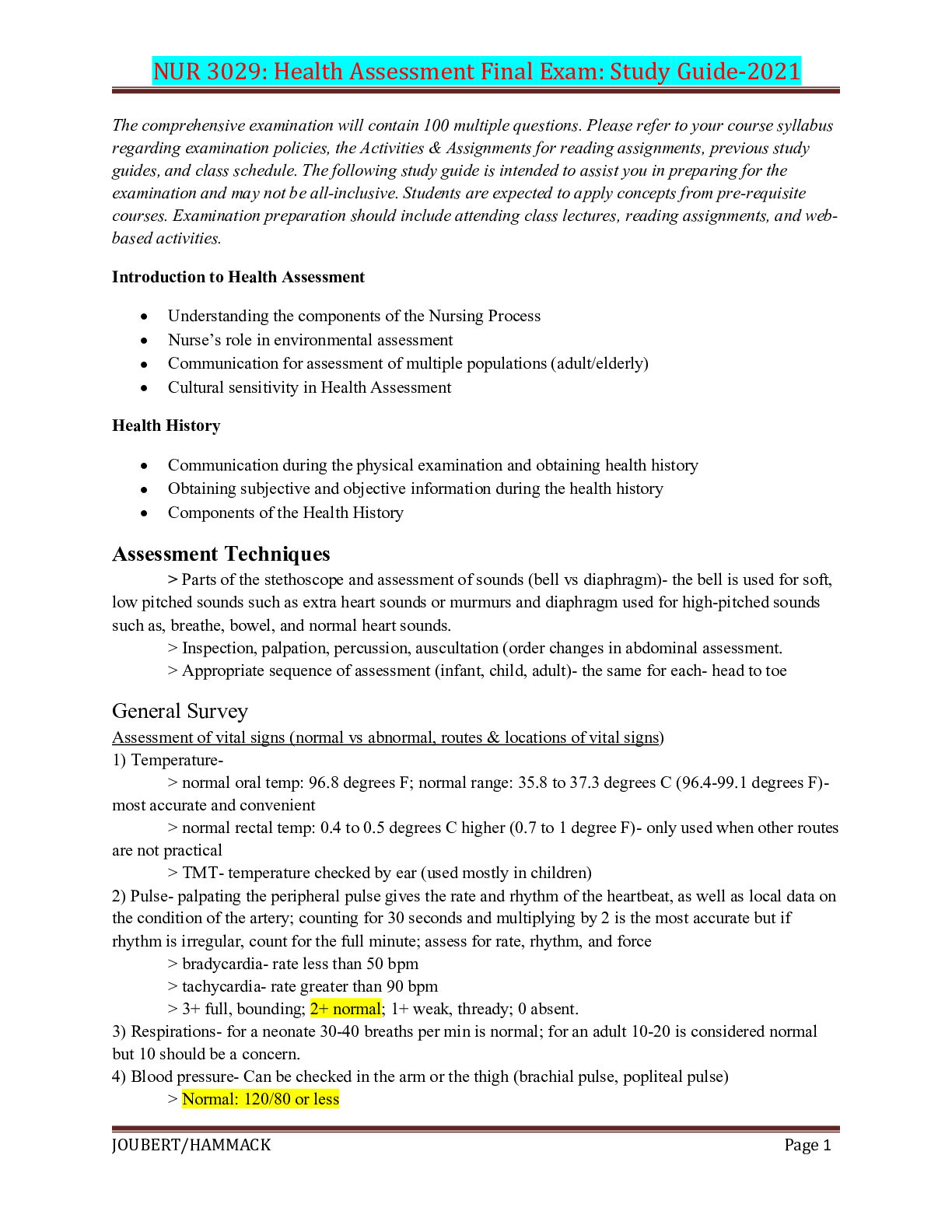
NUR 3029: Health Assessment Final Exam: Study Guide
JOUBERT/HAMMACK Page 1
The comprehensive examination will contain 100 multiple questions. Please refer to your
...
NUR 3029: Health Assessment Final Exam: Study Guide
NUR 3029: Health Assessment Final Exam: Study Guide
JOUBERT/HAMMACK Page 1
The comprehensive examination will contain 100 multiple questions. Please refer to your course syllabus
regarding examination policies, the Activities & Assignments for reading assignments, previous study
guides, and class schedule. The following study guide is intended to assist you in preparing for the
examination and may not be all-inclusive. Students are expected to apply concepts from pre-requisite
courses. Examination preparation should include attending class lectures, reading assignments, and webbased activities.
Introduction to Health Assessment
Understanding the components of the Nursing Process
Nurse’s role in environmental assessment
Communication for assessment of multiple populations (adult/elderly)
Cultural sensitivity in Health Assessment
Health History
Communication during the physical examination and obtaining health history
Obtaining subjective and objective information during the health history
Components of the Health History
Assessment Techniques
> Parts of the stethoscope and assessment of sounds (bell vs diaphragm)- the bell is used for soft,
low pitched sounds such as extra heart sounds or murmurs and diaphragm used for high-pitched sounds
such as, breathe, bowel, and normal heart sounds.
> Inspection, palpation, percussion, auscultation (order changes in abdominal assessment.
> Appropriate sequence of assessment (infant, child, adult)- the same for each- head to toe
General Survey
Assessment of vital signs (normal vs abnormal, routes & locations of vital signs)
1) Temperature-
> normal oral temp: 96.8 degrees F; normal range: 35.8 to 37.3 degrees C (96.4-99.1 degrees F)-
most accurate and convenient
> normal rectal temp: 0.4 to 0.5 degrees C higher (0.7 to 1 degree F)- only used when other routes
are not practical
> TMT- temperature checked by ear (used mostly in children)
2) Pulse- palpating the peripheral pulse gives the rate and rhythm of the heartbeat, as well as local data on
the condition of the artery; counting for 30 seconds and multiplying by 2 is the most accurate but if
rhythm is irregular, count for the full minute; assess for rate, rhythm, and force
> bradycardia- rate less than 50 bpm
> tachycardia- rate greater than 90 bpm
> 3+ full, bounding; 2+ normal; 1+ weak, thready; 0 absent.
3) Respirations- for a neonate 30-40 breaths per min is normal; for an adult 10-20 is considered normal
but 10 should be a concern.
4) Blood pressure- Can be checked in the arm or the thigh (brachial pulse, popliteal pulse)
> Normal: 120/80 or lessNUR 3029: Health Assessment Final Exam: Study Guide
JOUBERT/HAMMACK Page 2
> Prehypertension: 120-139/80-89
> Stage 1 hypertension: 140-159/90-99
> Stage 2 hypertension: >160/>100
Assessment of changes in BP (orthostatic BPS and nurse’s role)
> take serial measurements when you suspect volume depletion; when the person is known to
have hypertension or is taking antihypertensive medication; or when the person reports fainting or
syncope.
> have person rest supine for 2 to three minutes and take baseline readings of pulse and BP, and
then repeat the measurements with the person sitting, then standing (for person too busy to stand, assess
supine and then sitting with legs dangling. Normally when the position is changed from supine to
standing, there is a slight decrease (les than 10 mmHg) in systolic pressure.
> orthostatic hypotension- drop in systolic pressure of more than 20 mmHg or orthostatic pulse
increases in 20 bpm standing position.
> nurse must record the BP for each position, the arm used, and the cuff size if different from
standard adult; also record the pulse rate and rhythm.
* If BP cuff is too narrow for the arm, it will result in a false high BP reading and if it is too loose or
uneven it will result in a false low reading.
Pain Assessment and Vital Signs interpretation
>infants and children use the face pain scale
>PQRSTU
- Provocative/palliative
- Quality
- Region/Radiation
- Severity, 0-10
- Time
- Understands
* BP tends to be higher when a person is in acute pain; in persons with chronic pain BP is not normally
affected.
Integumentary Assessment
Normal vs abnormal changes in the skin (infant, child, adult, older adults)
> test for skin turgor (tenting), which signifies dehydration- abdomen on infant,
hand on an adult
> newborns nail beds may be cyanotic for the first few hours of life, then turn
pink.
> adolescents experience acne; appear in children 7 to 8 years of age but usually
peak at age 14 to 16 years in girls, and at 16 to 19 years in boys.
> skin for aging adult is much thinner
> acrochordons or “skin tags” occur frequently on eyelids, back, and axillae and
trunk.
> hair growth decreases in aging adult and the amount of decrease in axillae andNUR 3029: Health Assessment Final Exam: Study Guide
JOUBERT/HAMMACK Page 3
pubic areas. After menopause, women develop brisk hair on chin or upper lip; in men
coarse terminal hairs develop in ears nose and eyebrows but beard is unchanged; male
pattern alopecia is a genetic trait (gradual receding in a symmetric W shape); in males
and females, hair begins to change white due to loss of melanocyte function.
> with aging the nail growth rate decreases and surface may be brittle and
sometimes yellowed; toe nails are thickened- make sure it is normal and not due to
peripheral vascular disease
Abnormal skin and hair changes and descriptions
> pallor occurs with anemia, shock, arterial insufficiency, albinism (absence of
melanin), and vitiligo (destruction of melanocytes)
> cyanosis in light skinned people- blue, in dark skinned- check conjuctiva, oral
mucosa, and nail beds
> jaundice – yellow in sclera, hard palate, mucous membranes, skin; check palms
and soft palate in dark persons; light gray colored stool and dark golden urine.
> skin smooth with hyperthyroidism, skin dry in hypothyroidism
> in endocrine disorders cause excessive hair or hair loss
> tinea capitis- brittle scalp hair, dull, and coarse
> jagged nails- nervous picking habits; chronically dirty- poor self-care; clubbing
of nails occurs with congenital cyanotic heart disease and pulmonary disorders (nail is >
180 degrees with a spongy nail base)
> nails are thickened and rigid with arterial insufficiency
> alopecia- a condition in which hair is lost from some or all areas of the body,
usually from the scalp.
> wheal- superficial, raised, transient, and erythematous; slightly irregular
shaped due to edema; (ie. mosquito bite, allergic reaction; dermographism).
> bulla- larger than 1 cm diameter; usually single chambered; superficial in
epidermis; thin walled so it ruptures easily; (ie. friction burn, dermatitis, burns).
> papules- solid, elevated, and circumscribed, less than 1 cm in diamete, caused
by superficial thickening in the epidermis (ie. mole, wart).
> nodule- solid, elevated, hard or soft, larger than 1 cm. May extend deeper into
dermis than a papule.
Changes in skin turgor and associated conditions
> urticaria- “hives”; when wheals coalesce to form extensive reaction, intensely pruritic
> fissure- linear crack with abrupt edges, extends into the dermis, dry or moist. Ex: cheilosis- at
corners of mouth due to excess moisture; athlete’s foot.
Head & Neck
Sinuses
> using thumbs press the frontal sinuses by pressing up and under the eyebrows and over the
maxillary sinuses below the cheekbones- person should feel firm pressure, but no tenderness/pain.
> Abnormal: person feels tenderness in presence of acute infection (sinusitis) or with chronicNUR 3029: Health Assessment Final Exam: Study Guide
JOUBERT/HAMMACK Page 4
allergies
Nasal passages-
> lift up the tip of the nose with finger before inserting otoscope head; view nasal cavities with
the head erect and then with the head tilted back; Inspect he mucosa noting normal red color and smooth,
moist surface.
> observe the septum for deviation- a deviated septum is common and not significant unless air
flow is obstructed; also note any perforation or bleeding in the septum
> inspect the turbinates- the superior one will not be viewable, but the middle and inferior appear
the same light red color as the nasal mucosa; turbinate’s are tender.
> Abnormal: Rhinitis- nasal mucosa is swollen and bright red; discharge is common with rhinitis
and sinusitis, varying form watery to thick, purulent, and green-yellow; With chronic allergy, mucosa
looks swollen, boggy, pale, and gray*; perforation is seen as a spot of light from a penlight shining in the
other naris and occurs with cocaine use; epistaxis- nose bleeding; polyps are smooth, pale gray,
avascular, mobile and nontender.
Oral mucosa-
> The inside of the mouth looks pink, smooth, and moist, hard palate white with irregular
transverse rugae and the posterior soft palate is pinker, smooth, and upwardly moveable; leukoedema- a
benign milky bluish, white opaque areas- is normal.
> Abnormal: dappled brown patches are present with addisom’s disease; hard palate appears
yellow with jaundice; oral Kaposi sarcoma is the most common early lesion in people with AIDS;
candida infection will usually rub off, leaving a raw denuded area; leukoplakia- chalky white raised patch;
gums bleed with slight pressure indicating gingivitis
Thyroid gland
> is difficult to palpate; supply person with a glass of water and inspect the neck as the person
takes a sip and swallows- thyroid tissue should move up.
> Thyroid posterior examination:
- to palpate behind, ask person to stand up straight and bend the neck and slightly to the
left and then use your left hand to push the trachea slightly to the right. The right hand will then palpate
between the trachea and the sternocleidomastoid muscle. Reverse the procedure for the left side. You
should not be able to palpate the thyroid on a normal adult
> Thyroid anterior examination:
- alternate/best method of palpating thyroid. Stand facing the person ask him or her to tip
the head forward and to the right. This time use your right thumb to displace the trachea slightly to the
person’s right. Next, hook the left thumb and fingers around the sternocleidomastoid muscle and feel for
lobe enlargement when person swallows.
Assessment of the Throat
> uvula should be midline and when person says ah note the soft palate and uvula rise midlinetests one function of cranial nerve X, vagus.
> tonsils should be same color pink as oral mucosa and surface peppered with indentations or
crypts; tonsils are graded as 1+ visible, 2+ halfway between tonsilar pillars and uvula, 3+ touching theNUR 3029: Health Assessment Final Exam: Study Guide
JOUBERT/HAMMACK Page 5
uvula, 4+ touching each other- tonsils will be enlarged with acute infection
> touch the posterior wall with a tongue blade elicits a gag reflex. This tests cranial nerve IX and
X, the glossopharyngeal and vagus- with damage to these nerves patient may experience dysphagiaoccurs with pharyngitis, gastroesophageal reflux disease, stroke, and esophageal cancer.
> halitosis- breath odor
> diabetic ketoacidosis has a sweet, fruity, breathe odor
> hoarseness of the larynx has many causes- overuse of the voice, upper respiratory tract infection,
chronic inflammation, lesions, or a neoplasm.
Eye Assessment (internal/external)
Acuity/Snellen eye chart
Most commonly used and accurate measure of visual acuity; It consists of lines of letters arranged in
decreasing size; Person positions 20 feet from the chart and read the chart to the smallest line possible
while shielding one eye.
> Normal visual acuity is 20/20; the larger the denominator, the poorer the vision- poorer than
20/30 refer to an opthalmologist or optometrist.
Diagnostic positions test
Leading the eyes through six cardinal positions of gaze will elecit any muscle weakness during
movement. Ask the person to hold the head steady and to follow the movement of your finger, pen, or
penlight only with the eyes. Hold the target about 12 inches and move it to each of the six positions, then
back to the center. Check for nystagmus- involuntary eye movement and also lid lag- upper eyelid
continues to overlap the superior part of the iris.
> Normal response is parallel tracking of the object with both eyes.
> Abnormal eye movement is not parallel. Failure to follow in a certain direction indicates
weakness of an extraocular muscle or dysfunction of a cranial nerve innervating it; Nystagmus occurs
with disease of the semicircular canals in the ears, a paretic eye muscle, multiple sclerosis, or brain
lesions; lid lad occurs with hyperthyroidism.
Pupillary light reflexes
Darken the room and ask the person to gaze into the distance. Advance a light in from the side and note
the response. Resting size pupil of an adult is 3 to 5 mm. 5% of people normally have pupils of two
different sizes anisocoria
> Normal- you will see constriction of the same-sided pupil (a direct light reflex) and
simultaneous constriction of the other pupil (a consensual light reflex); record normal findings of all
maneuvers as PERRLA- Pupils, Equal, Round, React to Light, and Accommodation.
> Abnormal- absence of constriction; unequal-size pupils calls for a consideration of central
nervous system (anisocoria); blind eyes do not respond to light
Corneal light reflex
assess the parallel alignment of the eye axes by shining a light toward the person’s eyes. Direct the person
to stare straight ahead as you hold the light about 30 cm (12 in) away. Note the reflection of the light on
the corneas.
> Normal- it should be in exactly the same spot on each eye.NUR 3029: Health Assessment Final Exam: Study Guide
JOUBERT/HAMMACK Page 6
> Abnormal- asymmetry of the light reflex indicates deviation in alignment from eye muscle
weakness or paralysis. If you see this perform the cover test.
Macular degeneration- The macula is in the center of the retina, the light-sensitive layer of tissue at the
back of the eye. The macula is responsible for central vision (straight-ahead vision). Degeneration of the
macula occurs most often after the age of 60 years and is termed age-related macular generation (AMD)-
results in a loss of vision in the center of the visual field
Cataracts- clouding of the lens inside the eye which leads to a decrease in vision; appears as opaque
black areas against the red reflex.
**In whites over 40 years, the leading cause of blindness is age-related macular degeneration (54%),
followed by cataracts (9%).
Extra abnormal findings: swilling of lacrimal gland is a visible bulge in the outer part of the upper eyelid;
scleral icterus- even yellowing of the sclera extending up to the cornea, indicating jaundice; ptosisdrooping of the upper eyelid; presbyopia- decrease in power of accommodation with aging; cyanosis in
the lower lids or pallor in the outer canthus of the lower lid may indicate anemia; arcus senilis- normal
finding in old people which is due to a deposition of lipid material; phoria- mild weakness noted only
when fusion is blocked; tropia- more severe- a constant malalignment of the eyes; amblyopia- lazy eye;
esophoria- eye drift inward, exophoria- outward eye drift; diplopia- perception of two images of a
single object; photobia- inability to tolerate light
Aging Adult
> Lacrimal glands involute, causing decreased tear production and feelings of dryness/burning
> skin loses elasticity which causes drooping and wrinkling
> Pupil zise decrease, lens loses elasticity becoming hard and glasslike, which decreases the lens ability to
change shape to accommodate for near vision presbyopia
> at 70 years of age, fibers of the lens thicken and yellow, beginning senile cataract.
> aging person needs more light for reading because of decreased adaptation to darkness.
> cataracts, glaucoma (increased intraocular pressure), and macular degeneration (breakdown of cells in
the macula of the retina) are the most common causes of decreased visual acuity in older patients.
Ear Assessment
Normal and abnormal assessments
* Virus/bacteria from upper respiratory tract infection may migrate up the Eustachian tube to involve the
middle ear.
otalgia- earache/pain
otorrhea- discharge in ear that suggest infected canal or perforated eardrum
Presbycusis- gradual onset over years whereas a trauma hearing loss is often sudden; not associated with
upper respiratory tract
tinnitus- ringing, crackling or buzzing in your ears. Originates within the person; accompanies some
hearing or ear disorders
> a sticky yellow discharge accompanies otitis externa and may indicate otitis media if the drum is
ruptured;
> enlarged, tender lymph nodes in the region indicate inflammation of the pinna or mastoid process
> Impacted cerumen is a common cause of conductive hearing lossNUR 3029: Health Assessment Final Exam: Study Guide
JOUBERT/HAMMACK Page 7
> frank blood or clear watery drainage after trauma suggests basal skull fracture and warrants immediate
referral. CSF feels oily and is positive for glucose on TesTape.
> Check for any polyps furuncle, exostosis etc.
> Use of otoscope: hold otoscope upside down with the dorsa of your hand along the persons cheek;
insert the specula slowly and carefully along the axis of the canal and avoid touching the inner “bony”
section of the canal wall; rotate slightly to visualize the entire eardrum; do this before hearing
examination to see if impacted with cerumen.
> tympanic membrane: normally shiny and translucent, with a pearl gray color
- yellow-amber drum color occurs with otitis media with effusion (serous) and sometimes air
bubbles behind drum; red color with acute otitis media.
> eardrum is flat and slightly pulled in at the center, and flutters when person performs valsalva maneuver
or holds the nose and swallows- avoid doing so with upper respiratory infection because it could propel
infectious matter into the middle ear
Hearing assessment/Hearing Testing
Your screening for hearing deficit begins during the history; how well does the person hear
conversational speech? Ask the person directly if he or she thinks there is a hearing difficulty. If the
answer is yes, perform audiometric testing or refer for audiometric testing. If the answer is no, screen
using the whispered voice test.
1) Whispered Voice Test- test one ear at a time while masking hearing in the other ear to prevent
transmission around the head and shield the lips or stand behind the person so they cannot read your lips.
Standing 1 to 2 ft away whisper slowly a set of 3 random numbers, letters, or even words. Normally the
person should be able to repeat each one directly after you say it. A passing score is correct repeating of at
least 3 out of 6.
> abnormal: person is unable to hear whispered items. A whisper is a high frequency sound and is
used to detect high tone loss.
2) Tuning Fork Tests- measures hearing by air conduction or bone conduction, in which the sound
vibrates through the cranial bones to the inner ear.
> Weber Test- executed by hitting the tuning fork and then holding it in the middle of the
patient’s forehead. If the patient is unable to hear the tuning fork in this position, it can also be placed on
the nasal bone or in the middle of the front two teeth. The patient is then asked to determine where the
sound is heard the best. A normal result is when the sound is the same in both ears.
> Rinne Test- air conduction and bone conduction tested; first strike the tuning fork then hold it
next to the persons ear to see if he or she can hear it; next place the base of the tuning fork on bone in
front of ear and test if person can feel the vibration.
*both tests used to evaluate the Vestibulocochlear nerve (cranial nerve VIII)
Aging Adult
> An aging adult may have pendulous earlobes with linear wrinkling because of loss of elasticity of the
pinna
> Coarse wiry hairs may be present at the opening of the ear canal.
> eardrum may be whiter in color and more opaque, duller than in the younger adult.
> A high-tone frequency hearing loss is apparent for those affected with presbycusis, the hearing loss that
occurs with aging. This condition is revealed in difficulty hearing whispered words in the voice test and inNUR 3029: Health Assessment Final Exam: Study Guide
JOUBERT/HAMMACK Page 8
difficulty hearing consonants during conversational speech. The aging adult feels that “people are
mumbling” and feels isolated in family or friendship groups.
> impacted cerum is common in aging adults which blocks conduction in those wearing hearing aids and
accounts for 70% of malfunction in hearing aids returned to the manufacturer. Cerum should be removed
if it interferes with full assessment of the ear.
Lymphatic System
Cardiac Assessment
Anatomical Landmarks, Cardiac Cycle
> Precordium- area anterior chest directly overlying the heart and great vessels.
> Heart and great vessels are located between the lungs in the middle of the thoracic cage (mediastinum).
> top if the heart is the base, bottom is the apex (landmark for apical pulse)
> right side of heart is anterior and the left is posterior; left ventricle lies behind the right ventricle; right
atrium forms right border, left ventricle forms part of left border.
> great vessels lie at the base of the heart; pulmonary arteries leave the right artrium carrying deoxy blood
to lungs; pulmonary veins located in the left atrium bring back oxygenated blood from the lungs back to
heart; aorta sends blood to rest of body.
Inspection of Anterior chest: you may or may not see an apical pulse; a heave or a lift is a sustained
forceful thrusting of the ventricle during systole; it occurs in ventricular hypertrophy as a result of
increased workload.
Palpation of anterior chest: palpate the apical impulse; a thrill is a palpable vibration; it feels like theNUR 3029: Health Assessment Final Exam: Study Guide
JOUBERT/HAMMACK Page 9
throat of a purring cat; it signifies turbulent blood flow and accompanies loud murmurs.
For auscultation of anterior chest:
Aortic Area- Right 2nd intercostal space
Pulmonic Area- left 2nd intercostal space
Erb’s point- left of sternum 3rd intercostal space
Tricuspid area- 5th left intercostal space
Mitral area- 5th left intercostal space mid clavicular/nipple line
Assessment of Neck Vessels
*yield important information on heart function
1) Palpate the carotid artery
> medial to the sternomastoid muscle. Avoid excessive pressure b/c excessive vagal stimulation
slows down heart; palpate only one at a time; Normal contour is smooth with rapid upstroke and slower
downstroke and normal strength Is 2+.
> carotid sinus hypersensitivity is a condition in which pressure over the carotid sinus leads to
decreased HR, BP, and cerebral ischemia with syncope (occurs in older people with hypertension or
occlusion of carotid).
2) Auscultate
> middle-aged or older persons who show signs of CVD auscuultate each carotid artery with the
bell for presence of a bruit (blowing, swishing sound indicating blood turbulence)
> 3 different locations: angle of the jaw, midcervical area, and base of neck; ask person to take a
huge breath, exhale, and hold the breath while you listen so tracheal breath sounds are not present.
> carotid bruit only heard when vessel is ½ or 2/3 occluded; once fully occluded bruit disappears
so absence of a bruit doesn’t ensure absence or a carotid lesion.
3) Inspect Jugular Venous Pulse-
> external overlies sternocleidomastoid muscle, internal in the sternal notch (deep and medial to
sternocleidomastoid muscle)
> from jugular veins you can asses central venous pressure and judge the hearts efficiency as a
pump. (head of bed 30-45 degree angel, the higher you are the more the pressure falls)
> unilateral distension of external jugular veins is due to local cause (kinking or aneurysm); full
distended external jugular veins signify increased CVP as with heart failure
The Aging Adult
> with aging there is an increase in the systolic blood pressure (which increases pulse pressure)
due to stiffening of the large arteries which in turn is due to calcification of vessel walls.
> left ventricular wall thickness increases to accommodate the vascular stiffening mentioned
earlier that creates an increased workload on the heart.
> there is a decreased ability of the heart to augment cardiac output with exercise (decreased max
heart rate).
> no change in cardiac output at rest or resting heart rate wit age
> presence of dysrhythmias increases and ectopic beats are commonNUR 3029: Health Assessment Final Exam: Study Guide
JOUBERT/HAMMACK Page 10
> tachydysrhythmias may not be tolerated b/c myocardial wall is thicker and less compliant
> prolonged P-R interval (first degree AV block) and prolonged Q-T interval
> greater risk for CVD and CAD
Cultural and Genetic Considerations
> Higher percentage of men than women experience hypertension until age 45; After age 64 years women
have a much higher percentage of hypertension.
> Prevelance of hypertension in blacks is among the highest in the world: 31.8% African Americans,
25.3% American Indians, 23.3% in whites, and 21% for Hispanics and Asians.
> Nicotine increases rates of MI and stroke by causing increase in O2 demand and decrease in Oxy
supply, an activation of platelets and fibrinogen, and adverse change in lipid profile
> High levels of LDL add to lipid core of thrombus formation in arteries resulting in MI and strokes; high
risk cholesterol level 240mg/dL, 200-239 are borderline.
> prevelance for high cholesterol: 51.1% Mexican-American men and 49% women, 45% white men 48%
women, 40.2% African American mean 57.7% women
> prevelance for obesity: 74.8% Mexican American men 73% women, 73.7% African American men
77.7% women, and 72.4% white men 57.5% women
> CVD risk is two-fold greater among persons with DM (strong genetic factor); most prevelant in Africa
11%.
>hypertension is 2 to 3 times more common among women taking oral contraceptives especially obese
and older women
Heart Sounds (Normal, Extra, & Murmurs)
> First heart sound S1- beginning of systole ; av valve closure
> Second heart sound S2- end of systole, beginning of diastole; closure of semilunar valves (loudest at
the base)
> S3- normally is silent but occurs when ventricles are resistant to filling during the early rapid filling
phase; occurs immediately after S2 when the av valves open and the atrial blood first enters ventricle;
> S4- occurs at end of diastole, presystole, when the ventricle is resistant to filling; the atria contract and
push blood into a noncompliant ventricle, which creates these vibrations; S4 occurs just before S1.
> midsystolic click- associated with mitral valve prolapse is the most common extra sound
> ejection click- occurs early in systole at the start of ejection because it results from opening of the
semilunar valves; short and high pitched, with a click quality.
* S3 (ventricular gallop, Kentucky) and S4 (atrial gallop, Tennessee) both occur in diastole.*
> Mitral prosthetic valve sound- iatrogenic sound, gives an early diastolic sound an opening click just
after S2.
Murmurs:
> when certain conditions create turbulent blood flow and collision currents; murmur is a gentle blowing
swooshing sound that can be heard on the chest wall
> Following causes of murmurs:
Velocity of blood increases
Viscocity of blood decreases
Structural defects in the valves or unusual openings occurring in the chambers (wall defect)NUR 3029: Health Assessment Final Exam: Study Guide
JOUBERT/HAMMACK Page 11
Systolic (midsystolic ejection murmurs)
> aortic stenosis /pulmonic stenosis
> mitral regurgitation/tricuspid regurgitation
Diastolic rumbles of AV valves
> mitral stenosis/tricuspid stenosis
> aortic regurgitation/pulmonic regurgitation
Respiratory Assessment
Normal versus abnormal respiratory assessment findings/definitions/lung sounds
Assessment findings:
> tactile fremitus- palpable vibration; sounds generated from the larynx that are transmitted
through patent brochi to chest wall. Touch person’s chest while asking them to say “blue moon” or
“ninety nine”. Obstruction will decrease fremitus and compression or consolidation (lobar pneumonia)
causes an increase in fremitus.
> crepitus- coarse, crackling sensation palpable over the skin surface.
> check for bilateral chest expansion- unequal occurs with atelectasis, pneumothorax, or fractures
ribs
> hyperresonance- lower-pitched booming sound found when too much air is present such as in
emphysema or pneumothrax.
> dullness- soft muffled thud which signals abnormal density in the lungs, as with pneumonia,
pleural effusion, tumor, or atelectasis- should only be heard when percussing over the liver area
Respiratory patterns:
> tachypnea- rapid, shallow breathing. Increased rate, >24 per minute. This is a normal response
to fever, fear, or exercise.
> hyperventilation- increase in both rate and depth; occurs with extreme exertion, fear, or
anxiety.
> bradypnea- slow breathing. A decreased but regular rate <10 per minute, as in drug-induced
depression of the respiratory center in the medulla, increased intracranial pressure, and diabetic coma.
> hypoventilation- an irregular shallow pattern caused by an overdose of narcotics or
anesthetics. May also occur with prolonged bedrest or conscious splinting of the chest to avoid respiratory
pain.
> cheyne-stokes respiration- cycle in which respirations gradually wax and wane in a regular
pattern, increasing in rate and depth and then decreasing. The breathing periods last 30 to 45 seconds,
with periods of apnea (20 seconds) alternating cycle- normal in infants and aging persons during sleep.
> chronic obstructive breathing- normal inspiration and prolonged expiration to overcome
increased airway resistance (emphysema/COPD)
Adventitious lung sounds:
> Crackles- fine (discontinuous high pitched, short crackling popping sound heard upon
inspiration and not cleared by coughing; caused in pneumonia, heart failure, chronic bronchitis, asthma
and emphysema) or coarse (loud, low-pitched, bubbling and gurgling sounds that start in early
inspiration and may be present in expiration; decreased after coughing or suctioning; sounds like Velcro;NUR 3029: Health Assessment Final Exam: Study Guide
JOUBERT/HAMMACK Page 12
found in pulmonary edema, pneumonia, and pulmonary fibrosis)
> Pleural friction rub- superficial sound is coarse and low-pitched; grating quality as if two
pieces of leather are being rubbed together; sounds like crackles but close to the ear; inspiratory and
expiratory; caused by pleuritis and accompanied by pain with breathing
> wheeze- result of passage narrowed or airway obstruction; common in asthma or chronic
emphysema; high-pitched (occurs in both inspiration and expiration) or low-pitched (expiration).
> stridor- high-pitched, inspiratory, crowing sound, louder in neck than overall chest
Assessment of conditions (asthma, COPD/emphysema, infections)
=Patients with COPD/emphysema normally have a barreled chest; Person with pneumonia will normally
experience crackles; a person with asthma or emphysema will normally experience wheezing.
Distinguish between lung sounds and location
> Bronchial- high pitched, loud, harsh and hallow, location: trachea
> Bronchovesicular- moderate pitched, moderate amplitute, mixed sounds, location: over
bronchi, between scapulae, around upper sternum 1st and 2nd intercostal spaces
> Vesicular- Low pitched, soft, rustling like the sound of wind in trees, location: peripheral lung
fields where smaller bronchioles and alveoli are located.
Abdominal Assessment
Internal Anatomy of all 4 Quadrants
Right Upper Quadrant:
Liver
Gallbladder
Duodenum
Head of Pancreas
Right kidney and adrenal
Hepatic flexure of colon
Part of Ascending and transverse colon
Left Upper Quadrant:
Stomach
Spleen
Left lobe of liver
Body of pancreas
Left kidney and adrenal
Splenic flexure of colon
Part of transverse and descending colon
Right Lower Quadrant:
Cecum
Appendix
Right ovary and tube
Right ureter
Right spermatic cord
Left Lower Quadrant:
Part of descending colon
Sigmoid colon
Left ovary and tube
Left ureter
Left spermatic cord
Special Procedures
> Rebound Tenderness AKA “Blumber Sign”- assess for rebound tenderness when the person
reports abdominal pain or when you elicit tenderness during palpation. Choose a site away from painful
area. Hold hands perpendicular to abdomen; push down slowly and deeply then lift up quickly (perform at
end of examination). Positive response confirms peritoneal inflammation, which accompaniesNUR 3029: Health Assessment Final Exam: Study Guide
JOUBERT/HAMMACK Page 13
appendicitis.
> Inspiratory Arrest AKA “Murphy Sing”- In a person with inflammation of the gallbladder
(cholesystitis) pain occurs. Hold fingers under the liver border and ask person to take a deep breath.
Patient should be able to complete a deep breath without pain; If in extreme pain person will immediately
stop inhalation; less accurate in patients older than 60 because they don’t have abdominal tenderness.
> Iliopsoas Muscle Test- Perform when acute abdominal pain of appendicitis is suspected. While
person is in supine position, life the right leg straight up, flexing at the hip then push down over the lower
part of the right thigh as the person tries to hold up the leg. When the iliopsoas muscle is inflamed, which
occurs with an inflamed or perforated appendix, pain is felt in the right lower quadrant.
> Fluid wave test- used to differentiate ascites from gaseous distension. Firm stride with the
hand.
- Shift dullness- second test to distinguish ascites from gaseous distension. When a patient is
supine the ascites fluid settles into the flanks by gravity, displacing air-filled bowel upward. Because of
this you will hear tympanic note as you percuss over the top of the abdomen- gas filled intestines float
over the fluid. Percuss down the side for the abdomen and if fluid is present the note will change to
dullness
Changes in Aging Adult
> aging alters appearance of abdominal wall: fat accumulates in the suprapubic area in females as
a result of decreased estrogen levels and in males fat deposits in the abdominal area resulting in “big
belly” (away from extremities)
> abdominal musculature relaxes; thinner and less tone making organs easier to palpate and
possible note of peristalsis; liver and kidneys very easy to palpate
> salivation decreases, causing a dry mouth and a decreased sense of taste
> esophageal emptying is delayed therefore if eating fed in supine position it increases the risk for
aspiration
> Gastric acid secretions decrease which may cause pernicious anemia (interference with B12
absorption)
> incidence of gallstones increases- more common in females
>liver size decreases 25%; drug metabolism by the liver becomes impaired because by age 65
blood flow through liver is decreased by 33%
> frequent constipation (less than 3 bowel movements per week)
symptoms: straining, lumpy or hard stool, feeling of incomplete evacuation, feeling of
anorectal blockage)
causes- decreased physical activity, inadequate intake of water, low-fiber diet, side
effects of medications, IBS, hypothyroidism
Culture and Genetics
-Lactose intolerance:
> traditional estimated rate of 15% Americans, 50% Mexicans, and 80% African Americans;
> A studied showed much lower than these rates: 7.72% whites, 10% Mexicans, 19.5% African
Americas.
> Clinical significance- dairy foods meet crucial nutritional requirements including calcium,
magnesium, and potassium; can affect bone healthNUR 3029: Health Assessment Final Exam: Study Guide
JOUBERT/HAMMACK Page 14
-Obesity:
> caused by genetic predisposition, dietary intake, physical inactivity, and an obesogenic
environment (one that encourages large portions of high-fat, energy-dense foods).
> prevelance has increased in the U.S and globally. (1/3 of American adults are obese-BMI > 30)
and by 2015, 40% of Americans will be obese.
> In children, Mexican-American boys had a greater prevelance than white or black and
Mexican-American and black girls were significantly more likely to be overweight than white girls;
Increased risk for asthma, diabetes, liver disease, cardiovascular disease, sleep apnea, and joint
problems
> In adults there was no difference in men but among women, Mexican-Americans and AfricanAmericans were significantly more likely to be obese than were whites; results in type II diabetes and
cardiovascular disease.
Abdominal Assessment
1) Inspect
> look at the abdomen from the side of the body to determine the profile of the rib margin to pubic
bone; this describes the nutritional state and normally ranges from flat to round
> check for symmetry no bulging
> Make sure umbilicus is midline and inverted with no sign of discoloring or hernia. Becomes everted
with pregnancy.
> check for discoloration and that surface is smooth
> moles are common on abdomen
> if scar present label it and ask about its history
> waves of peristalsis and pulses from aorta can be seen in very lean persons
> pubic hair growth is normally diamond shaped in males and triangle shape in females
Abnormal:
- scaphoid abdomen caves in and protuberant shows abdominal distenstion (obesity, air or gas, ascities,
ovarian cyst, pregnancy, feces, tumor.
- any bulges can signify hernia
- umbilicus everted with ascites or underlying mass, deeply sunken with obesity, enlarged and everted
with hernia; turns bluish purlish with intrabdominal bleeding
- redness indicates localized inflammation; skin glistening and striae (stretch marks) with ascites.
- unusual color or shape of mole, lesions, rashes, cutaneous angiomas and dilated veins occur with portal
hypertension.
- poor skin turgor occurs with dehydration
- marked peristalsis with with distended abdomen could indicate intestinal obstruction
2) Auscultate bowel sounds (each quadrant)
> bowel sounds are high pitched gurgling cascading sounds
Abnormal:
- hyperactive sounds: loud high-pitched rushing tinkling sounds that signal increased motility.
Example: borborygmus (stomach growling).
- hypoactive sounds: follow abdominal surgery or with inflammation of the peritoneum (must
wait 5 minutes before deciding that bowel sounds are completely absent.
- note any presence of bruits. Check over aortic, renal arteries, iliac arteries, and femoralNUR 3029: Health Assessment Final Exam: Study Guide
JOUBERT/HAMMACK Page 15
3) Percuss
> percuss in all four quadrants (general tympany) to determine any tympany or dullness- move
clockwise
> percuss over the liver- in people with chronic emphysema the liver is displaced downward by
the hyperinflated lungs. You might hear some dullness because of this but the overall span is still within
normal limits.
> percuss on top of spleen
> ***look at special procedures above*** (shift dullness and fluid wave)
Abnormal:
- hepatomegaly
- dullness when palpating the spleen indicates enlargement (splenomegaly), which normally
occurs as a result of mono, trauma, or infection
- ascites
4) Palpate surface and deep areas
> begin with light palpation depress in skin about 1 cm. begin in right lower quadrant and move
clockwise unless pain is there start somewhere else
> voluntary guarding occurs when the person is cold tense or ticklish you can feel the muscles
relax after exhalation
> deep palpations are performed next but pushing down 5 to 8 cm (2 to 3 inches)
> use a bimanual technique on obese persons, pushing only with the top hand so the bottom can
concentrate on palpating
> when identifying a mass make sure to list 1) location 2) size 3) shape 40 consistency 5) surface
6) mobility 7) pulsatility 8) tenderness
> Palpating Liver:
- push deeply down and under the costal margin. Ask the person to breathe slowly and
with every exhalation moving the hand up 1 to 2 cm; can sometimes felt the margin during inspiration but
that’s it.
- hooking technique-stand by persons shoulder and swivel your body to the right so that
you face the persons feet and hook your fingers over the costal margin and ask person to take a deep
breath.
> palpation for spleen must be 3 times its normal size to be felt. Use one hand behind left side
b.w 11th and 12th ribs and lift up for support. Then using other hand obliquely in LUQ push your hand
deeply down and under left costal margin and ask person to take a deep breath
> palpation for kidneys must be deeper
Abnormal:
> muscle guarding, rigidity, large masses, tenderness
> involuntary rigidity is a constant, board-like hardness of the muscle. It is a protective
mechanism accompanying inflammation of peritoneum. It may be unilateral and the same area usually
becomes painful when the person increases intra-abdominal pressure by attempting to sit up.
> any tenderness other than by the sigmoid colon indicates local inflammation, inflammation ofNUR 3029: Health Assessment Final Exam: Study Guide
JOUBERT/HAMMACK Page 16
an organ or peritoneum, or enlarged organ
> liver palpable more than 1 to 2 cm below the costal margin is enlarged; record number of cm it
distends and consistency (hard, soft) and tenderness
> spleen englarged with mono trauma leukemia and lymphomas
***check for special procedures above***
Peripheral Vascular System Assessment
Pulse sites
Neck:
> temporal artery- palpated at the front of the ear
> carotid artery- palpated between the groove of the sternomastoid muscle and the trachea
Arms:
> brachial artery- major artery supplying the arm, which runs through the biceps-triceps furrow
of the upper arm and surfaces (is felt) at the antecubital fossa in the elbow medial to the biceps tendon.
Below this directly bifurcates into radial and ulnar
> radial and ulnar- run distally and form two arches supplying the hand; radial runs medial to
the radius at the wrist and ulnar is in the same relation to the ulna but deeper and harder to palpate
Legs:
> femoral artery- passes under the inguinal ligament and travels down the thigh. At lower thigh
it courses posteriorly and becomes the popliteal
> popliteal artery- felt behind the knee; it then divides
> doralis pedis- the anterior tibial artery becomes this once it reaches the dorsum of the foot.
*In an aging adult, blood vessels grow more rapidly resulting in arteriosclerosis
Venous flow & Lymphatic Drainage
Venous
>drains deoxy blood from tissues and returns it to the heart.
>low pressure system; walls are thinner than arteries; they have a larger diameter and are more distensible
(hold more blood and reduces stress on heart).
>mechanisms to keep blood moving: contracting skeletal muscles that milk the blood proximally, toward
the heart; pressure gradient caused by breathing, in which inspiration makes thoracic pressure decrease
and the abdominal pressure increase; and the intraluminal valves which ensure unidirectional flow.
PROBLEMS: if anything goes wrong with these mechanisms it can lead to venous stasis.
> while walking the calf muscles intermittently contract and relax (gastrocnemeus and soleus).
> At risk for venous disease: prolonged standing, sitting, bed rest, hypercoagulable states, dilated and
varicose veins (cause incompetent valves).
> obesity and pregnancy are increased risk factors for varicose veins.
Lymphatic Drainage
> lymphatic’s retrieve excess fluid from the tissue spaces and returns to the bloodstream.
> during circulation, lymphatic’s pick up any fluid from capillaries that veins cannot absorb (problem in
the lymphatic drainage system = edema!)
> vessels converge and drain into two main ducts the right lymphatic duct- drains the right side of headNUR 3029: Health Assessment Final Exam: Study Guide
JOUBERT/HAMMACK Page 17
and neck, right arm, right side of thorax, right lung, right side of heart, and right upper section of the liver
& empties into the right subclavian vein and thoracic duct- drains the rest of the body and empties into the
left subclavian vein.
> Main Functions: 1) conserve fluid and plasma proteins that leak out of capillaries, 2) form a major part
of the immune system that defends the body against disease, and 3) absorb lipids from the intestinal tract.
> Lymphatic microscopic vessels>vessels>drain into larger ones that have valves so flow is one way into
bloodstream
> flow of lymph is slower than flow of blood and is propelled by contracting muscles, pressure changes in
secondary breathing, and contraction of vessel walls
> lymph nodes- lymphatic tissues at intervals of the vessels that filter the fluid before it is returned to the
bloodstream and filter out microorganisms that could be harmful (exposed to B and T lymphocytes).
> spleen (destroys old RBCs, produces antibodies, stores RBCs, and filter microorganisms from blood)
tonsils (respond to local inflammation) and thymus (T lymphocyte production) aid the lymphatic system
Inspection and Palpation
Arms
Inspect:
>hands skin and nail beds temperature texture turgor edema clubbing (profile sign); clubbing
occurs with congenital cyanotic heart disease.
> check capillary refill; refill lasting more than 2 seconds signifies casoconstriction or decreased
cardiac output (hypovolumia or heart failure). Hands are cold clammy and pale.
> note for presence of any scars (on wrists may signify past self inflicted injury and needle tracts
may indicate IV drug use.
Palpate:
> both radial pulses noting rate rhythm elasticity of vessel wall and equal force ( 3+ increase, full
bounding; 2+ normal; 1+ weak; 0 absent); bounding pulse occurs with hyperkinetic states (exercise,
anxiety, fever) and hyperthyroidism; weak pulse occurs with shock and PAD.
> palpate brachial pulses their force should be equal bilaterally; also check epitrochlear lymph
nodes should not be palpable (enlarged if infection of forearm or hand is present).
> Allen test to check for occluded ulnar artery
Legs
Inspect:
>note skin color hair distribution venous pattern size (swelling or atrophy), and any skin lesions
or ulcers; with malnutrition youll see thin, shiny, atrophic skin, thick ridged nails, loss of hair, ulcers,
gangrene.
> note variscosities
> if deep vain thrombosis is suspected measure the calf circumference at the widest point for both
calves; if lymphedema is suspected measure the ankle, distal calf, knee and thing (asymmetry of 1-3 cm
occurs with mild lymphedema, 3-5 cm moderate lymphedema
> brown discoloration occurs with venous stasis
> venous ulcers occur at medial malleolus b/c of bacterial invasion of poorly drained tissue; In
artery deficits ulcers occur at the toes, metatarsal heads, and lateral maleoliNUR 3029: Health Assessment Final Exam: Study Guide
JOUBERT/HAMMACK Page 18
Palpate:
> palpate temperature along the legs down to the feet, comparing symmetric spots. Skin should be
warm and equal bilaterally; unilateral cool foot or leg or sudden temperature drop as you move down legs
occurs with arterial deficits
> have the person flex the knee and then compress the calf muscle anteriorly against the tibia; calf
pain is a positive homan’s sign, which occurs with deep vein thrombosis, phlebitis, achilles tendinitis,
gastrocnemius injury etc.
> palpate inguinal lymph nodes- should be 1 cm or less, movable, and nontender.
> palpate popliteal, femoral, dorsalis pedis, and posterior tibial pulses and grade on the 3-point
scale; bruit occurs with turbulent blood flow indicating partial occlusion.
> check for pretibial edema. Firmly deoress the skin over the tibia or the medial malleolus for 5
seconds and release; fingers should leave no indentation and a pit may be seen in a pregnant person or
someone who has been standing all day
> bilateral dependent pitting occurs with heart failure, diabetic neuropathy, and hepatic cirrhosis;
If pitting edema is present grade 1+ (mild pitting, slight indentation), 2+ (moderate pitting, indentation
subsides rapidly), 3+ (deep pitting, indentation remains a short time, leg swollen), or 4+ (very deep
pitting, indentation remains long time, leg swollen & deformity)
> unilateral pitting occurs with occlusion of deep vein; nonpitting and feels hard to touch
> manual compression test- While person is standing test length of varicose vein to determine
whether valves are competent place one had no the lower part and compress the vein with your other hand
15-20 cm higher; palpable wave transmission occurs when the vavles are incompetent
> raise legs 30 cm off the table and ask person to wag feet for 30 seconds to drain venous blood;
elevational palor indicates arterial insufficiency; next sit person up with legs over the side of the table to
test for return of color to the feet (10 sec or less); rubor occurs with severe arterial sufficiency
> motor loss occurs with severe arterial deficit and sensory loss as well
PVD
> Peripheral venous disease is a term describing damage, defects or blockage in the veins that carry blood
from the hands and feet to the heart. Peripheral venous disease can occur almost anywhere in the body but
is mostly seen in the arms and legs. The most common symptom of peripheral venous disease is pain
where the blood clot is located. You may also feel a warm area or notice an area of redness or swelling
over the affected vein.
PAD
> Peripheral artery disease (PAD) is a type of atherosclerosis. It occurs when arteries in the limbs (most
often the legs) become narrowed by cholesterol-rich material called plaque. Because PAD interferes with
circulation, advanced cases increase the risk for gangrene and amputation. Patients with PAD are also at
increased risk for other types of atherosclerosis, including heart attacks and strokes.
Claudication
> Claudication is a crampy leg pain that occurs during exercise, especially walking. The pain is due to
insufficient blood flow in the legs (caused by blocked arteries). Because the most frequently affected
artery in intermittent claudication is the popliteal artery, symptoms are most common in the calf muscles.NUR 3029: Health Assessment Final Exam: Study Guide
JOUBERT/HAMMACK Page 19
This artery leads off from the femoral artery. Symptoms may be felt as pain, achiness, cramping, a sense
of fatigue, or nonspecific discomfort that occurs with exercise.
> Raynaud's phenomenon - A condition in which the smallest arteries that bring blood to the fingers or
toes constrict (go into spasm) when exposed to cold or as the result of emotional upset. Raynaud's most
commonly occurs in women between the ages of 18 and 30. Symptoms include coldness, pain, and pallor
(paleness) of the fingertips or toes.
> Deep vein thrombosis (DVT) - A clot that occurs in a deep vein, and has the potential to dislodge, travel
to the lungs, occlude a lung artery (pulmonary embolism), and cause a potentially life-threatening event.
It is found most commonly in those who have undergone extended periods of inactivity, such as from
sitting while traveling or prolonged bed rest after surgery. Symptoms may be absent or subtle, but include
swelling and tenderness in the affected extremity, pain at rest and with compression, and raised vein
pattern.
> Varicose veins - Dilated, twisted veins caused by incompetent valves (valves that allow backward flow
of blood) allowing blood to pool. It is most commonly found in the legs or lower trunk. Symptoms
include bruising and sensations of burning or aching. Pregnancy, obesity, and extended periods of
standing intensify the symptoms.
Neurological Assessment
Lobes
Frontal-intellectual function, you=personality broca’s area. Broken when had stroke person
cannot talk but understands
Parietal- sensation; proprioception. Lateral neglect lose ½ perception of ones body, only
perceives one side. Cant see or sensation on one side
Temporal- by ear. Hear but doesn’t interpret Wernicke’s area.
Occipital- vision
When there’s a patient w/ stroke. Ask about the MRI to find out where the patient had the stroke
Mental status
Anxsy pants (looking anxious) check patient, might be low on oxygen
Mental status assessment glass glaucoma scale measures level of consciousness
Proprioception and cerebellar function
CN I-XII
I- Olfactory; sensory; smell not a test usually done
II- Optic; sensory; vision
III- Oculomotor; MIXED; motor is EOM movement, opening eyes. PNS pupil
constriction, lens shape
IV- Trochlear; motor; down and inward movement of eye
V- Trigeminal; mixed; motor muscles of mastication (chewing) and sensory sensation
of face/scalp, cornea, mucous membranes of mouth/nose
VI- Abducens; motor; lateral movement of eyeNUR 3029: Health Assessment Final Exam: Study Guide
JOUBERT/HAMMACK Page 20
VII- Facial; mixed; motor facial muscles, close eye, labial speech, close mouth. Sensory
taste (sweet, salty, sour, bitter) on anterior 2/3 of tongue. PNS salvia and tear
secretion
VIII- Acoustic; sensory; hearing and equilibrium
IX- Glossopharyngeal; mixed. Motor pharynx (phonation/ swallowing) sensory taste on
posterior 1/3 of tongue, pharynx (gag reflex) PNS parotid gland carotid reflex
X- Vagus; mixed; motor pharynx and larynx (talking +swallowing) sensory general
sensation from carotid body carotid sinus, pharynx and viscera. PNS carotid reflex
XI- Spinal; motor; movement of trapezius and sternomastiod muscles
XII- Hypoglossal; motor; movement of tongue
CN enter/exit brain rather than SPC. CN I/II extends to cerebrum. CN III-XII extends from
the lower diencephalon and brain stem. CN supply primarily to head/neck exception of CN X
(heart, resp. muscles, stomach, and gallbladder)
Reflex arc
Reflex is basic defense mechanisms of the NVS.
They are involuntary, operating below the level of conscious control and permitting a quick
reaction to painful/damaging situations
Reflex help body maintain balance and appropriate muscle tone
4 types of reflex
1. Deep tendon reflexs (myotatic) (patellar, knee jerk)
2. Superficial (corneal reflex/abdominal reflex)
3. Visceral (organic) pupillary response to light and accommodation. So when you do
the pupillary reflex test your examining visceral reflexs
4. Pathologic (abnormal) Babinski (or extensor plantar) reflex
Deep tendon reflex has 5 components
1. Intact sensory nerve (afferent)
2. A functional synapse in the cord
3. Intact motor nerve fiber (efferent)
4. Neuromuscular junction
5. Competent muscle
Spinal nerves
Dermatome- circumscribed skin area that is supplied mainly from on spinal cord segment.
Some dermatome landmarks are
1. In the dermatomes of C6-C8 are the thumb, middle finger, and fifth finger
2. Axilla level of T1
3. Nipple level of T4
4. Umbilicus level of T10 and groin level of L1
5. Knee L4
Aging Adults
General atrophy w/ steady loss of neuron structure in the brain and spc
Decrease in weight and volume w/ thinning of the cerebral cortex
Reduced subcortical brain structures
Expansion of the ventricles
Age 65, general loss of muscle bulk apparent in dorsal hand muscles
Loss of muscle tone in face, neck and around the spine
Decreased muscle strength
Impaired fine coordination and abilityNUR 3029: Health Assessment Final Exam: Study Guide
JOUBERT/HAMMACK Page 21
Loss of vibratory sense at the ankle
Decreased or absent Achilles reflex
Loss of position sense at the big toe
Pupillary miosis, irregular pupil shape and decreased pupillary reflexes
Reaction time slower in SOME older people due to velocity of nerve conduction
Increased delay at the synapse, so impulse takes longer to travel as a result pain sensations,
touch, taste, and smell may diminish
Motor system general slowing down of movement
Muscle strength and ability is decreased
Muscle tremors in hands, jaw, along w/ possible rep. facial grimacing (dyskinesias)
Decrease in cerebral blood flow and O2 consumption. Causes dizziness and loss of balance
w/ position change. NEED TO BE TAUGHT TO GET UP SLOWLY
Increased risk for fall and resulting injuries
Older people forget they fell, so hard to diagnose cause of injury
Good health, walk well but more slowly and deliberately
Some older people survey the ground for obstacles and uneven terrain
Some show hesitation
Culture and Genetics
Stroke is the 3rd most common death in the US
AI/AN (American Indians/ Alaskan Natives, Asian/Pacific Islanders and Hispanics die from
stroke at a younger age than whites
US southeast region concentrated with high mortality rates of stroke and is called, stroke belt
This may occur cause high proportion of people who live in this region have two or more
modifiable risk factors for stroke like
o High BP
o High cholesterol
o Diabetes
o Current smoking
o Physical inactivity
o Obesity
o Combination of factors: cultural norms for diet and exercise, poverty, lack of
economic opportunity, social isolation lack of access to health care and preventive
services
AI/AN men have a higher prevalence of HTN and high cholesterol
AI/AN women have the high rate of obesity, current smoking, and diabetes
Blacks have highest rate for strokes
Blacks have a higher prevalence for HTN and diabetes then whites
Important to develop community policy to control such things as access to healthful foods,
reduced tobacco exposure, opportunities for physical activity, and access to health care and
health education
Neurological assessment
Vertigo- rotational spinning sensation caused by vestibular apparatus in the ear or vestibular
nuclei in the brainstem
o Objective vertigo- do you feel as if the ROOM is spinning
o Subjective vertigo- do you feel as if YOU are spinning
Dizziness- feel light headed, feeling faint or swimming sensationNUR 3029: Health Assessment Final Exam: Study Guide
JOUBERT/HAMMACK Page 22
Seizures- occurs w/ epilepsy, a paroxysmal disease characterized by altered or loss of
consciousness, involuntary muscle movements, and sensory disturbances
o Aura is the subjective feeling of a seizure coming, it can be auditory, visual, or
motor
Cerebellar function test Rumberg test
Balance tests
1. Ask person to stand up with feet together and arms to the side
2. Once in a stable position, ask patient to close eyes and hold the position
3. Wait about 20 secs
4. Slight swaying may occur but normally person can maintain posture and balance with
eyes closed
5. Stand close to patient to catch the person in case he or she falls
6. Abnormalities: sways, falls, and widens base of feet to avoid to fall. A + Romberg test is
loss of balance that occurs when closing the eyes. Also, cerebellar ataxia (multiple
sclerosis, alcohol intoxication). Loss of proprioception, and loss of vestibular function
CN assessment
CNII visual acuity, visual fields, and ocular-funda test
CNIII PERRLA/ EOM
CNIII/IV/VI corneal light reflex uncover and cover test an diagnostic position test (EOMs) 6
cardinal gaze
CN V muscle strength, corneal reflex (mascara reflex) and sensation
CN VII squeeze eye shut, smile-show teeth, and puff out cheeks
CN VII bells palsy
CN VIII acoustic weber- sensory neuro/ rinne-conduction and whisper test
CN IX/X glosso/ vagus AHH test (gag reflex) s/p stroke
CNII spinal. Trapezius muscle/ sternomastiod muscle function shrug and lateral move of
head
CNXII stick out tongue (tongue movement)
Fine motor coordination and skilled movements
RAM rapid alternating movement
1. Ask person to pat knees with both hands, lift up, and flip hand over and pat knees with back
of hands (pat-a-cake)
2. Then ask person to do it faster
3. Normally this is done with equal turning and a quick, rhythmic pace
4. Alternatively, ask patient to touch thumb to each finger on the same hand
5. Starting w/ the index finger then reverse direction
6. Abnormalities: lack of coordination, slow, clumsy, and sloppy response is termed
dysdiadochokinesia and occurs w/ cerebellar disease. Dysmetria is clumsy movement
w/overshooting the mark and occurs w/ cerebellar disorders or acute alcohol intoxication.
Past-pointing is a constant deviation to one side.
Finger-to-nose test
1. Ask the person to close their eyes and to stretch out the arms
2. Ask the person to touch the tip of his/her nose w/ each index fingerNUR 3029: Health Assessment Final Exam: Study Guide
JOUBERT/HAMMACK Page 23
3. Alternating hands and increasing speed
4. Normally this is done w/ accurate and smooth movement
5. Abnormalities: misses nose. Worsening or coordination when the eyes are closed occurs w/
cerebellar disease or alcohol intoxication
Heel to shin test
1. Testing lower extremity coordination
2. Ask the patient who is in a supine position to place the heel on the opposite knee and run it
down the shin from knee to ankle.
3. Normally the person moves the heel in a straight line down the shin
4. Abnormalities lack of coordination, heels falls off shin occurs with cerebellar disease
Assessing sensory system tactile discrimination (fine touch)
Stereognosis
1. Test the person’s ability to recognize objects by feeling their forms, sizes, and weights.
2. With the person’s eyes closed place a familiar object (paper clip, key, coin, cotton ball, or
pencil) in their hand and ask person to ID the object
3. Normally, a person will explore it w/ the fingers and correctly name it
4. Test different objects in each hand
5. Testing the left hand assesses right parietal lobe functioning
6. Abnormalities occur w/ lesions of the sensory cortex or posterior column. Astereognosis is
the inability to ID object correctly. Occurs in sensory cortex lesions examples are strokes
(brain attack)
Graphesthesia
1. Is ability to read number by having it traced on the skin.
2. With person eyes closed, use blunt instrument to trace a single digit # or a letter on the palm.
3. Ask the person to tell you what it is
4. This test is a good measure of sensory loss if people cannot make the hand movement needed
for stereognosis as occurs in arthritis
5. Abnormalities inability to distinguish # occurs w/ lesions on the sensory cortex
DTR (deep tendon reflexes) or stretch tests reflexes
Checking If spinal cord is ATTACHED
Compare reflexes on both side, they should be equal
Reflex response graded on a 4 point scale
o 4+ very brisk, hyperactive with clonus, indicative of disease
o 3+ Brisker than average, may indicate disease, probably normal
o 2+ Average, normal
o 1+ diminished, low normal, or occurs only w/ reinforcement
o 0 no response
Normal people have diminished reflexes, or brisk ones
Best plan is to interpret DTR only
If reflex response fails to appear encourage patient to relax by varying the position or increase
strength of blow w/ hammer
Reinforcement is another tech. to relax the muscles and enhance the response
1. Ask the person to person an isometric exercise in a muscle group somewhat away from the
one being tested.
2. Ex to enhance patellar reflex, ask the person to lock the fingers together and pull as hard as
you can
3. Then strike the tendonNUR 3029: Health Assessment Final Exam: Study Guide
JOUBERT/HAMMACK Page 24
4. To enhance biceps response, ask person to clench teeth or to grasp the thigh with the opposite
hand
Superficial reflexes plantar reflex
Sensory receptors in skin rather than muscles but motor response is a localized muscle
contraction
Plantar reflex (L4-S2)
1. Position the thigh in slight external rotation
2. With the reflex hammer, draw a light stroke up the lateral side of the sole of the foot and
inward across the ball of the foot
3. Like an upside-down J
4. The normal response is plantar flexion of the toes and inversion and flexion of the
forefoot
5. Abnormalities is dorsiflexion of the big toe and fanning of all toes which is a +
Babinski sign (upgoing toes). This occurs w/ UMN disease of the corticospinal or
(pyramidal tract) this is an exception for infants due to nervous system not being fully
developed
Abnormal positions
Decorticate rigidity – indicates hemisphere lesion of cerebral cortex
Upper extremities –
o Flexion of arm, wrist, and fingers.
o Adduction of arm, which is (tight against thorax).
Lower extremitieso Extension
o Internal rotation
o Plantar flexion
Decerebrate rigidity – indicates lesion in brainstem at midbrain or upper pons
Upper extremities
o Stiffly extended
o Adducted
o Internal rotation
o Palms
o Pronated
Lower extremities
o Stiffly extended
o Plantar flexion
o Teeth clenched
o Hyperextended back
o More ominous (threatening) than decorticate rigidity
Musculoskeletal Assessment
Normal and Abnormal Assessments
> myalgia- usually felt as cramping or aching
> deformities: dislocation- complete loss of contact between two bones in a joint, subluxation- twoNUR 3029: Health Assessment Final Exam: Study Guide
JOUBERT/HAMMACK Page 25
bones in a joint stay in contact but their aligment is off, contracture- shortening of a muscle leading to
limited ROM, ankylosis- stiffness or fixation of a joint
> palpation: notice any heat, tenderness, swelling, or masses; palpable fluid is abnormal
1) Temperomandibular joint:
- place fingers in front of each ear and ask person to open and close the mouth. There should be a
smooth motion of the mandible. An audible or palpable snap or click occurs in many healthy people.
Move jaw side to side
- abnormal: swelling looks like a round bulge over the joint although it must be moderate or
marked to be visible. Crepitus and pain occur with temporomandibular joint dysfunction. Lateral motion
may be lost earlier and more significantly.
- palpate the contracted temporalis and masseter muscles as the person clenches the teeth. Ask
person to move jaw forward and laterally against your resistance and to open mouth against your
resistance. This tests the integrity of cranial nerve V (trigeminal).
2) Cervical spine:
- Inspect the alignment of the head and then spine should be straight and head erect
- palpate the spinous process and the sternomastoid, trapezius, and paravertebral muscles
- ask person to flex and extend the neck, look left to right, and bend the neck laterally left and
right.
- abnormal: head is tilted to one side, asymmetry of muscles, tenderness and hard muscles with
spasm, pain with movement, limited ROM, and person not able to hold flexion
3) Shoulder:
- ROM: hyperextension up to 50 degrees, forward flexion 180 degrees, internal/ external rotation
90 degrees; abduction 180 degrees and adduction 50 degrees
- Tess the strength of the shoulder muscles by asking the person to shrug the shoulders, flex
forward and up, and abduct against your resistance. The shoulder shrug also tests cranial nerve XI (11)
the spinal accessory nerve
- abnormal: redness, inequality of bone landmarks, atrophy (lack of fullness), dislocated
shoulder loses the normal rounded shape and looks flattened laterally; swelling from excess fluid is best
seen laterally, limited ROM, pain with motion, asymmetry, muscle spasms during abduction.
4) Elbow:
- inspect the size and contour in flexed and extended positions. Look for deformity, redness,
swelling.
- palpate with elbow flexed about 70 degrees and as relaxed as possible. Use your right thumb
and fingers to palpate the olecranon process and medial and lateral epicondyles.
- Test ROM: 160 degrees flexion, 0 degrees for extension, pronation and supination 90 degrees.
- abnormal: subluxation of the elbow shows the forearm dislocated posteriorly; effusion or
synovial thickening shows first as buldge or fullness in grove on either side of olecranon process, and
occurs with gouty arthritis; inflammation and local tenderness on epicondyles, head of radius, and
tendons; subcutaneous nodules are raised, firm, and nontender, and overlying skin moves freely
5) Wrist and hand:NUR 3029: Health Assessment Final Exam: Study Guide
JOUBERT/HAMMACK Page 26
- Inspect the hands and wrists on the dorsal and palmar sides, noting position, sontour and shape.
The normal functional position of the hand shows the wrist in slight extension. The muscles are full
showing no wrinkles, swelling, or redness, or nodules present.
- Palpate each joint in the wrist and hands. Facing the person, support the hand with your fingers
under it and palpate the wrist firmly with both your thumbs on its dorsum. Move your thumbs side to side.
On the hand palpate the metacarpophalangeal joints with your thumbs just distal to and on either side of
the knuckle. Use your thumb and index finger in a pinching motion to palpate the sides of the
interphalangeal joints, normally no synovial thickening, tenderness, or warmth should be present.
- Test ROM: wrist 70 degrees extension, 90 degrees flexion; fingers 30 degrees hyper extension,
and 90 degrees flexion; ulnar deviation 55 degrees and radial deviation 20 degrees; make a fist; touch
thumb to each finger and base of little finger.
- abnormal: subluxation of wrist, ulnar deviation, fingers list to ulnar side. Anklosis- wrist in
extreme flexion, dupuytren contracture- flexion contracture of fingers, swan neck or boutonniere
deformity in fingers, atrophy of the thenar eminence, ganglion cyst in wrist, synovial swelling on dorsum,
generalized swelling, and tenderness. Heberden and Bouchard nodules occur in the hand and are hard and
nontender and occur with osteoarthritis.
- Phalen test- ask person to hold both hands back to back while fliexing the wrists 90 degrees.
Acute flexion of the wrist for 60 seconds produces no symptoms in the normal hand; phalen test
reproduces numbness and burning in a person with carpal tunnel syndrome.
- Tinel Test- direct percussion of the location of the median nerve at the wrist produces no
symptoms in the normal hand; in carpal tunnel syndrome, percussion of the median nerve produces
burning and tingling along its distribution.
- Carpal tunnel syndrome- median entrapment neuropathy that causes paresthesia, pain,
numbness, and other symptoms in the distribution of the median nerve due to its compression at the wrist
in the carpal tunnel.
6) Hip:
- palpate the hip joints which should feel stable and symmetric.
- Test ROM: 90 degrees hip flexion, 0 degrees hip extension, 120 degrees hip flexion with knee
flexed, external rotation 45 degrees and internal rotations 40 degrees; abduction 45 degrees, adduction 30
degrees.
- abnormal: pain with palpation, crepitation, limited motion, pain with motion, flexion flattens
the lumbar spine, if this reveals a flexion deformity in the opposite hip, it represents a positive Thomas
Test. Limited internal rotation of hip is an early and reliable sign of hip disease
7) Knee:
- inspect the knee for any abnormalities, check for distinct concavities or hollows are present on
either side of the patella. Check for any fullness or swelling note any other locations such as the
prepatellar bursa and the suprapatellar pouch for any abnormal swellings. Enhance the palpation with the
knee in the supine position with complete relaxation of the quadriceps muscle. There should be no
warmth or tenderness.
- Test ROM: flexion of 130 degrees, hyperextension of 15 degrees, extension 0 degrees
- abnormal: lesions, genu varum (blow legs), genu valgum (knock knees), atrophy occurs with
disuse or chronic disorders, it appears in the medial part of the muscle, although it is difficult to noteNUR 3029: Health Assessment Final Exam: Study Guide
JOUBERT/HAMMACK Page 27
because the vastus medialis is relatively small. The quadriceps abnormally would feel fluctuant or boggy
with synvitis or supraptatellar pouch; sudden locking- person is unable to extend the knee fully which
usually occurs with a painful and audible pop or click.
- buldge sign- confirms presence of small amount of fluid as you try to move fluid from one side
of the joint to another. Firmly stroke up on the medial aspect of the knee two or three times to displace
any fluid. Tap the lateral aspect. Normally no fluid present
- abnormal: bulge sign occurs with very small amounts of effusion, 4 to 8 mL from fluid flowing
across the joint.
- ballottement of the patella- this test is reliable when larger amounts of fluid are present. Use
your left hand to compress the suprapatellar pouch to move any fluid into the knee joint. With your right
hand, push the patella sharply against the femur. If no fluid is present, the patella is already snug against
the femur.
- abnormal: If fluid has collected, your tap on the patella moves it through the fluid and you will
hear a tap as the patella bumps up on the femoral condyles. Irregular bony margins occur with
osteoarthritis. Pain at joint line. Pronounced crepitus is significant, and it occurs with degenerative
diseases of the knee.
- Special Test for Meniscal Tears: McMurray Test. Perform test when person has had a history
of trauma followed by locking, giving way, or local pain in knee. Position person supine as you stand on
the affected side. Hold the heel, and flex the knee and hip. Place your other hand on the knee with your
fingers on medial side. Rotate leg in and out to loosen joint. Externally rotate the leg and push a valgus
(inward) stress on knee. Then slowly extend knee. Leg should extend smoothly with no pain. -
- - abnormal: If you hear or feel a “click,” McMurray test is positive for a torn
meniscus.
8) Ankle and Foot:
- Inspect while person is sitting, as well as standing and walking. Compare both feet, noting
position of feet and toes, contour of joints, and skin characteristics. Foot should align with the long axis of
lower leg; imaginary line from midpatella to between the first and second toes. Weight-bearing should fall
on middle of foot, from the heel, along the midfoot, to between the second and thirs toes. Toes point
forward and lie flat. Note the location of any calluses or bursal reactions because they reveal areas of
abnormal friction. Support the ankle by grasping the heel with your fingers while palpating with your
thumbs. Explore joint space. Should be smooth, depressed, with no fullness, swelling or tenderness.
Palpate metatarsophalangeal joints between your thumb on the dorsum and your fingers on the plantar
surface. Using a pinching motion of your thumb and forefinger, palpate the interphalangeal joints on the
medial and lateral sides of toes.
- Test ROM: dorsiflexion 20 degrees, plantar flexion 45 degrees; inversion 30 degrees, eversion
20 degrees.
- abnormal: hallux valgus- distal part of the great toe is directed away from the body midline;
hammer toes; calluses; ulcers; swelling and tenderness; limited ROM; unable to hold flexion.
9) Spine:
- Straight Leg Raising or Lasegue Test: These maneuvers reproduce back and leg pain and
help confirm the presence of a herniated nucleus pulposus. Raise the affected leg just short of the point
where it produces pain. Then dorsiflex the foot. Raise the unaffected leg while leaving the other leg flat.NUR 3029: Health Assessment Final Exam: Study Guide
JOUBERT/HAMMACK Page 28
Inquire about the involved side. - abnormal: Lasegue test is positive if it reproduces sciatic pain. If that
occurs, it confirms the presence of a herniated nucleus pulposus. If lifting the unaffected leg reproduces
sciatic pain, it strongly suggests a herniated nucleus pulposus.
- Measure Leg Length Discrepancy: Perform this measurement if you need to determine
whether one leg is shorter than the other. For true leg length, measure between fixed points, from the
anterior iliac spine to the medial malleolus, crossing the medial side of the knee. Measurements are
normally equal or within 1 cm, indicating no true bine discrepancy. For apparent leg length, measure a
nonfixed point (the umbilicus) to a fixed point (medial malleolus) on each leg
- abnormal: Unequal leg lengths. True lengths are equal, but apparent lef lengths unequal- this
condition occurs with pelvic obliquity or adduction or flexion deformity in the hip.
Adolescents
- sit behind the child and ask the child to stand with the feet shoulder width apart and bend
forward slowly to touch the toes. Expect a straight vertical spine while standing and also while bending
forward. Posterior ribs should be symmetric, with equal elevation of scapula, shoulders, and iliac crests.
-Abnormal: scoliosis is most apparent during the preadolescent growth spurt. Asymmetry
suggests scoliosis- ribs hump up on one side as children bends forward and with unequal landmark
elevation;
- pregnant woman experiences postural changes including progressive lordosis and anterior
cervical flexion.
Range of Motion
active (voluntary) ROM- a patient can actively (without assistance) move a joint using the adjacent
muscles.
passive motion- if person is limited, attempt passive motion with the persons muscles relaxed and with
you moving the body parts; always anchor the joint with one hand while your other hand slowly moves it
to its limit. The normal ranges of active and passive should be the same.
> abnormal: limitation in ROM is the most sensitive sign of join disease; articular disease
produces swelling and tenderness around the whole joint and limits all planes of ROM in both active and
passive (extra-auricular- to a certain/specific spot in the joint); crepitation is an audible and palpable
crunching or grating that accompanies movement, as with rheumatoid arthritis.
Muscle Strength Testing
> test the strength of the prime mover muscle groups for each join. Ask person to flex and hold as you
apply opposing force.
> muscle strength should be equal bilaterally and should fully resist opposing forces.
> arm strength: stabilize persons arm with one hand have the person flex the elbow against your
resistance applied just proximal to the wrist. Ask the person to extend the elbow against resistance.
> wrist strength: position the person’s forearm supinated and resting on a table. Stabilize by holding your
hand at the persons midforearms and ask the person to flex the wrist against your resistance
> leg strength: ask person to maintain knee flexion while you oppose trying to pull the leg forward.
Muscle extension is demonstrated by the persons success in rising from a seated position in a low chair or
by rising from a squat without using hands for assistance.NUR 3029: Health Assessment Final Exam: Study Guide
JOUBERT/HAMMACK Page 29
Aging adult
> loss of bone resorption occurs more rapidly than new bone formation after age 40, which leads to a loss
of bone density or osteoporosis
> women have a greater degree of osteoporosis than men because 5 years after menopause, the lack of
estrogen leads to accelerated bone loss
> decreased height and postural changing is seen with aging due to shortening of the vertebral columnbegins at age 40 in males and 43 in females but not significant until 60 years; lengthening of the armtrunk axis.
> postural changes such as kyphosis with a slight flexion of hips and knees.
> lose fat in hips and face and deposit it in abdomen and hips.
> bony prominences more marked (tips of vertebrae, ribs, iliac crest) and body hollows deeper (cheeks,
axillae).
> absolute loss in muscle mass occurs and atrophy and weakness
**physical exercise increases skeletal mass and helps prevent or delay osteoporosis- fast walking is the
best prevention.
> for those with advanced aging changes, arthritic changes or musculoskeletal disability, perform a
functional assessment for ADLs- tests safety of independent living (walk, climb upstairs, walk down
stairs, pick up object from floor, rise up from a seating chair, and rise up from lying in bed).
> person walks with shuffling pattern with arms out for balance; person holds onto hand rails and may
haul body up with it; person holds hand rails walking downstairs (both); person bends at the waist instead
of bending the knees and holds onto furniture to support; persons uses arms to push of the chair arms,
upper trunk leans forward, and feet are planted wide; to get up from lying down aged person may roll to
one side and push with arms to lift torso and grab beside table.
Female and Male Client Assessment
Self Breast Examination teaching- finish own assessment then teach self-examination so you can focus on
the examination and to avoid diversion and also so patient is relaxed when you educate; Best time to
conduct BSE is right after the menstrual period, or the 4th through 7th day of the menstrual cycle, when the
breast are smallest and least congested; Advise a pregnant or menopausal woman who is not having
periods to select a familiar day to examine her breasts each month ie. birthday; emphasize the absence of
bumps, rather than the presence; Give facts such as, the majority of women will never get it, the majority
of breast lumps are benign, and if caught early survival rate is 98%
** When obtaining sexual history and assessing the patient it is important to as the patient about
menstrual cycle before sexual history to make the patient feel more comfortable.
Male assessment
> testicular examination
- inspect the scrotum as the male holds the penis out of the way; asymmetry is normal,
with left scrotal half usually lower than the right
- spread rugae out between your fingers, lift the sac to inspect the posterior surface (may
find sebaceous cysts that are yellowish, 1-cm nodules firm and nontender).
- palpate gently each scrotal half between your thumb and first two fingers firm and
rubbery, smooth, and equal bilaterally and freely movable and slightly tender to moderate pressureNUR 3029: Health Assessment Final Exam: Study Guide
JOUBERT/HAMMACK Page 30
Abnormal: scrotal swelling (edema) may occur with heart failure or renal failure; absent testis
may be a temporary migration or true cryptorchidism (testes that have never de; atrophied testis are small
and soft; fixed; nodules on testes or epididymides; marked tenderness; varicocele- torsion
> prostate examination- on the anterior wall of the male is the bulging prostate gland. Palpate
the entire prostate in a systemic manner but note that only the superior and part of the lateral surfaces are
accessible to examination; press into the gland at each location to check for nodules; surface should feel
smooth and muscular (size: 2.5 cm long 4 cm wide, elastic rubbery, slightly movable, nontender to
palpation, smooth, and heart shaped)- if abnormal it would feel large, flat, firm, tender, fixed, nodular,
etc.
Teaching about self examination with males
> TSE: encourage self-care by teaching males from 13 to 14 years old through adulthood how to
examine his own testicles; testicular cancer is rare before the age of 15 years, peaks during ages 20 to 39,
and then declines; testicular cancer has no early symptoms but if detected early before metastasis, the cure
rate is 100%; stress familiarity of male’s own body rather than only cancer detection as the goal. Points to
include during health teaching are T= timing, once a month, S= shower, warm water relaxes scrotal sac,
and E= examination, check for changes, report changes immediately.
External Genitalia(Vulva)
Mons pubis
Labia majoral (rounded folds of adipose tissue)
Labia mijora
Clitoris
Perineum: between vaginal opening and rectum
Urethra opening can be positioned above or below
Examining External Genitalia
Should have assistance by an aid or another nurse (required for male nurses)
Ensure patient wears a gown
Wear gloves throughout examination
Patient; place 1 heal at a time in the foot rests; thigh flexed & abducted at the hips; arms folded across
chest; butt at edge of table
Explain each step of the procedure; check patients face for discomfort
Tanner chart: explains sexual maturity*
Check for swelling, bruising, check their inguinal lymph nodes (palpate)
Internal Genitalia Anatomy
Examining Internal Genitalia
Separate labia and tell patient to bare down
Inspect perineal area: palpate for tenderness
Anal area: see if any hemorrhoids
*Do not use gel lubricant
Normal cervical discharge: odorless, clear to white or thick to thin
Cervical broom used to get specimens from inner and outer cervix
*To describe lesions; ex 2 o’clock at vaginal canal
Use 2 fingers to check vaginaNUR 3029: Health Assessment Final Exam: Study Guide
JOUBERT/HAMMACK Page 31
Palpate right and left ovaries
Rectovaginal Exam
Able to feel behind the cervix
Patient may feel like they are going to have a bowel movement
Rectovagino fistula: passage way; tissue breaks down & forms new passage way; feces comin out of
urethra
Anus And Rectum Exam
*Occult blood: nonvisible in rectum (hemacult test; hidden blood would turn blue)
*Overt blood is visible in rectum
o Bright red: hemmoroids, etc
o Dark blood: higher in GI tract
Describe Your Findings
Describe visible tissue
Find any lesions: locate geographically
*Nurses don’t do internal exams
Anatomy Of Male Genitalia And Hernias
Patient can be standing or supine
*In males, stds and less symptomatic
Shaft has 3 columns of tissue
Glands is hairless end of penis
Left scrotum is usually lower
Hernias: small intestine floats around and finds an opening in wall of abdomen
o Scrotal hernia: small intestine falls into hernia; from internal indirect inguinal hernia
o Umbilical hernias
o Inguinal canal hernias
o Femoral canal hernias
Examining Male Genitalia
Inspect glans, any lesions or scars
Compress glands to open urethral meatus
Note any discharge
Palpate shaft of penis; should be no tenderness
Assessing For Hernias
[Show More]