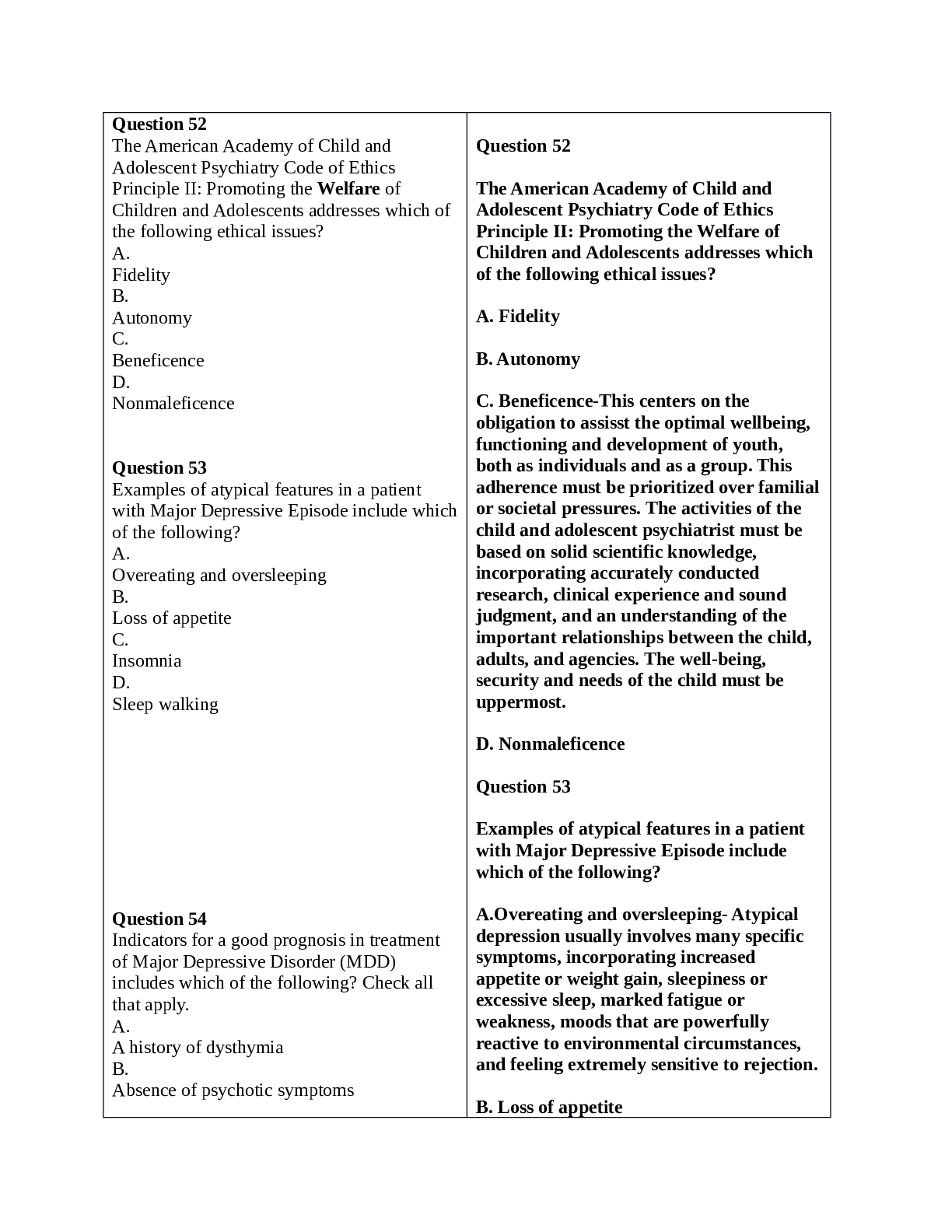
Question 52
The American Academy of Child and
Adolescent Psychiatry Code of Ethics
Principle II: Promoting the Welfare of
Children and Adolescents addresses which
of the following ethical issues?
A. Fidelity
B. Au
...
Question 52
The American Academy of Child and
Adolescent Psychiatry Code of Ethics
Principle II: Promoting the Welfare of
Children and Adolescents addresses which
of the following ethical issues?
A. Fidelity
B. Autonomy
C. Beneficence-This centers on the
obligation to assisst the optimal wellbeing,
functioning and development of youth,
both as individuals and as a group. This
adherence must be prioritized over familial
or societal pressures. The activities of the
child and adolescent psychiatrist must be
based on solid scientific knowledge,
incorporating accurately conducted
research, clinical experience and sound
judgment, and an understanding of the
important relationships between the child,
adults, and agencies. The well-being,
security and needs of the child must be
uppermost.
D. Nonmaleficence
Question 53
Examples of atypical features in a patient
with Major Depressive Episode include
which of the following?
A.Overeating and oversleeping- Atypical
depression usually involves many specific
symptoms, incorporating increased
appetite or weight gain, sleepiness or
excessive sleep, marked fatigue or
weakness, moods that are powerfully
reactive to environmental circumstances,
and feeling extremely sensitive to rejection.
B. Loss of appetite
C.
An advanced age of onset
D.
No more than one previous hospitalization for
MDD
Question 55
When assessing a child who has presented
with concerns of being anxious and worried,
the provider asks the child "Do you get
sudden surges of fear that make your body
feel shaky or your heart race?" to screen for
which of the following common diagnostic
possibilities?
A.
Obsessive -compulsive disorder
B.
Posttraumatic stress disorder
C.
Panic disorder
D.
Separation anxiety disorder
Question 56
Which of the following is not consistent with
the purpose of The ANA's Code of Ethics for
Nurses?
A.
It is a succinct statement of the ethical values,
obligation, duties, and professional ideals of
nurses individually and collectively.
B.
It is the profession's non-negotiable ethical
standard.
C.
It is an expression of nursing's own
understanding of its commitment to society.
D.
It clearly determines how ethical obligations
of nurses are met.
Question 57
ADHD, impulse-control, conduct disorder,
and intellectual disabilities and anxiety
disorders are predominant during which of the
following age ranges?
A.
Ages 0-5
C. Insomnia
D. Sleep walking
Question 54
Indicators for a good prognosis in
treatment of Major Depressive Disorder
(MDD) includes which of the following?
Check all that apply.
A. A history of dysthymia
B.Absence of psychotic symptoms
C. An advanced age of onset
D. No more than one previous
hospitalization for MDD
The Answers are B and D- Cases when
outcome is good are associated with
absence of pyschosis and no more than one
previous hospitalization for MDD. Cases
when outcome is really are linked with
improper treatment, extreme initial
symptoms incorporating psychosis, early
age of onset, previous episodes, not
complete recovery after one year of
treatment, pre-existing severe mental or
medical disorder, and family dysfunction.
Question 55
When assessing a child who has presented
with concerns of being anxious and
worried, the provider asks the child "Do
you get sudden surges of fear that make
your body feel shaky or your heart race?"
to screen for which of the following
common diagnostic possibilities?
A. Obsessive -compulsive disorder
B.Posttraumatic stress disorder
[Show More]