ENG 122 Practice Test for Reading Strategies Hacker
Skim the following selection and then answer the question.
GETTING HELP
People seeking help for psychological problems face a bewildering array of
choices. There ar
...
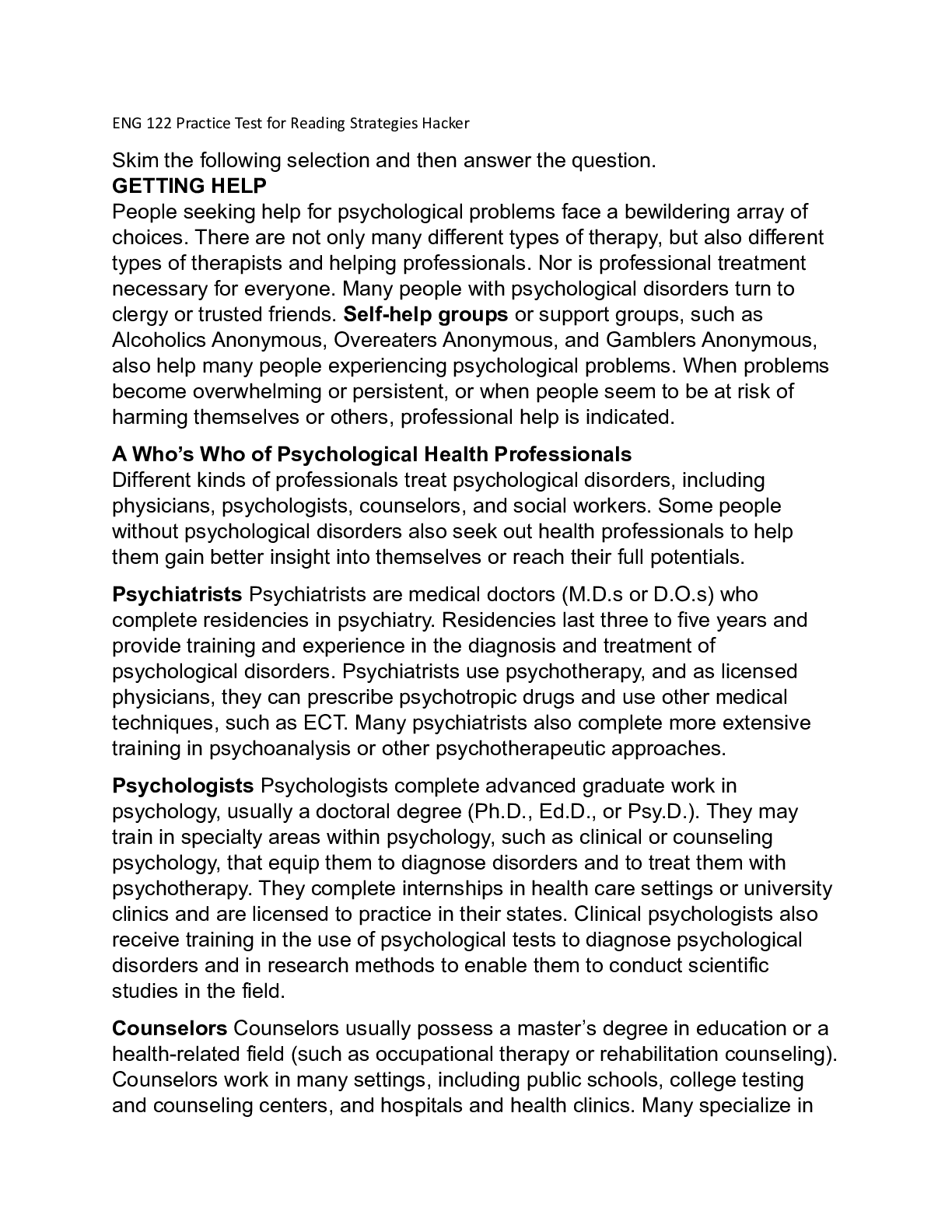
ENG 122 Practice Test for Reading Strategies Hacker
Skim the following selection and then answer the question.
GETTING HELP
People seeking help for psychological problems face a bewildering array of
choices. There are not only many different types of therapy, but also different
types of therapists and helping professionals. Nor is professional treatment
necessary for everyone. Many people with psychological disorders turn to
clergy or trusted friends. Self-help groups or support groups, such as
Alcoholics Anonymous, Overeaters Anonymous, and Gamblers Anonymous,
also help many people experiencing psychological problems. When problems
become overwhelming or persistent, or when people seem to be at risk of
harming themselves or others, professional help is indicated.
A Who’s Who of Psychological Health Professionals
Different kinds of professionals treat psychological disorders, including
physicians, psychologists, counselors, and social workers. Some people
without psychological disorders also seek out health professionals to help
them gain better insight into themselves or reach their full potentials.
Psychiatrists Psychiatrists are medical doctors (M.D.s or D.O.s) who
complete residencies in psychiatry. Residencies last three to five years and
provide training and experience in the diagnosis and treatment of
psychological disorders. Psychiatrists use psychotherapy, and as licensed
physicians, they can prescribe psychotropic drugs and use other medical
techniques, such as ECT. Many psychiatrists also complete more extensive
training in psychoanalysis or other psychotherapeutic approaches.
Psychologists Psychologists complete advanced graduate work in
psychology, usually a doctoral degree (Ph.D., Ed.D., or Psy.D.). They may
train in specialty areas within psychology, such as clinical or counseling
psychology, that equip them to diagnose disorders and to treat them with
psychotherapy. They complete internships in health care settings or university
clinics and are licensed to practice in their states. Clinical psychologists also
receive training in the use of psychological tests to diagnose psychological
disorders and in research methods to enable them to conduct scientific
studies in the field.
Counselors Counselors usually possess a master’s degree in education or a
health-related field (such as occupational therapy or rehabilitation counseling).
Counselors work in many settings, including public schools, college testing
and counseling centers, and hospitals and health clinics. Many specialize in
academic, vocational, marital, or family counseling, or in career development
or the treatment of milder psychological disorders, such as adjustment
disorders. Pastoral counselors are religious personnel (ministers, etc.) who
are trained to help parishioners cope with personal problems.
Social Workers Social workers usually hold a Master of Social Work (M.S.W.)
degree and are licensed by the state in which they practice. Clinical social
workers provide counseling or psychotherapy and help people obtain the
services they need from community agencies and organizations. For example,
they may help people with schizophrenia adjust to the community once they
leave the hospital. Many social workers, like counselors, also specialize in
marital or family therapy.
(Jeffrey S. Nevid, Spencer A. Rathus, and Hannah R. Rubenstein, Health in
the New Millennium)
Q1 Based on information in the first heading (the main heading), the selection
will most likely focus on
famous psychologists.
types of psychological health professionals.
why people seek psychological help.
different kinds of self-help groups.
Q2 Why do the words Psychiatrists, Psychologists, Counselors, and Social
Workers begin each of the last four paragraphs, respectively?
[Show More]









 Block 1 to 7.png)
.png)









.png)
.png)