SDV 100: Understanding Academic
Skills
Focusing on what is being said, repeating what you heard, asking a speaker to expand or clarify,
looking for non-verbal signals, and listening for requests are principles of ____
...
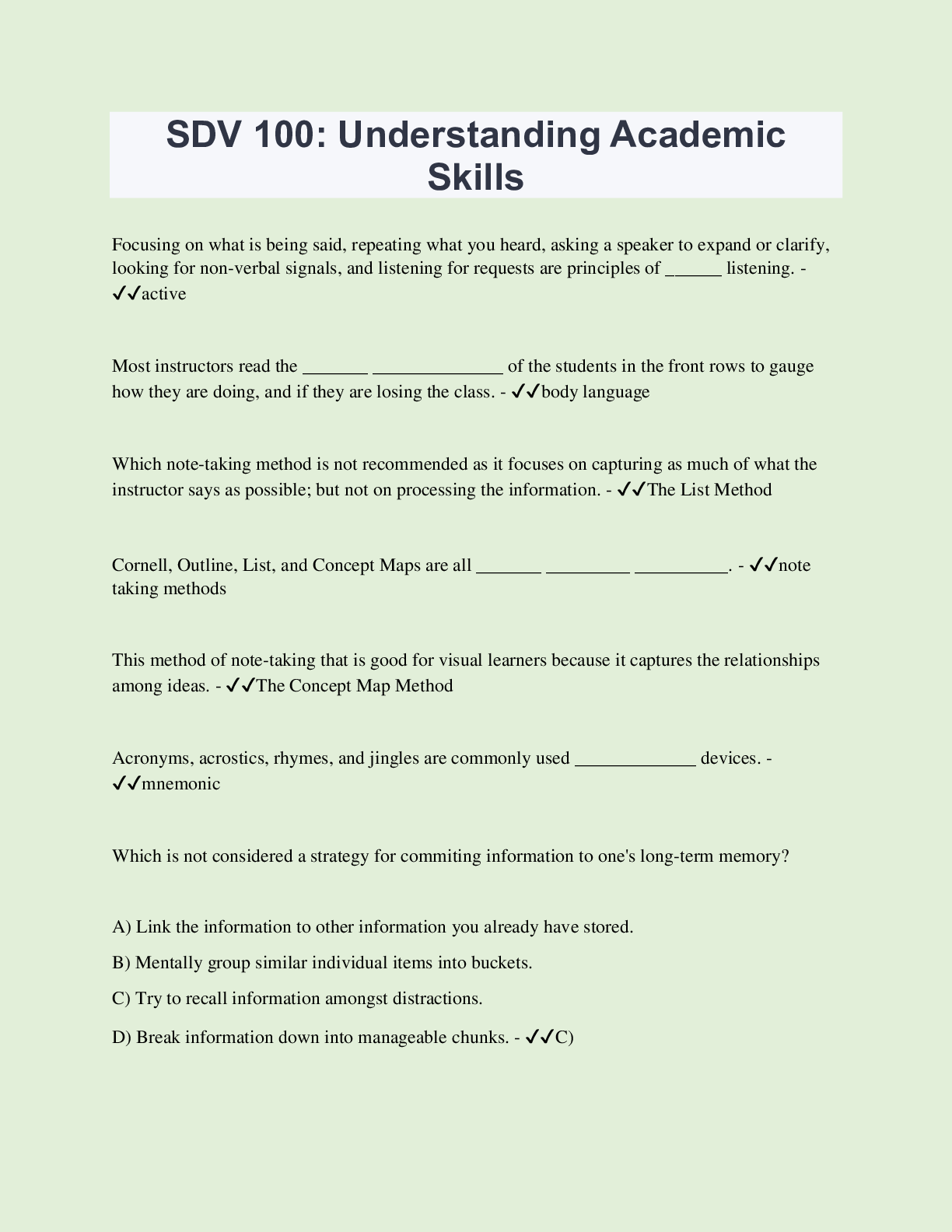
SDV 100: Understanding Academic
Skills
Focusing on what is being said, repeating what you heard, asking a speaker to expand or clarify,
looking for non-verbal signals, and listening for requests are principles of ______ listening. -
✔✔active
Most instructors read the _______ ______________ of the students in the front rows to gauge
how they are doing, and if they are losing the class. - ✔✔body language
Which note-taking method is not recommended as it focuses on capturing as much of what the
instructor says as possible; but not on processing the information. - ✔✔The List Method
Cornell, Outline, List, and Concept Maps are all _______ _________ __________. - ✔✔note
taking methods
This method of note-taking that is good for visual learners because it captures the relationships
among ideas. - ✔✔The Concept Map Method
Acronyms, acrostics, rhymes, and jingles are commonly used _____________ devices. -
✔✔mnemonic
Which is not considered a strategy for commiting information to one's long-term memory?
A) Link the information to other information you already have stored.
B) Mentally group similar individual items into buckets.
C) Try to recall information amongst distractions.
D) Break information down into manageable chunks. - ✔✔C)
________-________ memory allows one to apply knowledge to a specific task. - ✔✔Short-term
_______-________ memory allows one to store and recall information. - ✔✔Long-term
The learning cycle consists of what four steps? - ✔✔Prepare
Absorb
Record
Review/Apply
Reading your most difficult assignments early in your reading time, when you are freshest, is a
suggested reading strategy.
True or False - ✔✔True
Why is it important to read the graphics provided in textbooks?
A) They will increase your understanding.
B) They engage different comprehension processes.
C) They will create different kinds of memory links to help you remember the material.
D) All of the above. - ✔✔D)
Multitasking is dangerous to memorization and will cause you to need to reboot your _______-
________ memory each time you switch mental tasks. - ✔✔short-term
Why is the Cornell method of note taking is useful for the following, except: - ✔✔recording
everything the instructor says
How is summarizing main ideas in your own words useful? - ✔✔Aids with recall
Short-term memory is _______ memory. - ✔✔active
Long-term memory is _______ memory. - ✔✔passive
All of the follow are strategies for reading textbooks, except:
A) Divide the reading assignment into smaller blocks.
B) Take breaks.
C) Schedule blocks of time when you are most inattentive.
D) Connect the material with class lectures or other chapters. - ✔✔C)
Never Eat Sour Watermelons = North, East, South, West; the points of a compass.
Is an example of what mnemonic? - ✔✔Acrostic
PEN = Proton, Electron, Neutron; the parts of an atom.
Is an example of what mnemonic? - ✔✔Acronym
Making a deliberate decision to remember the specific data, using visual imagery, and working
from general information to the specific information are examples of ________________. -
✔✔linking
Students who don't listen effectively will have a hard time differentiating between what is the
main idea of a lecture and what's the supporting detail.
True or False - ✔✔True
2 column system of notes with a 'cue' column on left side with questions or main ideas; right side
are details or explanations, and summary at the bottom. - ✔✔Cornell Method
The outline method places most important ideas along the left margin, which are numbered with
roman numerals. Supporting ideas to these main concepts are indented and are noted with capital
letters. Under each of these ideas, further detail can be added, designated with an Arabic number,
a lowercase letter, and so forth. - ✔✔Outline Method
This method of note-taking that is good for visual learners because it captures the relationships
among ideas. - ✔✔Concept Map Method
[Show More]





.png)
.png)