Pharmaceutical Calculations
Density:
• Def.: It is a mass per unit volume of substance (1.8 g/ml).
• Calculated by dividing mass by volume.
Example: If 10 ml of sulfuric acid weight 18 g,
Density =
18 (g)
...
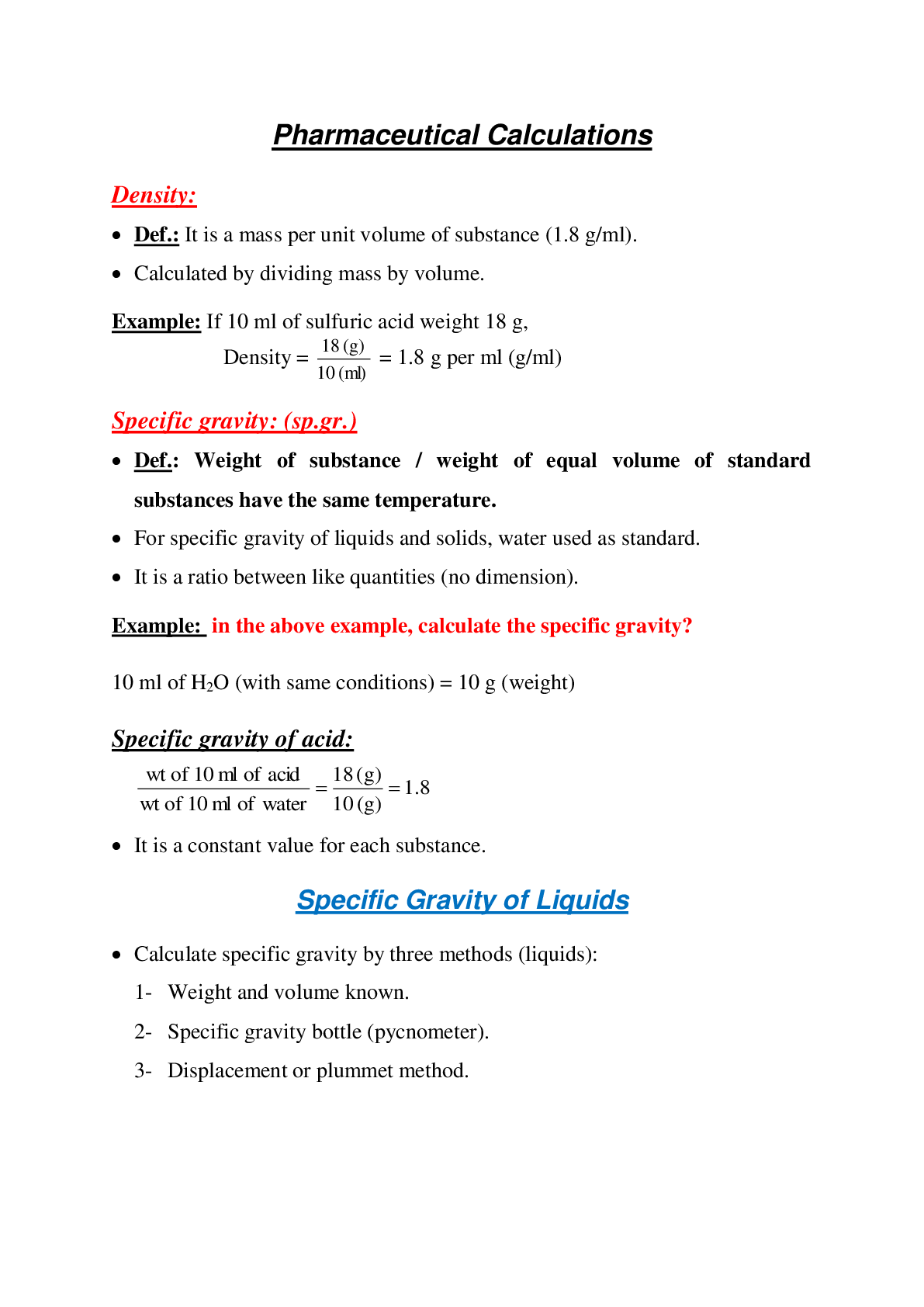
Pharmaceutical Calculations
Density:
• Def.: It is a mass per unit volume of substance (1.8 g/ml).
• Calculated by dividing mass by volume.
Example: If 10 ml of sulfuric acid weight 18 g,
Density =
18 (g)
10 (ml)
= 1.8 g per ml (g/ml)
Specific gravity: (sp.gr.)
• Def.: Weight of substance / weight of equal volume of standard substances have the same temperature.
• For specific gravity of liquids and solids, water used as standard.
• It is a ratio between like quantities (no dimension).
Example: in the above example, calculate the specific gravity?
10 ml of H2O (with same conditions) = 10 g (weight)
Specific gravity of acid:
wt of 10 ml of acid wt of 10 ml of water
18 (g) 1.8
10 (g)
• It is a constant value for each substance.
Specific Gravity of Liquids
• Calculate specific gravity by three methods (liquids): 1- Weight and volume known.
2- Specific gravity bottle (pycnometer). 3- Displacement or plummet method.
1- Specific gravity by known weight and volume of liquids:
Ex: If 54.96 ml of oil weight 52.8 g
Specific gravity of oil =
wt of 54.96 ml of oil wt of 54.96 ml of water
= 52.78 0.9603
54.96
N.B.:
54.96 ml of water weight 54.96 gm (under similar conditions).
2- Specific gravity of liquids by pycnometer (specific gravity bottle):
1- Wt of container (specific gravity bottle) (empty) (1). 2- Filled the container with water and weight (2).
3- Filled the container with liquid and weight (3). 4- Wt of water = (2) – (1) (4)
5- Wt of liquid = (3) – (1) (5)
Specific gravity =
wt of liquid
(5)
Example
wt of water
(4)
• Specific gravity bottle weights = 23.66 g (1)
• Filled with water weights = 72.95 g (2)
• Filled with liquid weights = 73.56 g (3) Specific gravity ?
• Wt of water = 72.95 – 23.66 = (2) – (1) = 49.29 gm
• Wt of liquid = 73.56 – 23.66 = (3) – (1) = 49.90 gm
Specific gravity =
49.90 1.012
49.29
Specific Volume
• Specific volume of substance =
volume of substance
volume of equal wt of water
• Specific gravity: comparison Wts of equal volumes
• Specific volume: comparison Vs of equal weights
• Are reciprocals of each other (specific gravity = 1/ specific volume)
(Specific volume= 1/specific gravity)
• If multiplied together = 1
Specific volume calculation (liquid):
1- Given volume of specified Wt. 2- Given its specific gravity
3- Calculate specific gravity by having specific volume.
Example:
1- Determine specific volume of syrup, 91.0 ml (its wt = 107.16 g)
Specific volume =
volume
91.0
of standard (water)
91.0
107.16
0.850
107.16 g of water = 107.16 g ml (volume)
2- What is specific volume of phosphoric acid having sp. gr. 1.71?
sp. volume =
1 0.585
1.71
3- What is sp. gr. of liquid has sp. volume 1.396
sp. gr. =
1 0.716
1.396
Calculations of weight (liquid):
• Calculation the weight of liquid when given
- Volume - specific gravity
sp. gr. water sp. gr. liquid
wt of equal volume
x
of water
x = weight of liquid
N.B: sp. gr. of water = 1
Wt of liquid = wt of equal volume of water x sp. gr. liquid Example: What is the wt of 3620 ml of alcohol having sp. gr. of 0.820?
• Sp. gr. of liquid x wt of equal volume of water = wt of liquid
• 3620 ml of water = wt of 3620 g
• Wt of liquid = 3620 (g) of water x 0.820 = 2968 g.
Calculations of volume (liquid):
• Calculate the volume of liquid:
- Wt - sp. gr.
sp. gr. liquid sp. gr. water
volume
of equal wt water x
x = volume of liquid V liquid =
volume
of equal wt water
sp. gr. liquid
Example:
What is the volume of 492 g nitric acid with sp. gr. 1.40?
492 g of water measure 492 ml
Volume =
492 351 ml
1.4
Percentages
Def.: Rate for hundred, no. and percent (%).
Ex: 25% = 25 parts of 100 parts = 25 / 100 = 0.25
Uses in Pharmaceutics:
1- Express the conc. of solute in solution.
2- Amount of active ingredient (drug or preparation).
3- Amount of active ingredient in dosage form.
Percentage calculation (concentration):
I- Percent (w/v) %
No. grams of substance in 100 ml (solution liquid). Ex: water or another.
II- Percent (v/v) %
No. of milliliters of substances in 100 ml of solution
III- Percent (w/w) %
No. of grams in 100 gm of solution or liquid.
N.B.:
• mg. %
- Number of milligrams of substances in 100 ml of liquid
- Used to determine conc. of drug or natural substances in biological fluid (blood).
• ppm (part per million):
- Used for very dilute solutions (determine conc.)
- For test limits.
I) Percentage weight-in-volume
1- Calculate (wt) of substance of known % (w/v) in specific volume.
2- Calculate the % (w/v) of solution by knowing:
• wt. solute or • volume of solution.
3- Calculate the volume of solution by knowing:
• (w/v) % or • (wt) of solute
gr. solute = vol. in ml x % (w/v)
Examples:
1- How many grams of dextrose required to prepare 4000 ml of 5% solution?
5
g. solute = 4000 x 100 = 200 g
5g. 100 ml , X 4000 ml
X = 4000 x 5 200 g
100
2- What is the % strength (w/v) of solution of urea, if 80 ml contain 12 g.?
% = g. solute of constituen t x100
volume in ml
% = 12 x100 15%
80
3- How many milliliters of 3% solution can be made from 27 g. ephedrine sulfate?
Volume in ml =
g. solute
%
27
0.03
900 ml
II) Percentage volume-in-volume (v/v) %: 1- Calculate (v) of active ingredient by knowing:
• (V) Liquid or • % (v/v)
2- Calculate % (v/v) by knowing:
• (V) Active ingredient or • volume of solution
3- Calculate (V) of solution by knowing:
• % (v/v) or • (V) active ingredient.
Examples:
1- How many ml. liquefied phenol should be used in: R/ Liquefied phenol 2.5%
Calamine lotion to 240.0 ml
(V) Active ingredient = (V) in ml. x % ml
240 ml x 0.025 = 6 ml.
or 2.5 – 100 ml
x – 240.0 ml x =
240 x 2.5 6 ml
100
2- Calculate the % (v/v) of solution given the volume of active ingredient and volume of solution?
ml.
% =
of active ingredient
x100
volume in ml.
Ex: - 250 ml of lotion
- used 4 ml liquefied phenol
Calculate the % (v/v) liquefied phenol in lotion?
4
% = 250
x 100 1.6% (V/V)
3- Calculate volume of solution given the volume of active ingredient and its
% (v).
Example:
Peppermint spirit contains 10% (v/v) of peppermint oil. What volume of spirit contain 75 ml of active ingredient?
Volume in ml =
75 750 ml
0.1
III) Percentage weight-in-weight (w/w) %:
1- Calculate the (wt) g drug by knowing:
• % or • (wt) solution.
2- Calculate the (wt) of solution by knowing:
• % or • (wt) of active ingredient
3- Calculate % by knowing:
• (wt) of solution or • (wt) of solution
Examples:
1- How many grams of phenol should be used to prepare 240 g. of 5% (w/w) solute in water?
g. of solute = wt solution (g.) x %
Weight of phenol = 240 x 0.05 = 12 g
2- How many g. of drug to make 120 ml of 20% (w/w) solute in having sp. gr. of 1.15?
1- wt of solution (120 ml) = 120 x 1.15 = 138 g.
2- wt of solute = 138 x 0.2 = 27.6 g.
3- If 1500 g. of solution contains 75 g. of drug substance, what is the % (w/w) of solution?
% = 75
1500
x100 5%
3- Calculate wt. of solution either by knowing % or wt. of active ingredient.
Ex: What wt. of 5% (w/w) solution can be prepared from 2 g. active
ingredient?
g. of solute
%
2
0.05
40 g.
Ratio Strength
• For expression the conc. of weak solution.
• 5% = 5 parts per 100 parts
5: 100 1: 20 (ratio strength).
Example:
1- Express 0.02% as ratio strength?
0.02 100 1: 5000
2 100
100
1/50 100 Ratio strength = 1: 5000
2- Express 1: 4000 as percentage strength?
1 4000
x 100 x =
100 0.025%
4000
Dilution and Concentration of Liquids
A- Calculate the % or ratio strength of solution made by diluting or concentrating a solute, giving • strength or • quantity (solution)
Example:
If 500 ml of 15% (v/v) solution of methyl salicylate in alcohol are diluted to 1500 ml. What % (v/v) ?
* 1500 15%
x = 5%
500 x
Quantity x conc. (Known) = quantity x conc. (Unknown)
* 500 x 15% = 1500 x (X %) X = 5%
B- Calculate the amount of solution with known strength by either diluting or concentrating a specific quantity of solution of given strength
Example:
How many grams (g.) of 10% (w/w) ammonia water can be made from 1800 g. of 28% (w/w) ammonia water?
* 10%
28%
1800
x
x = 5040 g.
Quantity x conc. (Known) = quantity x conc. (Unknown)
Or * 1800 (g.) x 28% = X (g.) x 10% x = 5040 g.
Stock Solutions
Definition:
• Are solutions of known concentration.
• Are strong solutions from which weaker ones are made.
• Are prepared in (w/v).
• Their concentrations expressed by ratio strength ( ).
Example:
How many milliliters of 1:400 (w/v) stock solutions should be used to make 4 liters of a 1:2000 (w/v) solution?
1) 4 liter = 4000 ml
100
1:400 (ratio strength) = 400
1:2000 = 0.05%
= 0.25%
0.25(%) 4000 (ml)
x = 800 ml
0.05(%) x (ml)
2) 4000 (ml)
x (ml)
x = 800 ml
800 ml taken from stock solution and completed to 4000 ml.
Dilution of Alcohol
Examples:
1- How much water should be mixed with 5000 ml of 85% (v/v) alcohol to make 50% (v/v) alcohol?
50 (%)
85 (%)
5000 (ml)
x (ml)
x = 8500 ml
i.e. 5000 ml (85%) alcohol add water to 8500 ml.
2- How much water should be added to 4000 g. of 90% (w/w) alcohol to make 40% (w/w) alcohol?
40 (%) 4000 (g.)
x = 9000 g.
90 (%) x (g.)
i.e. 4000 g. (90%) alcohol add water to 9000 ml.
Alligation
1- Alligation medical 2- Alligation alternate
1- Alligation Medical:
Def.: A method by which the weighted average percentage strength of mixture of two or more substances whose quantities and concentrations known quickly calculated.
Determine percentage strength of a mixture.
Calculate the (%) of mixture of two or more components of known (%).
Examples:
1- What is the percentage (v/v) of alcohol in a mixture of 3000 ml of 40% (v/v) alcohol, 1000 ml of 60% (v/v) alcohol and 1000 ml of 70% (v/v) of alcohol?
40 x 3000 = 120,000
60 x 1000 = 60,000
70 x 1000 = 70,000
Total 5000 = 250,000
% of alcohol in mixture =
250000 50%
5000
2- What is the % of zinc oxide in ointment prepared by mixing 200 g. of 10% ointment, 50 g. of 20% ointment, and 100 g. of 5% ointment?
10 x 200 = 2000
20 x 50 = 1000
5 x 100 = 500
= 3500 10%
350
Total 350 = 3500
2- Alligation Alternate:
Def. Calculate the relative amounts of solutions or substances of different strengths that used to make a mixture of required strength.
Example:
In what proportion should 20% benzocaine ointment be mixed with ointment base (without drug) to produce 2.5% benzocaine ointment?
20% minus 2.5 parts of 20% (drug + base)
gives
0% drug (base) 17.5 parts of oint. base
Relative amounts = 2.5: 17.5 or 1:7
Check: 20 x 1 = 20
0 x 7 = 0
Total
8 = 20
Percentage of oint. = 20 / 8 = 2.5%
2- Calculate the quantity of a solution or mixture of given strength that should be mixed with a specified quantity of another solution or mixture of given strength to make a solution or mixture of desired strength.
Example:
How many grams of 2.5% hydrocortisone cream should be mixed with
360.0 g. of 0.25% cream to make a 1% hydrocortisone cream?
2.5% 0.75 parts of 2.5% cream
0.25% 1.5 parts of 0.25%
Relative amounts = 0.75 : 1.5 or 1:2 Check: Homework
2 (parts) 360.0 (g.)
1 (part) x (g.) x =
360 180 g
2
180 : 360 = 1:2
• 180 (g.) of 2.5% hydrocortisone cream + 360 (g.) of 0.25% cream 1% hydrocortisone cream.
Specific Gravity of Mixtures
I- To calculate specific gravity of a mixture given the specific gravity of its ingredients.
Examples: What is sp. gr. of mixture of 1- 1000 ml of syrup sp. gr. = 1.3
2- 400 ml glycerin sp. gr. = 1.25
3- 1000 ml alixir sp. gr. = 0.950
1.3 x 1000 = 1300
1.25 x 400 = 500
0.95 x 1000 = 950
Total 2400 = 2750
Sp. gr. of mixture =
2750 1.146
2400
II-Calculate the relative or specific amounts of ingredients of given sp. gr. required to make mixture of desired sp. gr.?
Examples:
1- In what proportion must glycerin with sp. gr. of 1.25 and water be mixed to give a liquid having sp. gr. 1.10 ?
Gly. 1.25 0.10 parts of glycerin
1.10
water 1.00 0.15 parts of water
Relative amounts = 0.10 : 0.15 or 2:3 (gly. : water)
2- How many milliliters of each of two liquids with sp. gr. 0.950 and 0.875 should be used to prepare 1500 ml of liquid having sp. gr. of 0.925%.
(1) 0.950 0.050 parts of liquid (1)
(2) 0.875 0.025 parts (2)
Relative amounts = 0.050 : 0.025 = 2 : 1 Total = 3 parts
3 parts
2 parts
1500 ml
x ml
x = 1000 ml of liquid with sp. gr. 0.950
3 parts 1500 ml
y = 500 ml of liquid with sp. gr. 0.875
1 part y ml
1000 + 500 = 1500
[Show More]