NCLEX 75 Questions and Answers
Solved Correctly
The nurse is taking the health history of a patient being treated for Emphysema and Chronic
Bronchitis. After being told the patient has been smoking cigarettes for 30 y
...
NCLEX 75 Questions and Answers
Solved Correctly
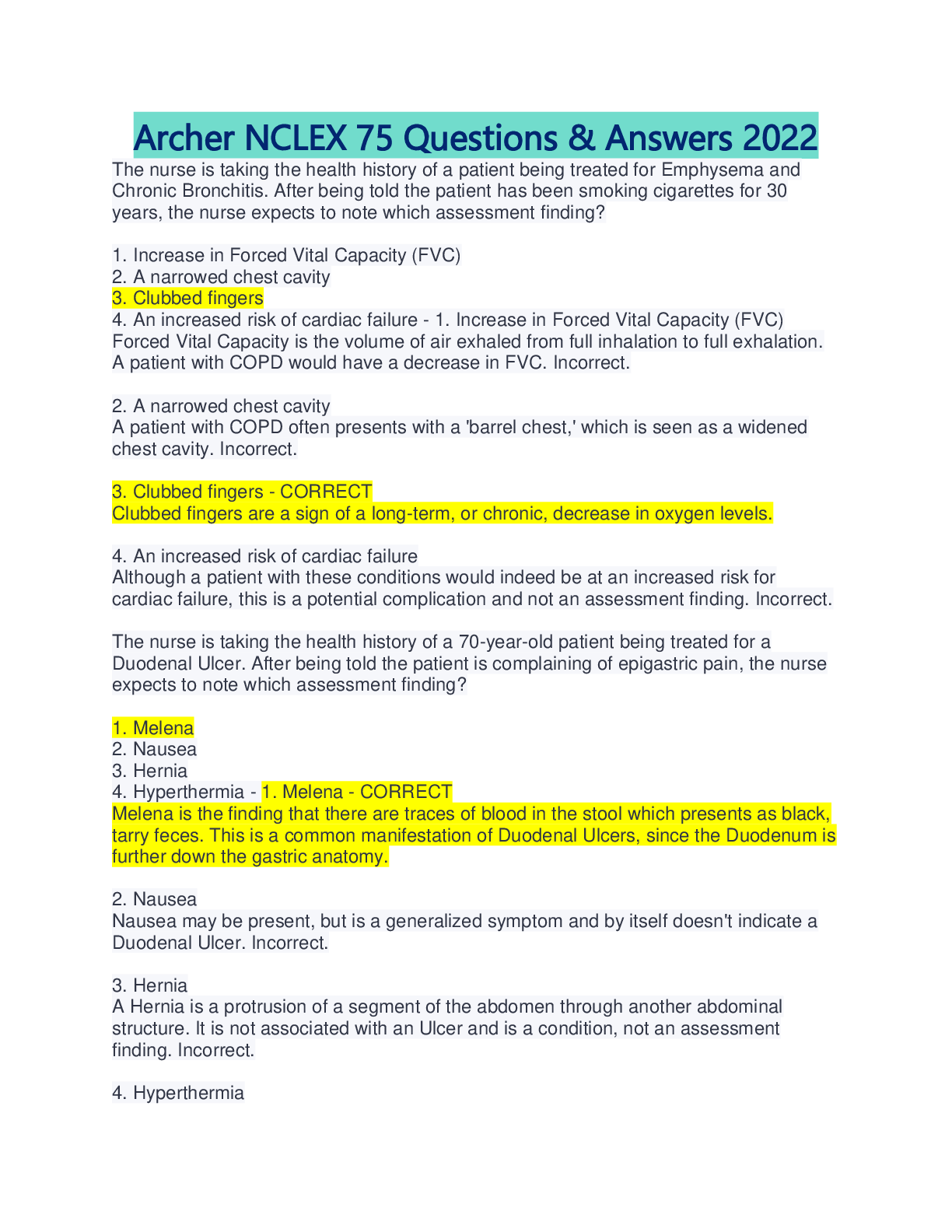
The nurse is taking the health history of a patient being treated for Emphysema and Chronic
Bronchitis. After being told the patient has been smoking cigarettes for 30 years, the nurse
expects to note which assessment finding?
1. Increase in Forced Vital Capacity (FVC)
2. A narrowed chest cavity
3. Clubbed fingers
4. An increased risk of cardiac failure ✔✔1. Increase in Forced Vital Capacity (FVC)
Forced Vital Capacity is the volume of air exhaled from full inhalation to full exhalation. A
patient with COPD would have a decrease in FVC. Incorrect.
2. A narrowed chest cavity
A patient with COPD often presents with a 'barrel chest,' which is seen as a widened chest cavity.
Incorrect.
3. Clubbed fingers - CORRECT
Clubbed fingers are a sign of a long-term, or chronic, decrease in oxygen levels.
4. An increased risk of cardiac failure
Although a patient with these conditions would indeed be at an increased risk for cardiac failure,
this is a potential complication and not an assessment finding. Incorrect.
The nurse is taking the health history of a 70-year-old patient being treated for a Duodenal Ulcer.
After being told the patient is complaining of epigastric pain, the nurse expects to note which
assessment finding?
1. Melena
2. Nausea
3. Hernia
4. Hyperthermia ✔✔1. Melena - CORRECT
Melena is the finding that there are traces of blood in the stool which presents as black, tarry
feces. This is a common manifestation of Duodenal Ulcers, since the Duodenum is further down
the gastric anatomy.
2. Nausea
Nausea may be present, but is a generalized symptom and by itself doesn't indicate a Duodenal
Ulcer. Incorrect.
3. Hernia
A Hernia is a protrusion of a segment of the abdomen through another abdominal structure. It is
not associated with an Ulcer and is a condition, not an assessment finding. Incorrect.
4. Hyperthermia
Hyperthermia, a high temperature, is not an assessment finding of a Duodenal Ulcer. Incorrect
A nurse is providing discharge teaching for a patient with severe Gastroesophogeal Reflux
Disease. Which of these statements by the patient indicates a need for more teaching?
1. "I'm going to limit my meals to 2-3 per day to reduce acid secretion."
2. "I'm going to make sure to remain upright after meals and elevate my head when I sleep"
3. "I won't be drinking tea or coffee or eating chocolate any more."
4. "I'm going to start trying to lose some weight." ✔✔1. "I'm going to limit my meals to 2-3 per
day to reduce acid secretion."
CORRECT - Large meals increase the volume and pressure in the stomach and delay gastric
emptying. It's recommended instead to eat 4-6 small meals a day.
2. "I'm going to make sure to remain upright after meals and elevate my head when I sleep"
Incorrect - This is a correct verbalization of health promotion for GERD.
3. "I won't be drinking tea or coffee or eating chocolate any more."
Incorrect - This is a correct verbalization of health promotion for GERD.
[Show More]
.png)
.png)