EPA 608 Type I from practice test
questions and answers rated A
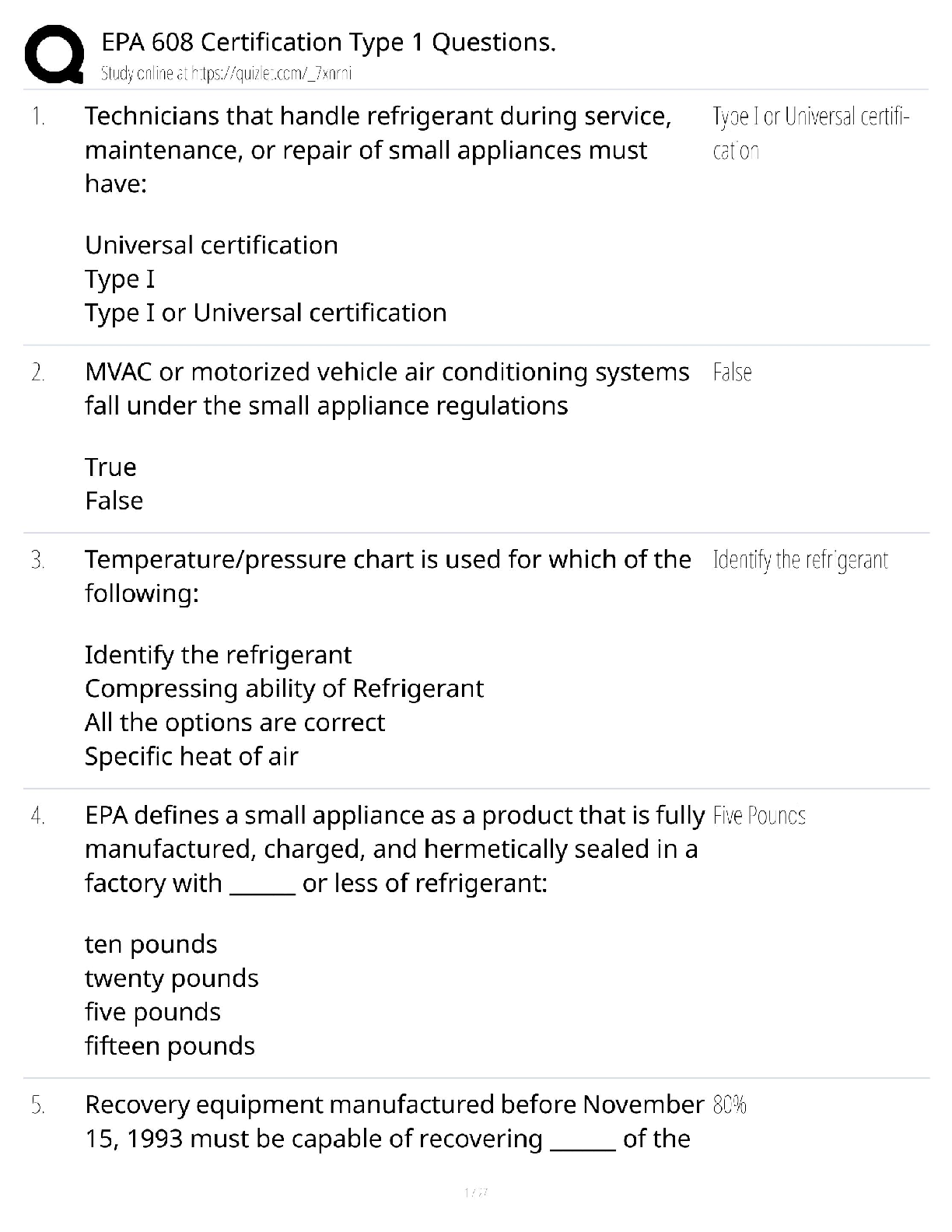
Technicians who perform sealed system service on small appliances must have; ✔✔Type I or
universal certification
A small appliance is defined by EPA as;
...
EPA 608 Type I from practice test
questions and answers rated A
Technicians who perform sealed system service on small appliances must have; ✔✔Type I or
universal certification
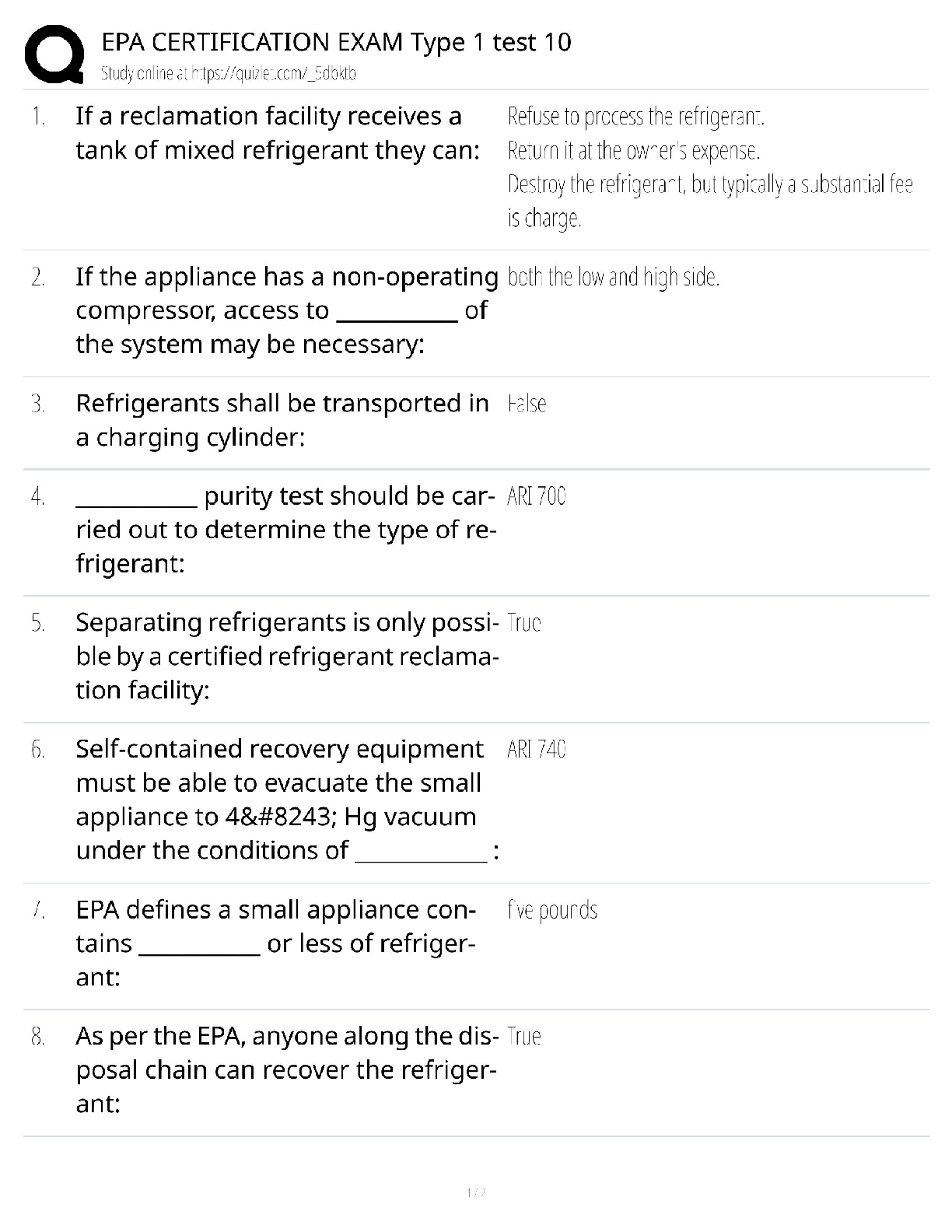
A small appliance is defined by EPA as; ✔✔Appliances manufactured, charged, and
hermetically sealed in a factory with 5 lbs or less of refrigerant
Type I Certification is required for; ✔✔Persons handling refrigerant during maintenance,
service, or repair of small appliances.
If regulations change after the technician becomes certified; ✔✔The technician is responsible for
complying with any future changes in the regulations.
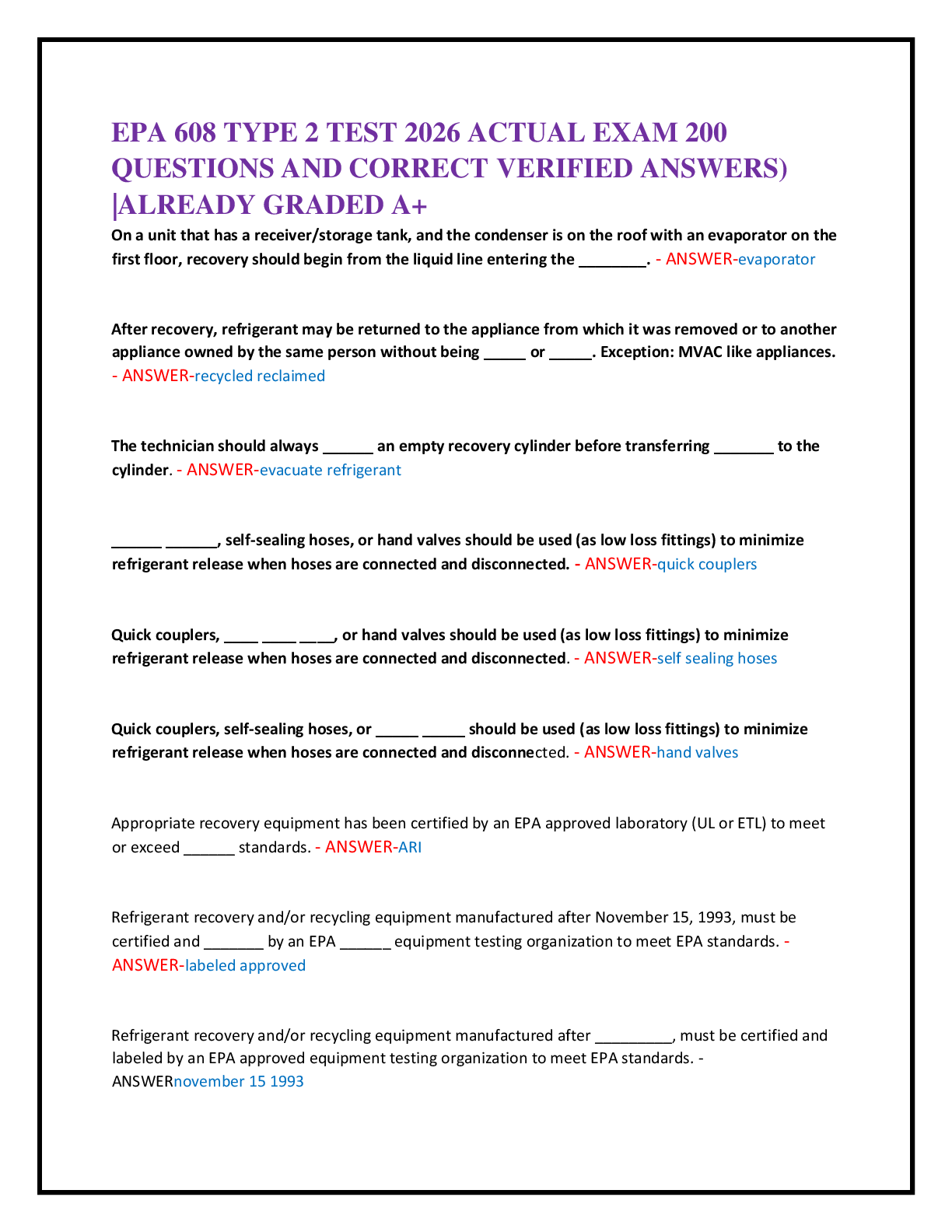
Recovery equipment manufactured after November 15, 1993 must be; ✔✔Certified by an EPA
approved testing laboratory.
Which of the following is true of small appliances refrigerant leaks; ✔✔EPA does not require
repair, but leaks should be repaired whenever possible.
Recovery equipment manufactured after November 15, 1993 must be capable of recovering;
✔✔90% of the refrigerant or achieving 5 inches of vacuum.
Recovering multiple types of refrigerants in the same cylinder; ✔✔Will make the reclaimed
refrigerants non reclaimable and a charge for disposal may be levied.
Self-contained or active recovery equipment; ✔✔Has its own means of recovery.
System-dependant or passive recovery equipment; ✔✔Captures refrigerant into a nonpressurized container with assistance of the appliance compressor.
What is defined as a non-condensible? ✔✔Air
When using a system-dependent recovery system on an appliance that has an operating
compressor, the technician should; ✔✔Run the compressor and recover from the high side of the
system.
When using a system-dependent recovery system on an appliance that has a non-operating
compressor, the technician should; ✔✔Place access fittings on both the low and high side of the
system.
System-dependant devices may only be used on appliances containing; ✔✔15 lbs of refrigerant
or less.
Small appliances are equipped with a straight piece of tubing (process stub) used to; ✔✔Install a
piercing type access valve fitting.
If a strong odor is detected while performing the recovery process, ✔✔A compressor burnout
has likely occurred.
After the refrigerant has been recovered, which of the following can be used to flush the system?
✔✔Nitrogen.
When filling a charging cylinder with a regulated refrigerant; ✔✔The refrigerant vapor that is
vented off the top of the cylinder must be recovered.
If after installing a fitting for the purpose of recovering the appliances refrigerant, you find that
the system pressure is 0 psig; ✔✔Recovery is not required.
Applying heat with a heat gun to the compressor; ✔✔Can help vaporize any trapped liquid
refrigerant during recovery.
Refrigerators in the 1950's and earlier may have used what refrigerants (recovery is not
required)? ✔✔Methyl Formate, Methyl Chloride, or Sulfur Dioxide.
Small appliances in recreational vehicles may use refrigerants such as Ammonia, Hydrogen, or
water, and therefore; ✔✔The refrigerant should not be recovered.
Recovery equipment manufactured before November 15, 1993 must be capable of recovering.
✔✔80% of the refrigerant or achieving 4 inches of vacuum.
When pressurizing a system with nitrogen you should; ✔✔Charge through a pressure regulator
and place a relief valve in the downstream line from the pressure regulator.
After recovering refrigerant, the Nitrogen used to flush the system may be: ✔✔Legally vented.
[Show More]