ACSM Certified Exercise Physiologist Exam 2022 Fully
Verified.
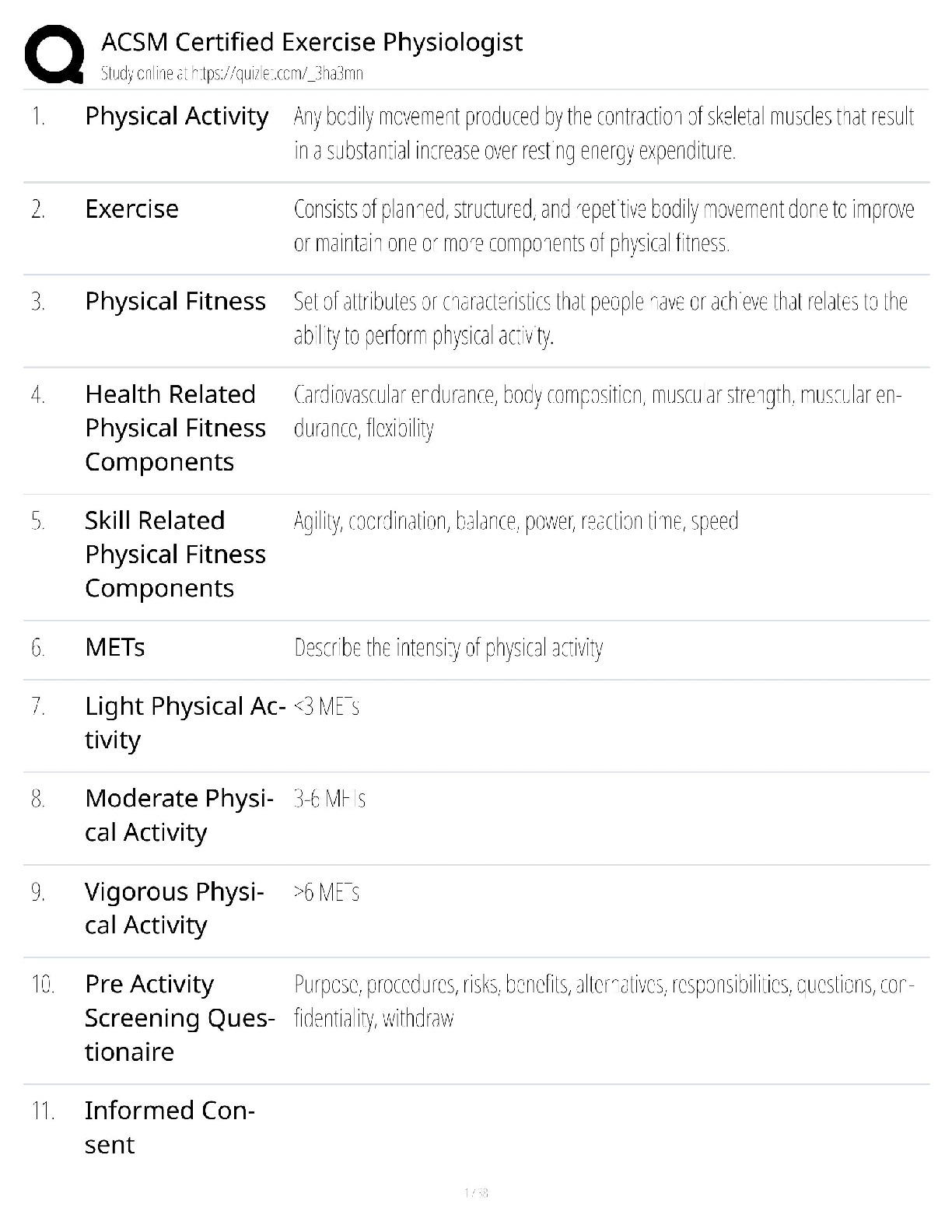
Physical Activity >>>>Any bodily movement produced by contracting skeletal muscles,
with an increase in energy expenditure.
Exercise >>>>Planned, purpose
...
ACSM Certified Exercise Physiologist Exam 2022 Fully
Verified.
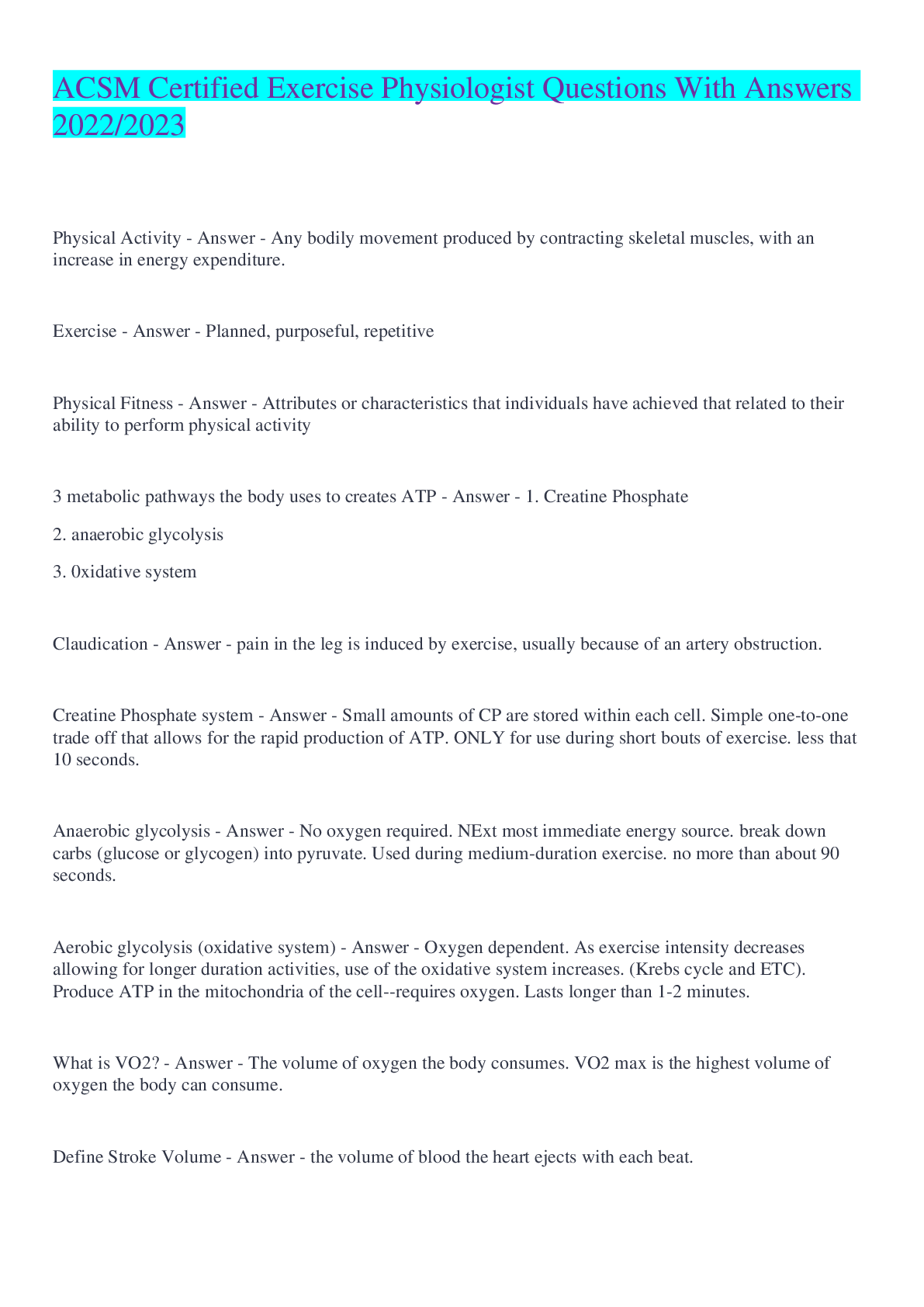
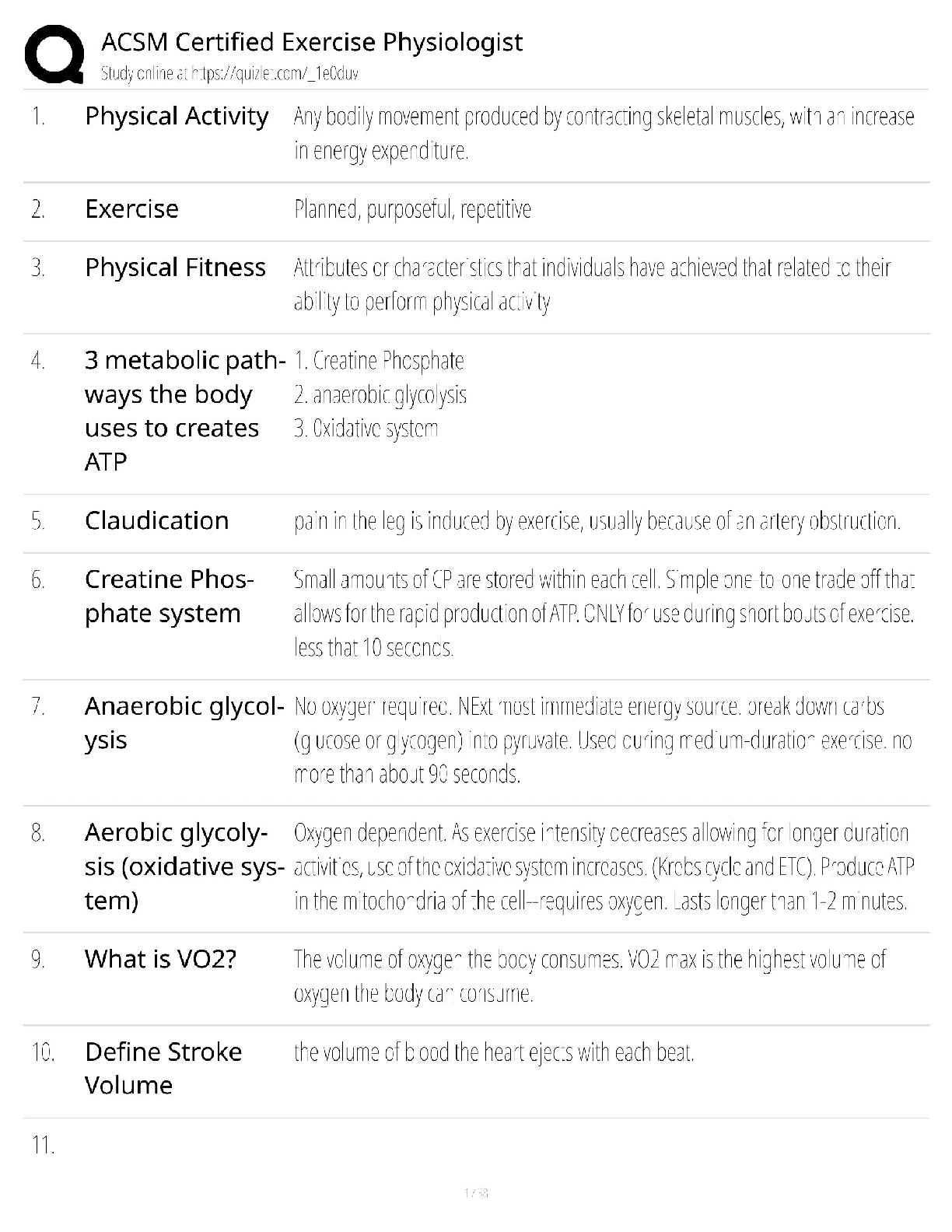
Physical Activity >>>>Any bodily movement produced by contracting skeletal muscles,
with an increase in energy expenditure.
Exercise >>>>Planned, purposeful, repetitive
Physical Fitness >>>>Attributes or characteristics that individuals have achieved that
related to their ability to perform physical activity
3 metabolic pathways the body uses to creates ATP >>>>1. Creatine Phosphate
2. anaerobic glycolysis
3. 0xidative system
Claudication >>>>pain in the leg is induced by exercise, usually because of an artery
obstruction.
Creatine Phosphate system >>>>Small amounts of CP are stored within each cell.
Simple one-to-one trade off that allows for the rapid production of ATP. ONLY for use
during short bouts of exercise. less that 10 seconds.
Anaerobic glycolysis >>>>No oxygen required. NExt most immediate energy source.
break down carbs (glucose or glycogen) into pyruvate. Used during medium-duration
exercise. no more than about 90 seconds.
Aerobic glycolysis (oxidative system) >>>>Oxygen dependent. As exercise intensity
decreases allowing for longer duration activities, use of the oxidative system increases.
(Krebs cycle and ETC). Produce ATP in the mitochondria of the cell--requires oxygen.
Lasts longer than 1-2 minutes.
What is VO2? >>>>The volume of oxygen the body consumes. VO2 max is the highest
volume of oxygen the body can consume.
Define Stroke Volume >>>>the volume of blood the heart ejects with each beat.
How does SV increase with workload? >>>>Similar to HR, it increases as workload
increases but only up to ~40% to 60% of VO2max. The percentages can be decreases
in sedentary individuals and increased with training.
What happens to resting HR as stroke volume increases? >>>>it decreases, as more
blood being pumped per beat allows the heart to beat less often.
What is cardiac output? >>>>a measure of blood pumped per minute. The product of
stroke volume and heart rate.What does Diastolic Blood pressure do during exercise? >>>>Remains stable or
decreases slightly.
What is rate pressure product? >>>>serves as an estimate of myocardial oxygen
demand. Product of HR and Systolic BP. HR X SBP
What is the Fick equation used to determine VO2 max? >>>>VO2max = HRmax X
SVmax X a-VO2 difference max (arteriovenous oxygen difference)
What is the gold standard to measure Cardiorespiratory fitness? >>>>VO2 max during
open circuit spirometry.
How does a submaximal exercise test work? >>>>It estimates VO2 max from the HR
response to submaximal single stage or graded exercise.
absolute oxygen consumption vs. relative oxygen consumption >>>>absolute is the raw
volume of O2 consumed by the body. Relative is the volume of O2 consumed relative to
body weight. Useful to compare fitness levels between individuals.
What is one of the largest components of PA-related energy expenditure?
>>>>Occupational Physical Ativity
5 Health related physical fitness components >>>>Cardiorespiratory endurance, body
composition, muscular strength, muscular endurance, and flexibility
6 Skill (performance) related physical fitness components >>>>Agility, coordination,
balance, power, reaction time, and speed
cardiorespiratory endurance >>>>ability of circulatory system and respiratory system to
supply o2 during sustained physical activity
Body composition >>>>relative amounts of muscle, fat, bone, and other vital parts of the
body
Muscular strength >>>>Ability of muscle to exert force
muscular endurance >>>>ability of muscle to continue to perform without fatigue
flexibility >>>>ROM at a joint. as per the skeletal muscles and not any external forces.
Agility >>>>ability to change position of the body in space with speed and accuracy
coordination >>>>ability to use the senses together with body parts to perform tasks
smoothly and accuratelybalance >>>>maintenance of equilibrium while stationary OR moving
reaction time >>>>time elapsed between stimulation and the beginning of the reaction
to said stimulus
speed >>>>ability to perform a movement within a short period of time
ACSM's weekly/daily physical activity recommendations >>>>150 minutes Moderate PA
per week (30 min or more most days of the week), 75 minutes of vigorous intensity
Can most sedentary individuals safely begin a low-to moderate intensity PA Program
without the need for baseline testing or medical clearance? >>>>Yes indeed
Most common musculoskeletal injuries occur in what area of the body? >>>>lower
body- particularly the knee or foot
Who is most at risk for sudden cardiac death? >>>>Sedentary individuals performing
infrequent exercise
Light PA is defined as >>>><3 MET's
Moderate PA is defined as >>>>3 to <6 MET's
Vigorous PA is defined as >>>>>/=6 MET's
What is 1 MET? Why do we use METs? >>>>1 MET = the relative oxygen consumption
at rest. or, 3.5 mL per kg per minute. It is an easy way for the general public to gauge
their exercise intensity. Also used to calculate energy expenditure over time.
What is a kilocalorie? what is it also known as? >>>>AKA: Calorie. estimate of energy
cost that can be directly related to physical activity and exercise. Weight gain, loss and
maintenance can be estimated remembering that 3,500kcal =1 lb of fat.
Is the ACSM's weekly recommended PA sufficient to prevent weight gain in the typical
american lifestyle? >>>>Hell na! They must go beyond these recommendations.
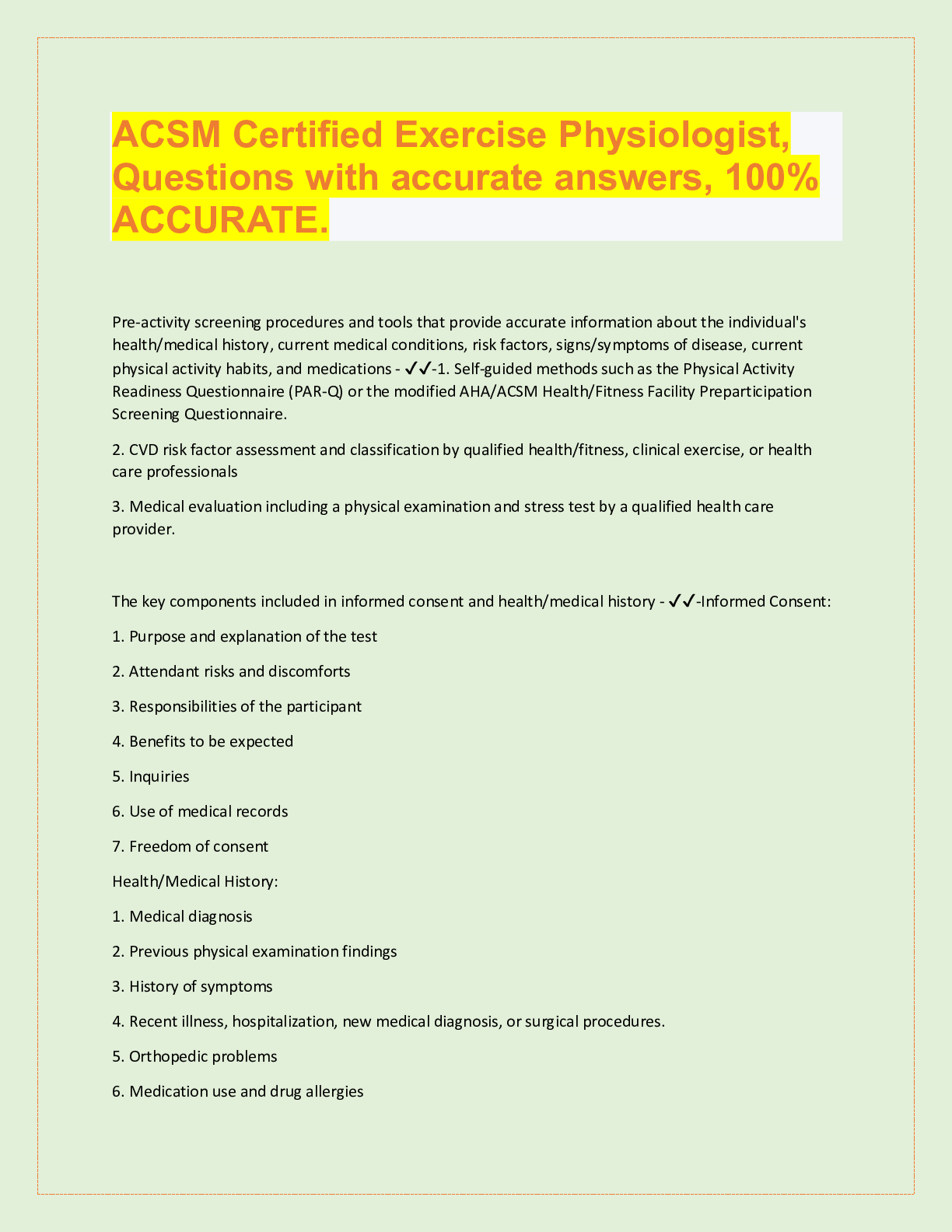
Two types of pre-participation self-guided screenings >>>>1. PAR-Q (physical Activity
Readiness Questionnaire)
2.Fitness Facility Pre-participation screening questionnaire
What is the PAR-Q? Limitation? >>>>A minimal standard for entry into Moderateintensity exercise programs. allows individuals to gauge their own medical readiness to
participate . does not screen well for those at low to moderate risk.What is a pre-participation screening questionnaire? >>>>Also useful for clients to
assess their health readiness. More comprehensive and recognizes signs and
symptoms of CVD and other risk-factor thresholds.
What are the ACSM Coronary Artery Risk factors? >>>>Age (Men 45 and older women
55 and older), Family History (MI, coronary revascularization or sudden death before 55
in father and 65 in mother or first degree relative), Smoker (current or quit within the last
6 months), Sedentary (no PA in at least 30 minutes of MPA at least 3 days per week for
the last 3 months), Obesity (BMI 30 or over, or waist girth >40in for men and >35in for
women), Hypertension (SBP 140 or more and/or DBP 90 or more confirmed on 2
seperate occasions), Dyslipidemia (LDL 130 or more OR HDL <40. OR on lipid lowering
meds), Prediabetes (Impaired FBG between 100 and 125.)
What is the negative risk factor? >>>>HDL value of greater than or equal to 60. (this is
reverse cholesterol transport and reduces the risk of CVD)
Dyspnea >>>>Shortness of breath
Orthopnea >>>>trouble breathing while lying down
paroxysmal nocturnal dyspnea >>>>difficulty breathing while asleep
What classifies as low, moderate, and high risk clients? >>>>Low: <2 risk factors and
asymptomatic
Moderate: 2 or more risk factors and Asymptomatic
High: Symptomatic OR known CVD, CPD, renal or metabolic disease
What is the exception to missing risk factor information? >>>>Prediabetes is counted as
a positive risk factor ONLY if the person is 45 or older OR The BMI is 25 or more (and
have additional risk factor for prediabetes)
What is a contraindication >>>>individual's characteristic that make PA more risky
Absolute contraindications to exercise >>>>Absolute cannot participate in andy PA
program and/or assessment and should consult with their doctor first.
Relative contraindications to exercise >>>>the benefit of exercise outweighs the risk of
testing.
Left main coronary stenosis, moderate stenotic valvular heart disease, Electrolyte
abnormalities, severe atrial hypertension, tachy or bradydysrhythmia, hypertrophic
myopathy, most disorders exacerbated by exercise, uncontrolled metabolic disease,
chronic infectious disease, Mental impairment, AV block.
Exercise testing is recommended for individuals at ____ risk >>>>High risk.
What is prehypertension? >>>>120-139 SBP and/or 80-89 DBPNormal BP? >>>><120 and <80
Stage 1 hypertension? >>>>140-159 SBP and 90-99 DBP
Stage 2 hypertension? >>>>160 + SBP 100+ DBP
Optimal LDL, total cholesterol, HDL, and triglyceride levels? >>>>LDL: <100
HDL: <40
Triglyceride: <150
TOTAL: <200
3 assesments for muscular endurance >>>>1. Bench press
2. Curl up
3. push up
twitch >>>>When a motor unit is stimulated by a single nerve impulse
tetanus >>>>motor unit stimulated constantly
summation >>>>motor unit has more than 1 stimulus
What is the SAID principle? What is it dependent on? >>>>The specificity principle.
Specific exercise elicits specific adaptations, creating specific training effects. (Specific
Adaptations to Imposed Demands). Dependent on the TYPE and MODE of exercise.
Example: a client wants to improve their time in an endurance run, you select training
stimulus that is appropriate. (eg. endurance activities, not swimming.
7 ways of determining exercise intensity >>>>1. Heart rate reserve method.
2. Peak HR method
3. Peak VO2. method
4. Peak METs method
5. VO2 reserve method
6. Talk test method
7. RPE method
(HRR) Heart rate reserve method KARVONEN FORMULA >>>>The difference between
max HR and resting HR.
Target HR = [(max HR -resting HR) X %intensity desired] + Resting HR.
Peak HR method >>>>220-age = max HR. (SD of 12-15 BPM)
Target HR = max HR X % intensity desired
Peak VO2 method >>>>must have measured or estimated VO2max.
Target VO2 = VO2max X intensity desiredPeak METs method >>>>Target METs = (%intensity desired)(VO2max in METS -1) +1
VO2 reserve method
What is VO2 reserve? >>>>VO2 reserve is the difference between VO2 max and VO2
rest. (determined in a lab setting)
Target VO2 reserve = [(VO2max - VO2 rest) x %intensity desired] + VO2rest
Talk test method >>>>differentiates between moderate and vigorous activity. If they can
talk, but not sing it is moderate. If they are unable to say more than a few words without
pausing for a breath it is vigourous.
Borg's RPE scale. What level is recommended to improve cardiorespiratory fitness?
>>>>ranges from 6 to 20. from no exertion at all to maximal exertion. 11 to 16 to
improve CRF.
What is the CR-10 scale of exertion? (Borg's category ratio scale) >>>>scale of 0 to 10.
in which 0 is sitting and 10 is max effort possible. 5-6 is mod. 7-8 is vig.
Symptoms identified during an exercise test in which the test should be stopped.
>>>>Drop in SBP 10 or below.
Rise in BP above 250 and/or 115.
Failure of HR to increase
failure of test equipment
Do individuals with cardiac, respiratory, metabolic, or musculoskeletal disorders need to
be supervised by trained personnel? >>>>Yes, when beginning an exercise program
What is target heart rate? How do you determine it? >>>>Must consider the habitual
PA, exercise level, and goals to determine the % intensity desired.
Common musculoskeletal injuries signs and symptoms. >>>>Point tenderness
Pain when body part is at rest
Joint pain
Pain that continues after warming up.
Swelling or discoloration
Increased pain with weight bearing activities
changes in normal bodily functions
Intrinsic risk factors to injury >>>>History of previous injury
Inadequate fitness/conditioning
Body composition
Bony alignment abnormalities
Flexibility/strength imbalances
Joint laxity
Musculoskeletal diseaseExtrinsic risk factors to injury >>>>Excessive load on the body
Type or speed of movement
number of reps
footwear
surface
training errors
excessive distances
fast progression
high intensity
running on hills
poor technique
fatigue
environment conditions
Exercise in heat yields? (relate to HR as well) >>>>Dehydration risk, increased blood
flow to the skin (away from working muscles), HIGHER HR values.
Exercise in the cold yields? >>>>Vasoconstriction of blood vessels in the skin, HR and
cardiac output are similar to thermoneutral environment, wearing bulky clothing is a
barrier, Respiratory rate is higher and VO2 max may be slightly lower. Some individuals
may perceive exercise to be more difficult in the cold
Exercise in high altitude >>>>"thin air" same amount of oxygen in the air at ALL
elevations. It is the change in barometric pressure that causes the PO2 to decrease. SV
decreases and HR increases during first initial days. Safe to assume that there will need
to be a significant reduction in intensity and duration of activities.
acclimatization vs. acclimation >>>>acclimatization - Physiological adaptation that
occurs in response to a change in the "natural" environment.
acclimation - physiological adaptation that occurs in response to EXPERIMENTALLY
induced changes in climate.
Heat acclimatization, cold acclimatization, altitude acclimatization benefits >>>>Heatlower core body temp, skin temp, high sweat rate, lower HR, lower perception of effort,
improved conservation of sodium. (recommended 10 consecutive days in heat)
cold- maintain heat production by means beside shivering, maintenance of hand and
feet temperatures.
altitude- Increases O2 carrying capacity in the blood. (Erythropoiesis, production of
additional RBC) "live high" "train low" Benefits last up to 3 weeks.
Smallest contractile unit of a muscle >>>>Sarcomere
Type I fibers >>>>Slow twitch fibers. Lower contractile force. better for endurance
activitiesType II fibers >>>>Fast twitch fibers. Higher contractile force. better for strength and
power activities.
Which type of muscle fibers are recruited first? >>>>Type I then Type II. as force
production increases.
initial simple assessment of muscular strength and change in muscular strength
between clients (calculation) >>>>(kg) weight lifted / (kg) body weight
What is a 1RM? Multiple RM? What equipment should be used? >>>>1RM is the
heaviest weight that can be lifted in 1 rep. using proper form and technique.
STANDARD muscular strength assessment. multiple RM can provide an index of
change over time. Performance is significantly greater on weight machines than free
weights. Allow 3 to 5 minutes between trials. Obtain 1RM within 4 sets.
Muscular endurance assessments. How do you determine which test to use based on
each client? >>>>Curl-up and push up test. Based on the needs of the client. (poor ab
strength is thought to contribute to low back pain.
What are the PROS principle of designing a resistance training program? What do they
mean? >>>>ProgressionRegularity
Overload
Specificity
Progression >>>>demands placed on the body must be continually and progressively
increased over time. Increase at 5% to 10% per week and decrease the reps by 2 to 4
when a given load can be performed for the desired number of reps.
Frequency >>>>Resistance training must be performed on a regular basis several times
per week to make gains. 2-3 per week.
Overload >>>>to enhance muscular fitness, the body must exercise at a level beyond
that at which it is normally stressed. Manipulated by changing the INTENSITY,
DURATION, or FREQUENCY
Specificity >>>>SAID principle. Specific adaptations to Imposed demands. Distinct
adaptations that take place as a result of the training program. Must mimics demands of
their sport or desired goals.
Types of resistance training (3). Explain each. >>>>DCER(isotonic)- most common.
weight lifted does not change through the lifting and lowering phase of an exercise. the
heaviest weight that can be lifted is limited by the strength of a muscle at the weakest
joint angle.
Isokinetics- muscle actions performed at a constant angular limb velocity.Plyometric training- enhances neuromuscular performance. quick, powerful movements
that involve a rapid stretch of a muscle (eccentric) followed by a rapic shortening
(concentric).
What is the amortization phase? >>>>in plyometrics it is the amount of time it takes to
change direction from eccentric to concentric. Should be as short as possible. (<0.1s) to
maximize training adaptations.
Resistance training program variables. >>>>Choice of exercise- promote balance
across joints and between opposing muscle groups.
Order of exercise- Total body (perform more challenging first and large muscle groups
first)
Resistance Load Used- Most important variables. Performed to muscle fatigue but not
exhaustion.
Training Volume- number of exercises performed per session, reps performed per set,
number of sets performed per exercise all influence training volume.
Rest intervals between sets- muscular strength (rest 2-3min) muscular endurance (rest
<1min)
repetition velocity-as individuals gain experience they may perform higher-velocity
movements.
Training Frequency- 2-3 x per week.
Periodization- regularly changing the training stimulus to keep it effective.
4 types of flexibility training >>>>1. Static- most common. slow constant motion held to
the point of mild discomfort.
2. Ballistic- rapid bouncing movements. Used by coaches for athletes to increase blood
flow before competition. Contraindicated.
3. PNF (proprioceptive neuromuscular facilitation)- combining passive stretching
combined with concentric and isometric. need partner. GTO plays an important role.
4. Dynamic flexibility- slow controlled movements, sport specific that increase core
temperature- relate to type of activity.
Muscle spindles >>>>collection of 3 to 10 muscle fibers that are innervated by a motor
neuron. Provide info about rate of change in a muscle.
What are Golgi Tendon Organs? >>>>located in the musculotendinous junction.
respond to changes in muscle tension.
Explain myotatic reflex reciprocal inhibition. >>>>Myotatic reflex "stretch reflex" occurs
in the stretched muscle by attempting to resist the stretch. Muscle spindles monitor
muscle length. Helps keep us upright.
What is reciprocal inhibition? >>>>*The antagonist muscle responds with reciprocal
inhibition. Causes antagonist to contract less as the agonist contracts.
Flexibility assesments >>>>Goniometerssit and reach tests- most commonly used for flexibility in lower back and hip joint.
functional movement screens
Flexibility program designs >>>>Flexibility gains are lost within 4 to 6 weeks of quitting
exercises. 2-3 x per week for at least 3-4 weeks may be required. Do these exercises
when the body is warm. hold to mild discomfort. NO link between ROM training and
prevention of lowback pain or muscle soreness.
Central abdominal obesity is associated with.. >>>>metabolic syndrome.
what is metabolic syndrome? >>>>a clustering of metabolic factors that increase the
risk of cardiorespiratory disease.
What are anthropometric measures? >>>>noninvasive and quantitative techniques for
determining body size by measuring specific body dimensions.
Anthropometric methods for measuring body composition >>>>BMI- measure of weight
in relation to height.
Waist circumference
Skinfolds
WHR
How to calculate BMI. Limitations of BMI? >>>>divide weight (kg) by height (meters
squared).
1kg = 2.2 lbs
1in = 2.54cm
1m = 100cm
Does not differentiate between fat and fat free mass. Not a true measure of body
fatness.
what is BMI classifications of:
Underweight
Normal
Overweight
Obesity class I
Obesity class II
Obesity class III >>>>Underweight <18.5
Normal 18.5-24.9
Overweight 25-29.9
Obesity class I 30-34.5
Obesity class II 35-39.9
Obesity class II 40+
Central obesity versus gynoid >>>>central (apple, or abdominal) vs. pear shaped (hips
and thighs)Waist to hip ratio >>>>identify people with more central abdominal fat. Divide the
circumference of the waist by the circumference of the hips (buttocks/hips) in inches.
Using waist circumference alone >>>>describes abdominal fat measurement. health
risks are higher when measurement is 35+ in for women and 40+ for men.
risk category for waist circumference in male and female adults. (very low, low, high,
very high) >>>>Women:
very low <70cm
Low 70-89cm
High 90-110cm
Very high >110
Men
very low <80cm
Low 80-9cm
High 100-120cm
Very high >120
standard circumference sites >>>>Abdomen
Arm
*Buttox/hip
Calf
Forearm
Hips/thigh
Mid-thigh
*Waist
% body fat methods. What is the % for men and women that is considered satisfactory
for health? >>>>Skinfold measurements
Bioelectrical Impedance
Lab methods for measuring body composition >>>>Hydrostatic weighing- calculates
body density from body volume
Air displacement plethysmography- measures body volume.
DEXA- x- ray to measure bone mineral content, body fat, and lean soft tissue.
what does hydrostatic weighing assume >>>>standard densities for muscle bone and
fat
9 skinfold measurements. Principle behind skinfold measurements
+- 3.5% error
Tension set at ~12 g/mm-2 >>>>Abdominal
TricepsBiceps
Chest/pectoral
Medial calf
Midaxillary
Subscapular
Suprailiac
Thigh
*the amount of subcutaneous fat is proportional to the total amount of body fat.
diagonal skinfolds >>>>Chest, suprailiac, subscapular; all other skinfolds are vertical
Procedures for skinfolds >>>>measure all on the right side of the body
pinch with thumb and index finger 1cm away from the center mark
wait 1-2 sec before reading the caliper
measure perpendicular to the skinfold.
7 site formula sites >>>>chest, midaxillary, triceps, subscapular, abdomen, suprailiac,
thigh
3 site formula sites (men) >>>>Chest
abdomen
thigh or subscapular
3 site formula sites (women) >>>>triceps
suprailiac
thigh or abdominal.
the National Heart, Lung, and Blood institute recommend _____% weight loss reduction
improves overall health >>>>5-10%
define negative energy balance >>>>energy expenditure must exceed energy intake.
define positive energy balance >>>>energy intake exceeds energy expenditure
define Total Energy Expenditure >>>>the total number of calories expended each day
and reflects th amount of energy required to carry out all metabolic processes within the
body
3 components of determining energy expenditure >>>>Resting energy expenditure
(REE)- 60-70% TEE
Thermic effect of food: 10% TEE
Physical activity expenditure: 20-30% TEE
define Resting energy expenditure
what influences it the most? >>>>resting metabolism! energy required to maintain
normal regulatory balance and body functions at rest. Also called basal energyexpenditure. The amount of calories a person uses if they want to do no activity
throughout the day.
lean body mass influences it because it is more metabolically active than fat.
define thermic effect of food >>>>energy required to eat and digest food. The more
physically active, the more active their metabolism TEE
recommended 1-2lbs/week weight loss in calories >>>>1lb of weight loss is a calorie
deficit of 3,500 calories. or 500 calories per day.
nor recommended for an individual to consume less than ____ calories per day
>>>>1,200 calories
ACSM postion stand indicates that engaging in _____ minutes per week of MVPA
would result in better weight management >>>>250 min/week.
demonstration of exercise is especially important in _____ populations >>>>overweight
or obese
Behavioral strategies for weight loss >>>>Self monitoring
goal setting
stimulus control
problem solving
How many calories in 1 gram of:
carb
protein
fat
alcohol >>>>1 g carbs- 4 calories
1 g protein- 4 calories
1g fat- 9 calories
1g alcohol- 7 calories
energy intake for carbs, protein and fat >>>>45 - 65% of daily energy intake; 70% for
athletes; 4 cal/gram
10-15% of daily intake; .8 g/kg of body wt.; athletes may need 1.2 - 1.4 for endurance
and 1.6-1.7 for strength; 4 cal/gram
3 abnormal curves of the spine >>>>hyperkyphosis, hyperlordosis, scoliosis
Pregnant women need an additional ____ calories per day >>>>150 cal per day then
300cal in the 3rd trimester
avoid exercising in the ______ position after week _____ >>>>Supine position after
week 16pregnant women need as increase dietary need for.... >>>>folic acid (B vitamin to
prevent serious birth defects) and iron.
Vitamin D intake have increased for?
what are the levels? >>>>all populations but particularly children and older adults (65+).
children and adolescents 1-18 600 IU
Older adults 800IU
Coronary Artery disease >>>>accounts for the most cardiovascular deaths. The most
prevalent types of CVD.
Define athlerosclerosis >>>>process where fatty streaks develop, causing the artery
wall the thicken while reducing the luminal diameter. begins with a focal injury to the
lining of the artery and eventually causes damage to the endothelium. The endothelium
then becomes more permeable to lipids , allowing LDL's to move easily through where
they are oxidized by macrophages. creating fatty streaks and plaque formation begins.
Define myocardial ischemia >>>>partial impairment of coronary artery artery blood flow
reduces oxygen to cardiac tissue.
Define myocardial infarction >>>>hEART ATTACK. results in heart tissue death.
stable ischemia vs. unstable ischemia >>>>stable: result of increased O2 demand of
the heart (as seen with exercise) increased chest pain
[Show More]


.png)
.png)