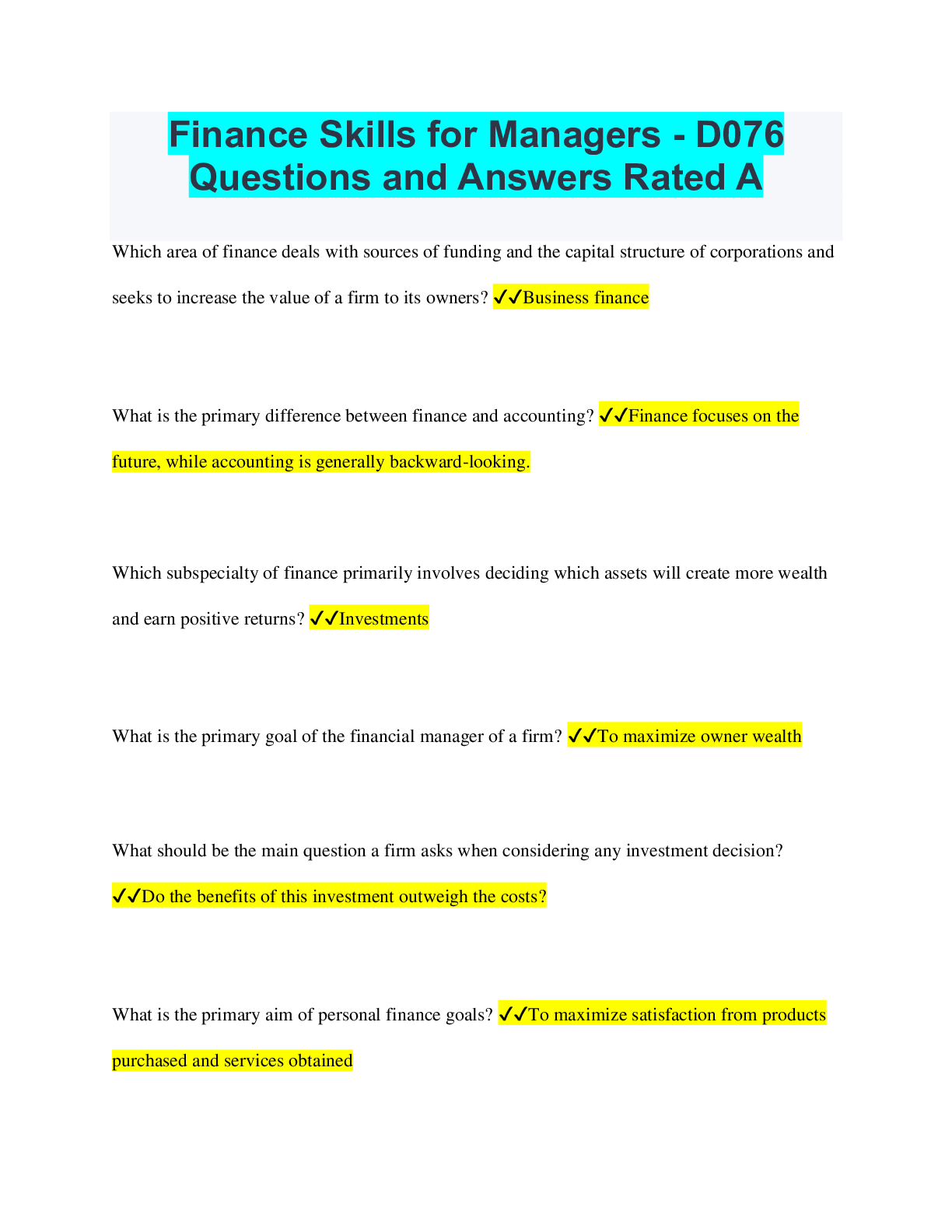
WGU D076 Questions and Answers
Rated A
Beta
A variable that describes how the price of a security varies with the market.
Business Finance
An area of finance that deals with sources of funding, the capital structure
...
WGU D076 Questions and Answers
Rated A
Beta
A variable that describes how the price of a security varies with the market.
Business Finance
An area of finance that deals with sources of funding, the capital structure of corporations, the
actions that managers take to increase the value of the firm to its owners, and the tools and
analysis used to allocate financial resources.
Capital Budgeting Criteria
Metrics and calculations used to determine whether a project or asset will add value and be a
worthwhile investment.
Capital Investment
The sum of money invested in a business to purchase long-term assets to further its objective of
maximizing owner wealth.
Capital Structure
The mixture of debt and equity used to finance a firm.
Cumulative
A feature of preferred stock specifying that if a company skips payment of a preferred stock
dividend one year, it is still required to pay that dividend sometime in the future before paying
any common dividends.
Defensive Assets
Companies or securities with beta less than 1.
Discount Rate
The name for interest rate when used in time value of money calculations.
Dividend Discount Model
A model used to evaluate common stock that calculates the value of a share of common stock
today by taking the present value of future dividend cash flows.
Efficient market
A market in which prices fully relect all the available information about a specific security.
Holding Period Return
The return over the entire period that an investor owns a financial security.
Internal Rate of Return (IRR)
The rate of return that a firm earns on its capital projects.
Market Risk
Risk that is inherent in the economy as a whole and cannot be diversified away; also called
systematic risk or no diversifiable risk.
Market-to-book Ratio (M/B Ratio)
A market ratio found by market value of equity divided by book value of equity.
Nonsystematic Risk
Risk that results from factors at a particular firm and can be reduced through diversification; also
called firm-specific risk or idiosyncratic risk.
Perpetuity Model
A formula used to value preferred stock that is based on the calculation of a perpetuity.
Plowback Ratio
The percent of net income retained in the firm; also called the retention ratio.
Quick Ratio
A liquidity ratio found by current assets less inventory, divided by current liabilities; also called
the acid-test ratio.
Return On Assets (ROA)
A profitability ratio found by net income divided by total assets.
Return
The money gained or lost on an investment over a certain period of time.
Risk Retention
A decision to take responsibility for a particular risk.
Securitization
The process of combining several types of contractual debt (such as mortgages) and reselling
them as a package to investors.
Upside Potential
The unlimited earnings potential of equity ownership.
Variable Expenditures
An expense that you have direct control over and that can change from period to period.
Profitability
Which type of ratio should be used to examine the cost efficiency of a firm's production?
Current ratio
Which ratio helps an analyst evaluate whether a company can cover its short-term obligations?
Quick ratio
Which ratio should an analyst use to consider the effect of a firm's inventory on a firm's ability to
meet current obligations?
Why is it important to consider the time value of money in an ideal evaluation method for capital
investment?
Because the value of a cash flow today is different from the value of a cash flow of the same
dollar amount in 10 years
Discretionary account
What kind of account is Notes payable?
Compound Interest equation
Total Interest=Principal×(1+Interest Rate)^Number of Periods−Principal
Present Value of a Perpetuity equation
Present Value=PMT/i
What does the DuPont Framework tell us?
One is that return on all the investors (debtholders and equity holders) is measured by the firm's
profitability and asset usage efficiency. The effect of debt, or in other words, the effect of the
capital structure of the firm, appears only on the return on equity.
How can you reduce DFN?
Slow Sales Growth
Examine Capacity
Constraints Lower
Dividend Payout
Increase Net Margin
What are the advantages of NPV?
NPV: Considers time value of money
Calculates value added to the firm
Considers risk and required return
What should you be aware of when calculating IRR?
The solution can only be obtained through trial and error (or interpolation).
What assumptions does the Gordon Growth Model make in order to make the dividend discount
model usable?
Dividends are paid every year. Dividends grow at a constant rate forever
What should you considering in the capital budgeting process of capital investment?
For the capital budgeting process of capital investment, it is essential to consider the time value
of money, the risk of a project, and all the cash flows of a project to evaluate whether the project
is worthwhile.
What is the ideal evaluation method for capital investment?
It includes all cash flows that occur during the life of the project.
It considers the time value of money.
It incorporates the cost of capital—or in other words, the required rate of return on the project.
What do market ratios measure?
Market ratios are used to evaluate the current share prices of a public firm's stock.
Debt-to-Equity Ratio=Total Liabilities/Total Owners' Equity
Debt-to-Equity Ratio equation
What are profitability ratios used for?
Profitability ratios help you understand a company's performance and cost efficiency and thereby
measure a company's profitability.
What are the three main comparison methods used in ratio analysis?
trend analysis, cross-sectional analysis, and progress measurement
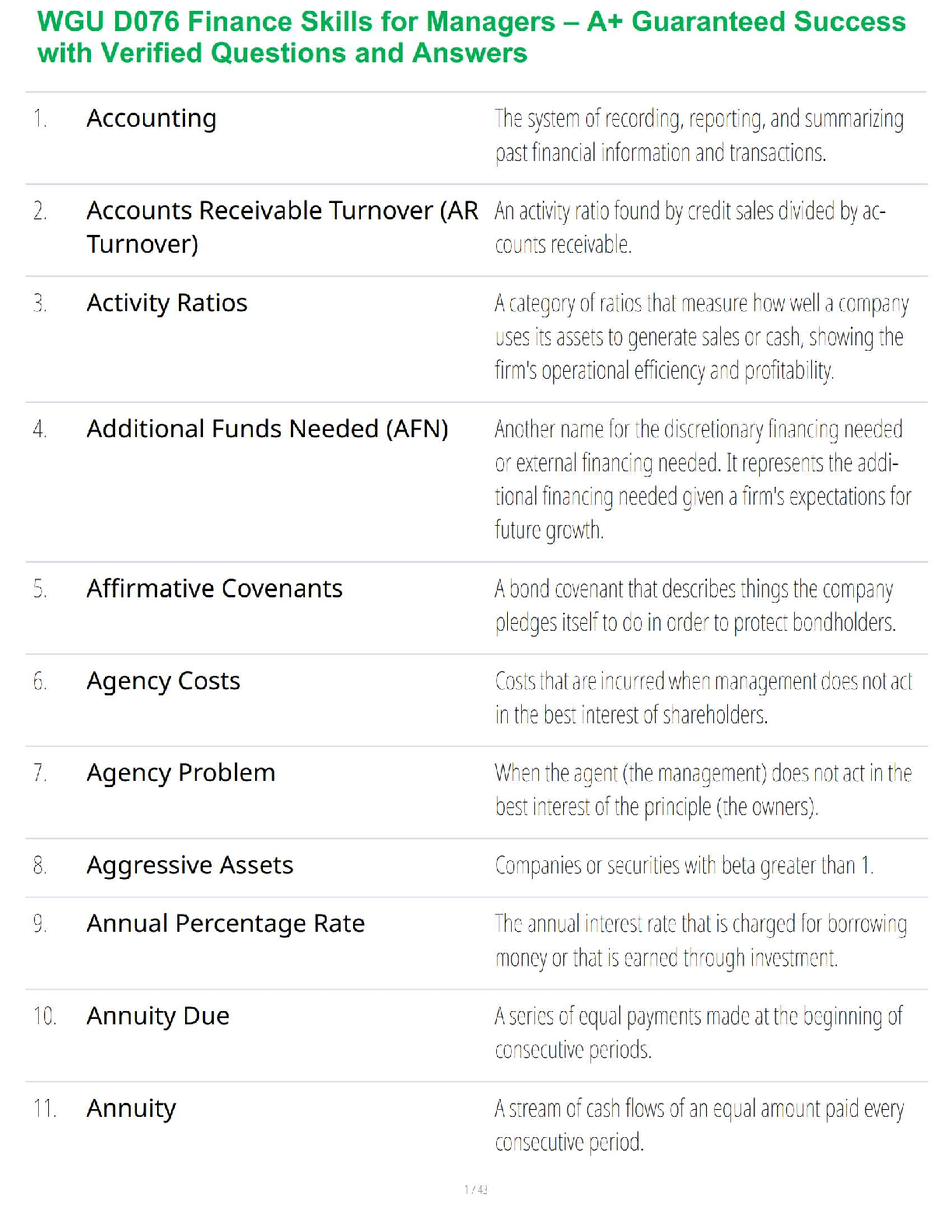
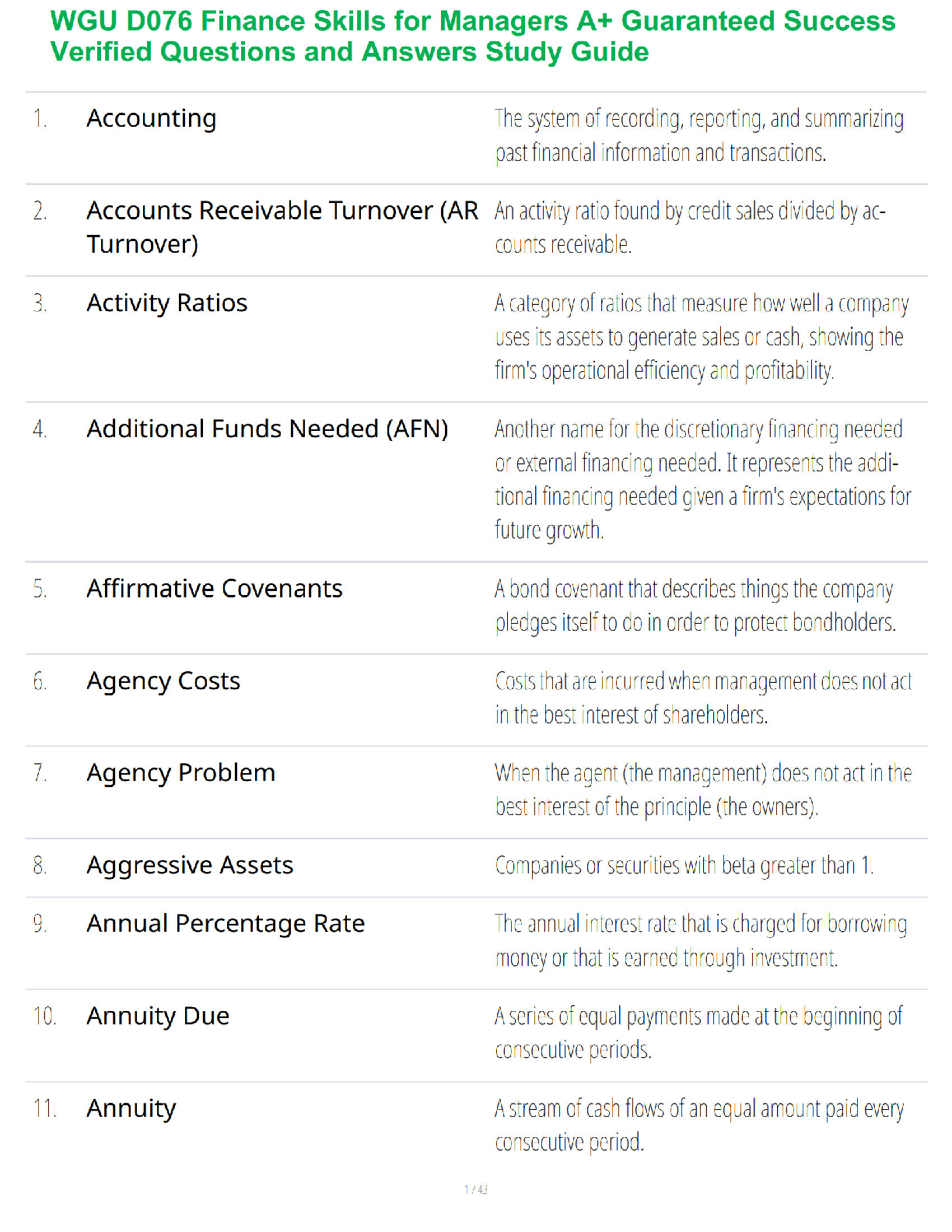
Accounting
The system of recording, reporting, and summarizing past financial information and transactions.
Accounts Receivable Turnover (AR Turnover)
An activity ratio found by credit sales divided by accounts receivable.
Activity Ratios
A category of ratios that measure how well a company uses its assets to generate sales or cash,
showing the firm's operational efficiency and profitability.
Additional Funds Needed (AFN)
Another name for the discretionary financing needed or external financing needed. It represents
the additional financing needed given a firm's expectations for future growth.
Affirmative Covenants
A bond covenant that describes things the company pledges itself to do in order to protect
bondholders.
Agency Costs
Costs that are incurred when management does not act in the best interest of shareholders.
Agency Problem
When the agent (the management) does not act in the best interest of the principle (the owners).
Aggressive Assets
Companies or securities with beta greater than 1.
Annual Percentage Rate
The annual interest rate that is charged for borrowing money or that is earned through
investment.
Annuity Due
A series of equal payments made at the beginning of consecutive periods.
Annuity
A stream of cash flows of an equal amount paid every consecutive period.
Asset Pricing
The process of valuing assets.
Auction Market
A secondary market with a physical location and where prices are determined by investors'
willingness to pay.
Average Collection Period (ACP)
An activity ratio found by the number of days in a year (365) divided by AR turnover.
Balance Sheet Forecasting
Using sales growth and the profit forecast to construct a pro forma balance sheet to understand
the future implications of the sources and uses of finances.
Banks and Credit Unions
Receive deposits and extend loans to individuals and businesses.
Benchmarking
The process of completing a financial analysis to compare a firm's financial performance to that
of other similar firms.
Bid-ask Spread
The difference between the bid and ask prices that compensate the specialist for the risk that he
or she bears for willingness to provide liquidity.
Board of Directors
A group of people who jointly supervise the activities of an organization.
Bond Indenture
A legal contract that governs the relationship between a firm and its bondholders.
Bondholders
A person who loans a corporation money by buying debt securities.
Cannibalization
The reduction in sales of a company's own products due to introduction of another similar
product.
Capital Asset Pricing Model (CAPM)
A model used to determine the risk-return relationship for an asset.
Capital Budgeting
The process of evaluation and planning for purchases of long-term assets.
Capital Markets
A type of financial market used for long-term assets that are held for greater than one year.
Capital
A financial asset that can be used by a firm or individual. Examples of capital may be machinery
or cash held by a firm.
Capital-constrained Environment
When a limited amount of funds are available.
Cash Budgets
A plan for controlling cash inflows and outflows business to balance income with expenditures.
Cash Management
Managing the day-to-day finance operations of a firm.
Central Banks
Ensure that a nation's economy remains healthy by controlling the amount of money circulating
in the economy.
Common Stock
A type of stock that represents equity in a firm and confers the right to vote at shareholder
meetings.
Compounding Interest
The interest on the principal plus the interest on earned interest.
Compounding
Finding a future value given a present value.
Corporate Bonds
A debt instrument that is issued by a corporation in order to raise capital.
Corporate Governance
The system of rules, practices, and processes by which a firm is directed and controlled.
Correlation
The measure of the relationship between two variables that move in relation to each other.
Cost of Capital
The cost to a firm to use an investor's capital; see interest rate.
Coupon Rate
The stated interest rate of a bond; also known as coupon yield.
Coupon Yield
The stated interest rate of a bond; also known as coupon rate.
Covenants
Statements in a bond indenture that outline things the company will obligate itself to do or not do
in order to protect bondholders.
Credit Analysts
A commercial bank position with the responsibility to assess the riskiness of lending to
borrowers and determining whether or not loans should be extended to potential bank clients.
Cross-sectional Analysis
Comparing a firm's financial ratios to other firms' ratios or industry averages.
Current Market Value
What someone would pay right now for an asset.
Current Ratio
A liquidity ratio found by current assets divided by current liabilities.
Dealer Market
A secondary market made up of multiple dealers that hold an inventory of securities and quote
prices.
Debt Ratio
A financing ratio found by total liabilities divided by total assets.
Debt-to-equity Ratio
A financing ratios found by total liabilities divided by total equity.
Default Risk
The probability of a loss resulting from a borrower's failure to repay a contractual obligation;
also called credit risk.
Default
Failure to meet a debt obligation.
Discount Bond
A bond whose price is below its par value.
Discounting
Finding a present value given a future value.
Discretionary Accounts
Accounts that do not vary automatically with sales but are left to the discretion of management.
Discretionary Financing Needed (DFN)
The additional financing needed given a firm's expectations for future growth.
Diversification
The process of "spreading" your money over many different assets.
Dividends in Arrears
A feature of preferred stock specifying that if a company ignores preferred stock dividends, it
cannot pay anything to its common stockholders.
DuPont Framework
An expanded formula of the return of equity, net margin times total asset turnover times leverage
multiplier, which represent the components of profitability, activity (efficiency), and financing.
Estates
Everything that a person owns or controls, especially at death.
Ethical Dilemma
An issue in the process of deciding between multiple options where no option is completely
acceptable from an ethical standpoint.
Ethics
Following accepted standards of moral conduct.
Expected Return
A hypothesized estimate of future prices or returns under different scenarios based on
expectational data.
External Financing Needed (EFN)
Another name for the discretionary financing needed or additional funds needed. It represents the
additional financing needed given a firm's expectations for future growth.
Face Value
The sum of money that a corporation promises to pay at the expiration of a bond; also called par
value.
Finance
The study of managing and allocating funds at the personal or business level.
Financial Institutions
An area of finance that includes firms or organizations that exist to accept a wide variety of
deposits, to offer investment products to individuals and businesses, to provide loans, or to
broker financial transactions.
Financial Managers
A person who makes strategic financial decisions in a corporation.
Financial Policy Implementation
Incorporating new finance ideas within a firm.
Financial Risk
Increased volatility in earnings as a result of using debt.
Firm-specific Risk
Risk that results from factors at a particular firm and can be reduced through diversification; also
called nonsystematic risk or idiosyncratic risk.
Fisher Effect
An economic theory developed by Irving Fisher holding that the real interest rate is equivalent to
the nominal interest rate minus the expected inflation rate.
Fixed Asset Turnover (FAT)
An activity ratio found by sales divided by fixed assets.
Fixed Expenditures
An expense that you do not have direct control over and that remains constant from period to
period.
Fixed-income Securities
Another name for bonds; a financial security in which the borrower pays a fixed interest payment
to investors each year.
Future Value
The worth of cash flows in terms of the dollar amount in the relative future.
Gordon Growth Model
A formula used to value common stock based on the assumptions that dividends are paid every
year and grow at constant rate forever.
Gross Margin
A profitability ratio found by gross profit divided by sales.
Harvest
Generating cash or stock from the sales or IPO of companies in the portfolio of investments.
Hurdle Rate
The required rate of return that a company expects to earn in order to consider a project.
Hybrid Security
A security that has some elements that resemble equity and others that resemble debt.
Idiosyncratic Risk
Risk that results from factors at a particular firm and can be reduced through diversification; also
called firm-specific risk or nonsystematic risk.
Incremental Cash Flows
Cash flows that result from accepting a project.
Inflation
The rate at which the average price level of a basket of chosen goods and services in an economy
increases over a period of time.
Initial Public Offering (IPO)
When a privately held company first offers shares of stock to outside investors to raise capital,
therefore becoming a publicly owned company.
Insurance Companies
Charge premiums to invest in bonds and stocks to pay claims.
Interest Rate Risk
The probability that changes in interest rates will impact the value of a bond.
Interest Rate
The percentage of the principal that a lender charges a borrower for the use of assets.
Intrinsic Value
The value of an asset as determined through fundamental analysis without referring to the asset's
market value.
Inventory Turnover
An activity ratio found by COGS divided by inventory.
Investment Bank
A financial intermediary that offers complex financial transactions such as underwriting,
facilitating mergers, and buying and selling financial securities on behalf of large institutions.
Investments
An area of finance that involves deciding which assets to invest in to create wealth in the future.
Legal
Following the laws and rules set by an authority.
Leverage Ratios
A category of ratios that consider how a firm is financed.
Leverage
Another name for debt or liability.
Liquid Asset
An asset that can be converted into cash quickly without the loss of significant value.
Liquidity Ratios
A category of ratios that measure a firm's ability to meet short-term obligations.
Liquidity
The ability to turn financial securities into cash easily without losing significant value.
Market Capitalization
The current market value of a publicly traded company's total outstanding shares, indicating the
size of a company.
Market Ratios
A category of ratios that are used to evaluate the current share price of a public firm's stock.
Marketing
The business function responsible for generating sales.
Maturity Date
The date at which a bond expires.
Money Market
A type of financial market used for short-term assets that are held for less than one year.
Morals
Following one's standards of right and wrong behavior.
Mutual Fund
An investment company that continually offers investments and buys financial securities and
instruments on behalf of investors.
Mutually Exclusive
When two or more events do not coincide.
NASDAQ
A computer network where stocks are bought and sold. It is the second-largest stock exchange in
the world. Typically, technology-related companies will go public through this exchange.
Negative Covenants
A bond covenant that describes things the company pledges itself not to do in order to protect
bondholders.
Net Margin
The percentage of sales remaining after all costs have been deducted from a company's total
sales. Also known as net profit margin; indicates the profit earned by the firm.
New York Stock Exchange (NYSE)
A physical trading floor and a computer network where stocks are bought and sold. It is the
largest stock exchange in the world.
Nominal Rate
The rate at which invested money grows for a certain period of time.
[Show More]
.png)
.png)








.png)
.png)
.png)