NLP Using Python
1. 1. HandsOn- Simple Operations with text
a. Problem 1
#!/bin/python3
import math
import os
import random
import re
import sys
import zipfile
os.environ['NLTK_DATA'] = os.getcwd()+"/nltk_data"
...
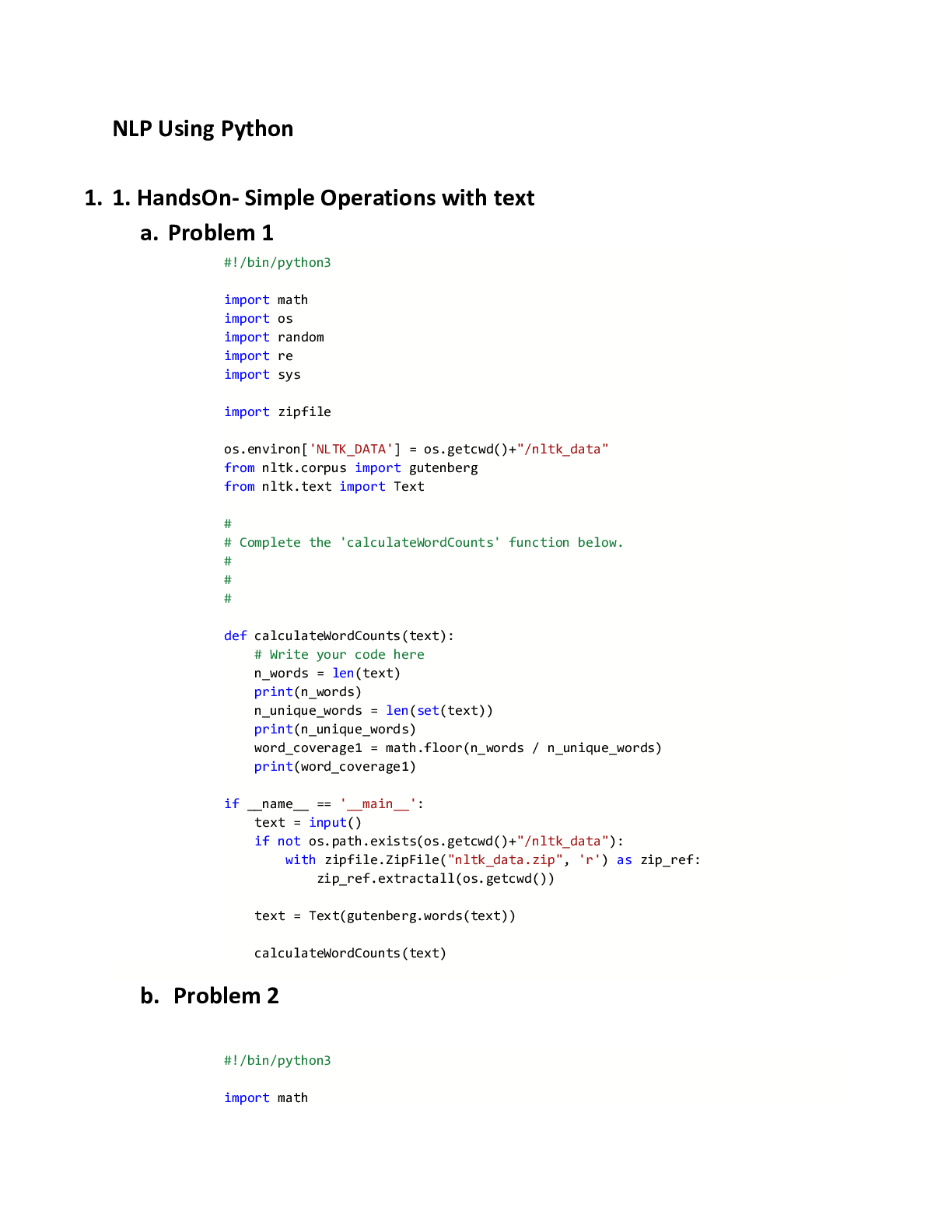
NLP Using Python
1. 1. HandsOn- Simple Operations with text
a. Problem 1
#!/bin/python3
import math
import os
import random
import re
import sys
import zipfile
os.environ['NLTK_DATA'] = os.getcwd()+"/nltk_data"
from nltk.corpus import gutenberg
from nltk.text import Text
# #
Complete the 'calculateWordCounts' function below.
# # #
def calculateWordCounts(text):
# Write your code here
n_words = len(text)
print(n_words)
n_unique_words = len(set(text))
print(n_unique_words)
word_coverage1 = math.floor(n_words / n_unique_words)
print(word_coverage1)
if __name__ == '__main__':
text = input()
if not os.path.exists(os.getcwd()+"/nltk_data"):
with zipfile.ZipFile("nltk_data.zip", 'r') as zip_ref:
zip_ref.extractall(os.getcwd())
text = Text(gutenberg.words(text))
calculateWordCounts(text)
b. Problem 2
#!/bin/python3
import mathimport os
import random
import re
import sys
import zipfile
os.environ['NLTK_DATA'] = os.getcwd() + "/nltk_data"
from nltk.corpus import gutenberg
from nltk.text import Text
# #
Complete the 'filterWords' function below.
# # #
def filterWords(text):
# Write your code here
unique_words = set(text)
ing_words = [word for word in list(unique_words) if word.endswith('ing')]
big_words = [word for word in list(text) if len(word) > 15 ]
upper_words = [word for word in list(unique_words) if word.isupper()]
return (ing_words, big_words, upper_words)
if __name__ == '__main__':
text = input()
if not os.path.exists(os.getcwd() + "/nltk_data"):
with zipfile.ZipFile("nltk_data.zip", 'r') as zip_ref:
zip_ref.extractall(os.getcwd())
text = Text(gutenberg.words(text))
ing_words, big_words, upper_words = filterWords(text)
print(sorted(ing_words))
print(sorted(big_words))
print(sorted(upper_words))
c. Problem 3
#!/bin/python3
import math
import os
import random
import re
import sys
import zipfile
os.environ['NLTK_DATA'] = os.getcwd() + "/nltk_data"
from nltk.corpus import gutenbergfrom nltk.text import Text
import nltk
# #
Complete the 'findWordFreq' function below.
# #
def findWordFreq(text, word):
# Write your code here
wordfreq = 0
for w in text:
if(w == word):
wordfreq = wordfreq+1
textfreq = nltk.FreqDist(word for word in list(text) if word.isalpha())
mostfreq = textfreq.max()
return(wordfreq, mostfreq)
if __name__ == '__main__':
text = input()
word = input()
if not os.path.exists(os.getcwd() + "/nltk_data"):
with zipfile.ZipFile("nltk_data.zip", 'r') as zip_ref:
zip_ref.extractall(os.getcwd())
text = Text(gutenberg.words(text))
word_freq, max_freq = findWordFreq(text, word)
print(word_freq)
print(max_freq)
2. Hands-On-Accessing Text Corpora
a. Problem 1
#!/bin/python3
import math
import os
import random
import re
import sys
import zipfile
os.environ['NLTK_DATA'] = os.getcwd() + "/nltk_data"
import nltkfrom nltk.corpus import inaugural
# #
Complete the 'accessTextCorpora' function below.
# #
The function accepts following parameters:
# 1. STRING fileid
# 2. STRING word
#
def accessTextCorpora(fileid, word):
# Write your code here
file_words = inaugural.words(fileid)
wordcoverage = int(len(file_words)/len(set(file_words)))
ed_words = [words for words in set(file_words) if words.en
dswith('ed')]
textfreq2 = [word.lower() for word in file_words if word.i
salpha()]
textfreq = nltk.FreqDist(textfreq2)
wordfreq = textfreq[word]
return wordcoverage, ed_words, wordfreq
if __name__ == '__main__':
fileid = input()
word = input()
if not os.path.exists(os.getcwd() + "/nltk_data"):
with zipfile.ZipFile("nltk_data.zip", 'r') as zip_ref:
zip_ref.extractall(os.getcwd())
word_coverage, ed_words, word_freq = accessTextCorpora(fil
eid, word)
print(word_coverage)
print(sorted(ed_words))
print(word_freq)
b. Problem 2
[Show More]