RESTAURANT MOGUL OVERVIEW
In this project, you will open multiple restaurants and build a profitable restaurant empire.
You will begin by following a series of steps to open your first restaurant. These include
market
...
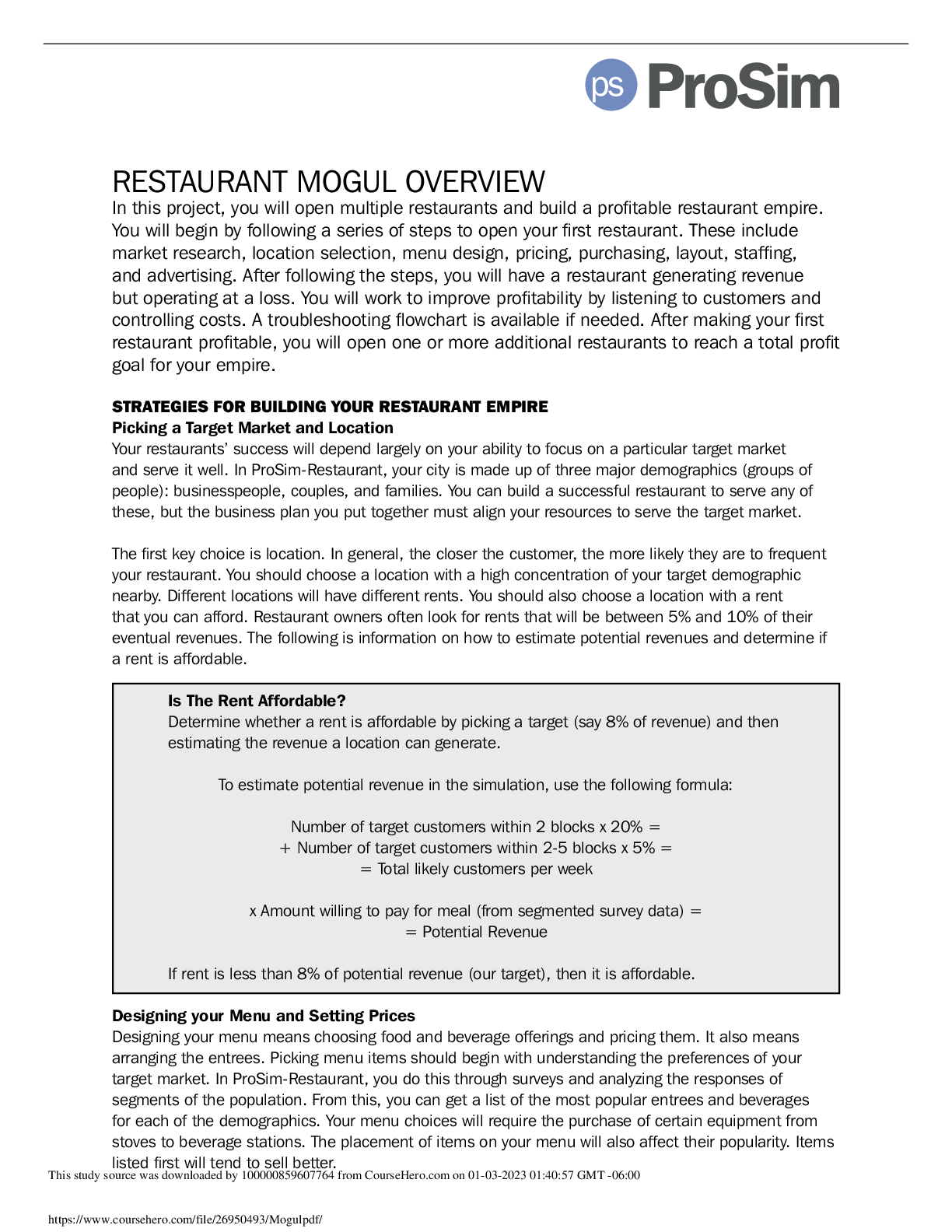
RESTAURANT MOGUL OVERVIEW
In this project, you will open multiple restaurants and build a profitable restaurant empire.
You will begin by following a series of steps to open your first restaurant. These include
market research, location selection, menu design, pricing, purchasing, layout, staffing,
and advertising. After following the steps, you will have a restaurant generating revenue
but operating at a loss. You will work to improve profitability by listening to customers and
controlling costs. A troubleshooting flowchart is available if needed. After making your first
restaurant profitable, you will open one or more additional restaurants to reach a total profit
goal for your empire.
STRATEGIES FOR BUILDING YOUR RESTAURANT EMPIRE
Picking a Target Market and Location
Your restaurants’ success will depend largely on your ability to focus on a particular target market
and serve it well. In ProSim-Restaurant, your city is made up of three major demographics (groups of
people): businesspeople, couples, and families. You can build a successful restaurant to serve any of
these, but the business plan you put together must align your resources to serve the target market.
The first key choice is location. In general, the closer the customer, the more likely they are to frequent
your restaurant. You should choose a location with a high concentration of your target demographic
nearby. Different locations will have different rents. You should also choose a location with a rent
that you can afford. Restaurant owners often look for rents that will be between 5% and 10% of their
eventual revenues. The following is information on how to estimate potential revenues and determine if
a rent is affordable.
Designing your Menu and Setting Prices
Designing your menu means choosing food and beverage offerings and pricing them. It also means
arranging the entrees. Picking menu items should begin with understanding the preferences of your
target market. In ProSim-Restaurant, you do this through surveys and analyzing the responses of
segments of the population. From this, you can get a list of the most popular entrees and beverages
for each of the demographics. Your menu choices will require the purchase of certain equipment from
stoves to beverage stations. The placement of items on your menu will also affect their popularity. Items
listed first will tend to sell better.
Pricing involves both understanding food costs and the willingness of customers to pay for certain
items. In starting up your restaurant, you will likely want to set your prices so that food costs are around
30% of the selling price and beverage costs are around 10% of the selling price of beverages. As your
restaurant gets going, you can experiment with raising or lowering prices on individual items. In general,
items with high cost ingredients (such as proteins) may support lower margins, while items with low cost
ingredients (such as starches) may support higher margins. See the sidebar for how to set prices based
on a target food cost percentage.
Purchasing
The menu you design requires a certain set of ingredients. If you purchase too few ingredients,
customers will be unhappy when they can’t get the entrees they want. Eventually your restaurant’s rating
(called Gazats ratings in the sim) will fall and fewer customers will come in. If you purchase too much,
perishables will go bad and that waste will cut into your profits.
It’s common to think of purchasing a certain amount per week. But restaurants tend to talk about
inventory “par values” -- the amount they want on hand to begin the evening. Purchases are then
planned to bring the inventory up to that level. In ProSim-Restaurant, you can purchase ingredients daily
to replenish inventory to par values.
The following is an analytical approach to setting initial inventory levels—par values.
Laying Out your Restaurant
You control layout in the front of the house and the back of the house. In the front of the house, you set
the number of tables and how they are configured to seat different size parties. You will probably want to
begin your restaurant with a range of two-tops, four-tops, six-tops, and eight-tops. As your build clientele
from your target market, you can see the sizes of parties that are arriving. If you have long waits, for
certain table configurations, you can change them by dragging and dropping tables.
Your back of the house layout involves equipment in the kitchen. You will probably begin with at least
one piece of equipment needed to prepare the meals on your menu. You can then watch the kitchen
on busy nights to see which pieces seem to be in constant use. After observing this, you can try adding
additional pieces of the most heavily used equipment. See the sidebar for a more analytical method of
estimating how many pieces of each type of equipment you will need.
[Show More]








dfdfefe.png)