Antepartum Care
UNFOLDING Reasoning
History of Present Problem:
Anne Jones is a 17-year-old Caucasian teenager who thinks she may be pregnant because she has missed two periods.
Her last menstrual period, she thinks,
...
Antepartum Care
UNFOLDING Reasoning
History of Present Problem:
Anne Jones is a 17-year-old Caucasian teenager who thinks she may be pregnant because she has missed two periods.
Her last menstrual period, she thinks, was about one month ago. She states she had a little bit of spotting last week but
didn’t have a “full period”. She complains of her breasts being tender, swollen, frequent urination, and nausea in the
morning. This is her first office visit and she is not sure why she feels so crummy but suspects she might be pregnant.
Her urine pregnancy test is positive. Her primary care provider orders a prenatal lab panel and a urinalysis.
Personal/Social History:
Anne is a senior in high school who stands on her feet while working at McDonalds after school. She drinks six colas
daily, denies alcohol use, and does not smoke. She takes no medications except for occasional acetaminophen for
headaches and ibuprofen for menstrual cramps. Anne is 5’4” (160 cm) and weighs about 105 lbs. (47.7 kg) according to
Anne. A 24-hour recall nutrition history reveals a typical day’s diet: breakfast- pop tart and can of cola; Lunch- a slice of
pizza, chocolate chip cookie, can of cola; Dinner- fried chicken, green beans, biscuit, can of cola; snacks, including
cookies and can of cola. She broke up last week with her boyfriend, and he is not aware she might be pregnant. She wants
to keep the baby but has not told her parents.
Copyright © 2019 Keith Rischer, d/b/a KeithRN.com. All Rights reserved.
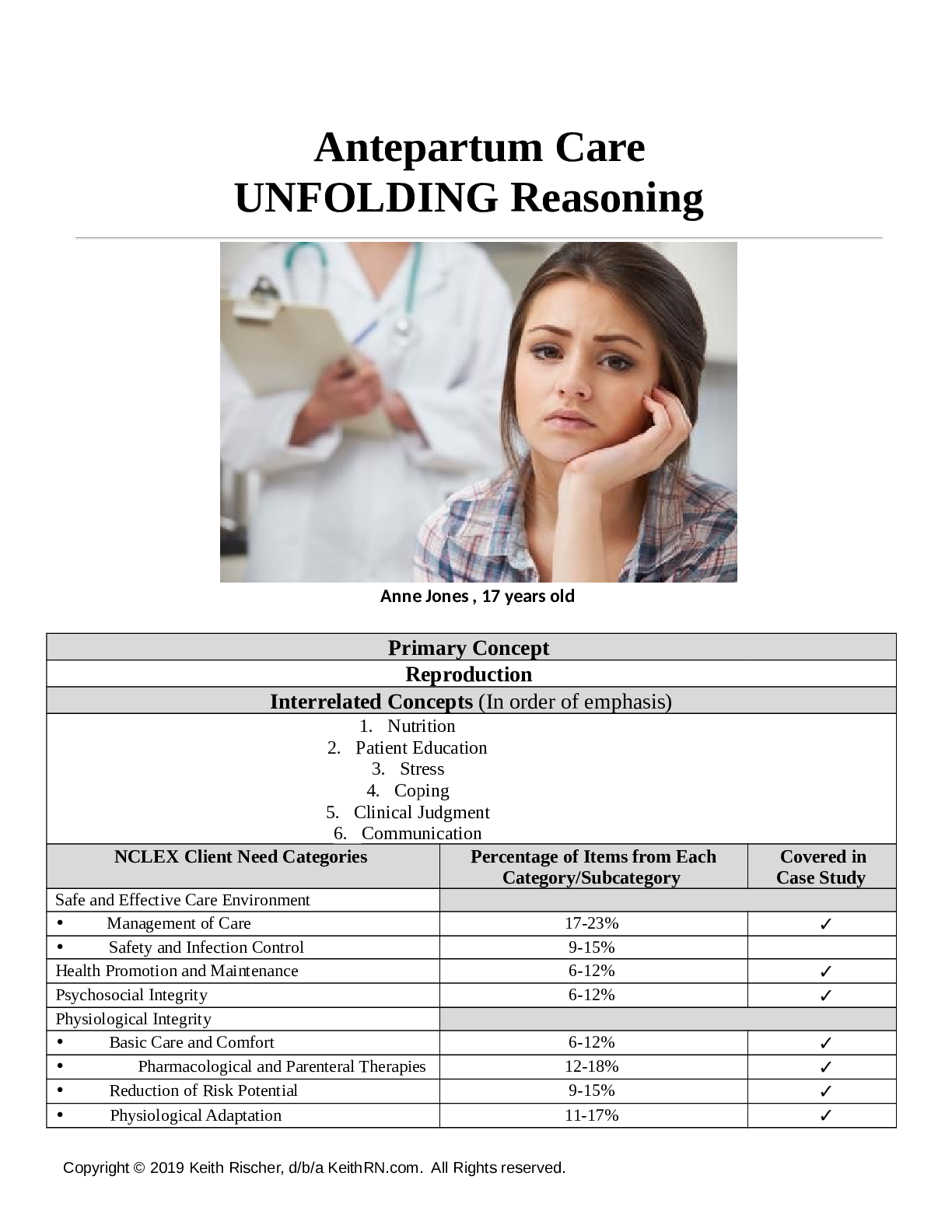
Anne Jones, 17 years old
What data from the histories are RELEVANT and must be interpreted as clinically significant by the nurse?
RELEVANT Data from Present Problem: Clinical Significance:
17 y/o reports 2 missed periods
Reports some spotting
c/o breast tenderness/swelling
c/o frequent urination
c/o nausea in the morning
positive pregnancy test
-All are signs of pregnancy
RELEVANT Data from Social History: Clinical Significance:
high school senior
job requires standing for long periods
denies ETOH use
denies tobacco use
reports a poor diet
has not let anyone know about potential
pregnancy
-Patient is going to need a nutrition consult to help her accommodate
healthier eating habits
-Patient’s age/ eating habits puts her at risk for preeclampsia
-Patient should be educated on the importance of not picking up
smoking or alcoholic drinking
-Patient is at risk for not having a support system if she does not let
anyone know about pregnancy
Patient Care Begins:
Current VS: P-Q-R-S-T Pain Assessment:
T: 98.6 F/37.0 C (oral) Provoking/Palliative: Breast tenderness
P: 76 (regular) Quality: Tender to touch and movement
R: 18 (regular) Region/Radiation: Both breasts
BP: 125/80 Severity: 4/10 but better if wears a bra
O2 sat: not assessed Timing: For the past couple of months
How will the nurse interpret each of these findings? (Address each one)
RELEVANT VS Data: Clinical Significance:
T: 98.6 F
P: 76 (Regular)
R: 18 (Regular)
BP: 125/80
4/10 Breast tenderness
for past couple of months
Temp, Pulse, Resp are not clinically significant. BP is clinically significant. Could
potentially be a sign of impending preeclampsia. Patient should be monitored and educated
on better eating habits.
Breast tenderness is not clinically significant due to the increased hormone production
Current Assessment:
Copyright © 2019 Keith Rischer, d/b/a KeithRN.com. All Rights reserved.
GENERAL
APPEARANCE:
Calm, body relaxed, no grimacing, appears to be slightly nervous, Height 5’4” (160 cm),
weight 100 lbs. (45.5 kg), 5 lbs. (2.3 kg) weight loss from pre-pregnant weight, no appetite.
BMI 18
RESP: Breath sounds clear with equal aeration bilaterally ant/post, nonlabored respiratory effort
CARDIAC: Pink, warm & dry, no edema, heart sounds regular with no abnormal beats, pulses strong,
equal with palpation at radial, brisk cap refill
NEURO: Alert and oriented to person, place, time, and situation (x4)
HEENT: Normal cephalic, slight bleeding at gum lines. Conjunctiva of eyelids; appears pale
Chest: Breasts tender on palpation, areola darkened and occasional veins present
Abdomen: Soft; no masses, uterus palpable below the level of the symphysis pubis,
Extremities: Mild spider varicose veins on the medial aspect of the left leg, deep tendon reflexes 2+
Pelvic Exam: Vagina and cervix deep purple in color, uterus slightly enlarged. Hegar’s sign present
How will the nurse interpret each of these assessment findings? (Address each one)
RELEVANT Assessment Data: Clinical Significance:
5lb weight loss
No appetite
Pale conjunctiva
Bleeding gums
Uterus palpable below level of
symphysis pubis
Varicose veins
Vagina/cervix deep purple
Loss of appetite stems from nausea. 5lb weight loss is from the patient not
having appetite. Patient should be educated on attempting to eat bland foods
and increasing her fluid intake.
Pale conjunctiva is an indicator of anemia. CBC should be monitored.
Bleeding gums is an indicator of gingivitis. If gums are tender, it could
impact patient’s eating habit. Risk of infection is increased.
Uterus is palpable below symphysis pubis. This indicates that patient is less
than 8 weeks pregnant.
Varicose veins are present due to standing for long periods of time. Patient
should be educated on wearing compression socks as well as trying to limit
her standing.
Purple discoloration on vagina and cervix is caused due to the increased
blood flow. Shows a positive Chadwick’s si
[Show More]




.png)