1. How can I help you?
2. What other symptoms or problems do you concerns?
3. When did yuour flank pain start?
4. Does anything make your flank pain better or worse?
5. What do your flank pain feel like?
6. How seve
...
1. How can I help you?
2. What other symptoms or problems do you concerns?
3. When did yuour flank pain start?
4. Does anything make your flank pain better or worse?
5. What do your flank pain feel like?
6. How severe is your flank pain?
7. Where more precisely is your flank pain?
8. Any change in your flank pain since it began.
9. Does your flank pain radiated?
10. Tell me about the health of your grandparents, parents and children
11. Are you sexually active?
12. Do you have any allergies?
13. Are you taking any prescription medications?
14. Are you taking any over-the-counter or herbal medications?
15. Is your period late?
16. When did your fever start?
17. How high is your fever?
18. Do you have pain when you urinate?
19. Is your urine pink or red in color(blood in urine)
20. Are you having problems with your period?
21. Can you tell me about any current or past medical problems you have had?
22. Any previous medical surgical or dental procedure.
Surname 2
Discussion Question 2
Based on your performance and the expert feedback in your PHYSICAL EXAM collection,
describe two errors in your exam performance or documentation. Use specific references from
your text to explain the importance of these findings in correct assessment of this client.
I did not omit an exam, but I performed a few that were not indicated.
Rectal exam
A DRE would not be appropriate according to a study by Quaas et al. (2009). Performing a DRE
has been commonly recommended on initial evaluation for undifferentiated abdominal area pain.
The researchers found that the diagnosis in the groups were unaffected by whether or not a DRE
was performed. In conclusion, given the discomfort and minimal predictive value of the DRE,
the highly selective practice seems unreasonable (Quaas et al., 2009). Alternately, Goolsby and
Grubbs state that a digital rectal examination is included in the abdominal examination (2015).
Auscultate abdomen
Auscultate the abdomen before beginning the gynecological examination by listening for bowel
sounds and bruits, noting any abnormalities in the bowel sounds (Gooslby & Grubbs 2015). My
thought process was completion of the abdominal assessment before moving on to the
gynecological exam, and absence of bowel sounds may indicate obstruction.
Discussion Question 3
Based on your performance on the PHYSICAL EXAM collection, describe one key finding that
you included in your list and describe a specific physical exam that you can perform at the pointof-care to further evaluate the finding. Use specific references from your text.
Right CVA tenderness to palpation.
CVA tenderness is highly suspicious of kidney origin. Perform percussion at the CVA and flank
to elicit and identify pain that may be associated with hydronephrosis or pyelonephritis (Gooslby
& Grubbs, 2015). In addition to UA and lab work, non-invasive point of care ultrasound guided
palpation (sonopalpation) may aid clinicians in localizing pain to discrete anatomic structures in
cases of suspected acute pyelonephritis lacking classic features (Faust & Tsung, 2017). This
device (sonographic Murphy sign) has been used to rule-in cholecystitis with good results.
Although not diagnostic in itself, the authors agree that sonopalpation of the kidney may be a
useful and reproducible tool to confirm or refute a diagnosis of acute pyelonephritis (2017).
Discussion Question 4
Based on your performance and the expert feedback in your ASSESSMENT identification of
problem categories, choose one missed/incorrect category and use specific references from your
text to explain the importance of this category in arriving at correct differential diagnoses for this
client
I included the category of musculoskeletal, that was not indicated by the experts.
Surname 3
Trauma or injury involving the ribs could be the cause of a differential diagnosis – “Twelfth Rib
Syndrome (or slipping rib syndrome)” is an example. More likely in women, and frequently
after physical strain - ribs shift due to pulled ligaments; causing back pain at the location of the
12th rib. When slipping rib syndrome occurs, the movement can irritate the nerves and put a
strain on specific muscles in the affected area, resulting in pain and inflammation (Cadman
2017).
Discussion Question 5
Based on your performance and the expert feedback in your ASSESSMENT of differential
diagnoses, describe one incorrect/missed differential diagnosis and use specific references from
your text to support the inclusion of the diagnosis for this client.
I did not list acute appendicitis as a differential diagnosis.
Appendicitis can mimic some of the symptoms of acute pyelonephritis. Presentation may be
vague abdominal pain that localizes, and may or may not have fever, anorexia, leukocytosis,
vomiting, urinary symptoms or flank pain (Long, 2016). Symptoms will vary by patient. For
instance: this patient did not have urinary complaints, which are common in pyelonephritis, but
did have flank pain which is possible with appendicitis. According to the author, over 1/3 of
patients with pyelonephritis will present atypically - and a careful exam, history, and imaging can
support a diagnosis (2016).
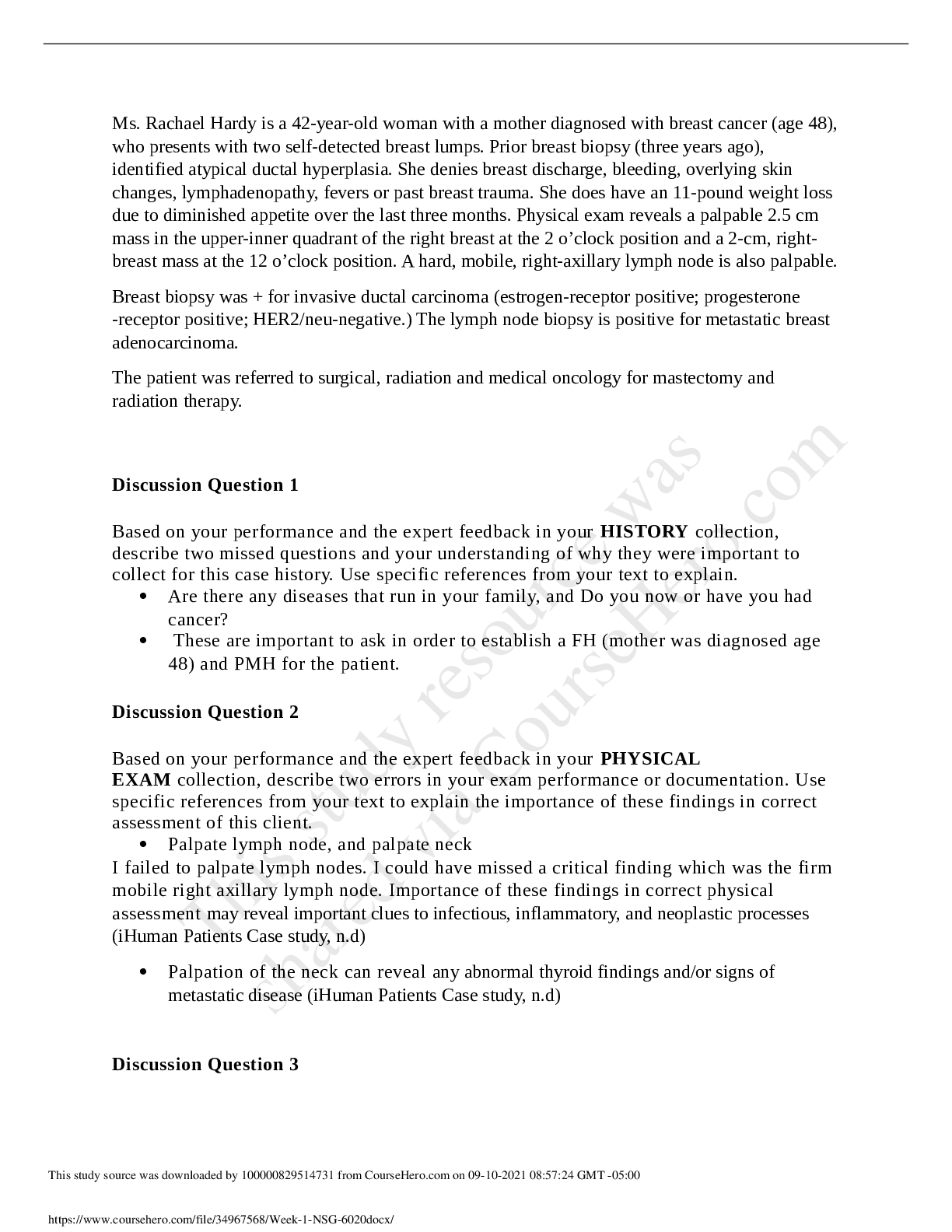
Discussion Question 1
Two missed history questions were, “Are you sexually active?” and “Do you have any blood in
your urine?” When performing a genitourinary history and physical, asking the patient about his
or her sexual history is appropriate and should include a general history of sexual habits. The
amount of detail needed for a sexual history should be guided by the nature of the patient’s
complaints. Asking the patient about blood in the urine can help narrow down a diagnosis, such
as pyelonephritis. One of the diagnostic features of this illness is red blood cells in the urine,
which would be found during a urinalysis (Goolsby & Grubbs, 2014).
[Show More]


.png)






.png)