THEORY OF ACCOUNTS
PRE COMPREHENSIVE EXAMINATION 1/4
LET’S GO!
1) On December 31, 2020, Babe Time Corporation had cash accounts at three different banks. One account balance is
segregated solely for a January 15, 202
...
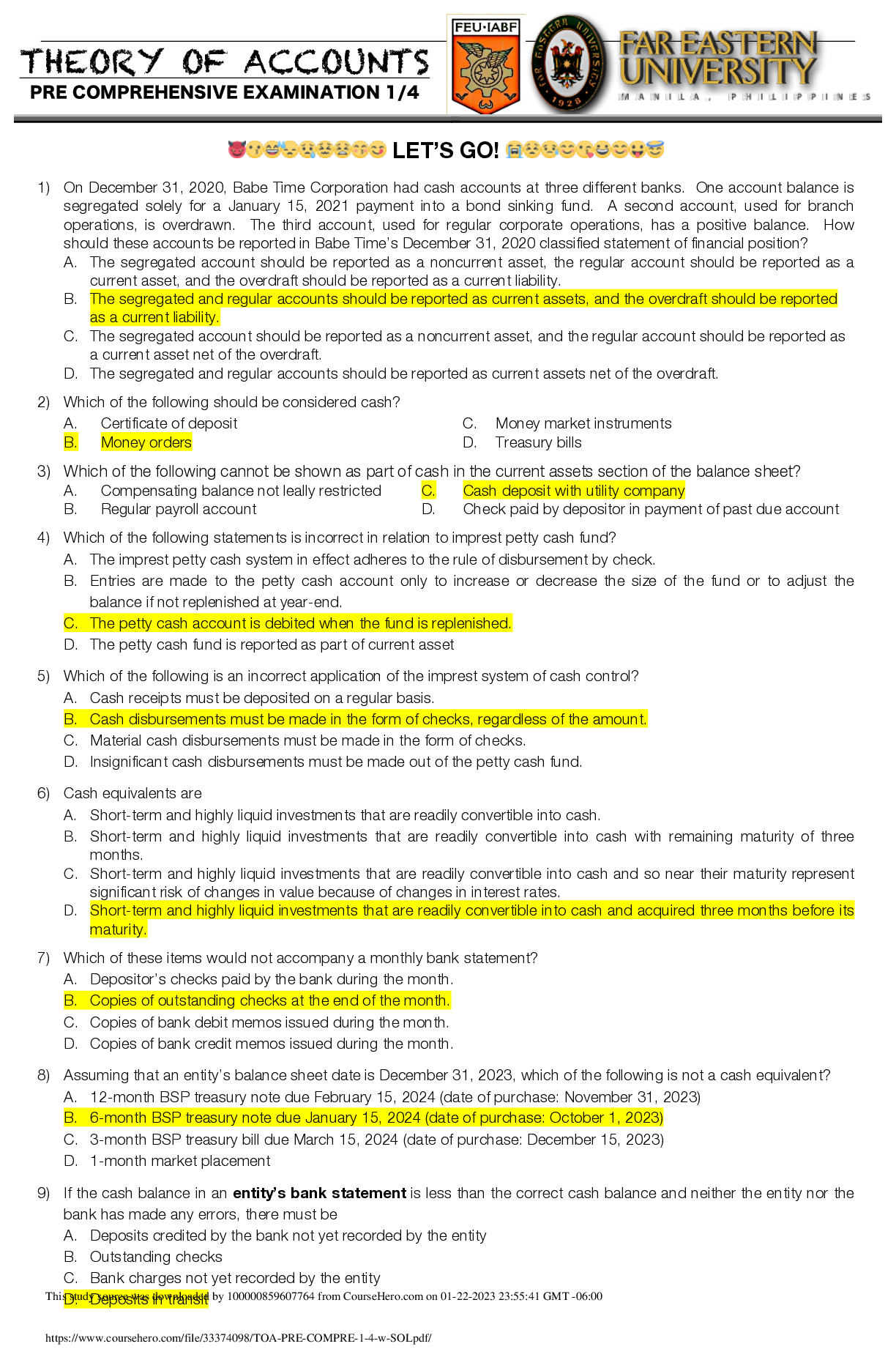
THEORY OF ACCOUNTS
PRE COMPREHENSIVE EXAMINATION 1/4
LET’S GO!
1) On December 31, 2020, Babe Time Corporation had cash accounts at three different banks. One account balance is
segregated solely for a January 15, 2021 payment into a bond sinking fund. A second account, used for branch
operations, is overdrawn. The third account, used for regular corporate operations, has a positive balance. How
should these accounts be reported in Babe Time’s December 31, 2020 classified statement of financial position?
A. The segregated account should be reported as a noncurrent asset, the regular account should be reported as a
current asset, and the overdraft should be reported as a current liability.
B. The segregated and regular accounts should be reported as current assets, and the overdraft should be reported
as a current liability.
C. The segregated account should be reported as a noncurrent asset, and the regular account should be reported as
a current asset net of the overdraft.
D. The segregated and regular accounts should be reported as current assets net of the overdraft.
2) Which of the following should be considered cash?
A. Certificate of deposit C. Money market instruments
B. Money orders D. Treasury bills
3) Which of the following cannot be shown as part of cash in the current assets section of the balance sheet?
A. Compensating balance not leally restricted C. Cash deposit with utility company
B. Regular payroll account D. Check paid by depositor in payment of past due account
4) Which of the following statements is incorrect in relation to imprest petty cash fund?
A. The imprest petty cash system in effect adheres to the rule of disbursement by check.
B. Entries are made to the petty cash account only to increase or decrease the size of the fund or to adjust the
balance if not replenished at year-end.
C. The petty cash account is debited when the fund is replenished.
D. The petty cash fund is reported as part of current asset
5) Which of the following is an incorrect application of the imprest system of cash control?
A. Cash receipts must be deposited on a regular basis.
B. Cash disbursements must be made in the form of checks, regardless of the amount.
C. Material cash disbursements must be made in the form of checks.
D. Insignificant cash disbursements must be made out of the petty cash fund.
6) Cash equivalents are
A. Short-term and highly liquid investments that are readily convertible into cash.
B. Short-term and highly liquid investments that are readily convertible into cash with remaining maturity of three
months.
C. Short-term and highly liquid investments that are readily convertible into cash and so near their maturity represent
significant risk of changes in value because of changes in interest rates.
D. Short-term and highly liquid investments that are readily convertible into cash and acquired three months before its
maturity.
7) Which of these items would not accompany a monthly bank statement?
A. Depositor’s checks paid by the bank during the month.
B. Copies of outstanding checks at the end of the month.
C. Copies of bank debit memos issued during the month.
D. Copies of bank credit memos issued during the month.
8) Assuming that an entity’s balance sheet date is December 31, 2023, which of the following is not a cash equivalent?
A. 12-month BSP treasury note due February 15, 2024 (date of purchase: November 31, 2023)
B. 6-month BSP treasury note due January 15, 2024 (date of purchase: October 1, 2023)
C. 3-month BSP treasury bill due March 15, 2024 (date of purchase: December 15, 2023)
D. 1-month market placement
9) If the cash balance in an entity’s bank statement is less than the correct cash balance and neither the entity nor the
bank has made any errors, there must be
A. Deposits credited by the bank not yet recorded by the entity
B. Outstanding checks
C. Bank charges not yet recorded by the entity
D. Deposits in transit
TOA: PRE COMPREHENSIVE EXAMINATION 1/4 PAGE 2 OF 9
10) Which statement is true?
A. Certificates of deposit are usually classified as cash on the statement of financial position.
B. Companies include postdated checks and petty cash funds as cash.
C. Cash equivalents are investments with original maturities of six months or less
D. Savings accounts are usually classified as cash on the statement of financial position
11) In a bank reconciliation, a DAUD/DAIF check is usually
A. Added to the bank balance C. Deducted from the bank balance
B. Added to the book balance D. Deducted from the book balance
12) In which account are postage stamps classified?
A. Cash B. Office supplies C. Receivables D. Inventory
13) Which of the following is true about erroneous bank credit?
A. Cash balance per bank is understated
B. Cash receipts per bank is overstated
C. It should be recorded as a credit to cash in bank account
D. It should be added to balance per bank in preparing bank reconciliation
14) The adjusting entries for a bank reconciliation
A. May include a debit to accounts receivable for overstatement of cash receipt arising from a collection of open
account.
B. May include a debit to accounts payable for overstatement of cash disbursements arising from payment of open
account.
C. May include a credit to cash for net proceeds of bank loan.
D. May include a credit to notes payable for net proceeds of note collected by the bank in behalf of the depositor.
15) Under which section of the statement of financial position is “cash restricted for plant expansion” reported?
A. Current assets B. Noncurrent assets C. Current liabilities D. Equity
16) Which of the following statement is true?
A. Outstanding checks will cause the cash balance per ledger to be greater than the balance reported by the bank, all
other things being equal.
B. Bank service charge will cause the cash balance per ledger to be higher than that reported by the bank, all other
things being equal.
C. In a bank reconciliation statement, the items found immediately below the “balance per bank statement” caption
needs journal entries.
D. In preparing monthly bank reconciliation, the amount of matured time deposits transferred by the bank to the
current account of the depositor must be added to the balance reported on the bank statement to arrive at the
correct cash balance.
17) Statement 1: A bank reconciliation should be prepared by the individual responsible for cash receipts and
disbursements.
Statement 2: In a bank reconciliation statement, the amount of NSF check must be added to the depositor’s cash
balance in determining the correct cash balance.
A. True; false B. True; true C. False; true D. False; false
18) The following statements relate to cash:
I. The term cash equivalents refer to demand credit instruments such as money orders and bank drafts.
II. The purpose of establishing a petty cash fund is to keep enough cash on hand to cover all normal operating
expenses of the business for a period of time.
III. Classification of a restricted cash balance as current or noncurrent should parallel the classification of the related
purpose or obligation for which cash was restricted.
IV. Compensating balances by a bank should always be excluded from the “cash” classification on the balance
sheet.
A. All of the statements are false C. Only two of the statements are false
B. Three of the statements are false D. Only one of the statement is false
19) The payments of accounts payable made subsequent to the close of the accounting period are recorded as if they
were made at the end of the current period.
A. Imprest system B. Lapping C. Window dressing D. Kiting
20) Under the imprest fund system, which of the following is not true?
A. The imprest petty cash system in effect adheres to the rule of disbursement by check.
B. Entries are made to the Petty cash account only to increase or decrease the size of the fund or to adjust the
balance if not replenished at year-end.
C. The Petty cash account is debited when the fund is replenished.
D. The account “Cash short/over” if debit balance, is presented as part of operating expenses.
TOA: PRE COMPREHENSIVE EXAMINATION 1/4 PAGE 3 OF 9
21) In most situations, the petty cash fund is reimbursed just prior to the year-end and an adjusting entry is made to avoid
A. The overstatement of cash and the understatement of expenses
B. The understatement of cash and the overstatement of expenses
C. The misstatement of revenues
D. The understatement of cash with the appropriate statement of expenses
22) Which is true when a petty cash fund is used?
A. The primary purpose of petty cash fund is to effectively plan cash inflows and outflows.
B. The petty cashier’s summary of petty cash payments serves as a journal entry that is posted to the appropriate
general ledger account.
C. The reimbursement of the petty cash fund should be credited to the cash account.
D. Entries that include a credit to the cash account should be recorded at the time payments from the petty cash fund
are made.
23) A petty cash system is designed to
A. Cash checks for employees C. Account for all cash receipts and disbursements
B. Handle cash sales D. Pay small miscellaneous expenses
24) The entry to replenish the petty cash fund for P1,000 of various minor expenditures would include a:
A. Debit to cash B. Credit to cash C. Debit to petty cash D. Credit to petty cash
25) The following statements relate to cash. Which statement is incorrect?
A. The purpose of establishing a petty cash fund is to pay small expenses which cannot be paid conveniently by
means of check.
B. Classification of a restricted cash balance as current or noncurrent should be parallel the classification of the related
obligation for which the cash was restricted.
C. Compensating balance required by a bank may be included in “cash and cash equivalent”.
D. The term “cash equivalent” refers to demand credit instruments such as money order and bank drafts.
26) Which of the following is true regarding cash discounts?
A. Purchase discount is recognized under the gross price method at the time of purchase of goods.
B. Purchase discount lost is recorded under the gross price method when the cash discounts are taken.
C. Purchase discount lost is recorded under the net price method when the cash discounts are taken.
D. Purchase discount is recorded under the gross price method when the cash discounts are taken.
27) The credit balance in customer’s accounts should be
A. Netted against the debit balances in other customer’s accounts.
B. Presented separately as currently liability.
C. Reported as a loss contingency.
D. Reported as a valuation account to receivables.
28) What is the normal journal entry for recording bad debts expense under direct write-off method?
A. Debit Allowance for Doubtful Accounts, credit Accounts Receivable.
B. Debit Allowance for Doubtful Accounts, credit Bad Debt Expense.
C. Debit Bad Debt Expense, credit Accounts Receivable.
D. Debit Bad Debt Expense, credit Allowance for Doubtful Accounts.
29) A company uses the allowance method to recognize uncollectible accounts expense. What is the effect at the time of
the collection of account previously written off on each of the following accounts?
Allowance for bad debt Bad debt expense Allowance for bad debt Bad debt expense
A. No effect No effect C. Increase Decrease
B. Increase No effect D. No effect Decrease
30) Receivable from officers, employees, or affiliated companies should be reported in the statement of financial position as
A. Current assets, if collectible within twelve months or operating cycle, whichever is longer.
B. Noncurrent assets only
C. Current assets, if collectible within twelve months
D. Offsets to capital
31) Loans receivable from company employees are classified as current assets of they are reasonably expected to be
realized in cash
A. Within one year or within the normal operating cycle, whichever is shorter.
B. Within one year or within the normal operating cycle, whichever is longer.
C. Within the normal operating cycle
D. Within one year, the length of the normal operating cycle notwithstanding
TOA: PRE COMPREHENSIVE EXAMINATION 1/4 PAGE 4 OF 9
32) A company writes off as uncollectible an account receivable from a bankrupt customer. The company has an adequate
amount in its Allowance for Bad debts. This transaction will
A. Decrease profit for the period C. Decrease the amount of owner’s equity
B. Decrease total current assets D. Have no effect on total current assets
33) If receivables are hypothecated against borrowings, the amount of receivables involved should be
A. Disclosed in the statements or notes
B. Excluded from the total receivables, with disclosure
C. Excluded from the total receivables, with no disclosure
D. Excluded from the total receivables and a gain or loss is recognized between the face value and the amount of
borrowings
34) Per requirement of PFRS, an entry should be made to the bad debt expense account
A. When an account receivable with terms 2/10, n/30 is past thirty-day due
B. When an account receivable previously written off is determined to be collectible
C. When an account receivable is determined not to be collectible and is written off
D. In the period when a sale is made and not when the receivable associated with the sale is determined to be
uncollectible
35) On April 1, 2020, a company received a one-year note receivable bearing interest at the market rate. The face amount
of the note receivable and the entire amount of the interest are due on March 31, 2021. The interest receivable account
at June 30, 2010 would consist of the amount representing
A. The excess on April 1, 2020 of the present value of the notes receivable over its face value
B. Three months of accrued interest income
C. Nine months of accrued interest income
D. Twelve months of accrued interest income
36) Loan receivable is subsequently measured at
A. Fair value C. Fair value plus transaction cost
B. Fair value minus transaction cost D. Amortized cost
37) Which of the following statements is true?
A. When a specified customer’s account which had already been written off is later collected, sales revenue is
increased by the amount of the recovery.
B. A non-interest bearing note is measured on the statement of financial position at face value less the amount of
unamortized discount.
C. When individual customers’ accounts have credit balances of material amounts, these amounts must be deducted
from the debit balance in other customers’ accounts in the statement of financial position.
D. It is appropriate to measure the impairment on receivable based on recognized sales or other revenues.
38) Assuming that the ideal measure of short-term receivables in the statement of financial position is the discounted value
of the cash to be received in the future, failure to follow this practice usually does not make the statement of financial
position misleading because
A. Most short-term receivables are not interest bearing
B. The allowance for uncollectible accounts includes a discount element
C. The amount of the discount is not material
D. Most receivables can be sold to a bank or factor
39) JaYbo Company factored its receivable without recourse with Bojay Bank. JaYbo received cash as a result of this
transaction which is best described as a
A. Loan from Bojay collateralized by JaYbo’s accounts receivable
B. Loan from Bojya to be repaid by the proceeds from JaYbo’s accounts receivable
C. Sale pf JaYbo’s accounts receivable to Bojay, with the risk of uncollectible accounts retained by JaYbo
D. Sale of JaYbo’s accounts receivable to Bojay, with the risk of uncollectible accounts transferred to Bojay.
40) Factoring of receivable is usually done on a
A. With recourse, notification basis C. With recourse, non-notification basis
B. Without recourse, notification basis D. Without recourse, non-notification basis
41) Statement 1: Trade receivables are classified as current assets if they are to be collected within one year or within the
normal operating cycle, whichever is shorter.
Statement 2: Non-trade receivables are classified as current assets if they are to be collected within one year or within
normal operating cycle, whichever is longer.
A. Both are true B. Both are false C. Only 1 is true D. Only 1 is false
42) The amount of accounts receivable is included in total receivables with appropriate disclosures when
A. Pledged (yes); Assigned (yes); factored (yes) C. Pledged (yes); Assigned (no); factored (no)
B. Pledged (yes); Assigned (yes); factored (no) D. Pledged (no); Assigned (no); factored (no)
TOA: PRE COMPREHENSIVE EXAMINATION 1/4 PAGE 5 OF 9
43) Note receivable discounted with recourse should be
A. Included in total receivables with disclosure of contingent liability
B. Included in total receivables without disclosure of contingent liability
C. Excluded from total receivables with disclosure of contingent liability
D. Excluded from total receivables without disclosure of contingent liability
44) Accounting for the imputed interest on a noninterest bearing note receivable is an example of what aspect of
accounting theory?
A. Substance over form B. Matching C. Verifiability D. Accounting entity
45) The assignor’s equity in assigned accounts that is required to be disclosed in the notes is equal to the
A. Bank loan balance
B. Assigned accounts receivable
C. Bank loan balance minus the assigned accounts receivable
D. Assigned accounts receivable minus the bank loan balance
46) This includes compensation for activities such as evaluating the borrower’s financial condition, evaluating guarantees,
collateral and other security, negotiating the terms of the loan, preparing and processing documents and closing the
loan transaction.
A. Direct origination cost B. Origination fees C. Service charges D. Loans
47) A 120-day, 15% interest bearing note receivable is discounted to a bank at 18% after being held for 45 days. The
proceeds received from the bank upon discounting would be the
A. Maturity value less discount at 18% for 120 days C. Maturity value less discount at 18% for 75 days
B. Maturity value less discount at 18% for 45 days D. Face value less than the discount at 15%
48) A note receivable bearing a reasonable interest rate is sold to a bank with recourse. The notes receivable discounted
account should be reported as a
A. Contra-asset account for the proceeds from the discounting transactions
B. Liability account for the proceeds from the discounting transactions
C. Contra-asset account for the face amount of the note
D. Liability account for the face amount of the note
49) A 90-day, 15% interest-bearing note receivable is sold to a bank with recourse after being held for 60 days. The
proceeds are calculated using a 12% interest rate. The amount credited to notes receivable at the date of the
discounting transactions would be
A. The same as the cash proceeds C. The face value of the note
B. Less than the face value of the note D. The maturity value of the note
50) Jaebom Company prepares an accounts receivable aging schedule with a series of computations as follows: 2% of the
total peso balance of accounts from 1-60 days past due, plus 5% of the total peso balance of accounts from 61-120
days past due and so on. How would you describe the total of the amounts determined in this series of computations?
A. It is the amount of uncollectible accounts expense for the year.
B. It is the amount that should be added to the allowance for uncollectible accounts at year-end.
C. It is the amount of the desired credit balance of the allowance for uncollectible accounts to be reported in the yearend financial statements.
D. When added to the total of accounts written off during the year, this new sum is the desired credit balance of the
allowance account.
51) Inventories are assets (choose the incorrect one)
A. Held for sale in the ordinary course of business.
B. In the process of production for sale.
C. Held for use in the production or supply of goods or services.
D. In the form of materials or supplies to be consumed in the production process or in the rendering of services
52) Inventories are defined as:
A. Assets held for sale in the ordinary course of business, in the process of production for such sale, or in the form of
materials or supplies to be consumed in the production process or in the rendering of services
B. Assets held for sale, in the process of production, or in the form of materials or supplies to be consumed in the
production process
C. Tangible assets held for sale in the ordinary course of business, in the process of production, or in the form of
materials or supplies to be consumed in the production process or in the rendering of service
D. Property (land or a building, or part of a building, or both) held to earn rentals or for capital appreciation or both.
53) The seller actually paid the freight charges but is not legally responsible for the same.
A. FOB destination, freight prepaid C. FOB shipping point, freight prepaid
B. FOB destination, freight collect D. FOB shipping point, freight collect
TOA: PRE COMPREHENSIVE EXAMINATION 1/4 PAGE 6 OF 9
54) An entity shall include in its inventory all goods
A. Owned and possessed by the entity at the balance sheet date.
B. Owned but not possessed by the entity at the balance sheet date.
C. Possessed but not owned by the entity at the balance sheet date.
D. Owned by the entity at the balance sheet date, regardless of location.
55) Which of the following is excluded in the scope of PAS 2 on inventories?
A. Inventories of a service provider C. Manufacturing supplies
B. Construction in progress D. Raw materials
56) When using a periodic inventory method, which of the following generally would not be separately accounted for in the
computation of cost of goods sold?
A. Trade discounts applicable to purchases during the period.
B. Cash discounts taken during the period.
C. Purchase returns and allowances of merchandise during the period.
D. Cost of transportation in for merchandise purchases during the period.
57) A company using periodic inventory system neglected to record a purchase of merchandise on account at year-end.
This merchandise was omitted from year-end physical count. How will these errors affect inventory at year-end and
cost of goods sold for the year.
A. No effect; understate C. Understate; understate
B. No effect; overstate D. Understate; no effect
58) During period of rising prices, when the FIFO inventory cost flow method is used, a perpetual inventory system would
A. not be permitted
B. result in the same ending inventory as a periodic inventory system
C. result in a higher ending inventory than a periodic inventory system
D. result in a lower ending inventory than a periodic inventory system.
59) The retail method has been used by a retail department store during its first year of operations. As of the end of the
year, compare the markdowns with markdown cancellations:
A. Markdown will be greater than or equal to markdown cancellation
B. Markdown will be equal to markdown cancellation
C. Markdown will be less than or equal to markdown cancellation
D. Markdown cannot be equal to markdown cancellation
60) The retail inventory method would include which of the following in the calculation of the goods available for sale at both
cost and retail
A. Purchase returns C. Markdowns and markups
B. Sales returns D. Purchase discounts
61) The net method of recording purchases
A. is the theoretically accepted method because the cost measured represents the cash equivalent price of the
inventory
B. is more convenient than the gross method from a bookkeeping standpoint
C. is the one used by most companies
D. violates the matching principle
62) When the conventional retail inventory method is used, markdowns are commonly ignored in the computation of the
cost to retail ratio because
A. markups are also ignored
B. there may be no markdowns in a given year
C. this tends to give better approximation of the lower of cost or market
D. this tends to result in the showing of a normal profit margin in a period when no markdown goods have been sold
63) Cost of goods sold is understated if
A. Beginning inventory is overstated C. Ending inventory is understated
B. Net purchases is overstated D. Ending inventory is overstated
64) All of the following correctly describe the average cost inventory cost flow method except:
A. a moving average cost is used with a perpetual inventory system only.
B. the average cost methods are based on the view that the cost of inventory on hand and the cost of goods sold
during a period should be representative of all purchase costs available for the period
C. a weighted-average unit cost is used with a periodic inventory system only
D. a moving average cost is used with either a periodic or a perpetual inventory system
65) The average method of cost flow assumption, when used in a perpetual inventory system, is called
A. Moving average B. Weighted average C. Simple average D. B or C
66) Which of the following is included in an entity’s inventories?
A. Damaged and worthless merchandise C. Goods purchased under “lay-away” sale
B. goods in-transit sold under FOB shipping point D. Goods sold under a sale with repurchase obligation
TOA: PRE COMPREHENSIVE EXAMINATION 1/4 PAGE 7 OF 9
67) Which of the following costs would be considered as inventoriable cost?
A. Foreign exchange differences arising from acquisition of inventories involving a foreign currency.
B. Storage cost necessary on goods still work in process.
C. Import duties and refundable purchase taxes.
D. Abnormal amounts of wasted materials, labor and overhead
68) Which statement is incorrect with respect to inventories under PAS 2?
A. Inventories shall be measured at the lower of cost and net realizable value.
B. The cost of inventories shall comprise all costs of purchase, cost of conversion and other costs incurred in bringing
the inventories to their present location and condition.
C. The cost of inventories of a service provider consists primarily of labor and other costs of personnel directly
engaged in providing the service, including supervising personnel and attributable overhead.
D. The allocation of fixed production overhead to the cost of production is based on actual level of production.
69) Under the periodic method, cost of goods sold is computed by
A. Adding the cost of purchases during the period to the cost of the inventory on hand at the beginning of the period
and adding this figure to the cost of the inventory on hand at the end of the period.
B. Adding the cost of purchases during the period to the cost of the inventory on hand at the end of the period and
subtracting the inventory on hand at the beginning of the period.
C. Subtracting the cost of the inventory on hand at the ending of the period from the cost of goods available for sale.
D. Carefully matching selling and administrative expenses with the sales to which they are related and then reporting
these expenses in the same period the associated revenue is reported.
70) Which of the following statements is incorrect about perpetual inventory system?
A. Inventory account is debited upon purchase
B. One of the entries made to make up return of goods sold on account is Dr. inventory and Cr. cost of goods sold.
C. Sales allowance granted to customer on account would require an entry debiting sales returns and allowance and
crediting accounts receivable/
D. A physical inventory is made at year-end in order to set up the cost of goods sold.
71) At the end of the fiscal year, Olympus Airlines has an outstanding non-cancellable purchase commitment for the
purchase of 2 million gallons of jet fuel at a price of P4.50 per gallon for delivery during the coming summer. If the
market price of jet fuel at the end of the year is P4.00, how would this situation be reflected in the annual financial
statements?
A. Report gain of P1,000,000 in the income statement.
B. Record loss and estimated liability of P1,000,000.
C. Record purchases and accounts payable amounting to P8,000,000.
D. Disclose only the existence of the purchase commitment in the notes to FS.
72) The proper treatment for the amount of recovery of loss on purchase commitment is
A. Reported in the income statement as deduction from cost of goods sold.
B. Reported as other income that is limited only for the amount of loss on purchase commitment recognized in the
previous period.
C. Ignored when the purchase commitment is not subject to cancellation
D. Reported as other comprehensive income.
73) An understatement of the ending inventory in Year 1, if not corrected, will cause
A. Year 1 net income to be understated and Year 2 net income to be overstated.
B. Year 1 net income to be overstated and Year 2 net income to be overstated.
C. Year 1 net income to be overstated and Year 2 net income to be correct.
D. Year 1 net income to be overstated and Year 2 net income to be understated.
74) What is the treatment of inventory normal spoilage under the FIFO retail method?
A. Included in the computation of cost ratio C. Deducted from goods available for sale at cost
B. Deducted from sales D. Deducted from goods available for sale at retail
75) In computing cost ratio, the conservative/conventional retail method should
A. Include markup and markdowns C. Include markup but not markdown
B. Exclude markup and markdowns D. Exclude markup but not markdown
76) A trading securities is
A. Security which has been purchased recently C. Security which is held for resale in the near future
B. Security held in the account of a brokerage firm D. Security which will be transferred in exchange
TOA: PRE COMPREHENSIVE EXAMINATION 1/4 PAGE 8 OF 9
77) For investments in trading securities, which of the following market value changes are recognized in earnings?
A. Realized gains only C. Unrealized losses only
B. Realized losses only D. Realized and unrealized gains and losses
78) The statement of financial position may include unrealized gains and losses from which type of investment securities?
A. Trading securities only C. Investment in bonds measured at amortized cost
B. Investment measured at FVTOCI D. Trading and investment measured at FVTOCI
79) Which of the following items should be treated as dividend income?
A. Reverse stock split C. Shares received in lieu of cash
B. Cash received in lieu of shares D. Cash dividend under equity method
80) How would an increase in the fair value of the ordinary shares affect the investment account under each of the following
appropriate investment account under each of the following appropriate classification?
Trading securities Investment in associate Trading securities Investment in associate
A. Increase Increase C. No effect No effect
B. Increase No effect D. No effect Increase
81) Investment is equity securities that provide neither control nor significant influence over the investee are measured at the
end of the reporting period at
A. Fair value B. Cost C. Carrying value D. Net realizable value
82) Which of the following dividends received by an investor holding equity investments values at fair value is not
recognized as dividend income?
A. Shares received in lieu of cash dividend C. Cash dividend
B. Cash received in lieu of share dividend D. Property dividend
83) Which of the following is true about fair value model in accounting for investment in associate of a small and medium
entity?
A. Investment should be carried at the balance sheet date at fair value less cost to sell.
B. Impairment loss shall be recognized if recoverable value is lower than carrying amount.
C. Transaction cost should be expensed outright at initial recognition.
D. Dividend received is considered a deduction form investment account.
84) The following statements are based on PAS 28 – Investment in Associates:
I. An investment in associate shall be accounted for using the equity method (benchmark) or cost method
(alternative).
II. An investor shall discontinue the use of equity method from the date when it ceases to have significant influence
over an associate and shall account for the investment in accordance with PFRS 9.
III. On the loss of significant influence, the investor shall measure at historical cost any investment the investor retains
in the former associate.
A. Only I is false B. Only II is true C. Only III is true D. All are false
85) Which of the following statements is proper accounting treatment and measurement of investments?
A. Investments at fair value shall be carried at fair value less cost to sell.
B. Investment in associate shall be carried using the equity method.
C. Dividends paid reduce the carrying amount of investment at fair value.
D. Share in profit of investee increases the investment at fair value.
86) A bond is purchased bonds on January 1. The investor’s carrying value at the end of the first year would be highest if
the bond was purchased at a
A. Discount & amortized by straight line method C. Premium & amortized by straight line method
B. Discount & amortized by effective interest method D. Premium & amortized by effective interest method
87) If a bond investment is purchased between interest payment dates, the buyer should pay, in addition to the purchase
price of the bonds, the amount of accrued interest computed
A. From the date of acquisition to the nearest interest payment date.
B. From the last interest payment date to the date of acquisition.
C. From the last interest payment date to the next nearest payment date.
D. None of the above.
88) An investor purchased a bond classified as long-term between the interest dates at a premium. At purchase date, the
carrying value of the bond is
A. More than the cash paid to the seller C. More than the face value of the bond
B. Less than the face value of the bond D. Equal to the cash paid to the seller
TOA: PRE COMPREHENSIVE EXAMINATION 1/4 PAGE 9 OF 9
89) Which of the following is true with regards to the accrued interest on bonds payable that are sold between interest
dates?
A. The accrued interest is computed using the effect rate.
B. The accrued interest will be paid to the seller when the bonds mature.
C. The accrued interest is extra income to the buyer and treated as bond issue cost of the buyer.
D. The accrued interest is added to the issue price of the bond to determine the total cash proceeds from bond
issuance.
90) Gains or losses on sale of Investment at FVOCI are recognized
A. In profit or loss whether debt or equity securities.
B. In profit or loss when debt securities only.
C. In other comprehensive income whether debt or equity securities.
D. In profit or loss when equity securities only.
91) Assume an investor purchases bonds at a premium the bonds are to be held as a long-term investment which of the
following statement is true regarding the amount of bond interest revenue to be reported over life of the bonds?
A. The periodic amount of bond interest revenue will always be above the periodic amount of cash received for interest
B. The pattern of the periodic amount of bond interest revenue is an increasing amount
C. The periodic amount of bond interest revenue will always be equal to the periodic amount of cash received
D. The periodic amount of bond interest revenue will always be less than the periodic amount of cash received
92) What is the treatment of premium or discount on trading bond investment?
A. As part of the cost of the bond investment until the investment is sold.
B. As part of the cost of the bond investment and amortized over 5 years.
C. As expense or revenue in the period the bond is purchased.
D. As part of the cost of the bond investment and amortized over the remaining llife of the bonds.
93) XYZ Company did not amortize the discount on its trading bond investment. What effect would this have on the
carrying value of the investment and on net income, respectively?
A. No effect, no effect B. Understate, overstate C. Overstate, overstate D. Understate, understate
94) This distinguishes an investment in associate from other types of investment
A. Ownership interest of less than 20% C. Presence of significant influence
B. Ownership interest of 20% or more D. Representation in the board of directors
95) Significant influence
A. cannot be inferred from the presence of potential voting rights
B. is presumed to exist if ownership interest is at least 10%
C. cannot be obtained from ownership of preference shares
D. can only be obtained from ownership of shares in an incorporated entity
96) Financial assets include all of the following, except
A. Cash in bank C. Loans receivable
B. Trade accounts and note receivable D. Inventories and prepaid items
97) The usual factors considered in classifying investments in securities as short term are
A. Ready marketability and type of investments C. Type of investment only
B. Ready marketability and management intentions D. Ready marketability only
98) For investments in trading securities, which of the following market value changes are recognized in earnings?
A. Realized gains only C. Unrealized losses only
B. Realized losses only D. Realized and unrealized gains and losses
99) Both fair values and subsequent growth of the investee are not as relevant for investments in which of the following
categories?
A. Securities reported under the equity method C. Financial asset measured at amortized cost
B. Trading securities D. Financial asset measured at OCI
100) Which of the following is not correct regarding trading securities?
A. They are classified as current assets
B. Unrealized holding gains or losses are reported in profit or loss
C. Cash dividend share be recognized as dividend income
D. Share in profit of the investee increases carrying amount of the investment.
END OF PRE COMPREHENSIVE EXAM 1/4
[Show More]





 1e Gail Fayerman.png)
.png)