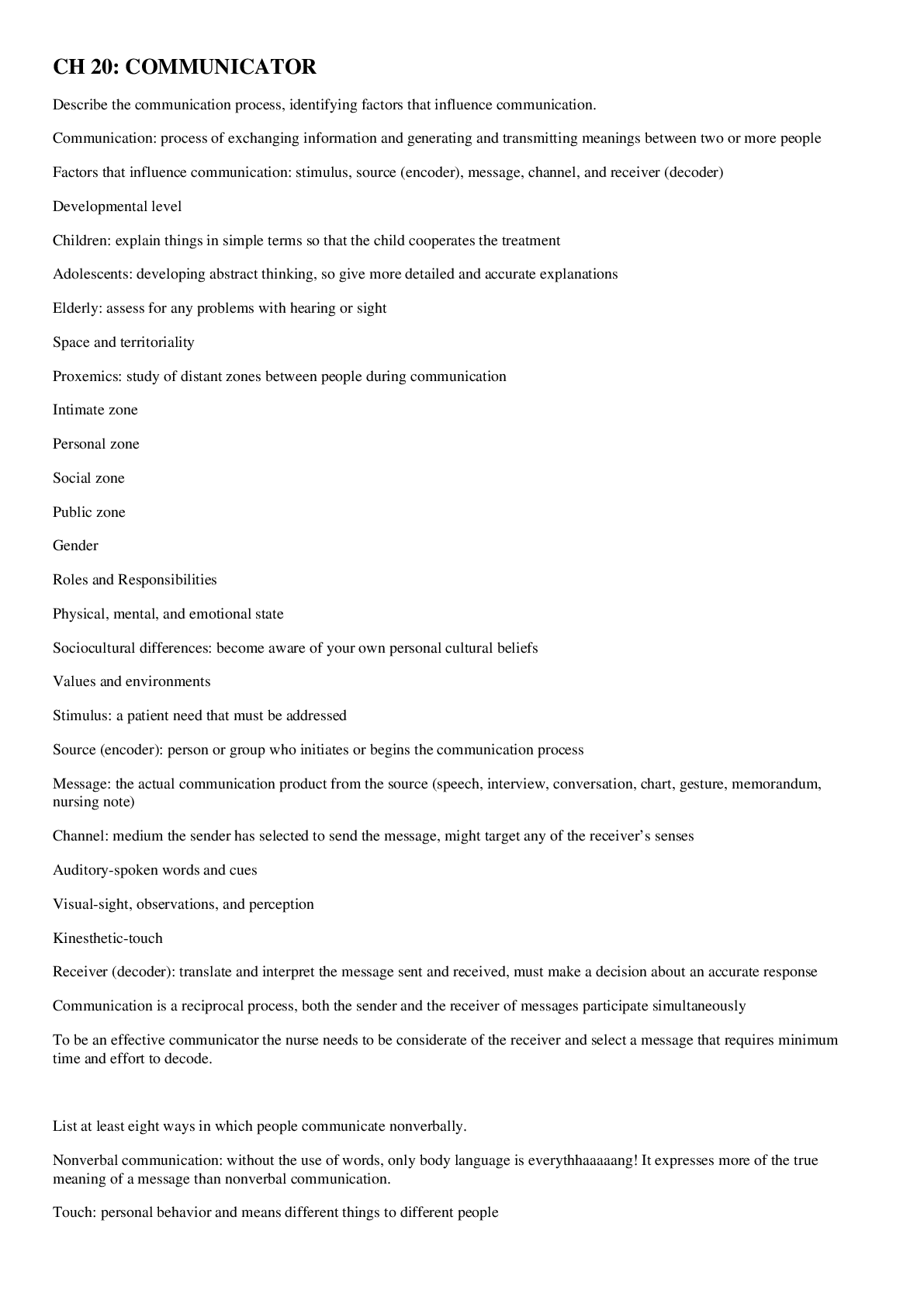
1. Describe the communication process, identifying factors that influence communication.
a. Communication: process of exchanging information and generating and transmitting meanings between two or more people
b. Factor
...
1. Describe the communication process, identifying factors that influence communication.
a. Communication: process of exchanging information and generating and transmitting meanings between two or more people
b. Factors that influence communication: stimulus, source (encoder), message, channel, and receiver (decoder)
1. Developmental level
a. Children: explain things in simple terms so that the child cooperates the treatment
b. Adolescents: developing abstract thinking, so give more detailed and accurate explanations
c. Elderly: assess for any problems with hearing or sight
2. Space and territoriality
a. Proxemics: study of distant zones between people during communication
b. Intimate zone
c. Personal zone
d. Social zone
e. Public zone
3. Gender
4. Roles and Responsibilities
5. Physical, mental, and emotional state
6. Sociocultural differences: become aware of your own personal cultural beliefs
7. Values and environments
■ Stimulus: a patient need that must be addressed
■ Source (encoder): person or group who initiates or begins the communication process
■ Message: the actual communication product from the source (speech, interview, conversation, chart, gesture, memorandum, nursing note)
■ Channel: medium the sender has selected to send the message, might target any of the receiver’s senses
1. Auditory-spoken words and cues
2. Visual-sight, observations, and perception
3. Kinesthetic-touch
■ Receiver (decoder): translate and interpret the message sent and received, must make a decision about an accurate response
c. Communication is a reciprocal process, both the sender and the receiver of messages participate simultaneously
d. To be an effective communicator the nurse needs to be considerate of the receiver and select a message that requires minimum time and effort to decode.
2. List at least eight ways in which people communicate nonverbally.
a. Nonverbal communication: without the use of words, only body language is everythhaaaaang! It expresses more of the true meaning of a message than nonverbal communication.
■ Touch: personal behavior and means different things to different people
■ Eye contact: attention-getting method, respect and willingness to listen and to keep communication open, absence indicates anxiety or defenselessness or avoidance of communication.
1. Asian and Native Americans: view it as invasion of a person’s privacy
2. Other cultures: avoid eye contact out of respect to not make eye contact with superiors.
■ Facial expressions: some people have expressive faces while others mask their feelings, nurses need to control their own facial expressions
■ Posture: good health and positive attitude means their bodies are in good alignment, depressed or tired people are most likely to slouch, can be a good indicator of tension or pain
■ Gait: should be a bouncy, purposeful walk
■ Gestures: examples are thumbs up means victory, kicking an object expresses anger
■ General physical appearance: illnesses can cause some alterations in general physical appearance
■ Dress and grooming
■ Sounds: examples are a person might cry because of sadness or joy, gasping often indicates fear, pain, or surprise
■ Silence: complete understanding of each other
3. Discuss professional responsibilities when using electronic communication.
a. Protecting patient privacy and confidentiality and preventing unintended consequences for the employer or the nurse
b. Must adhere to HIPAA regulations that protect patient confidentiality and privacy and be aware of their employer's policies about using social media
c. Derogatory comments can lead to civil lawsuits against the nurse
d. Nurses must not transmit or place online individually identifiable patient information.
e. Nurses must observe ethically prescribed professional patient–nurse boundaries.
f. Nurses should understand that patients, colleagues, institutions, and employers may view postings.
g. Nurses should take advantage of privacy settings and seek to separate personal and professional information online.
h. Nurses should bring content that could harm a patient’s privacy, rights, or welfare to the attention of appropriate authorities.
i. Nurses should participate in developing institutional policies governing online conduct.
■ Social Media: Can’t transmit or place online individual patient information
1. Professional boundaries must be followed
■ Emails & Texts: Risk for violating patient privacy and confidentiality exists any time a message is sent electronically. Health care agencies usually have security measure in place to safeguard.
4. Describe the interrelation between communication and the nursing process.
a. Assessment- gather information using both verbal & nonverbal forms. Also determine if patient needs any assistive devices for communication at this point. Identify preferred language.
b. Diagnosis- nurse communicates findings to other professionals written and spoken word.
c. Planning- communication between nurse, patient and nurse and other health care team members here is crucial.
d. Implementation- verbal & nonverbal communication enhances care giving and encourages behavior.
e. Evaluation- Spoken and unspoken word about what goals were achieved; also using SBAR.
f. Ability to communicate with patients and others nurses which is essential for effective use
g. Nursing process: Provides guidance and direction needed to communicate with patient effectively
h. Knowledge to communicate the process and effective communication technique is fundamental
5. Identify patient goals for each phase of the helping relationship.
a. Orientation phase:
■ nursing relation with the patient, location, frequency, lengths contact, duration of the relationship, and way personal info (patient) will be handled
■ establish tone and guidelines for the relationship
■ identify each other by name
■ clarify roles of both people
■ establish an agreement about the relationship
■ provide patient with orientation to the health care system
b. Working phase:
■ to meet patient physical and psychosocial needs
■ interaction or ensure achievement of the health goal or objectives agreed upon
■ provide whether assistance is needed to achieve each goal
■ provide teaching and counseling
■ Patient will cooperate in activities that work toward achieving mutually acceptable goals
■ Patient will express feelings and concerns to the nurse
c. Termination phase:
■ patient is discharged home and initial agreement is acknowledge
■ examine goals of helping relationship for attainment
■ make suggestions for future efforts
■ encourage patient to express emotions about the termination
■ help patient establish relationship with another nurse
■ assist transferring from one agency to another.
■ Patient will identify the goals accomplished or the progress made
6. Use effective communication techniques when interacting with patients from different cultures.
a. Assess your personal beliefs surrounding people from different cultures
■ Set aside values, biases, ideas, attitudes that are judgmental and may negatively affect care
b. Assess communication variables from a culture perspective
■ Determine ethnic identity, use patient as source of info, assess cultural factors
c. Plan care based on the communicated needs and cultural background
d. Modify communication approaches to meet cultural needs
■ Respond in a reassuring manner, be attentive to signs of fear, anxiety, etc.
e. Understand that respect for the patient and communicated needs is central to the therapeutic relationship
f. Communicate in a nonthreatening manner
g. Use validating techniques in communication
h. Be considerate of reluctance to talk when the subject involves sexual matters
■ Some cultures do not discuss sexual matters freely
i. Adopt special approaches when the patient speaks a different language
j. Use interpreters to improve communication
7. Use a standardized communication technique (SBAR) to communicate with physicians and transfer patient information to other nurses.
a. Process of accurate presentation and acceptance of patient related information from one caregiver or team to another caregiver or team using effective communication.
b. Eliminate breakdowns in communication and potential adverse events
c. S: situation
d. B: background
e. A: Assessment
f. R: recommendations
8. Evaluate yourself in terms of the interpersonal competencies needed in nursing.
a. Occurs between two or more people with a goal to exchange messages.
b. Nurses communicate with patients, family members, and members of the health care system.
c. Influences sharing, problem solving, goal attainment, team building, and effectiveness in critical nursing roles.
d. Group communication
■ Small group communication - when nurses interact with two or more people.
1. ex) staff meetings, patient care conferences, teaching sessions, support groups
■ Organizational communication - when people and groups within an organization communicate to achieve established goals
1. ex) nurses working with interdisciplinary groups
2. ex) nurses on a practice council meeting to review unit policies.
■ Group dynamics - how individual group members relate to one another during process of working toward group goals
e. Effective groups are respectful to each other. If a group member dominates or thwarts the group process, then the leader or other group members must confront that member to promote the needed collegial relationship.
f. Characteristics of effective/ineffective groups
■ Group identity: value aims of the group
■ Cohesiveness: trust and like one another
■ Patterns of interaction: honest, direct communication
■ Decision making: problems are identified, and decision making is appropriate
■ Responsibility
■ Leadership
■ Power
9. Describe how each type of ineffective communication hinders communication.
a. Failure to perceive the patient as a human being
b. Failure to listen
c. Nontherapeutic comments and questions
■ Cliché
■ Using questions requiring only yes or no answer
■ Using questions containing words “Why” and “How”
■ Using questions that probe for information
■ Using leading questions
■ Using comments that give advice
■ Using judgmental comments
d. Changing the subject
e. Giving false reassurance
f. Gossip and rumor
g. Disruptive interpersonal behavior
■ Incivility: rude, intimidating, an undesirable behavior
h. Bullying
■ Horizontal violence: nurse-nurse hostility
i. Aggressive behavior
10. Describe strategies that counteract disruptive professional behaviors.
a. Education must be provided for all staff regarding respectful, professional behavior.
b. All staff members must be held accountable for their behavior.
c. Zero-tolerance policies must be implemented regarding disruptive behaviors and protection must be provided for those who report these behaviors.
d. Those in leadership positions must attend training regarding professional standards of behavior and function as a positive role model.
e. Surveillance and reporting systems must be available to identify unprofessional behaviors.
f. Emphasis must be placed on the importance of documenting bullying behaviors.
11. Establish therapeutic relationships with patients assigned to your care, and describe effective interventions for patients with impaired verbal communication.
a. Check box 20-6: Communicating with patients who have special needs
■ Visually impaired patients-acknowledge presence, state your name, mind your nonverbal communication. Explain reasons for touching patient. Indicate the end of conversation. Call bell and glasses easily in reach.
■ Hearing impaired patients- gently touch or go into vision of patient. Talk directly and face them. Don’t cover mouth, use sign language or write down ideas. Clean hearing aids.
■ Patient with a physical barrier (laryngectomy or endotracheal tube)
■ Cognitively impaired patients- make direct eye contact, no open ended questions and give time for response.
■ Unconscious patients- Careful of what is said in front of them. Speak before touch. Keep noise level down and always assume they can hear.
■ Patients who do not speak english
b. Specific communication strategies may be necessary for older adults who have speech, language, and hearing disorders.
■ Avoid “elderspeak” - communication must be respectful, positive, and individualized, avoid the “baby talk.”
[Show More]






.png)