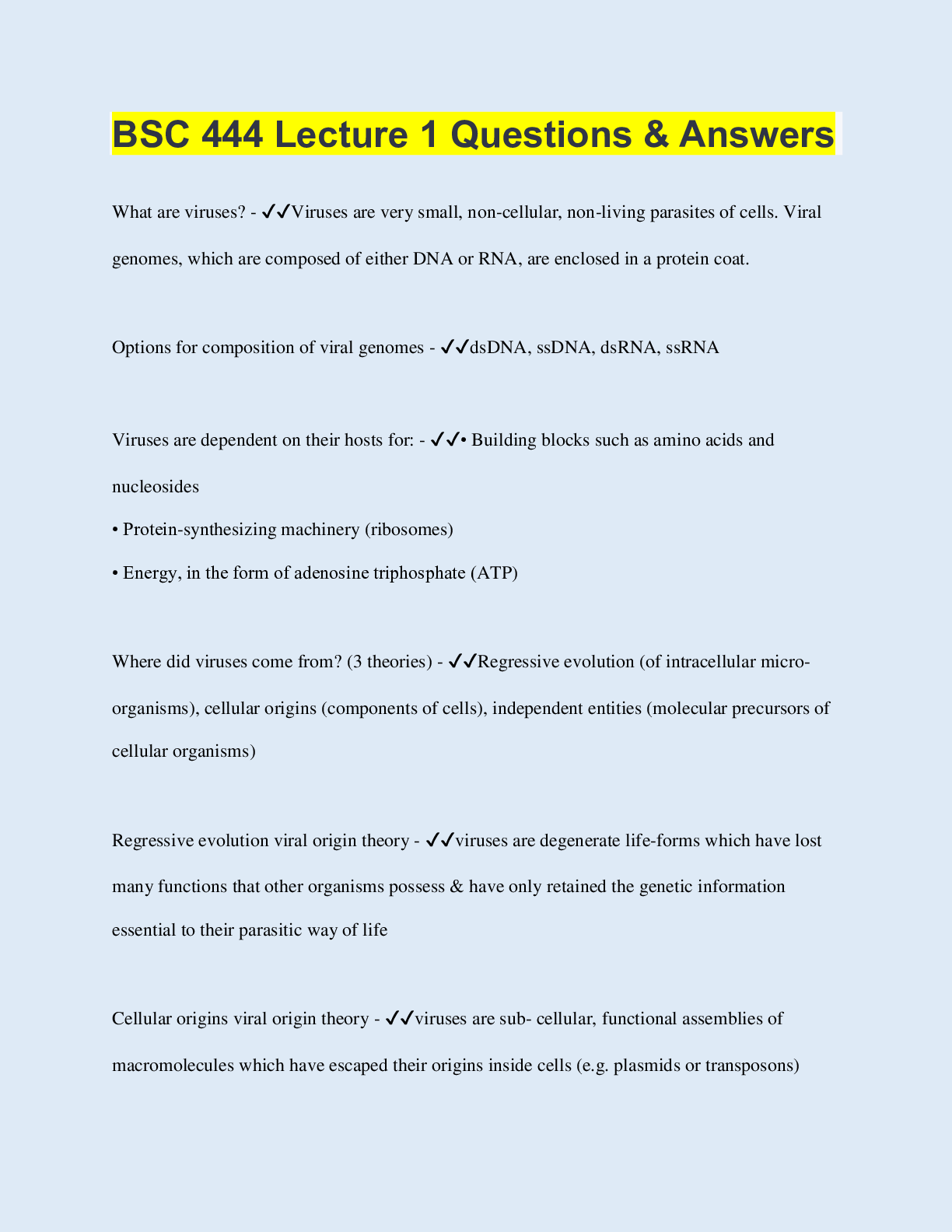
BSC 444 Lecture 1 Questions & Answers
What are viruses? - ✔✔Viruses are very small, non-cellular, non-living parasites of cells. Viral
genomes, which are composed of either DNA or RNA, are enclosed in a protein coat.
...
BSC 444 Lecture 1 Questions & Answers
What are viruses? - ✔✔Viruses are very small, non-cellular, non-living parasites of cells. Viral
genomes, which are composed of either DNA or RNA, are enclosed in a protein coat.
Options for composition of viral genomes - ✔✔dsDNA, ssDNA, dsRNA, ssRNA
Viruses are dependent on their hosts for: - ✔✔• Building blocks such as amino acids and
nucleosides
• Protein-synthesizing machinery (ribosomes)
• Energy, in the form of adenosine triphosphate (ATP)
Where did viruses come from? (3 theories) - ✔✔Regressive evolution (of intracellular microorganisms), cellular origins (components of cells), independent entities (molecular precursors of
cellular organisms)
Regressive evolution viral origin theory - ✔✔viruses are degenerate life-forms which have lost
many functions that other organisms possess & have only retained the genetic information
essential to their parasitic way of life
Cellular origins viral origin theory - ✔✔viruses are sub- cellular, functional assemblies of
macromolecules which have escaped their origins inside cells (e.g. plasmids or transposons)
Independent entities viral origin theory - ✔✔viruses evolved on a parallel course to cellular
organisms from the self-replicating molecules believed to have existed in the primitive prebiotic
'RNA world'
What are the 3 problems every virus must solve? - ✔✔1. How to reproduce during it's "visit"
inside a host cell.
2. How to spread from one individual to another.
3. How to evade its host's defenses.
Reproduction Problem:
Most mature cells are no longer actively replicating their DNA or dividing, thus, this machinery
is usually shut down to conserve energy.
Viral Solutions: - ✔✔Viruses either possess ways to turn the cell back "on", or they bring in their
own parts to substitute for cellular parts that are turned "off".
Spread Problem #1:
Physical transport from one host to another
Viral Solution: - ✔✔Viruses have evolved to take advantage of host behaviors as a means of
transport (e.g.
coughing, sneezing, sexual behaviors)
Spread problem #2:
Coexisting with new host long enough to reproduce and spread again.
Viral solution: - ✔✔Viruses generally infect large organs which have many cells. That way, the
virus can kill or damage (either directly or indirectly) a relatively large number of cells without
doing serious harm to the host (ex: cold viruses infect the respiratory tract)
Evading host defenses - ✔✔Every successful virus has evolved strategies that allow it to elude
the host's antiviral defenses
What are 2 causes of viral pathogenesis? - ✔✔1. Actions of the virus itself
2. Host immune response (host's reactions to the virus)
How do scientists study virus evolution? - ✔✔• Virologists use PCR and RT-PCR to recover and
amplify genomes of past viruses.
• Viral genome sequences are then compared to estimate the evolutionary relationships between
viruses and to follow changes in rapidly evolving viruses such as HIV.
• The sequence data is then used to produce phylogenetic trees that indicate how modern viruses
may have arisen from common ancestors.
What are the 3 mechanisms of virus evolution? - ✔✔Mutations, recombination, reassortment
Virus evolution through mutations: - ✔✔As nucleic acids are copied by polymerases some errors
are made
• If the error is in a protein-coding sequence AND if the error results in a change in the amino
acid encoded, then the error results in a mutation.
• As natural selection operates, the mutations that survive are those that best fit the virus for its
continued survival.
Selective pressures on viruses - ✔✔Immune response, viral processes
Immune response as a selective pressure - ✔✔a new antigenic type of a virus is at an advantage
because the host's immune system has not previously encountered it
Viral processes as a selective pressure - ✔✔virus attachment proteins must retain the
configurations that allow them to bind to cell receptors and viral enzymes must retain their
catalytic abilities.
Why do RNA viruses evolve more quickly than DNA viruses? - ✔✔RNA-dependent RNA
polymerases and reverse transcriptases have minimal proofreading activity compared to DNAdependent DNA polymerases (thus mutations are more likely to occur)
Typical polymerase error rates - ✔✔DNA pol: per 10^7 to 10^11 bases added
RNA pol: per 10^3 to 10^6 bases added
Reverse transcriptase: per 10^3 to 10^6 bases added
Virus evolution through recombination: - ✔✔• Recombination is a process that results in the
production of a new genome, derived from two parental genomes.
• For viruses, recombination may occur when a cell is infected with two related viruses; the new
virus that is produced is referred to as a recombinant virus.
• Both DNA and RNA viruses can undergo recombination.
How DNA viruses recombine - ✔✔DNA viruses recombine via cleavage of the parental DNA
molecules followed by ligation
How ssRNA viruses are thought to recombine - ✔✔Template switching mechanism
Virus evolution through
reassortment: - ✔✔• Reassortment is a category of recombination that can occur with segmented
genome viruses that package all their segments into one virion. Unique to RNA viruses with
segmented genomes!
• If a cell is co-infected by two strains of one of these viruses the progeny virions may contain
mixtures of genome segments from the two parental strains.
• These mixed virions are called reassortants.
[Show More]











![Preview of [SOLVED] EDCO 740 / EDCO740 Quiz 1 (LATES 2021/2022 Graded A)](https://scholarfriends.com/storage/EDCO_740_Quiz_1.png)

