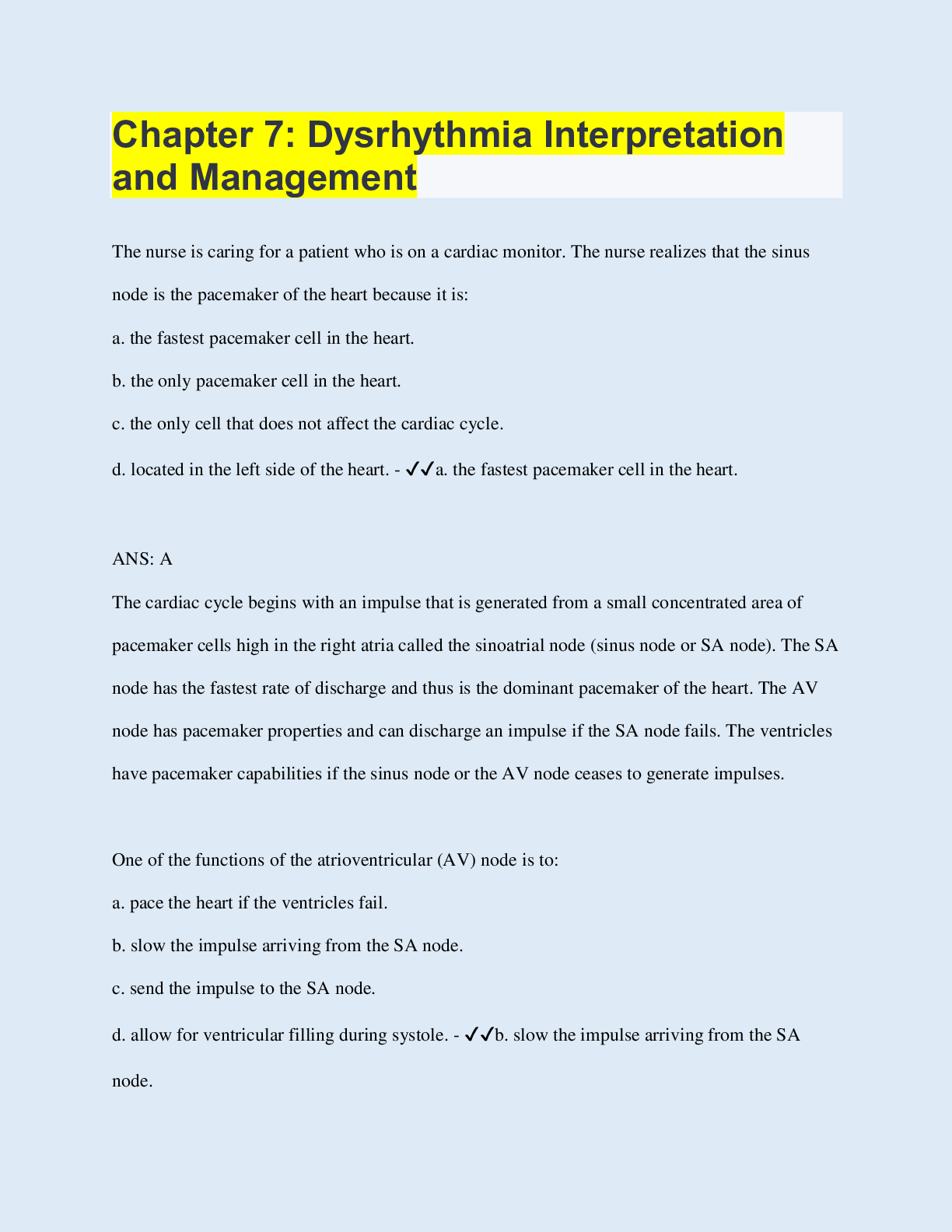
Chapter 7: Dysrhythmia Interpretation
and Management
The nurse is caring for a patient who is on a cardiac monitor. The nurse realizes that the sinus
node is the pacemaker of the heart because it is:
a. the fastest p
...
Chapter 7: Dysrhythmia Interpretation
and Management
The nurse is caring for a patient who is on a cardiac monitor. The nurse realizes that the sinus
node is the pacemaker of the heart because it is:
a. the fastest pacemaker cell in the heart.
b. the only pacemaker cell in the heart.
c. the only cell that does not affect the cardiac cycle.
d. located in the left side of the heart. - ✔✔a. the fastest pacemaker cell in the heart.
ANS: A
The cardiac cycle begins with an impulse that is generated from a small concentrated area of
pacemaker cells high in the right atria called the sinoatrial node (sinus node or SA node). The SA
node has the fastest rate of discharge and thus is the dominant pacemaker of the heart. The AV
node has pacemaker properties and can discharge an impulse if the SA node fails. The ventricles
have pacemaker capabilities if the sinus node or the AV node ceases to generate impulses.
One of the functions of the atrioventricular (AV) node is to:
a. pace the heart if the ventricles fail.
b. slow the impulse arriving from the SA node.
c. send the impulse to the SA node.
d. allow for ventricular filling during systole. - ✔✔b. slow the impulse arriving from the SA
node.
ANS: B
The impulse from the SA node quickly reaches the atrioventricular (AV) node located in the area
called the AV junction, between the atria and the ventricles. Here the impulse is slowed to allow
time for ventricular filling during relaxation or ventricular diastole. The AV node has pacemaker
properties and can discharge an impulse if the SA node (not the ventricle) fails. The electrical
impulse is then rapidly conducted through the bundle of His to the ventricles (not the SA node)
via the left and right bundle branches.
The normal rate for the SA node when the patient is at rest is:
a. 40 to 60 beats per minute.
b. 60 to 100 beats per minute.
c. 20 to 40 beats per minute.
d. more than100 beats per minute. - ✔✔b. 60 to 100 beats per minute.
ANS: B
The sinus node reaches threshold at a rate of 60 to 100 times per minute. Because this is the
fastest pacemaker in the heart, the SA node is the dominant pacemaker of the heart. The AV
node has an inherent rate of 40 to 60 beats per minute and the His-Purkinje system can fire at a
rate of 20 to 40 beats per minute. Sinus tachycardia results when the SA node fires faster than
100 beats per minute.
When assessing the 12-lead electrocardiogram (ECG) or a rhythm strip, it is helpful to
understand that the electrical activity is viewed in relation to the positive electrode of that
particular lead. When an electrical signal is aimed directly at the positive electrode, the inflection
will be:
a. negative.
b. upside down.
c. upright.
d. equally positive and negative. - ✔✔c. upright.
ANS: CWhen an electrical signal is aimed directly at the positive electrode, an upright inflection
is visualized. If the impulse is going away from the positive electrode, a negative deflection is
seen; and if the signal is perpendicular to the imaginary line between the positive and negative
poles of the lead, the tracing is equiphasic, with equally positive and negative deflection.
The patient is admitted with a condition that requires cardiac rhythm monitoring. To apply the
monitoring electrodes, the nurse must first:
a. apply a moist gel to the chest.
b. make certain that the electrode gel is dry.
c. avoid soaps to avoid skin irritation.
d. clip chest hair if needed. - ✔✔d. clip chest hair if needed.
ANS: DAdequate skin preparation of electrode sites requires clipping the hair, cleansing the
skin, and drying vigorously (moisture gels are not applied). Cleansing includes washing with
soap and water, or alcohol, to remove skin debris and oils. Before application, the electrodes are
checked to ensure that the gel is moist. It is difficult for electrodes to adhere to the chest in the
presence of chest hair. Clipping, not shaving, is recommended since shaving may create small
nicks that can become a portal for infection.
Electrocardiogram (ECG) paper contains a standardized grid where the horizontal axis measures
time and the vertical axis measures voltage or amplitude. The nurse must understand that each
horizontal box indicates:
a. 200 milliseconds or 0.20 seconds duration.
b. 40 milliseconds or 0.04 seconds duration.
c. 3 seconds duration.
d. millivolts of amplitude. - ✔✔b. 40 milliseconds or 0.04 seconds duration.
ANS: BECG paper contains a standardized grid where the horizontal axis measures time and the
vertical axis measures voltage or amplitude. Horizontally, the smaller boxes denote 0.04 seconds
each or 40 milliseconds; the larger box contains five smaller boxes and thus equals 0.20 seconds
or 200 milliseconds.
The nurse is examining the patient's cardiac rhythm strip in lead II and notices that all of the P
waves are upright and look the same except one that has a different shape and is inverted. The
nurse realizes that the P wave with the abnormal shape is probably:
a. from the SA node since all P waves come from the SA node.
b. from some area in the atria other than the SA node.
c. indicative of ventricular depolarization.
d. normal even though it is inverted in lead II. - ✔✔b. from some area in the atria other than the
SA node.
ANS: BNormally a P wave indicates that the SA node initiated the impulse that depolarized the
atrium. However, a change in the shape of the P wave may indicate that the impulse arose from a
site in the atria other than the SA node. The P wave represents atrial depolarization. It is usually
upright in leads I and II and has a rounded, symmetrical shape. The amplitude of the P wave is
measured at the center of the waveform and normally does not exceed three boxes, or 3
millimeters, in height.
The QT interval is the total time taken for ventricular depolarization and repolarization.
Prolongation of the QT interval:
a. decreases the risk of lethal dysrhythmias.
b. usually occurs when heart rate increases.
c. increases the risk of lethal dysrhythmias.
d. can only be measured with irregular rhythms. - ✔✔c. increases the risk of lethal dysrhythmias.
ANS: CThe QT interval is measured from the beginning of the QRS complex to the end of the T
wave. This interval measures the total tim
[Show More]

















![Preview of [SOLVED] EDCO 740 / EDCO740 Quiz 1 (LATES 2021/2022 Graded A)](https://scholarfriends.com/storage/EDCO_740_Quiz_1.png)


