Cardiac Dysrhythmias Test Bank
Questions
The nurse assesses a client's ECG tracing and observes that not all QRS complexes are preceded
by a P wave. How should the nurse interpret this observation?
A. The client has
...
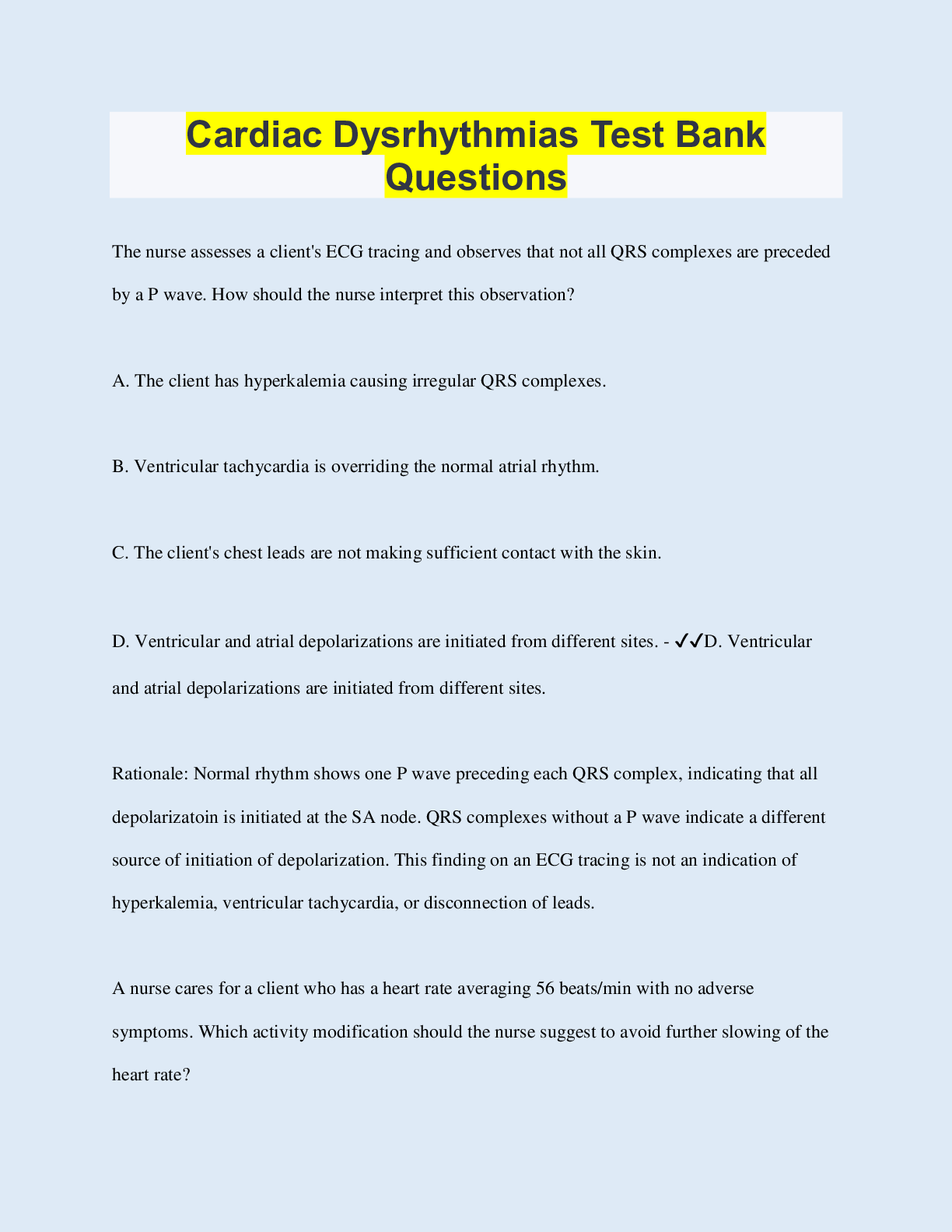
Cardiac Dysrhythmias Test Bank
Questions
The nurse assesses a client's ECG tracing and observes that not all QRS complexes are preceded
by a P wave. How should the nurse interpret this observation?
A. The client has hyperkalemia causing irregular QRS complexes.
B. Ventricular tachycardia is overriding the normal atrial rhythm.
C. The client's chest leads are not making sufficient contact with the skin.
D. Ventricular and atrial depolarizations are initiated from different sites. - ✔✔D. Ventricular
and atrial depolarizations are initiated from different sites.
Rationale: Normal rhythm shows one P wave preceding each QRS complex, indicating that all
depolarizatoin is initiated at the SA node. QRS complexes without a P wave indicate a different
source of initiation of depolarization. This finding on an ECG tracing is not an indication of
hyperkalemia, ventricular tachycardia, or disconnection of leads.
A nurse cares for a client who has a heart rate averaging 56 beats/min with no adverse
symptoms. Which activity modification should the nurse suggest to avoid further slowing of the
heart rate?
A. Make certain that your bath water is warm.
B. Avoid straining while having a bowel movement.
C. Limit your intake of caffeinated drinks to one a day.
D. Avoid strenuous exercise such as running. - ✔✔B. Avoid straining while having a bowel
movement.
Rationale: Bearing down strenuously during a bowel movement is one type of Valsalva
maneuver, which stimulates the vagus nerve and results in slowing of the heart rate. Such a result
is not desirable in a person who has bradycardia. The other instructions are not appropriate for
this condition.
A nurse is assessing clients on a med-surg unit. Which client should the nurse identify as being at
greatest risk for atrial fibrillation?
A. A 45-year-old who takes an aspirin daily.
B. a 50-year-old who is post coronary artery bypass surgery.
C. A 78-year-old who had a carotid endarterectomy.
D. An 80-year-old with COPD. - ✔✔B. a 50-year-old who is post coronary artery bypass
surgery.
Rationale: Atrial fibrillation occurs commonly in clients with cardiac disease and is a common
occurrence after coronary artery bypass graft surgery. The other conditions do not place these
clients at higher risk for atrial fibrillation.
A nurse assesses a client with atrial fibrillation. Which manifestation should alert the nurse to the
possibility of a serious complication from this condition?
A. Sinus tachycardia
B. Speech Alterations
C. Fatigue
D. Dyspnea with activity - ✔✔B. Speech Alterations
Rationale: Clients with atrial fibrillation are at risk for embolic stroke. Evidence of embolic
events includes changes in mentation, speech, sensory function, and motor function. Clients with
atrial fibrillation often have a rapid ventricular response as a result. Fatigue is a nonspecific
complaint. Clients with atrial fibrillation often have dyspnea as a result of the decreased cardiac
output caused by the rhythm disturbance.
A nurse evaluates prescriptions for a client with chronic atrial fibrillation. Which medication
should the nurse expect to find on this client's medication administration record to prevent a
common complication of this condition?
A. Solatol (Betapace)
B. Warfarin (Coumadin)
C. Atropine (Sal-Tropine)
D. Lidocaine (Xylocaine) - ✔✔B. Warfarin (Coumadin)
Rationale: A-fib puts clients at risk for developing emboli. Clients at risk for developing emboli
are treated with anticoagulants, such as heparin, enoxaparin, or warfarin. Sotalol, atropine, and
lidocaine are not appropriate for this complication.
A nurse administers prescribed adenosine (Adenocard) to a client. Which response should the
nurse assess for as the expected therapeutic response.
A. Decreased intraocular pressure
B. Increased heart rate
C. Short period of asystole
D. Hypertensive crisis - ✔✔C. Short period of asystole
Rationale: Clients usually respond to adenosine with a short period of asystole, bradycardia,
hypotension, dyspnea, and chest pain
A nurse cares for a client with an intravenous temporary pacemaker for bradycardia. The nurse
observes the presence of a pacing spike but no QRS complex on the client's ECG. Which action
should the nurse take next?
A. Administer intravenous diltiazem (Cardizem).
B. Assess vital signs and LOC.
C. Administer sublingual nitroglycerin
D. Assess capillary refil and temperature - ✔✔B. Assess vital signs and LOC.
Rationale: In temporary pacing, the wires are threaded into the epicardial surface of the heart and
exit through the chest wall. The pacemaker spike should be followed immediately by a QRS
complex. Pacing spikes seen without subsequent QRS complexes imply loss of capture. The
nurse shpuld assess for cardiac output via vital signs and LOC. The other interventions would not
determine if the client is tolerating the loss of capture.
[Show More]


.png)
.png)
.png)
.png)