Chapter 1: Introduction to Real Estate
Questions and Answers Already Passed
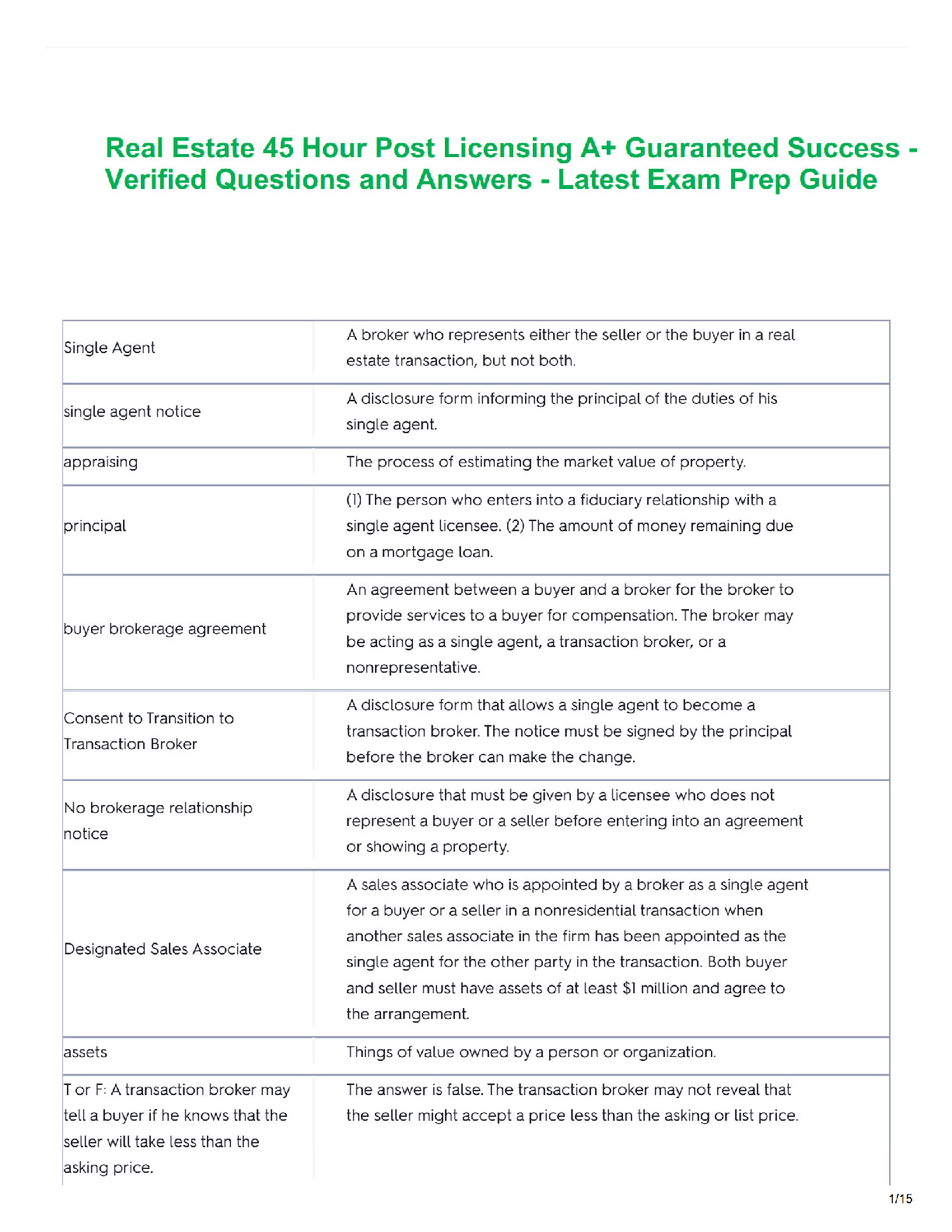
brokerage ✔✔business of bringing people together in a real estate transaction
broker ✔✔person or company licensed to buy, sell, exchange, or
...
Chapter 1: Introduction to Real Estate
Questions and Answers Already Passed
brokerage ✔✔business of bringing people together in a real estate transaction
broker ✔✔person or company licensed to buy, sell, exchange, or lease real property for others
and charge a fee for these services.
licensee ✔✔person who has passed a state mandated real estate licensing exam and conducts
brokerage activities on behalf of, or for the broker.
appraisal ✔✔the process of estimating a property's market value based on established methods
and the licensed or certified appraiser's professional judgement.
property management ✔✔person or company hired to maintain and manage property on behalf
of its owner to protect the owner's investment and maximize the return on their investment.
financing ✔✔business of providing the funds that make real estate transactions possible. Usually
mortgage loans or trust deed loans secured by the property.
subdivision and development ✔✔the division of a single property into smaller parcels -- involves
on-site and off-site improvements on the land
home inspection ✔✔professional conducts a visual survey of property's structure, systems, and
site conditions then prepares a valuable analytical report to purchaser and homeowner.
Counseling ✔✔individual with industry expertise provides clients with competent independent
advice based on sound professional judgement.
Education ✔✔teaches courses in pre-licensing programs of real estate to technical aspects of tax
law to practitioners and consumers. Mandates by state licensing laws establish minimum
educational requirements for obtaining and keeping a real estate license. Continuing ed courses
ensure licensees keep their skills and knowledge current
National Association of Realtors ✔✔largest trade organization serving the real estate business.
Sponsors organizations and designations to those who complete specific courses in area of
interest. Members subscribe to a Code of Ethics and are entitled to be called REALTORS or
REALTOR-ASSOCIATES. See website at www.realtor. org. (NAR)
National Association of Real Estate Brokers ✔✔members are known as Realtists, also adhere to
a Code of Ethics, and rose out of civil rights movement as an association of racial minority real
estate brokers in response to unfair housing laws. The NAREB is dedicated to equal housing
opportunity.
Residential (real property type) ✔✔all property used for single or multi-family housing
Commercial (real property type) ✔✔business property: includes office space, shopping centers,
hotels, theaters, parking garages.
Mixed-use (real property type) ✔✔property that allows for two uses: commercial and residential,
in the same building.
Industrial (real property type) ✔✔warehouses, factories, power plants, land in industrial districts,
etc.
Agricultural (real property type) ✔✔farms, timberlands, ranches, and orchards.
Special purpose (real property type) ✔✔churches, schools, cemeteries, and government-held
lands.
supply and demand ✔✔prices for goods and services are determined by s and d. when supply
increases and demand is stable prices decline; when supply is stable but demand increases prices
rise.
factors affecting supply ✔✔factors affecting supply: labor force availability; construction and
material costs; government controls; and financial policies
labor force availability ✔✔shortage of skilled labor may decrease new construction lowering
supply
construction and material costs ✔✔affect supply as incresed costs of construction and materials
may decrease new construction, lead t higher prices and increased rents further slowing market.
government controls ✔✔monetary policy of Federal Reserve Board in setting discount rate of
interest for the money it lends to commercial banks plays a signficant role in people's ability to
purchase homes. environmental regulations may affect supply or value of land in a local market.
State and local taxation policies may have a positive or negative affect, employment, new
businesses, and industries can expand or contract local markets.
local governments ✔✔regulation of land use controls, building codes, and zoning ordinances
shape the character of a community and control use of land. This may stabilize, increase or
decrease real estate values.
Factors affecting demand ✔✔population, demographics, employment and wage levels are affect
demand in the real estate market.
population ✔✔demand for housing rises and falls with the population. Population shifts and
changes from cold climates to warm, economic changes (plant closings) social concerns (public
school quality) effect demand in one location, matched by increased demand elsewhere
demographics ✔✔study and description of a population which is a major factor in determining
the quantity and type of housing in a community. Family size, ratio of adults to kids, ages of
children, number of retirees, income, lifestyle and other factors influence the amount and type of
housing needed
employment and wage levels ✔✔decisions about entering the market are closely related to
consumer confidence and stability of income. Low wages and scarce job opportunities lead to a
drop in real estate demand. Conversely high wages and abundance of jobs lead to a rise in
demand.
consumer confidence ✔✔perceived job security, availability of credit and impact of inflation all
contribute to people's decisions to enter the real estate market or not.
[Show More]
.png)