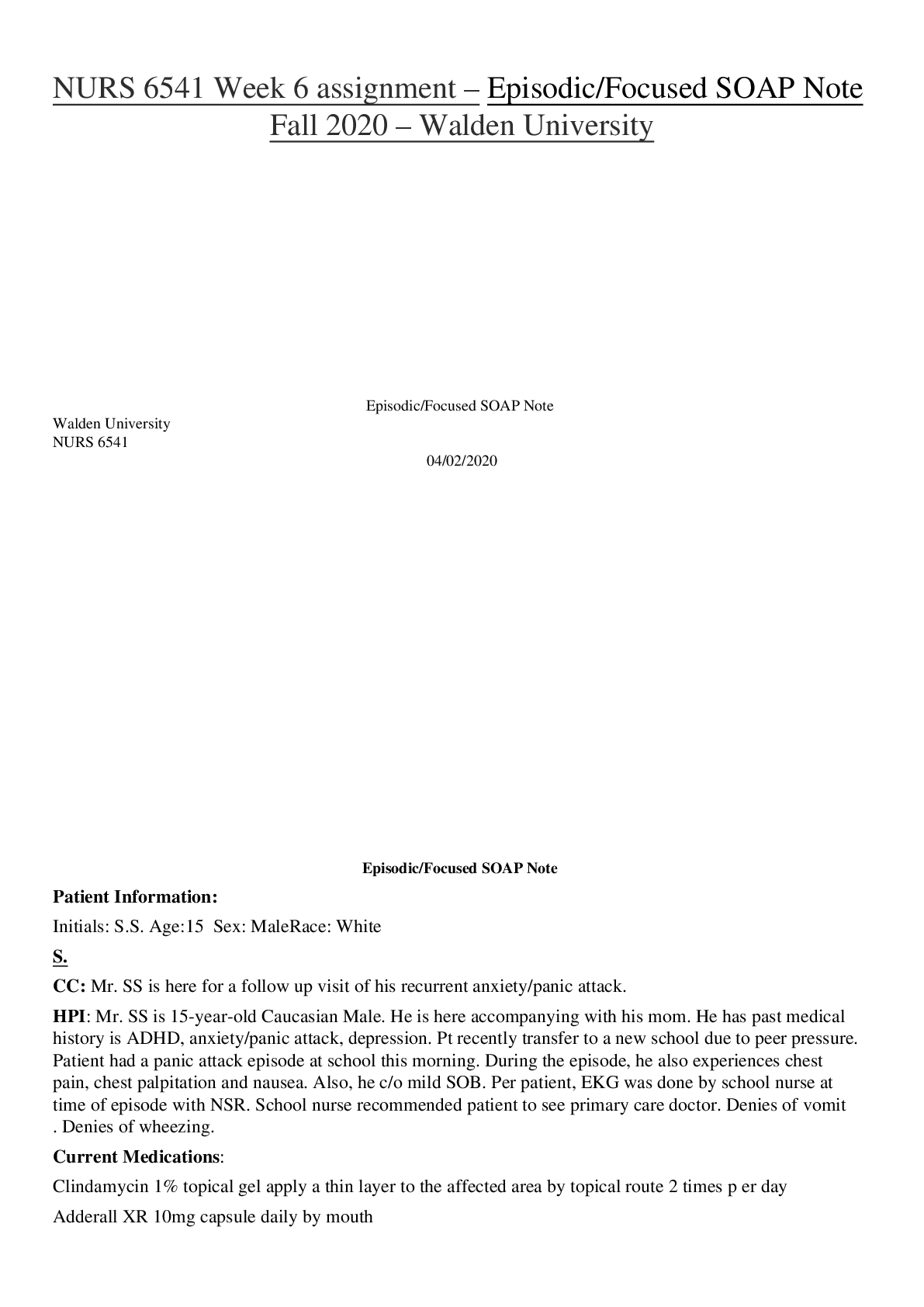
NURS 6541 FINAL EXAM
Primary Care Adolescent & Child.
Question 1
0 out of 0 points
When completing this quiz, did you comply with Walden University’s Code of Conduct
including the expectations for academic integri
...
NURS 6541 FINAL EXAM
Primary Care Adolescent & Child.
Question 1
0 out of 0 points
When completing this quiz, did you comply with Walden University’s Code of Conduct
including the expectations for academic integrity?
Selected Answer: Yes
Question 2
1 out of 1 points
Antibiotic therapy is one of the mainstays of treatment for which of the following causes of
wheezing?
Selected Answer: c.
Epiglottitis
Question 3
1 out of 1 points
Dave, age 17, has gynecomastia. You should also assess him for
Selected Answer: c.
Testicular cancer
Question 4
1 out of 1 points
A small-for-gestational-age infant is born to a 35-year-old woman. He has low-set and
malformed ears, microcephaly, rocker-bottom feet, inguinal hernias, cleft lip/palate, and
micrognathia. Chromosomal analysis is likely to reveal which of the following?
Selected Answer: e.Edwards syndrome (trisomy 18)
Question 5
1 out of 1 points
Primary dysmenorrhea is due to
Selected Answer: a.
Elevated prostaglandin level
Question 6
1 out of 1 points
A 3-week-old male infant with 2 days of projectile, nonbilious vomiting and constant feeding.
Which of the following is the most likely etiology?
Selected Answer: f.
Pyloric stenosis
Question 7
1 out of 1 points
Which fo the following foods would be most appropriate for a child with celiac disease?
Selected Answer: a.
Rice with butter
Question 8
0 out of 1 points
Which of the following is a measure of childhood intelligence?
Selected Answer: a.
Bayley scales Question 9
1 out of 1 points
An 8-month-old baby arrives to the office with his mother with a complaint of
decreased left arm movement. He is a product of a normal term pregnancy, has had
no medical problems, and was in good health when his mother dropped him off at the
daycare center. Upper arm radiographs show a left humerus spiral fracture. Which of
the following is the most appropriate next step in management?
Selected
Answer:
b.
Send the child to the hospital for admission and call child protective
services.
Question 10
1 out of 1 points
A 4-year-old female with profuse vomiting, sweating, lacrimation, and diarrhea, who seizes in
the emergency room. Which of the following is the most likely etiology?
Selected Answer: f.
Insecticide ingestion
Question 11
1 out of 1 points
A 9-year-old is diagnosed with dyspepsia without hematemesis, melena, or occult blood. The
most appropriate next step is
Selected Answer: d.
Trial of ranitidine (Zantac)
Question 12
1 out of 1 points
Which of the following therapeutic options is common for the treatment of both bee stings and
bite wounds?
Selected Answer: d.Tetanus vaccination
Question 13
1 out of 1 points
You are examining Beth, age 9 months, and note a palpable right supraclavicular node. You
know that this finding is suspicious for
Selected Answer: d.
Lymphoma of the mediastinum
Question 14
1 out of 1 points
When examining a child with abdominal pain, what symptom would lead to a likely organic
etiology?
Selected Answer: c.
Night waking
Question 15
1 out of 1 points
Which of the following objective data are associated with significantly better long-term
outcomes in children born with open spina bifida?
Selected Answer: b.
Perineal sensation
Question 16
1 out of 1 points
A 14-year-old has a 3-week history of fever, anorexia, and abdominal pain. What additional
symptom would cause the NP to suspect Crohn's disease?
Selected Answer: b.Blood, mucous diarrhea
Question 17
1 out of 1 points
A 3-year-old presents with macrocephaly, developmental delay, coarse facial
features, large tounge, kyphosis, hip dislocation, tonsillar and adenoidal hypertrophy,
and hepatomegaly. She is receiving early intervention services without improvement.
What is the best next step?
Selected Answer: a.
Refer to genetics for further evaluations
Question 18
1 out of 1 points
Ben has been diagnosed with folliculitis, an inflammatory condition involving the
pilosebaceous follicle. What is the most common cause of this condition?
Selected Answer: d.
Staphylococcus aureus
Question 19
1 out of 1 points
Which of the following is not true of insect stings from bees, wasps, and fire ants?
Selected
Answer:
b.
Greater reaction of hypersensitivity occurs most often with the initial
exposure than with subsequent exposures.
Question 20
1 out of 1 points
Unilateral wheezing is a finding suggestive ofSelected Answer: c.
Foreign body aspiration
Question 21
1 out of 1 points
A 16-year-old is brought in as a walk-in by his parents. His parents state that he
acutely developed a fever, chills and rash. He has been confused and not answering
their questions. On examination he is toxically ill appearing, and is febrile, tachycardia
and hypotensive. He is noted to have a diffuse petechial rash. What is the most likely
diagnosis?
Selected Answer: d.
Meningococcemia
Question 22
1 out of 1 points
A 12-year-old girl was brought to the emergency department because of severe sore
throat, muffled voice, drooling, and fatigue. She had been sick for the past 3 days and
is unable to eat because of painful swallowing. The parents deny any history of
recurrent pharyngitis. The patient still managed to open her mouth and you were able
to see an abscess at the upper pole of the right tonsil with deviation of the uvula
toward the midline. Examination of the neck reveals enlarged and tender lymph
nodes. Which of the following is the most appropriate management?
Selected Answer: c.
Incision and drainage of the abscess
Question 23
1 out of 1 points
A 15-day-old infant has respiratory distress. A quick observation suggests she has
slight cyanosis, hepatosplenomegaly, and features consistent with Down Syndrome.
The cardiac examination demonstrates a loud first heart sound, a low-pitched, middiastolic murmur at the lower left sternal border, and a harsh apical holosystolic
murmur in the mitral area. Which of the following cardiac conditions most likely
explains her heart findings?Selected Answer: c.
Complete atrioventricular canal (endocardial cushion defect)
Question 24
1 out of 1 points
The organism that causes hand, foot, mouth syndrome is what virus?
Selected Answer: d.
Coxsackie
Question 25
1 out of 1 points
Your patient has inflammatory bowel disease. Which of the following finding is most
consistent with ulcerative colitis?
Selected Answer: a.
Left-sided abdominal pain
Question 26
1 out of 1 points
Jesse, age 5, has a diagnosis of encopresis. After the diagnosis, what would be your next
action?
Selected Answer: b.
Rule out a neurologic disorder.
Question 27
1 out of 1 points
The parents of an 8-year-old Down Syndrome boy arrive for his annual well-child visit. He
wants to participate in sports, including the Special Olympics. Until further examination can
be completed, which of the following sports would you suggest as being safe?Selected Answer: e.
Tennis
Question 28
1 out of 1 points
Six months after being diagnosed with what appears to be insulin-dependent diabetes, the 5-
year-old in the case presentation has a significant decrease in his insulin requirement. Which
of the following is the most likely explanation?
Selected Answer: a.
He has entered the "honeymoon phase" of his diabetes.
Question 29
1 out of 1 points
The classic radiographic finding of croup is
Selected Answer: d.
Steeple sign
Question 30
1 out of 1 points
A common cause of in-toeing in childhood is
Selected Answer: a.
Internal tibial torsion
Question 31
1 out of 1 points
Mrs. Bay is upset. She is convinced something is seriously wrong with her son. He is a 2-
month-old and frequently vomits after feeding. Which of the following is most suggestive of
GERD (gastroesophageal reflux disease)?Selected Answer: d.
He drinks 7 to 8 ounces every 3 hours.
Question 32
0 out of 1 points
Which of the following is true regarding the diagnosis of epiglottitis?
Selected
Answer:
a.
Every effort should be made to visualize the epiglottitis in the office and
confirm the diagnosis
Question 33
1 out of 1 points
Of the following patients, which child should not receive a tuberculin skin test?
Selected
Answer:
d.
A 2-year-old who was infected with RSV 2 months ago and is currently
asymptomatic.
Question 34
1 out of 1 points
Hope is a 7-month-old who presents in January with a 1-day history of cough, yellow
nasal discharge, and low-grade temp (T max 100°F). She was previously healthy.
She does have 2+ edema of the nasal turbinates and cloudy rhinorrhea. She is
afebrile in the office. Her chest, mouth, and ears are clear. You prescribe:
Selected Answer: b.
Saline drops, bulb suction, humidified air, and increased PO fluids
Question 35
1 out of 1 points
An ex-preemie with bronchopulmonary dysplasia has been discharged to home from theNICU. One potential problem area that requires close monitoring is
Selected Answer: d.
Insufficient caloric intake.
Question 36
1 out of 1 points
Which of the following symptoms are most suggestive of pneumonia in a young child?
Selected Answer: a.
Fever, tachypnea, coryza, cough, scattered rales
Question 37
1 out of 1 points
A 14-month-old child has lower extremity bowing, a waddling gait, genu varum, and is
at the 5th percentile for height. Laboratory data include low-normal serum calcium,
moderately low serum phosphate, and elevated serum alkaline phosphatase levels,
hyperphosphaturia, and normal parathyroid levels. Which of the following is the most
likely diagnosis?
Selected Answer: c.
Genetic primary hypophosphatemia
Question 38
0 out of 1 points
Lisa has Cushing's syndrome. You would suspect her to have or to develop
Selected Answer: b.
Generalized increased pigmentations of the skin
Question 39
1 out of 1 points
You have a patient that you think may have intussusception. Which of the following findingmay you see?
Selected Answer: b.
Inconsolable screaming
Question 40
1 out of 1 points
An 11-month-old male with intermittent bouts of crying and nonbilious vomiting, has a
history of Meckel diverticulum. A small elongated mass is felt on the right side of his
abdomen. Which of the following is the most likely etiology?
Selected Answer: e.
Intussusception
Question 41
1 out of 1 points
Tracy, the mother of a 2-year-old, is concerned because her daughter walks on her toes all the
time. What do you tell her?
Selected Answer: d.
Toe walking is considered normal until age 3.
Question 42
1 out of 1 points
Mark, age 15, is 5 feet tall andn weighs 85 pounds. You suspect anorexia and know that the
best initial approach is to
Selected Answer: b.
Confront Mark with the fact that you suspect an eating disorder.
Question 43
1 out of 1 points
The following clinical description best matches which genetic disorder? A tall, thin 14-year-old boy has no signs of puberty. He was delayed in his speech development and
always has done less well in school than his siblings. He is shy, and teachers report
his activity is immature. Physical examination reveals breast development, and long
limbs with a decreased upper segment/lower segment ration. He has small testes
and phallus.
Selected Answer: c.
Klinefelter syndrome (XXY)
Question 44
1 out of 1 points
Which test is routinely recommended for a preparticipation sports physical?
Selected Answer: d.
A Snellen test
Question 45
1 out of 1 points
Prophylactic penicillin should be started in children with sickle cell anemia by
Selected Answer: d.
2 to 3 months of age
Question 46
1 out of 1 points
Which of the following statements is not true with slipped capital femoral epiphysis?
Selected
Answer:
b.
It is thought to be caused by repetitive stresses in young athletes prior to
growth spurts.
Question 47
1 out of 1 pointsFifth disease is usually
Selected Answer: d.
Seen in children ages 5 to 14 years of age
Question 48
1 out of 1 points
A head injury in which bruising or tearing of the cerebral structures occurs is a
Selected Answer: b.
Contusion
Question 49
1 out of 1 points
Sam is a healthy 17-year-old student. He is thinking about having sex and asks for more
information about condoms. You give him all of the following information except
Selected Answer: b.
Latex condoms are the most recommended and are heat tolerant.
Question 50
1 out of 1 points
A 15-year-old girl has experienced abdominal pain, vomiting, and lethargy for 3 days.
Her chest and throat examinations are clear, but her abdominal examination is
significant for right lower quadrant pain. Rectal examination is equivocal for pain, and
her pelvic examination is remarkable for pain upon movement of her cervix.
Laboratory data include elevated white blood cell count, serum glucose level of 145
mg/dL, and serum bicarbonate level of 21mEq/dL. Her urinalysis is remarkable for 1+
white blood cells, 1+ glucose, and 1+ ketones. Which of the following is the most
likely diagnosis?
Selected Answer: b.
Pelvic inflammatory disease (PID)
Question 511 out of 1 points
A common presenting symptom of inflammatory bowel disease is
Selected Answer: c.
Unexplained fever
Question 52
1 out of 1 points
Tommy has bloody diarrhea. His family eats fast-food four to five times each week. Which
organism may have caused the diarrhea?
Selected Answer: b.
E. Coli
Question 53
1 out of 1 points
While doing a 5-year-old well child exam, you notice two small patches of hair loss. Broken
hair is present, as is erythema and scaling. On the basis of this information, which of these is
the likely diagnosis?
Selected Answer: b.
Tinea corporis
Question 54
1 out of 1 points
A 14-year-old girl from another state was followed for 7 years for a history of insulindependent diabetes mellitus. Her hemoglobin A1C is 14.9%. This laboratory test indicates
which of the following?
Selected Answer: a.
Her glucose control is poor.
Question 551 out of 1 points
A 6-year-old boy is left alone for 10 hours, now with hematemesis and pneumomediastinum
on chest x-ray. Which of the following is the most likely etiology?
Selected Answer: e.
Esophageal foreign body
Question 56
1 out of 1 points
The following clinical description best matches which genetic disorder? An
institutionalized male juvenile delinquent upon close examination has severe
nodulocystic acne, mild pectus excavatum, large teeth, prominent glabella, and
relatively long face and fingers. His family says he has poor fine motor skills (such as
penmanship), an explosive temper, and a low-normal IQ.
Selected Answer: a.
XYY male
Question 57
1 out of 1 points
Riley, a 12-year-old girl, has scaly, hyperpigmented lesions in a "Christmas tree" distribution.
It is predominantly on her trunk. One lesion is on her buttock that is larger than the other, at
about 4 cm in diameter. What is your diagnosis?
Selected Answer: b.
Pityriasis rosea
Question 58
1 out of 1 points
A healthy, thriving 4-year-old male has had sudden episodes of drawing his knees to his chest
and crying like he is in acute pain for the last 5 hours. These episodes are separated by quiet
times when he appears normal and comfortable. He is not vomiting and has not had a bowel
movement today. What is the most likely diagnosis.
Selected Answer: d.Intussusception
Question 59
0 out of 1 points
In children who have not received antibiotics in the past month, which antibiotic is
recommended by the Centers for Disease Control and Prevention for the
management of acute bacterial respiratory infection?
Selected Answer: c.
Amoxicillin plus clavulanic acid (Augmentin)
Question 60
1 out of 1 points
Which of the following is not a feature of DiGeorge syndrome?
Selected Answer: b.
Frontal bossing
Question 61
1 out of 1 points
What is the appropriate management of a child with asthma who presents with acute wheezing
and/or coughing?
Selected Answer: b.
Administer a short-acting beta agonist
Question 62
1 out of 1 points
Jennifer, age 16, is an active cheerleader who just developed type 1 diabetes. She is worried
that she will not fit in with her friends anymore because she does not think she can have all
the same snacks they have. How do you respond?Selected
Answer:
d.
Any snacks that are sufficient in calories to maintain your normal weight
are okay.
Question 63
1 out of 1 points
Shelby is a healthy 4-week-old who presents to your office in mid-January with a 3-
day history of nasal congestion with occasional cough. She started running a lowgrade fever last night (T max 101.5°F). Now she is refusing to nurse and has
paroxysmal coughing and noisy/labored breathing. Physical exam reveals an illappearing infant with lethargy and tachypnea, intercostal retractions, expiratory
wheezes, and occasional rales. She does not attend day care but has a 3-year-old
sibling who does and who recently had a “cold.” What is the MOST LIKELY cause of
Shelby’s illness?
Selected Answer: b.
RSV bronchiolitis
Question 64
1 out of 1 points
The diet of a 3-year-old with cystic fibrosis should be supplemented with which of the
following?
Selected Answer: d.
Vitamin D
Question 65
1 out of 1 points
Which of the following vaccines provides protection against a common type of
sepsis/meningitis?
Selected Answer: b.
Haemophius influenzae vaccine Question 66
1 out of 1 points
You are seeing a patient you think may have IBD. Which of the following tests would not be
helpful?
Selected Answer: b.
Amylase and lipase
Question 67
1 out of 1 points
Sarah, age 13, is markedly obese and has a poor self-image. How do you differentiate between
compulsive eating and bulemia?
Selected Answer: a.
A compulsive eater does not induce vomiting.
Question 68
1 out of 1 points
Which of the following is not associated with congenital adrenal hyperplasia?
Selected Answer: c.
Hypernatremia
Question 69
1 out of 1 points
Which of the following is not a sign or symptom of congenital hypothyroidism?
Selected Answer: a.
Frequent stooling
Question 70
1 out of 1 pointsA 2-year-old girl has increased work of breathing. Her father notes she had cough
and subjective fever over the past 3 days. She has been complaining that her “belly
hurts” and has experienced one episode of post-tussive emesis but no diarrhea. Her
immunizations are current, and she is otherwise healthy. Her temperature is 102°F.
She is somnolent but easily aroused. Respirations are 28 breaths/min, and her
examination is remarkable for decreased breath sounds at the left base posteriorly
with prominent crackles. Which of the following acute interventions is the LEAST
likely to assist in the diagnosis?
Selected Answer: a.
Sputum culture
Question 71
1 out of 1 points
During a track and field meet, a 16-year-old male pole-vaulter falls to the ground screaming in
pain. He complains of intense pain in his right scrotum. He vomits twice while waiting for the
ambulance. He most likely has
Selected Answer: b.
Testicular torsion
Question 72
0 out of 1 points
A 5-year-old girl is somewhat short and has mild leg bowing. Her medical history is
significant only for well-controlled seizure disorder. Serum calcium, phosphorus, and
alkaline phosphatase levels and urinary amino acid concentration are normal. A bone
age is notable for abnormal distal radius and ulna mineralization. Which of the
following is the most likely diagnosis?
Selected Answer: b.
Genetic primary hypophosphatemia
Question 73
1 out of 1 points
Screening infants for anemia should occur at what age?Selected Answer: a.
9 months
Question 74
1 out of 1 points
When Jason, age 12, slid into homeplate while playing baseball, he injured his ankle. You are
trying to differentiate between a strain and a sprain. You know that a sprain
Selected Answer: c.
Is an injury to the ligaments that attach to the bones in a joint.
Question 75
1 out of 1 points
Which of the following is not found in an adolescent with untreated Graves' disease?
Selected Answer: c.
Tendency to gain weight easily
Question 76
1 out of 1 points
A 10-year-old male presents with a fever of 102ºF and complaints of leg pains. His
mother reports that he had an upper respiratory infecion with a sore throat about 2
weeks ago. No treatment was needed. On examination, he has tender and swollen
knees bilaterally. His heart rate is 125 bpm and a blowing systolic murmur is heard at
the apex. No murmur was noted at in the chart. The mostly diagnosis is:
Selected Answer: a.
Rheumatic fever
Question 77
1 out of 1 points
The most common congenital heart defect in children asSelected Answer: c.
Ventricular septal defect
Question 78
1 out of 1 points
You are on call and receive a phone call from the parents of a 13-year-old known
asthmatic. She has been having chest tightness and a worsening cough for 48 hours.
She has significant nasal discharge that began 14 days ago and intermittent
complaint of headache. She is now running a low-grade fever. Her peak flow the last
48 hours is 70–80% of personal best. Her temperature right now is 101.7°F. She is
on salmeterol with corticosteroid (Advair) and PRN albuterol. Which of the following is
most appropriate?
Selected
Answer:
c.
See her in the office in the morning and prescribe a 14-day course of
amoxicillin plus the addition of a short course of oral steroids.
Question 79
1 out of 1 points
You see a 7-year-old with a positive stool culture for Salmonella enteriditis. The appropriate
therapy for a non-dehydrated child is
Selected Answer: d.
Bland diet with focus on maintaining hydration
Question 80
1 out of 1 points
Chest pain in young children is usually
Selected Answer: b.
Noncardiac in origin
Question 811 out of 1 points
During the 2-year-old well-child visit, the child's mother shows you a picture from the
birthday party. You notice only one eye has a red reflex on the picture. When you do the
exam, in the right eye, you notice leukocoria. What is your diagnosis?
Selected Answer: c.
Retinoblastoma
Question 82
1 out of 1 points
A 6-week-old boy, born by vaginal delivery after an uncomplicated term gestation,
has experienced cough and “fast breathing” for 2 days. His mother relates that he has
a 1-week history of nasal congestion and watery eye discharge, but no fever or
change in appetite. He has a temperature of 99.4°F and a respiratory rate of 44
breaths/min. He has nasal congestion, clear rhinorrhea, erythematous conjunctivae
bilaterally, and watery, right eye discharge. His lungs demonstrate scattered crackles
without wheezes. Which of the following is the most likely pathogen?
Selected Answer: e.
Chlamydia trachomatis
Question 83
1 out of 1 points
The most common central nervous system side effect of mumps in children is
Selected Answer: a.
Ataxia
Question 84
1 out of 1 points
Which malignancy is associated with genitourinary anomalies?
Selected Answer: a.
Wilms' tumor Question 85
0 out of 1 points
In evaluating Tommy, a child with bloody diarrhea, which of the following would not be an
appropriate first action?
Selected Answer: d.
Check growth chart
Question 86
1 out of 1 points
When a neonate is initially protected against measles, mumps, and rubella because the mother
is immune, this is an example of which type of immunity?
Selected Answer: d.
Natural passive
Question 87
1 out of 1 points
An 11-year-old has been diagnosed with mild intermittent asthma. Which of the following is
not a routine part of the clinical management?
Selected
Answer:
c.
School excuse to not participate in recess and/or physical education
activities
Question 88
1 out of 1 points
Anthony is a known asthmatic. He has symptoms three times a week but never more than
once a day. Exacerbations affect his normal activities occasionally. He awakens with cough
three to four times a month. You classify his asthma as
Selected Answer: c.
Mild persistent Question 89
1 out of 1 points
Hypercholesterolemia in children older than 2 is defined as a total cholesterol at or above
Selected Answer: d.
200 mg/dL
Question 90
0 out of 1 points
A 2-year-old presents with a history of wheezing and persistent cough. The father reports the
child had a coughing/choking episode about a week ago that was spontaneously resolved. A
few days later she began to cough and wheeze. This scenario is most consistent with
Selected Answer: b.
Bronchiolitis
Question 91
1 out of 1 points
Robert, your 15-year-old male patient, is here today for a well visit. He is tall in stature and
has increased arm span, laxity of joints, pectus excavatum, and an abnormal echocardiogram.
Which of the following diagnosis would you suspect Robert as having?
Selected Answer: c.
Marfan syndrome
Question 92
1 out of 1 points
The most common trigger for an acute asthma episode in the very young child is
Selected Answer: c.
Respiratory infections
Question 931 out of 1 points
All of the following is treatment for a child with phimosis except
Selected Answer: a.
Ice packs
Question 94
1 out of 1 points
An adolescent who has tall stature, increased arm span, laxity of joints, pectus excavatum, and
abnormal echocardiogram woudl be expected to have
Selected Answer: a.
Marfan syndrome
Question 95
1 out of 1 points
Seborrhea dermatitis is common for both infants and adolescents. Which is not correct for this
condition?
Selected
Answer:
b.
The condition in adolescents is known as acne with comedones and popular
and pustular lesions.
Question 96
1 out of 1 points
Vomiting in infancy has a long list of differential diagnoses. Which of the following other
symptoms would mostly likely point to pyloric stenosis?
Selected Answer: b.
Sausage-shaped mass in abdomen
Question 97
1 out of 1 pointsA previously healthy male has a 3-month history of increasing headaches, blurred
vision, and personality changes. Previously he admitted to marijuana experimentation
more than 1 year ago. On examination he is a healthy, athletic-appearing 17-year-old
with decreased extraocular range of motion and left eye visual acuity. Which of the
following is the best next step in his management?
Selected Answer: a.
Neuroimaging
Question 98
1 out of 1 points
Which of the following conditions is most responsible for developmental delays in children?
Selected Answer: a.
Fetal Alcohol Syndrome
Question 99
1 out of 1 points
The following clinical description best matches which genetic disorder? A 15-year-old
girl with primary amenorrhea is noted to be well below the 5th percentile for height.
She has hypertension, a low posterior hairline, prominent and low-set ears, and
excessive nuchal skin.
Selected Answer: d.
Turner syndrome (XO)
Question 100
1 out of 1 points
An adolescent female presents with a 2-day history of increasing lower abdominal pain. She
has mild vomiting and anorexia and fevers to 101F. She is unable to defecate but has an urge
to do so. CBC reveals a slightly elevated WBC of 14,000, but is otherwise normal. Serum
electrolytes are normal. The next step is
Selected Answer: b.
Refer to surgery for evaluation for appendicitis. Question 101
1 out of 1 points
A 7-year-old presents with abrupt fever, stridor, drooling, and hyperextension of the
neck. You examine the nose and throat and notice one tonsil is enlarged and there is
marked erythema of the pharynx with uvular deviation. Which is most appropriate?
Selected
Answer:
a.
Refer to otolaryngology for management of a peritonsillar abscess and
possible hospital admission
Friday, May 8, 2020 3:48:09 AM EDT
[Show More]


 J21.png)


.png)








![Preview of NR667 Complete Question Bank with Correct Answers: Final Exam Study Guide [2026 Updated]](https://browseimages.nyc3.digitaloceanspaces.com/paper-images/2026/02/25/AULA53fD2026-02-25-02-58699ee3d811bc7.png)