HESI ANATOMY AND PHYSIOLOGY
30 questions that I did!
1. The pulse point located behind the knee is palpated over which artery? Popliteal
2. Part of the body Facing forward- Anterior
3. ……ABCD of cancer? Melanoma {The
...
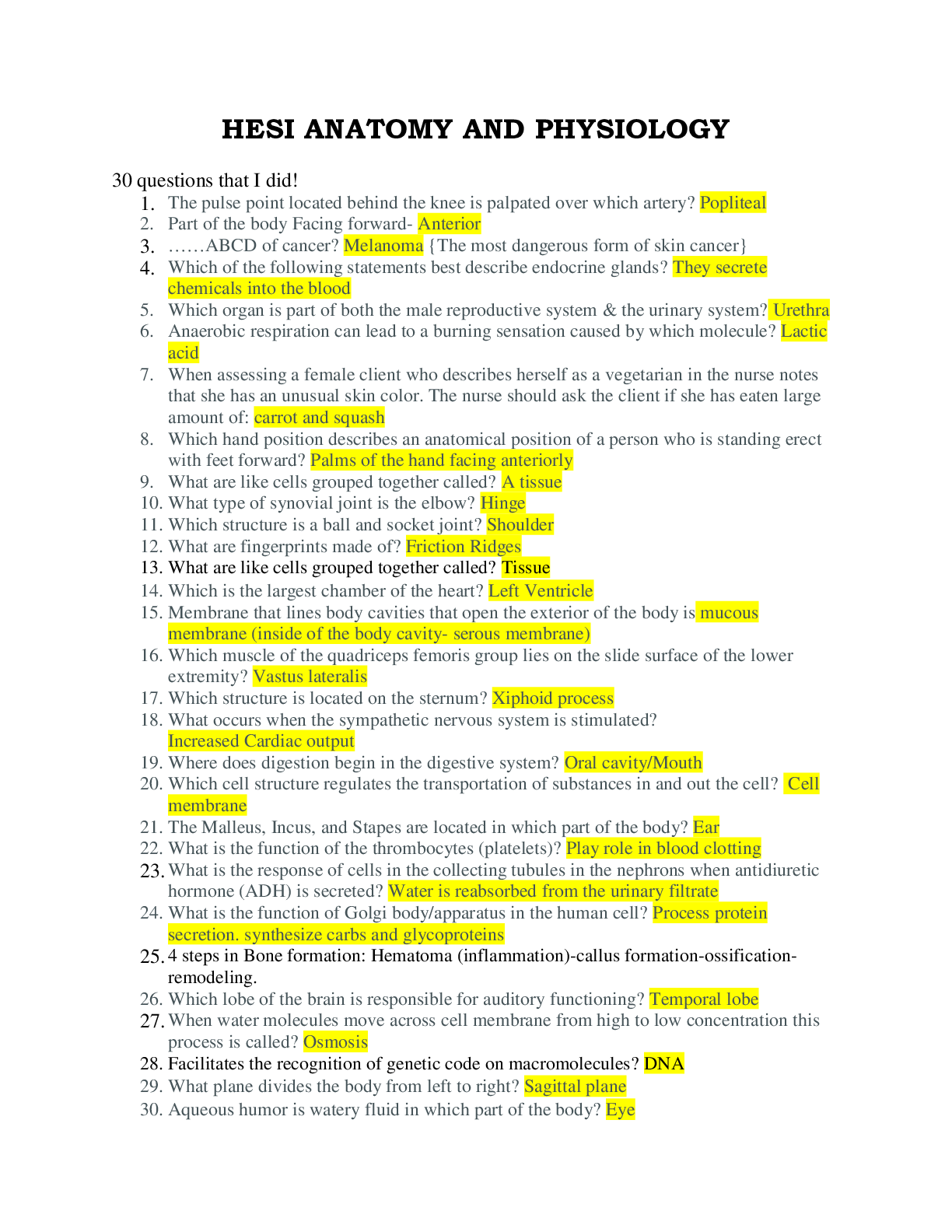
HESI ANATOMY AND PHYSIOLOGY
30 questions that I did!
1. The pulse point located behind the knee is palpated over which artery? Popliteal
2. Part of the body Facing forward- Anterior
3. ……ABCD of cancer? Melanoma {The most dangerous form of skin cancer}
4. Which of the following statements best describe endocrine glands? They secrete
chemicals into the blood
5. Which organ is part of both the male reproductive system & the urinary system? Urethra
6. Anaerobic respiration can lead to a burning sensation caused by which molecule? Lactic
acid
7. When assessing a female client who describes herself as a vegetarian in the nurse notes
that she has an unusual skin color. The nurse should ask the client if she has eaten large
amount of: carrot and squash
8. Which hand position describes an anatomical position of a person who is standing erect
with feet forward? Palms of the hand facing anteriorly
9. What are like cells grouped together called? A tissue
10. What type of synovial joint is the elbow? Hinge
11. Which structure is a ball and socket joint? Shoulder
12. What are fingerprints made of? Friction Ridges
13. What are like cells grouped together called? Tissue
14. Which is the largest chamber of the heart? Left Ventricle
15. Membrane that lines body cavities that open the exterior of the body is mucous
membrane (inside of the body cavity- serous membrane)
16. Which muscle of the quadriceps femoris group lies on the slide surface of the lower
extremity? Vastus lateralis
17. Which structure is located on the sternum? Xiphoid process
18. What occurs when the sympathetic nervous system is stimulated?
Increased Cardiac output
19. Where does digestion begin in the digestive system? Oral cavity/Mouth
20. Which cell structure regulates the transportation of substances in and out the cell? Cell
membrane
21. The Malleus, Incus, and Stapes are located in which part of the body? Ear
22. What is the function of the thrombocytes (platelets)? Play role in blood clotting
23. What is the response of cells in the collecting tubules in the nephrons when antidiuretic
hormone (ADH) is secreted? Water is reabsorbed from the urinary filtrate
24. What is the function of Golgi body/apparatus in the human cell? Process protein
secretion. synthesize carbs and glycoproteins
25. 4 steps in Bone formation: Hematoma (inflammation)-callus formation-ossificationremodeling.
26. Which lobe of the brain is responsible for auditory functioning? Temporal lobe
27. When water molecules move across cell membrane from high to low concentration this
process is called? Osmosis
28. Facilitates the recognition of genetic code on macromolecules? DNA
29. What plane divides the body from left to right? Sagittal plane
30. Aqueous humor is watery fluid in which part of the body? EyeA&P version 1 and 2
1. What are the chemical substances that prevent a sharp change in the pH of a fluid
when an acid or a base is added to it? Buffer
2. What do T-lymphocytes do? Defend the body against microbes
3. Which structure produces T-lymphocytes? Thymus
4. Which structure produces B-lymphocytes? Red bone marrow
5. What is the function of Eustachian tube? Equilibrates pressure between the middle ear
and external environment
6. What physiological response occurs when epinephrine and non-ephedrine- Blood is
directed toward the heart, skeletal muscles and brain.
7. Which of the following is a structure found in the upper respiratory system?
Pharynx(throat). It includes nose (nostrils), nasal cavity, mouth, and larynx (voice box).
The structure in the lower RS includes: Trachea, primary bronchi and lungs.
8. Calcaneus is located in what part of the body? Foot
9. Dorsiflexion plantar flexion are types of joint movement that are associated with
which part of the body? Foot
10. A person who has damage to their ulnar nerve will have decreased sensation in which
area? Arm – inability to abduct hands and fingers
11. The ankle is distal to the knee
12. Posterior means what part of the body? The back
13. Which bones are located in the forearm? Ulna and Radius
14. Which bone dose not articulate with any other bone? Hyoid – is a U-shape bone in the
neck that supports the tongue
15. Which of the following elements is necessary for muscle contraction? Calcium
16. Diet is important because bone are storage places for? Calcium and phosphorous
17. What female reproductive organ produces oocytes, estrogen, progesterone? Ovaries
18. Which layer of the cutaneous membrane are nerve ending located- Dermis {Where is
the nerve ending close to the skin? Dermis}
19. Which bones are formed first by intramembrous ossification? Flat bones of skull
20. Ligaments provides with connection? Bone to bone (Tendon -muscle to bone)
21. Sprain occurs when there is a tear in which structure? Ligament
muscle/ankle/shoulder
22. Why are tendons and ligament most likely to be slow in healing following an injury?
Lack of blood supply/because these connective tissues are avascular.
23. Compact tissue with Haversian canals is classified as what type of tissue? Bone
24. What structure conducts urine from the kidney to the urinary bladder? (The tube
between kidney and urinary bladder) Ureter
25. As part of the negative feedback system, which type of cell is stimulated to resorb
bone matrix in response to a decrease in calcium in the blood? Osteoclasts
26. Sweat on the skin's surface cools the body through which process? Evaporation
27. A Client has large pituitary tumor. The nurse knows that this tumor exists in which
part of the body? Head /Client has large pituitary tumor what part of the body does
this effect? Head hurt, sickness, low blood pressure
28. Which anatomical structure houses the malleus, incus, and stapes? Skull ear
29. Ceruminous glands secrete Ear wax/ Cerumen30. What is the function of the Sebaceous gland? To produce sebum or oil
31. The nurse explains to a client that the stomach is lined by which type of membrane?
Mucous {The respiratory system is lined with a mucous membrane that secret
mucus}
32. The mediastinum is located within which cavity? Thoracic
33. What effects do serotonin has on neurotransmitters?
Involved with mood, sleep, appetite and anxiety
34. What does antidiuretic hormone act on? helps to control blood pressure by acting on
the kidneys and the blood vessels. /Regulates and balances the amount of water in the
body
35. The occipital region is located in which part of the body? Head (at the back)/ lower
part of the cranium
36. In white blood cells what contributes to phagocytosis?
Macrophages, neutrophils
37. Thrombocytes (platelets) smallest type of blood cell important for blood clotting.
When bleeding occurs it swell, clump together and form sticky plug that helps stop
the bleeding.
38. Which blood element carries oxygen- Erythrocytes (Red blood cells)
39. Which structure carries oxygen to the cells? Hemoglobin
40. Blood cell formation – Hemopoiesis {Blood cells is also called hematopoietic cell,
hemocyte or hematocyte. The three main types of blood cells are Platelets
(thrombocytes), Red blood cells (erythrocytes) and White blood cells (leukocytes) -
basophil, neutrophil, eosinophil, lymphocytes and monocytes}.
41. Which gland is commonly known as the "Master Gland"? Pituitary Gland
42. What epidermal derivative is involved in temperature homeostasis?
Eccrine gland- regulates temperature
43. Which statement are true about bone? Osteoblast, epiphyseal, diaphysis.
44. What internal structure of the ear is concerned with hearing? Cochlea
45. Which structure of the gastrointestinal tract controls the movement of content from
small intestine to the large intestine? Ileocecal valve
46. What are the divisional regions of the large intestine (colon)? Cecum, transverse
colon, sigmoid colon. (cecum-ascending-transverse-descending-sigmoid colons)
47. Where in the human body are nutrients absorbed? Small intestine (Small intestine is
made up of three segment – Duodenum, Jejunum, and ileum).
48. Ossification begins during what? Embryonic development
49. Fertilization occurs in the? Oviduct
50. Fertilization of an ovum occurs in which anatomical structure? Fallopian tubes
51. Which term is used to describe the waist bones/area? Carpal
52. An over-production of cerumen (earwax) can accumulate in which area?
External ear canals
53. The mitral value is located between which two structures?
Left ventricle & Left atrium (Tricuspid – right ventricle and right atrium)
54. The olfactory nerves are associate in which sense? Smell
55. Which of the special senses respond to chemical? Taste and olfaction
56. Which vessel brings blood from the lungs to the heart? Pulmonary vein
57. What vessel carries blood from the body to the heart? Vena cava58. Which hormone(s) is/are produced by the ovaries?
Estrogen & progesterone (Men – Estrogen and testosterone)
59. Two principles divisions that makeup nervous system? Central Nervous System
(CNS) and Peripheral Nervous System (PNS)
60. The orthopedic surgeon informs you that you have broken the distal region of the
humerus. What area is he describing? Epiphysis
61. Which term is used to describe movement of the arms and legs away from midline of
the body? Abduction- arm away from the body (Adduction- arm towards the body’s
midline)
62. Which part of the body do you check for carotid pulse- Carotid Artery. Structure
provides a pulse reading in the neck? Carotid Artery
63. What is the primary function of the hemoglobin (blood)? Carry oxygen
64. What stimulates the chemoreceptors to function? rise in CO2; Fall in O2 (increase in
blood pressure)
65. Which condition causes a client to say "I can't see far away"? Nearsightedness
66. What organ produces insulin? Pancreas
67. When drawing blood from antecubital region which blood vessel is used to obtain
blood? a) Ulnar vein b) Radial artery c) Axillary artery d) Brachial vein (Median
cubital)
68. What hormone induces growth of pubic and axillary hair at puberty? Testosterone and
estrogen
69. Increase in rate of depth of breath results in what blood PH change? Alkalosis
70. What is the function of the hypothalamus? (Regulate body temperature)
Regulate function of body, balance and thermoregulatory
71. The passive movement of molecules or particles along a concentrated gradient or
from a region of higher concentration to a lower concentration is called Diffusion /
Filtration is the process by which water and solutes are forced through a membrane or
capillary wall by fluid or hydrostatic pressure
72. Transverse plane is a cross section of the body. Coronal – separates back and front}
73. What part of the body is the lower back? Lumbar vertebrae
74. High levels of which ion would most likely result in a cardiac arrest? Potassium
75. What blood vessel perfuses the kidney? Renal vein
76. The skin is the largest organ of the body. What gives the skin its color? Melanin
77. What is the outer most protective layer of the skin? Epidermis (the inner layer of the
skin is dermis- composed of fibrous connective tissue with blood vessels, sensory
nerve endings, hair follicles and glands)
78. The organ of corti is located in? Ear
79. The rough endoplasmic reticulum functions in the human cell to?
Synthesize proteins
Function of rough ER- protein synthesis, membrane production. Smooth ER synthesize lipids
and steroids, regulate calcium concentration
80. Tissue repair is enhanced by a diet high in? Protein
81. What is the definition of chyme? partly digested food! The result of action by the
stomach. (the thick, wet mass of partly digested food that leaves the stomach)
82. What are hormones? chemical messengers secreted by endocrine glands that controls
or coordinates the activities of other tissues.83. What cellular process helps to move debris and mucous through the lining of tubules?
Cilia (An epithelial cell that other goes circle of movement is cilia)
84. Which is a hollow organ? Gall bladder (heart, stomach)
85. Which muscle is included in the quadriceps femoris group?
Rectus femoris, Vastus lateralis, Vastus medialis, Vastus intermedius
86. Which of the following location would the urinary bladder & internal reproductive
organ be found? Pelvic region/cavity
87. Which part of the brain attaches to spinal cord? Medulla oblongata
88. Which structure is responsible for normal respiratory function?
Medulla oblongata – it controls breathing
Cerebrum – associated with movement and sensory input
Cerebellum- responsible for muscle / muscular co-ordination
Medulla oblongata- controls many vital functions such as respiration and heartbeat/rate
89. T4 is controlled by what? Thyroid
90. What gland is located on the anterior surface of the trachea? Thyroid Gland
91. Function of ADH - reabsorption of water
92. Which hormone is produced by the posterior pituitary gland? ADH and Oxytocin
93. Which hormone is produced by the anterior pituitary gland? Follicle stimulating
hormone (FSH) {also includes – TSH, LH, ACTH, Growth Hormone and PRL}
94. What female hormone stimulate the development of Graafian follicles? FSH
95. What occurs when the sympathetic nervous system is stimulation is increased? Blood
pressure rises, goose bumps
96. What part of the body is the buttock- dorsal. / The buttock is on which surface of the
body? posterior body surface
97. The esophagus is located in which body cavity? Thoracic
98. The tympanic membrane is located between which structures?
External auditory canal and middle ear (tympanic membrane -ear drum, it is a thin
membrane that separates the outer (external) ear from the middle ear)
99. What is the end result of meiosis? 23 chromosomes {Mitosis – cell division that
produces two identical daughters (process in which DNA is duplicated); Mitosis is
necessary for growth and repair/ Meiosis - cell division that takes place in the gonads
(the ovaries and testes), chromosomes number reduces from 4623}.
100. How many days is the average menstrual cycle? 28 days
101. Urinary system in the human body primary task is to? Expel waste
102. What is the function of the phrenic nerve? Innervates the diaphragm
The phrenic nerve (cervical plexus) is a nerve that originates in the neck (C3-C5) and
passes down between the lung and the heart to reach the diaphragm. It is important for
breathing, as it passes motor information to the diaphragm and receives sensory
information from it, there are two phrenic nerves, a left and a right one.
103. What does vitamin D do to the skin? Vitamin D contributes to skin cell growth,
repair, and metabolism. It optimizes the skin’s immune system and help destroy free
radicals that can cause premature aging. Vitamin D regulates two important bone
materials- calcium and phosphorous, which stimulates internal absorption of Ca and P
to maintain healthy blood levels and build and maintain bone. Biological function of
vitamin D- calcium balance, immunomodulation, regulate cell-growth, and reduces
hypertension by downregulating renin production.104. Which of the following produce progesterone to prepare the uterus for pregnancy?
Corpus luteum
105. Which antibodies are found in the plasma of type A blood? Anti B
106. Which antibodies are found in the plasma of type AB blood? Neither A or B
107. What encloses the heart? Pericardium
108. Where is the tibialis anterior muscle located? Lower leg
(Largest bone of the leg- Tibia, smallest bone of the leg- Fibula)
109. How many carb per gram do carbohydrates contain? 4
110. Where is the pulmonary ossification center located? Diaphysis
111. Which of the following best describes a capillary? Location for gas and nutrient
exchange (nutrients and gas exchange occur in the capillaries, not veins or arteries)
112. Which one increases angle at the joint? Extensor
113. What are the four basic tissue types? Connective, Epithelium, Nervous, Muscle.
114. Order of organization of living things: Organelle, cells, tissues, organs, organ
systems, organisms, populations, communities, ecosystem, and biosphere
115. What is the function of aldosterone in the kidneys, when it is secreted? It
conserves sodium in the body
116. What does lymphatic system do? Filter lymph, remove debris.
Function of lymph nodes- They filter lymph and assist the immune system in building an
immune response. Lymph is a clear fluid that comes from blood plasma and exits blood
vessels at capillary beds.
117. What structure of the eye picks out color? Retina
118. What is the transparent portion of the fibrous layer of the eye? Cornea
119. The basic unit of life and the building block of tissue/organism- Cell
120. The study of tissues/cells - Histology
121. What characteristic best describe dermis? Structure and strength
122. Osteoblast – cells that form compact bone
123. Broken humerus adolescent: classified as a proximal fracture or a shaft fracture.
124. The enzymes that regulates all chemical reactions within the body - Proteins
125. Hormones are chemical messengers that control the growth, differentiation, and
metabolism of specific target cells. Two types- Steroid hormone and Protein hormone
The main production of endocrine gland is hormones
126. Causes of ear infection in children? It is the length of the Eustachian tube. (Kids
have shorter Eustachian tube).
127. Herpes is a viral infection usually characterized by? Skin eruption / Sign of
Herpes? Rash
128. Function of trachea, bronchi, and bronchioles? Warm and moisten air before it
enters the lungs
129. Which subdivision of autonomic nervous system operates using the
neurotransmitters norepinephrine and epinephrine? Sympathetic Nervous System
130. Sensory neurons (afferent) transmit nerve impulses toward the CNS {spinal cord
and brain}, Motor (efferent) neurons transmit nerve impulses away from d CNS
towards the organs such as muscles, glands, &digestive organs. PNS- all other
neurons in d body.131. Axons transmit the impulse away from the cell body, while dendrites transmit the
impulse towards the cell body.
132. What part of the male reproduction produce most of the semen? Seminal Vesicle
133. Produce most of the sperm- Seminiferous Tubules
134. It is very cold… shivering? What muscle is involved? Skeletal muscle
[Show More]








.png)
.png)