Pharm HESI Practice Questions and
Answers Rated A
1. DM peripheral neuropathy prescribed pregabalin x 2 weeks; reports diminished foot pain.
Nurse notes no improvement in healing of several toe ulcers
A. Review plan
...
Pharm HESI Practice Questions and
Answers Rated A
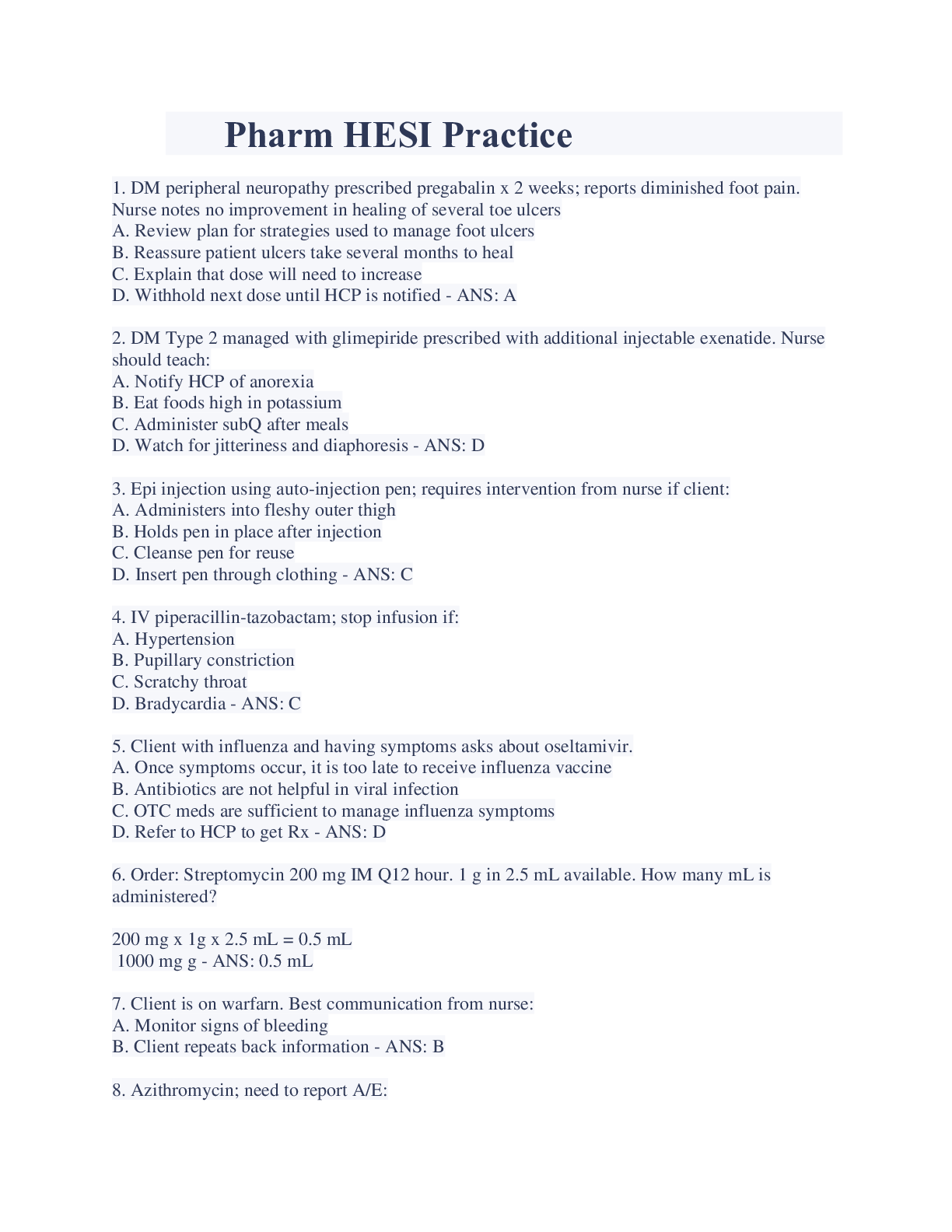
1. DM peripheral neuropathy prescribed pregabalin x 2 weeks; reports diminished foot pain.
Nurse notes no improvement in healing of several toe ulcers
A. Review plan for strategies used to manage foot ulcers
B. Reassure patient ulcers take several months to heal
C. Explain that dose will need to increase
D. Withhold next dose until HCP is notified ✔✔ANS: A
2. DM Type 2 managed with glimepiride prescribed with additional injectable exenatide. Nurse
should teach:
A. Notify HCP of anorexia
B. Eat foods high in potassium
C. Administer subQ after meals
D. Watch for jitteriness and diaphoresis ✔✔ANS: D
3. Epi injection using auto-injection pen; requires intervention from nurse if client:
A. Administers into fleshy outer thigh
B. Holds pen in place after injection
C. Cleanse pen for reuse
D. Insert pen through clothing ✔✔ANS: C
4. IV piperacillin-tazobactam; stop infusion if:
A. Hypertension
B. Pupillary constriction
C. Scratchy throat
D. Bradycardia ✔✔ANS: C
5. Client with influenza and having symptoms asks about oseltamivir.
A. Once symptoms occur, it is too late to receive influenza vaccine
B. Antibiotics are not helpful in viral infection
C. OTC meds are sufficient to manage influenza symptoms
D. Refer to HCP to get Rx ✔✔ANS: D
6. Order: Streptomycin 200 mg IM Q12 hour. 1 g in 2.5 mL available. How many mL is
administered?
200 mg x 1g x 2.5 mL = 0.5 mL
1000 mg g ✔✔ANS: 0.5 mL
7. Client is on warfarn. Best communication from nurse:
A. Monitor signs of bleeding
B. Client repeats back information ✔✔ANS: B
8. Azithromycin; need to report A/E:
A. Yellow sclera
B. Flatulence and nausea
C. Urinary frequency
D. Headache ✔✔ANS: A
9. 1 L infused in 9 hours. What is mL/hour?
1000 mL/ 9 hr ✔✔ANS: 111 mL/hr
10. Client receiving multiple antihypertensive medications and has serum potassium of 6.2.
Patient will likely be prescribed:
A. Aldactone
B. Lisinopril
C. Hydrochlorothiazide
D. Valsartan ✔✔ANS: C
11. Sodium polystyrene sulfate for acute kidney injury. Which lab value indicates the medication
is effective?
A. Hgb 13.5
B. Serum glucose 120
C. Serum ammonia 30
D. Serum potassium 3.8 ✔✔ANS: D
12. Chronic Hepatitis C on ribavin with alpha-interferon reports fatigue and dyspnea. Monitor:
A. Potassium
B. Hemoglobin
C. Glucose
D. Sodium ✔✔ANS: B
13. Probenecid (uricosuric):
A. Prevents formation of kidney stones
B. Decreases pain and burning during urination
C. Increases strength of urine stream
D. Promotes excretion of uric acid in urine ✔✔ANS: D
14. Gentamycin sulfate IVPB peak and trough on fourth dose. Measure:
A. Peak 3 hours after giving 4th dose
B. Trough just after receiving 3rd dose
C. Peak right before 4th dose
D. Trough just before 4th dose ✔✔ANS: D
15. Insulin glargine 20 units SubQ at bedtime with additional sliding scale aspart
A. Fingerstick glucose at 0730, 1130, 1730, and at bedtime
B. Test glucose in the AM and PM
C. Test glucose three times a day before meals ✔✔ANS: A
16. Reduce risk of rhinitis with nasal spray calcitonin by:
A. Alternate nostril each day
B. Avoid lying down within 30 minutes after use
C. Take OTC antihistamine with each daily dose
D. Use NSAID as needed ✔✔ANS: A
17. Client on isotretinoin wants to get pregnant
A. Discontinue medication 1 month before trying to conceive ✔✔ANS: A
18. Patient with medical history of routine magnesium hydrochloride and fluoxetine was recently
prescribed ciprofloxacin. What is most important?
A. Do not take magnesium hydrochloride within 2 hours of Cipro
B. Report reduced frequency and urgency
C. Take cipro with meals to decrease GI distress
D. Eat yogurt daily to reduce chances of superinfection ✔✔ANS: A
19. Patient on long-term NSAIDs c/o of gastric pain and bloody stool. HCP discontinues NSAID
and prescribes PPI.
A. Call clinic if diarrhea and headache occur
B. Resume diet of milk, cream, and bland foods
C. Once pain subsides, NSAIDs will be recontinued
D. Notify HCP of black stool ✔✔ANS: D
20. Codeine with acetaminophen highest priority
A. Tell nurse if pain is not relieved
B. Request assistance when ambulating to the bathroom
C. Med will work in 30 minutes
D. Administer stool softener/laxative at same time ✔✔ANS: B
21. Oprelvekin given after chemo. Platelets increase from 85 to 105.
A. Withhold next dose
B. Notify HCP
C. Assess for thrombophlebitis
D. Administer next dose as scheduled ✔✔ANS: D
22. Bulk forming laxatives:
A. Take med one hour after meals and with other meds
B. Follow medication with additional glass of water
C. Remain upright for 30 minutes following drug administration
D. Avoid dairy products with this medication ✔✔ANS: B
23. Montelukast (leukotriene modifier)
A. This will stop asthma attack immediately
B. I will take tab every night to control asthma
C. I will not use my inhaler twice a day while on this medication
D. I should take this only when having an asthma attack ✔✔ANS: B
24. Client with respiratory infection prescribed antibiotic and antipyretic for 5 days. What is the
best indication that the antibiotic was effective?
A. Sputum specimen shows no growth
B. WBC stayed stable at 12,000
C. Peak antibiotic level is within therapeutic level
D. Afebrile for last 48 hours ✔✔ANS: A
25. SLE patient takes hydroxychloroquine should:
A. Monthly chest x-rays
B. Ophthalmic exam every 6-12 months
C. Folic acid 1 mg daily
D. Bone density exam yearly ✔✔ANS: B
26. Gingko
A. Interacts with aspirin and NSAIDs
B. Increases anxiety and headache
C. Can cause nausea and diarrhea
D. Should be avoided in pregnancy ✔✔ANS: A
27. Client taking sildenafil complains of nasal congestion, dizziness, nausea, dyspepsia. What is
the priority?
A. Assess for muscle/back pain
B. Palpate for abdominal distention and tenderness
C. Auscultate breath sounds bilaterally
D. Measure blood pressure while lying and standing ✔✔ANS: D
28. Client with emphysema c/o of difficulty breathing and audible expiratory wheezing. He was
given albuterol for the 3rd time in 12 hours. Nurse needs to intervene if client c/o of:
A. Throat irritation
B. Increased anxiety
C. Uncontrolled shaking
D. Irregular heart beat ✔✔ANS: D
29. Most important nursing intervention for high dose corticosteroid use. Patient wants to stop
due to S/E.
A. Stop gradually and taper off meds
B. Assess for other adverse effects
C. Encourage to take with food
D. Review dose schedule to ensure taking prescribe amount ✔✔ANS: A
30. Action prior to giving digoxin PO?
A. Verify urine output is greater than 30 mL/hr
B. Check L radial pulse for 30 seconds
C. Listen heart sounds at 5th intercostal space
D. Check for signs of orthostatic hypotension ✔✔ANS: C
31. What is the priority intervention when patient is given Contin epidural with opioid analgesic?
A. Antiemetic PRN as prescribed
B. Insert indwelling catheter
C. Give stool softener
D. Attach pulse oximeter ✔✔ANS: D
32. Client taking clonazepam has slurred speech and ataxic gait.
A. Report to HCP
B. Discontinue medications immediately
C. Refrain from alcohol
D. Document continued seizure activity ✔✔ANS: A
33. Donepezil hydrochloride is given to Alzheimer's for:
A. Fluid volume excess
B. Altered breathing pattern
C. Chronic pain
D. Disturbed thought process ✔✔ANS: D
34. A client on a nitroglycerin drip has a blood pressure of 78/36 it was last checked.
A. Obtain blood pressure automatically every 5 minutes
B. Change dilution of nitro infusion
C. Begin dopamine infusion at 5 mcg/kg/min
D. Decrease rate of nitroglycerin infusion ✔✔ANS: D
35. A client on tetracycline with GI upset should eat
A. Cheese and crackers
B. Toasted wheat bread and jelly
C. Cold milk
D. Yogurt ✔✔ANS: B
36. Open-angle glaucoma is prescribed eye drops
A. Until smaller angle is restored
B. Until excess pressure is reduced
C. Long-term control of normal eye pressure
D. Long term control of pain and swelling ✔✔ANS: C
37. A client with cirrhosis refuses to take lactulose because he had 3 soft stools yesterday
A. Encourage oral liquids
B. Assess signs of dehydration
C. Measure abdominal girth for reduction
D. It is given to reduce ammonia levels ✔✔ANS: D
38. Hydromorphone is given every 6 hours for 4 days
A. Auscultate bowel sounds
B. Count radial and apical pulse simultaneously
C. Measure glucose level
D. Observe for edema at ankles ✔✔ANS: A
39. WBC increased from 25,000 to 50,000 following 5 doses of filgrastim
A. Implement neutropenic precautions
B. Assess vital signs
C. Review culture and sensitivity results
D. Inform client that medication is effective ✔✔ANS: D
40. Client is given PTU for hyperthyroidism and c/o of sore throat and fever; highest priority:
A. Assess for change in taste sensation
B. Warm fluids and saline throat rinse
C. Observe for signs of hyperthyroidism
D. Monitor WBC ✔✔ANS: D
41. Sumatriptan is contraindicated in patients with:
A. Coronary artery disease
B. Seasonal allergic rhinitis
C. Irritable bowel syndrome
D. Diabetes Type II ✔✔ANS: A
42. Patient with rheumatic arthritis on methotrexate for rheumatic arthritis; now prescribed
adalimumab
A. Obtain routine vaccines as scheduled
B. Annual eye exams
C. Chest x-ray prior to initial dose
D. Avoid crowds and people who are sick ✔✔ANS: D
43. Client on atorvastatin should eat (SATA):
A. Grapefruit
B. Whole milk
C. Oatmeal
D. Whole banana
E. Yogurt ✔✔ANS: C, D, E
44. Pyridostigmine
A. Schedule to take before bed
B. Break medication and sprinkle on food
C. Give med 30 minutes prior to meals
D. Avoid dairy for at least 30 minutes ✔✔ANS: C
45. H2RA for gastritis; instruct:
A. Notify HCP of heartburn
B. Give 30 mL antacid with medication
C. Take 8 oz of water with medication
D. Chew thoroughly before swallowing ✔✔ANS: C
46. Benztropine mesylate for extrapyramidal symptoms. Further evaluation is needed if:
A. Increased mouth movements
B. Dry mouth
C. Decreased bowel movements
D. Decreased hand tremors ✔✔ANS: A
47. Vasopressin; notify HCP if
A. Low urine specific gravity
B. Polydipsia
C. Worsening headache
D. Polyuria ✔✔ANS: C
48. Ascorbic acid 5000 mg PO daily
A. Avoid dark green vegetables
B. Include citrus fruits in daily diet
C. Stand for 30 minutes after administration
D. Take vitamin in one dose ✔✔ANS: B
49. Client taking cyclosporine should avoid
A. Orange
B. Apple
C. Grapefruit
D. Grape ✔✔ANS: C
50. Acetaminophen overdose. Most important blood values to monitor for first 72 hours
A. LDH or LD, SGOT or ALT, SGPT, AST
B. BUN, creatine, specific gravity
C. WBC, Hgb, Hct
D. Arterial blood pH, pCO2, O2 saturation ✔✔ANS: A
51. Client is prescribed phenazopyridine because
A. Calms spasm in urinary tract
B. Eliminates urinary bacteria
C. Analgesic effect of irritated bladder mucosa ✔✔ANS: C
52. Ramipril; eats low fat diet and uses salt substitute to reduce sodium intake.
A. Remind client to avoid dairy
B. Determine if salt substitute has potassium
C. Encourage continued adherence to diet
D. Advise increase of potassium rich fruits and vegetables ✔✔ANS: B
53. Cefoxitin given to patient with penicillin allergy. Finding most important to HCP
A. Vomiting and diarrhea
B. Decreased renal output
C. Itching and macular rash ✔✔ANS: D
54. Rifampin adverse effect:
A. Yellow sclera
B. Orange urine
C. Use condoms for contraception
D. Persistent tinnitus ✔✔ANS: A
55. Antidepressant common side effect
A. Bradycardia, delirium, sedation
B. Dry mouth, blurred vision, constipation
C. Headache, jaundice, diarrhea
D. Insomnia and hypertension ✔✔ANS: B
[Show More]
.png)

.png)


.png)