English Language > EXAM > English Language (A-Level) | CLA Quiz Questions and Answers,100% CORRECT (All)
English Language (A-Level) | CLA Quiz Questions and Answers,100% CORRECT
Document Content and Description Below
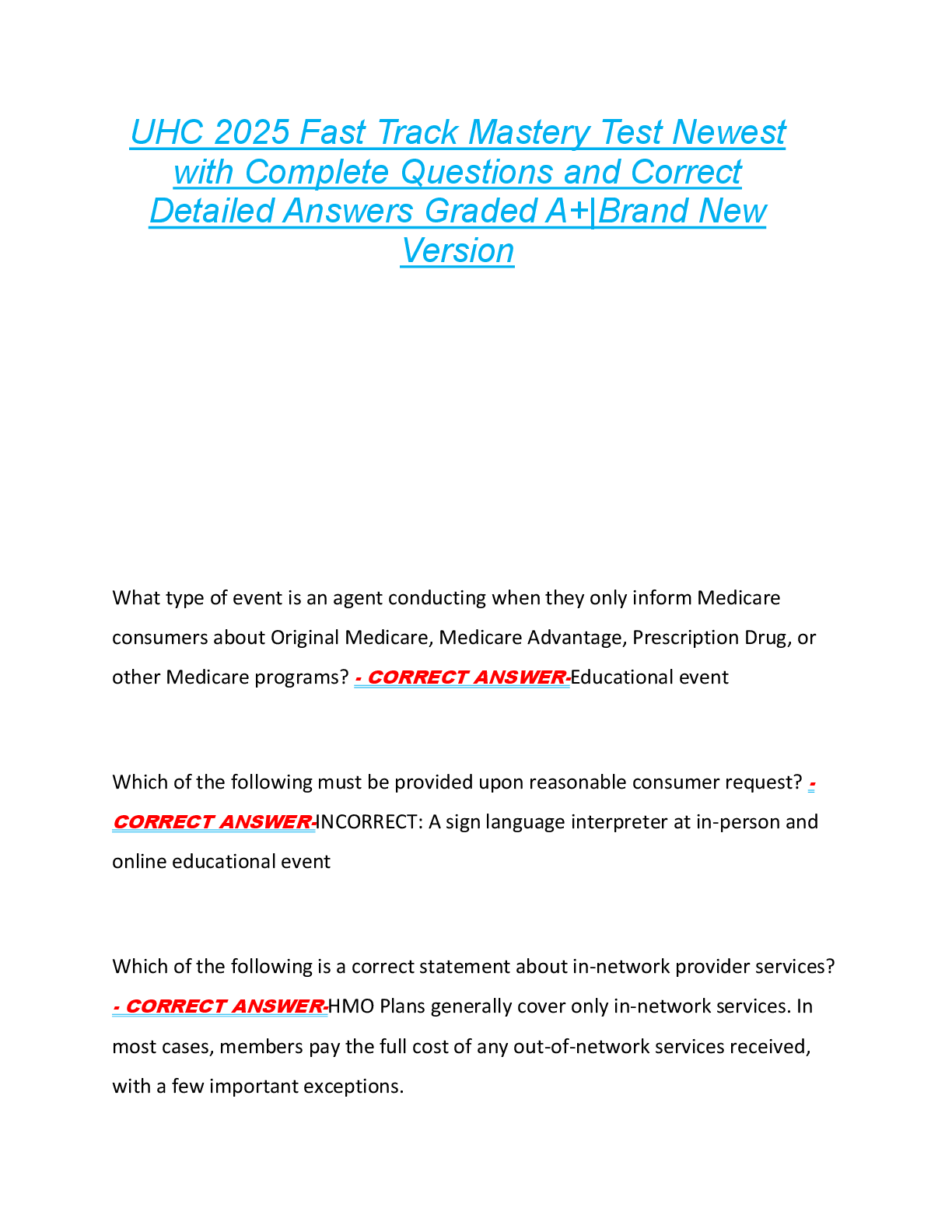
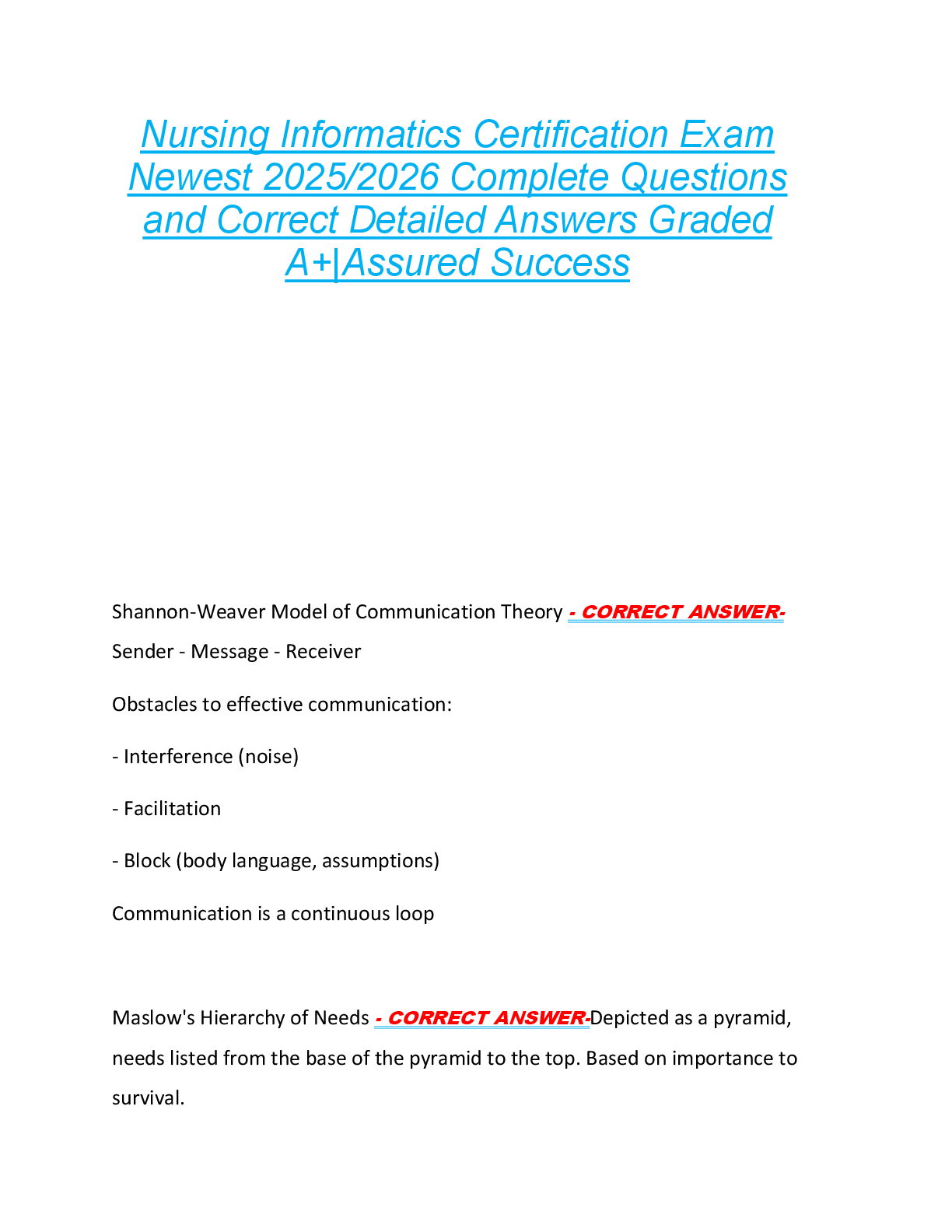
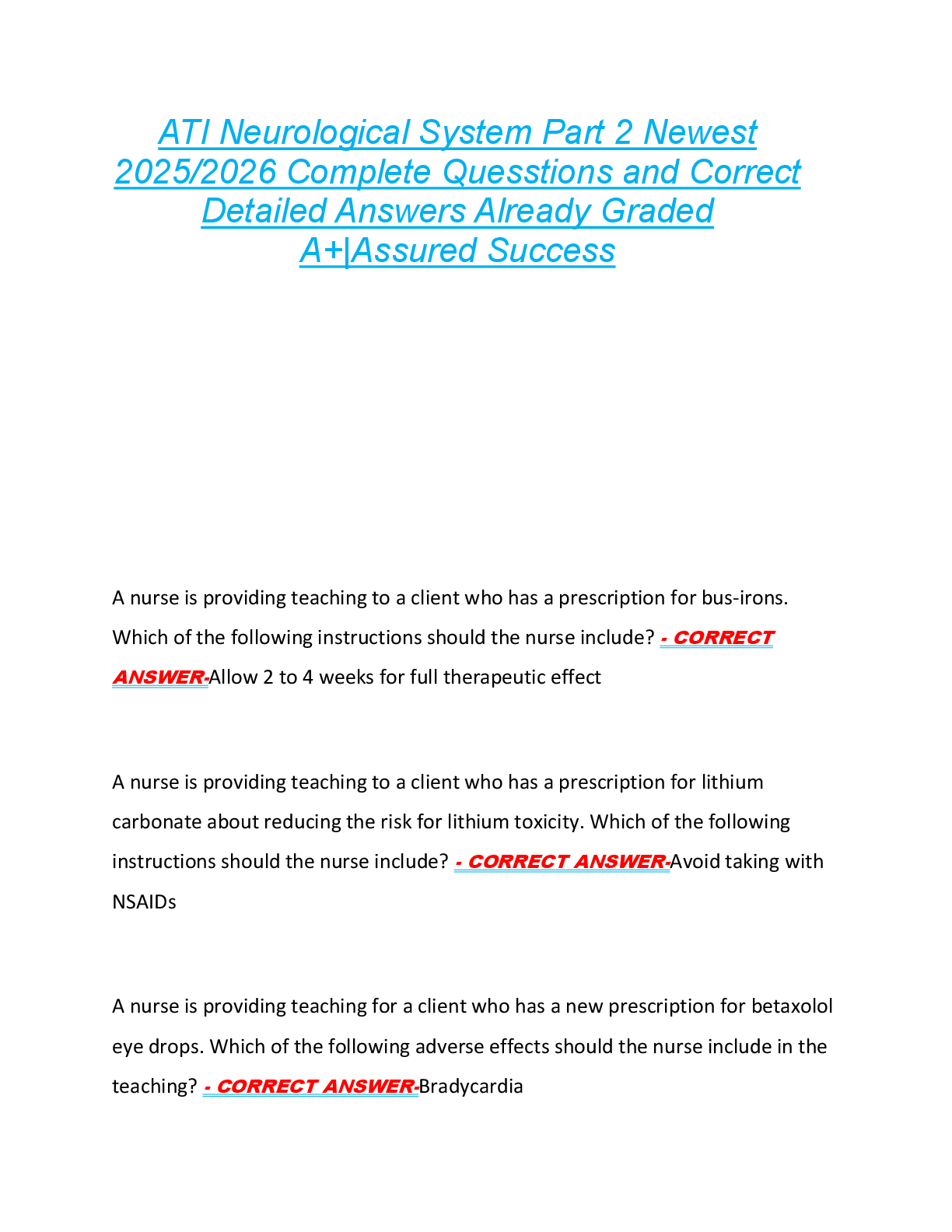
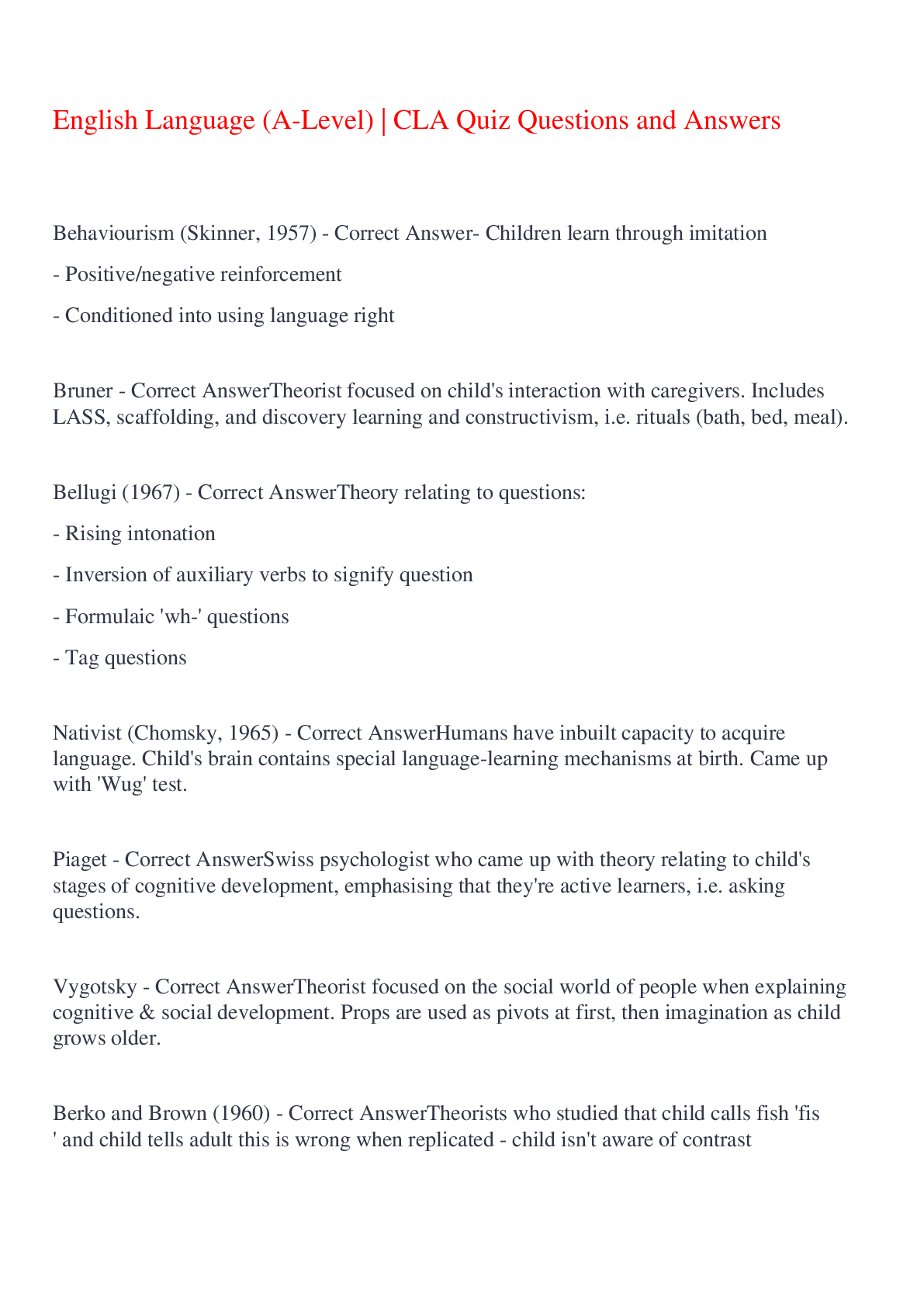
English Language (A-Level) | CLA Quiz Questions and Answers Behaviourism (Skinner, 1957) - Correct Answer- Children learn through imitation - Positive/negative reinforcement - Conditioned into ... using language right Bruner - Correct AnswerTheorist focused on child's interaction with caregivers. Includes LASS, scaffolding, and discovery learning and constructivism, i.e. rituals (bath, bed, meal). Bellugi (1967) - Correct AnswerTheory relating to questions: - Rising intonation - Inversion of auxiliary verbs to signify question - Formulaic 'wh-' questions - Tag questions Nativist (Chomsky, 1965) - Correct AnswerHumans have inbuilt capacity to acquire language. Child's brain contains special language-learning mechanisms at birth. Came up with 'Wug' test. Piaget - Correct AnswerSwiss psychologist who came up with theory relating to child's stages of cognitive development, emphasising that they're active learners, i.e. asking questions. Vygotsky - Correct AnswerTheorist focused on the social world of people when explaining cognitive & social development. Props are used as pivots at first, then imagination as child grows older. Berko and Brown (1960) - Correct AnswerTheorists who studied that child calls fish 'fis' and child tells adult this is wrong when replicated - child isn't aware of contrast LASS (Language Acquisition Support System) - Correct AnswerThis refers to the child's interaction with adults around them and how this interaction supports language development. Scaffolding - Correct AnswerAdults question and encourage kids to develop speech. One-word, Two-word, Telegraphic, Post-telegraphic - Correct AnswerThe four stages of language acquisition. Labelling, Packaging, Network building - Correct AnswerAitchison's stages of children's linguistic development Syntactical advances - Correct Answer- Ordering words into phrases & clauses - Making different utterance types (simple, compound, complex) Instrumental, regulatory, interactional, personal, representational, imaginative, heuristic - Correct AnswerHalliday's functions of speech Deletion - Correct AnswerRemoving final consonant in words Substitution - Correct AnswerSubstituting one letter for another Addition - Correct AnswerAdding extra vowel sound to word ending, creating CVCV pattern Assimilation - Correct AnswerChanging a consonant or vowel for another. Reduplication - Correct AnswerRepeating a whole syllable, e.g. 'dada' and 'mama' Overgeneralisation - Correct AnswerExtending word meanings or grammatical rules beyond normal use, i.e. 'runned' instead of 'ran' Consonant cluster reduction - Correct AnswerConsonant clusters can be difficult to articulate, so children reduce them to smaller units, e.g. 'pider' ('spider') Unstressed syllable deletion - Correct AnswerOmitting opening syllable in polysyllabic words Vegetative, 0-4 months - Correct AnswerSounds of discomfort or reflexive actions, and age at which this usually happens Cooing, 4-7 months - Correct AnswerComfort sounds and vocal play using open mouthed vowel sounds, and age at which this usually happens Babbling, 6-12 months - Correct AnswerRepeated patterns of consonant & vowel sounds, i.e. 'baba', and age at which this usually happens Protowords, 9-12 months - Correct AnswerWord-like vocalisations: not making actual words, but used consistently for same meaning; sometimes called 'scribble talk', and age at which this usually happens Holophrastic/One-word, 12-18 months - Correct AnswerSingle-word utterances, and age at which this usually happens Two-word, 18-24 months - Correct AnswerTwo-word utterances, and age at which this usually happens Telegraphic, 24-36 months - Correct AnswerThree or more word combinations, and age at which this usually happens Post-telegraphic, 36+ months - Correct AnswerMore grammatically complex combinations, and age at which this usually happens Plosive - Correct AnswerConsonant produced by forcing vocal chord closure to begin another word or sound (P, B) Fricative - Correct AnswerConsonant sound formed by constricting air flow through vocal tract (f, v, th, z, s, sh, sion) Affricative - Correct AnswerStop consonant that's released slowly into period of fricative noise (i.e. /ch/ in church) Approximants - Correct AnswerSimilar to vowels: air flow goes through the mouth, e.g. w, r and j Nasals - Correct AnswerProduced by air moving through the nose (m, n) Lateral - Correct AnswerCreated by placing tongue on ridge of teeth, then air moving down side of mouth (l) 24 months - Correct AnswerAge in which p, b, m, d, n, w, t sounds are typically produced 30 months - Correct AnswerAge in which k, g, h sounds are typically produced 36 months - Correct AnswerAge in which f, s, j, l sounds are typically produced 42 months - Correct AnswerAge in which tഽ, dζ, v, z, ഽ, r sounds are typically produced 48+ months - Correct AnswerAge in which θ, ð, ζ sounds are typically produced Sensorimotor, pre-operational, concrete operational, formal operational - Correct AnswerPiaget's stages of language development [Show More]
Last updated: 2 years ago
Preview 1 out of 4 pages
Buy this document to get the full access instantly
Instant Download Access after purchase
Buy NowInstant download
We Accept:

Also available in bundle (1)
Click Below to Access Bundle(s)
CLA Assessment /Quiz and Final Exams 25 sets Questions and Answer,100% CORRECT
ENGLISH LANGUAGE (A-LEVEL) | CLA QUIZ QUESTIONS AND ANSWERS CLA QUIZ QUESTIONS AND ANSWERS LATEST 2022/2023 CLA QUIZ QUESTIONS AND ANSWERS LATEST, CLA PRACTICE TEST QUESTIONS AND ANSWERS 2022/2023...
By securegrades 2 years ago
$30.5
24
Reviews( 0 )
$7.00
Can't find what you want? Try our AI powered Search
Document information
Connected school, study & course
About the document
Uploaded On
Feb 04, 2023
Number of pages
4
Written in
All

Additional information
This document has been written for:
Uploaded
Feb 04, 2023
Downloads
0
Views
130