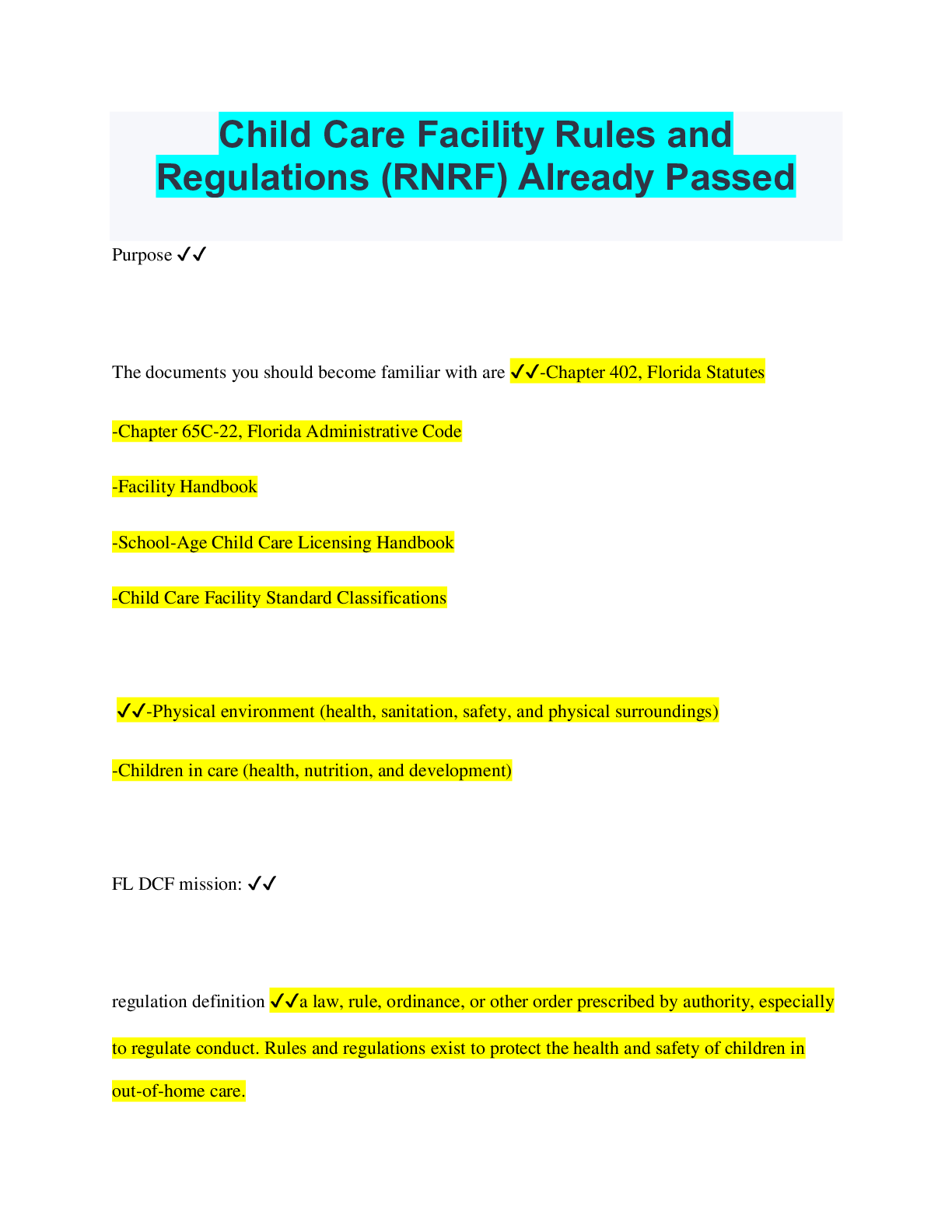
Child Care Facility Rules and
Regulations (RNRF) Already Passed
Purpose ✔✔
The documents you should become familiar with are ✔✔-Chapter 402, Florida Statutes
-Chapter 65C-22, Florida Administrative Code
-Facilit
...
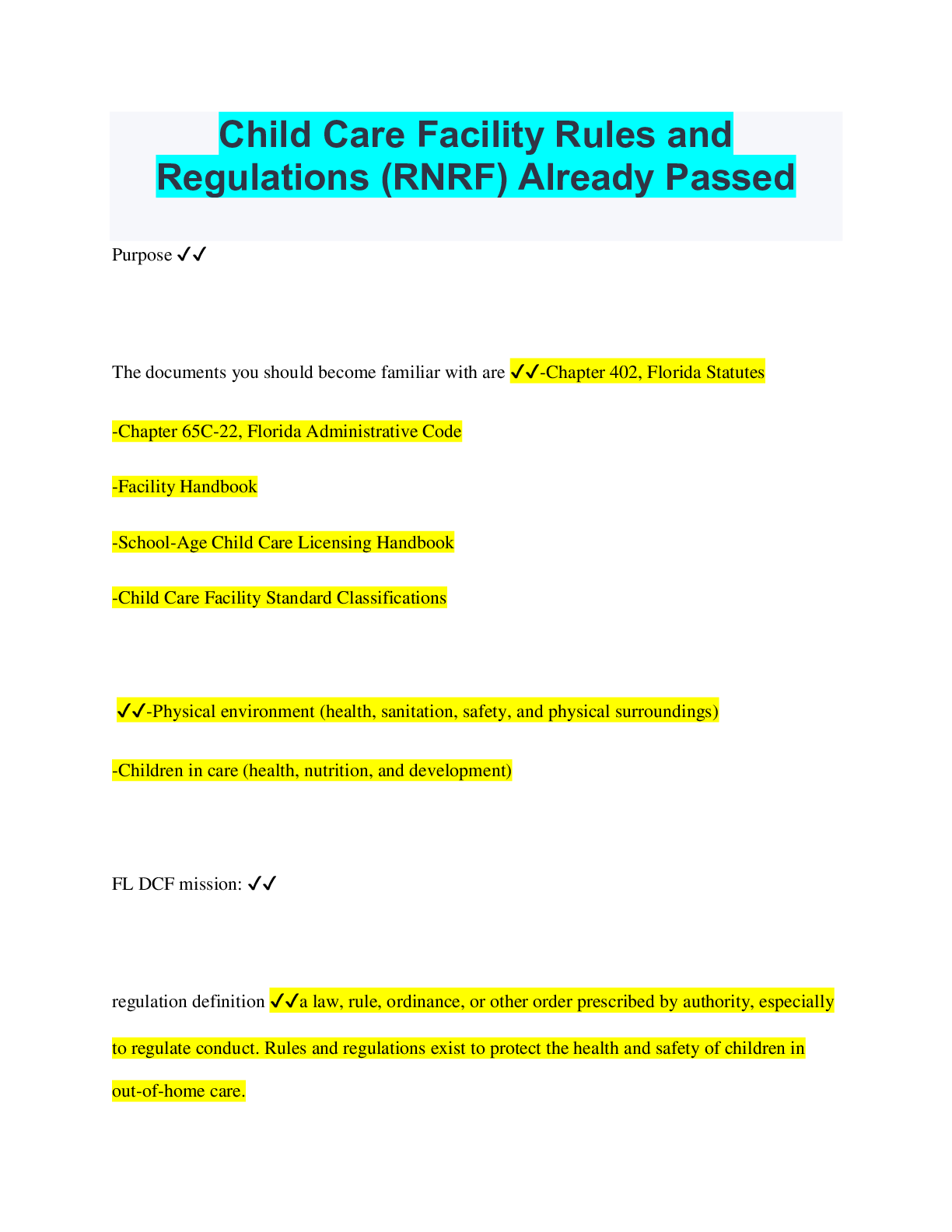
Child Care Facility Rules and
Regulations (RNRF) Already Passed
Purpose ✔✔
The documents you should become familiar with are ✔✔-Chapter 402, Florida Statutes
-Chapter 65C-22, Florida Administrative Code
-Facility Handbook
-School-Age Child Care Licensing Handbook
-Child Care Facility Standard Classifications
✔✔-Physical environment (health, sanitation, safety, and physical surroundings)
-Children in care (health, nutrition, and development)
FL DCF mission: ✔✔
regulation definition ✔✔a law, rule, ordinance, or other order prescribed by authority, especially
to regulate conduct. Rules and regulations exist to protect the health and safety of children in
out-of-home care.
Florida law definition ✔✔Florida Law means a bill passed by the Florida Legislature, which
includes the House and Senate, and signed by the governor of Florida. The permanent collection
of these state laws is found in the Florida Statutes.
Rules definition ✔✔Rules implement, interpret, and/or describe laws found in the Florida
Statutes. The permanent collection of these rules is found in the Florida Administrative Code.
For child care regulations, the Department of Children and Families' Office of Child Care
Regulation writes the rules. The Department has adopted a handbook as part of the Florida
Administrative Code to provide guidance and clarification in order for providers to implement
the rules and regulations.
ordinance definition ✔✔An ordinance is a local law enacted by a county or municipality and
only applies within the jurisdiction of the particular county or city.
The DCF's Office of Child Care Regulation ✔✔
child care personnel ✔✔Includes all owners, operators, employees, and volunteers working in a
child care facility
Foster Grandparents ✔✔Directly supervised volunteers who participate in the federal program
pursuant to 45 Code of Federal Regulations part 2552; they work with one or more children with
special or exceptional needs in child care programs
Direct Supervision ✔✔Actively watching and directing children's activities within the same
space, and responding to the needs of each child while in care
Director ✔✔On-site administrator or individual who has the primary responsibility for the day-
to-day operation, supervision, and administration of a child care facility
Owner ✔✔
Stable Walls or Barriers ✔✔
Weekend Child Care ✔✔
Classroom/Room/
Designated Space ✔✔
Department ✔✔
Sanitize ✔✔
child care ✔✔
A child care program is either licensed, registered, or exempt from licensure. The main types of
child care programs in Florida are ✔✔-Child Care Facilities
-Specialized Child Care Mildly Ill Facilities
-Family Day Care Homes
-Large Family Child Care Homes
Before-school and after-school sites ✔✔are programs, regardless of location, providing care for
children who are at least five years old, and who are enrolled in and attend kindergarten or
above. These programs provide care only before and after school, on teacher planning days,
holidays, and breaks that occur during the school district's official academic calendar year.
A school-age child care program must be licensed prior to operation and for continued operation,
unless the program demonstrates that it is exempt because it is located on a public/nonpublic
school school site and is all of the following: ✔✔-Operated and staffed directly by that school or
through a formal agreement
-Serving only the school-age children attending the school during the day
-Following the standards set forth by the Florida Building Code State Requirements for Public
Educational Facilities
(Licensed school-age child care programs are not subject to all of the same regulations as
licensed child care facilities, so it is important to review the appropriate standards handbook.)
A school-age child care program may also be exempt from licensure if: ✔✔
Child care for mildly ill children means ✔✔
Specialized Child Care Facilities are ✔✔licensed programs that provide child care for more than
five mildly ill children unrelated to the operator, which receive a payment, fee, or grant for any
of the children receiving care, wherever operated, and whether or not operated for profit. These
programs were created by the Legislature in order to implement standards, in conjunction with
the Florida Department of Health, specific to caring for mildly ill children, such as those with the
flu.
Drop-in child care ✔✔is a child care arrangement where families occasionally leave their child
for no more than four hours but remain on the premises, such as child care at a shopping mall. A
communication system must be provided to the family to ensure they can return immediately to
the child if necessary. A family is not required to submit the physical or immunization
documentation for the child using drop-in care; however, the family must attest to the child's
status of immunization and current health. Drop-in child care arrangements must be licensed and
shall meet all requirements for a child care facility unless specifically exempted, such as
religious exemption.
Evening child care ✔✔
Access ✔✔
Programs Exempt from Licensure ✔✔There are programs that are not included in the definition,
and therefore, are exempt from licensure. The following programs are considered exempt from
licensure by the Florida Statutes and Florida Administrative Code:
-Public and Non-Public Schools—School Day
-Programs for Children Grades Six and Above
-School-Age Programs on School Sites That Meet Certain Criteria
-Instructional/Tutorial Programs
-Open Access Programs
-National Membership Organizations That Meet Certain Criteria
-Summer Day Camps and 24-Hour Camps
-Vacation Bible Schools
-Transient Establishments (hotels, resorts, and similar establishments)
-Non-Custodial In Home Care
-Religious Exemption Pursuant to s. 402.316, F.S.
Public and Non-Public Schools—School Day ✔✔
Programs for Children Grades Six and Above ✔✔
School-Age Programs on SchoolSites That Meet Certain Criteria ✔✔
Instructional/Tutorial Programs ✔✔Programs that are classified as instructional or tutorial are
not designated as Gold Seal Quality Care providers. If they have a single instructional/tutorial
purpose and that is the only service they provide, then they are exempt from licensure. Some
examples of these programs include, but are not limited to:
-Tutoring
-Computer class
-Ballet class
-Karate class
-Baseball instruction or other sport
The program cannot provide any service beyond the instructional and tutorial/academic activity
in order to qualify under this category of exemption. Also, the program cannot cater, serve, or
prepare meals. The program may choose to provide drinks and ready-to-eat snacks that are
individually pre-packaged and do not require refrigeration. An instructional/tutorial session may
not exceed two hours for one session or three hours for a session with multiple academic areas.
These programs do not contract to deliver
[Show More]
.png)
.png)

.png)
.png)