ALTA Review for CALT EXAM Questions and Answers,100% CORRECT
Document Content and Description Below
ALTA Review for CALT EXAM Questions and Answers
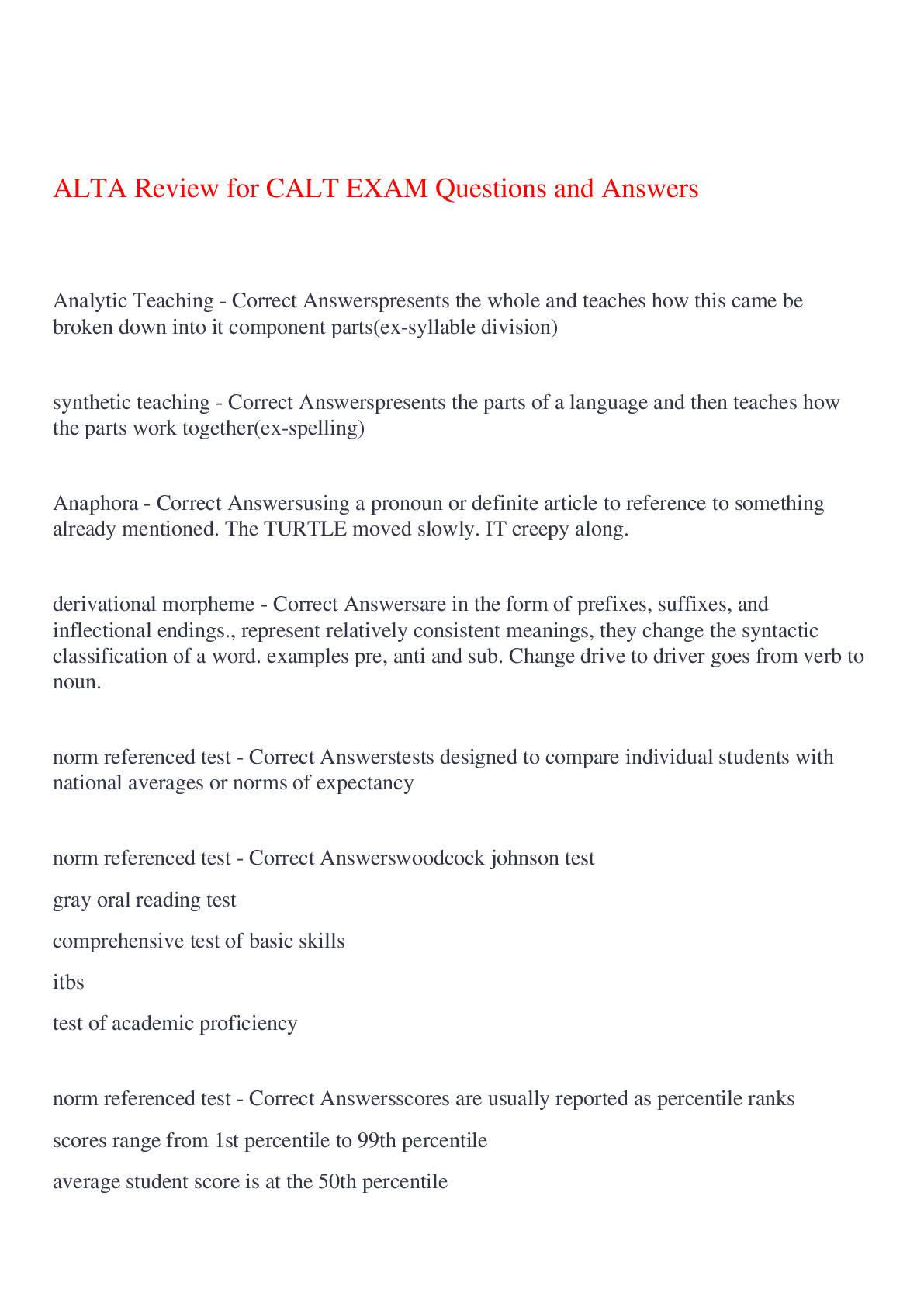
Analytic Teaching - Correct Answerspresents the whole and teaches how this came be broken down into it component parts(ex-syllable division)
syn
...
thetic teaching - Correct Answerspresents the parts of a language and then teaches how the parts work together(ex-spelling)
Anaphora - Correct Answersusing a pronoun or definite article to reference to something already mentioned. The TURTLE moved slowly. IT creepy along.
derivational morpheme - Correct Answersare in the form of prefixes, suffixes, and inflectional endings., represent relatively consistent meanings, they change the syntactic classification of a word. examples pre, anti and sub. Change drive to driver goes from verb to noun.
norm referenced test - Correct Answerstests designed to compare individual students with national averages or norms of expectancy
norm referenced test - Correct Answerswoodcock johnson test
gray oral reading test
comprehensive test of basic skills
itbs
test of academic proficiency
norm referenced test - Correct Answersscores are usually reported as percentile ranks
scores range from 1st percentile to 99th percentile
average student score is at the 50th percentile
Quartile - Correct Answersa way of describing position of a score on a normal referenced test. the score falls in one of five groups
criterion referenced test - Correct AnswersA test that describes the specific types of skills, tasks, or knowledge of an individual relative to a well-defined mastery criterion. The content of criterion-referenced tests is limited to certain specified objectives. The student's performance on this type of test helps the teacher to determine the specific criteria or skills on which the student needs help.
criterion reference test - Correct Answersquick phonics screener
words their way spelling inventory
test created by teachers
STAAR
Summative Assessment - Correct AnswersAssessing student learning at the end of an educational experience to evaluate the effectiveness of the experience.
Formative Assessment - Correct Answersused to see if students have learned material right after it has been presented
morphonology - Correct Answersstudy of the different allomorphs of the morpheme and the rules governing their use
6 syllable types - Correct AnswersClosed, open, vowel-consonant-silent e, vowel pair, R-controlled, and consonant-le.
Section 504 Rehabilitation Act of 1973 - Correct AnswersExtends civil rights to people with disabilities
idea - Correct AnswersIndividuals with Disabilities Education Act
section 504 and idea - Correct Answers504 states that any program receiving "federal funds" must provide equivalent service, but must be identical. Under IDEA, students have more access to more services-the program is federal funded.
IQ Discrepancy Model - Correct Answerscapture and compare a student's scores on different types of test. it compares assessments of a child's intellectual ability (IQ) with how much progress he's making in school (academic achievement.
quasi-experimental research - Correct Answersattempts to determine the cause and effect without strict randomized controlled trials, is valid, but less reliable
FAPE - Correct AnswersFree Appropriate Public Education- Special Education Services that are provided at public expense must meet standards of that state's educational agency. Must be available to preschool, elementary, and secondary levels and must follow individual education plans
Qualitative Research - Correct Answersresearch that collection data through various kinds of observations
Quantitative research - Correct Answersresearch results are based on a large sample that is represented by the population
Scarborough's reading rope - Correct AnswersLanguage comprehension -INCREASINGLY STRATEGIC! (background knowledge, vocab, syntax/semantics, verbal reasoning & literacy knowledge) + word recognition-INCREASINGLY AUTOMATIC! (decoding, sight words, phonological awareness) = skilled reading (fluency and comprehension)
Morphology - Correct Answersunits of meaning involved in word formation
Morpheme - Correct Answerssmallest unit of MEANING in language
unbound or free morpheme - Correct Answersa morpheme that can stand alone
bound morpheme - Correct AnswersA morpheme that must be "bound" with another morpheme to form a word. Ex: un, ish, es, ed, pre
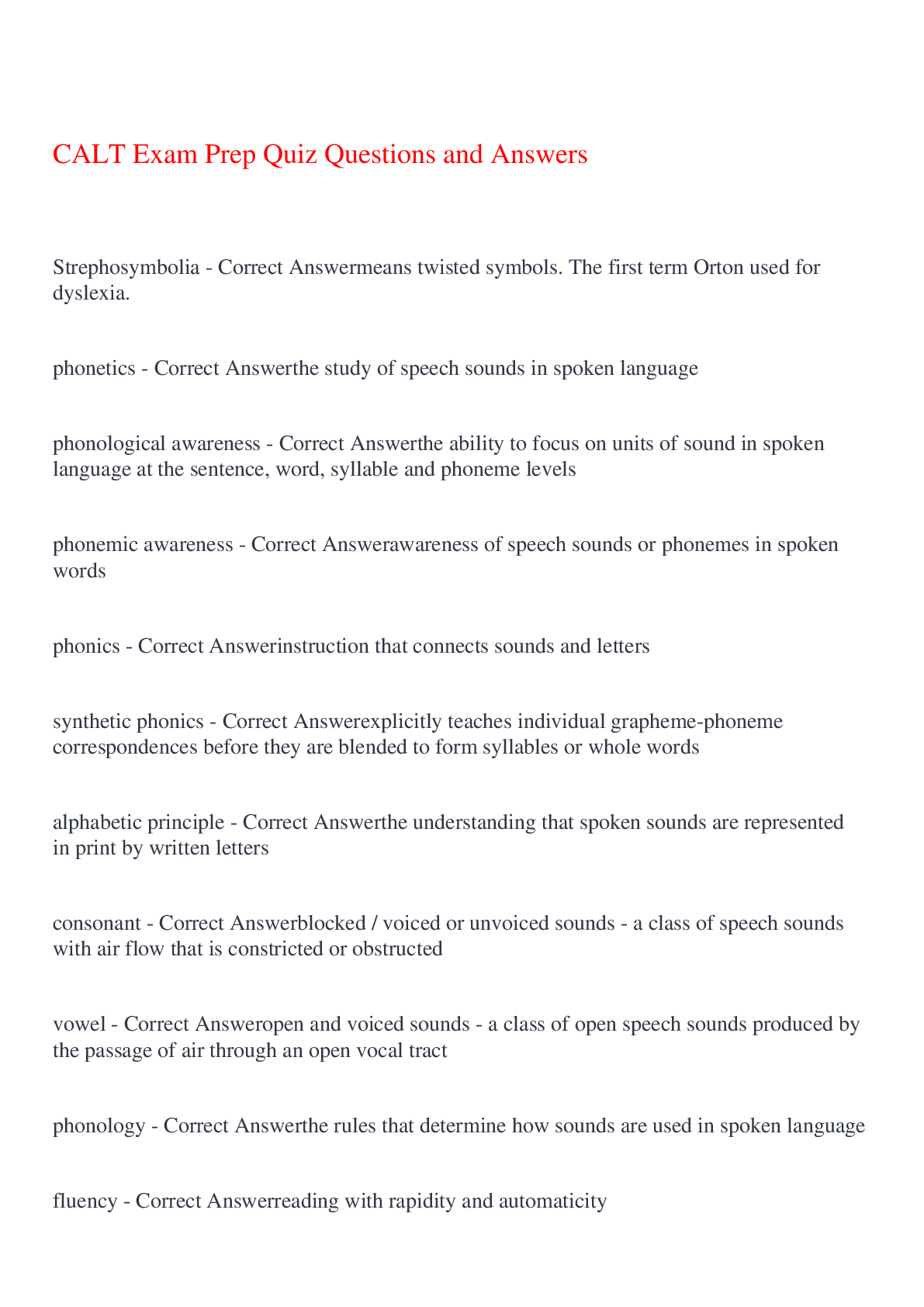
Phonetics - Correct Answersstudy of the characteristics of individual speech sounds(articulation, how the air flows, activity of the vocal chords)
Phonology - Correct Answerssystem for rules that determine how sounds are used in spoken language. pronunciation variations occur based on phoneme position or surrounding sounds.
Phonics - Correct AnswersInstruction in the association of speech sounds with printed symbols. provides the visual representative of spoken word.
spelling - Correct Answerstranslates speech sounds into letters or letters patterns. spelling starts with sounds not letters sequence.
orthography - Correct Answersrules that government how words are represented in writing.
Diagnostic Teaching - Correct Answersteaching that is informed by a continual assessment of student needs. academic abilities and limitations.
prescriptive teaching - Correct Answersindividualized teaching based on needs. must flow from assessment, addressing the learner and and his style of learning.
spelling score 0 - Correct Answersnot all sounds are represented (tk or thk for thick)
spelling score 1 - Correct Answersall sounds are marked, but two or more letters are not reasonable representations of the sounds or extra letters are added(tig or fek or thick; tickgt or thiegk for thick)
spelling score 2 - Correct Answersall sounds are marked, but one letter is not reasonable representation of a sound; no extra letters are added (tik or thek for thick)
spelling score 3 - Correct Answersall sounds are marked with reasonable representations (thik of thick for thic)
spelling score 4 - Correct Answersthe spelling is almost conventional, but a letter is added or doubled (thicker or thick for thick)
spelling score 5 - Correct Answerscorrect spelling
Precommunicative Stage - Correct AnswersThe child uses symbols from the alphabet but shows no knowledge of letter-sound correspondences. The child may also lack knowledge of the entire alphabet, the distinction between upper- and lower-case letters, and the left-to-right direction of English orthography.
Semiphonetic Stage - Correct AnswersThe child begins to understand letter-sound correspondence--that sounds are assigned to letters. At this stage, the child often employs rudimentary logic, using single letters, for example, to represent words, sounds, and syllables (e.g., U for you).
transitional stage - Correct Answersthe speller begins to assimilate the conventional alternative for representing words to a reliance on visual representative and an understanding of the structure of words. some examples are EGUL for eagle and HIGHEKED for hiked.
correct stage of spelling - Correct AnswersThe speller knows the basic rules. The correct speller understands how to deal with such things as prefixes and suffixes, silent consonants, alternative spellings, and irregular spellings. A large number of learned words are accumulated, and the speller recognizes incorrect forms. The child's generalizations about spelling and knowledge of exceptions are usually correct.
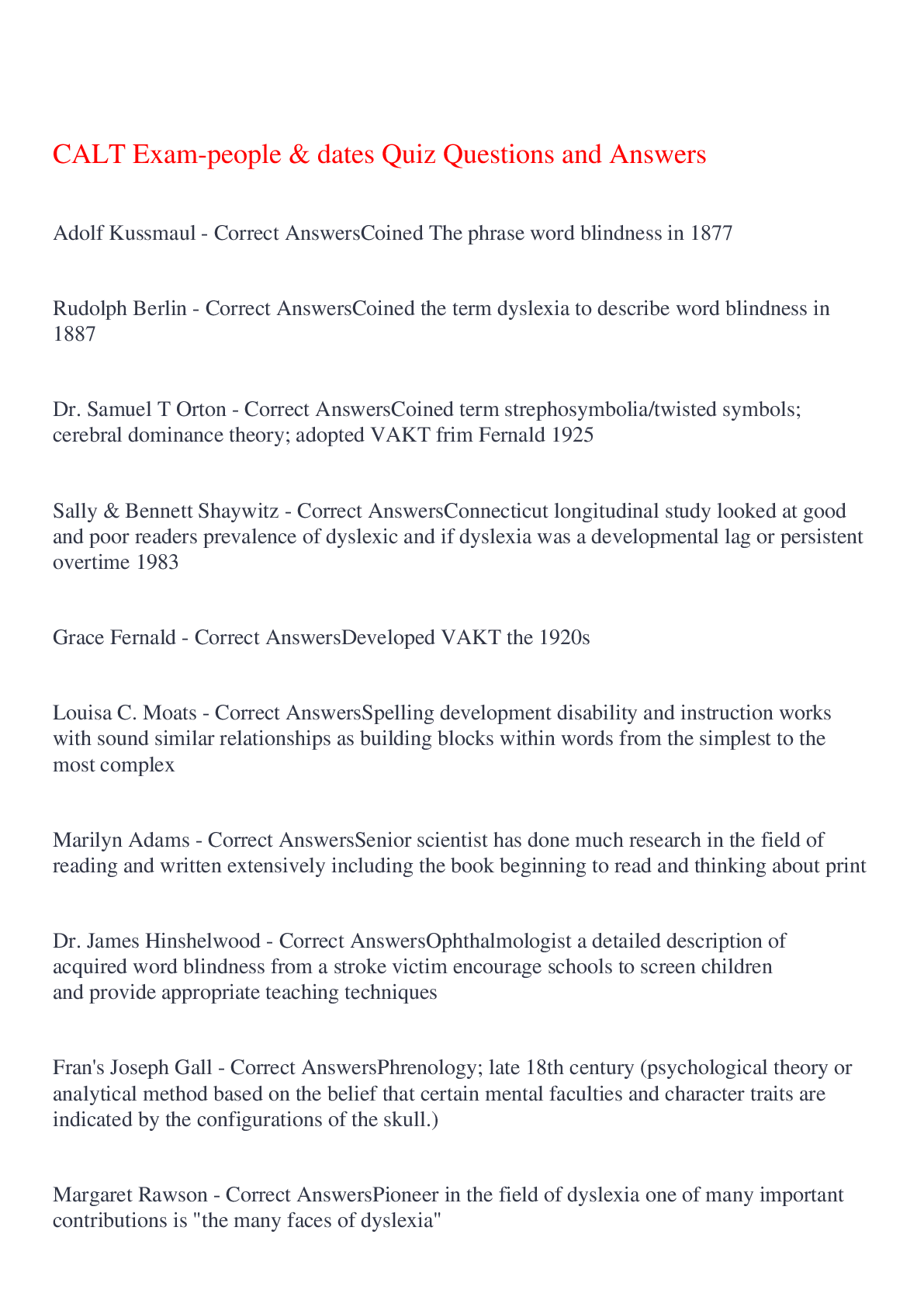
Rudolf Berlin (1887) - Correct Answers-German physician
-used the word "dyslexia" to describe loss of ability to read due to brain injury
Adolf Kusmaul - Correct Answers1877 - first used the term "word-blindness".
James Hinshelwood - Correct Answers(1895)Opthamologist from Scotland who coined the term "congenital word blindness"
advocate for specific instructional approach using the alphabetic method to appeal you as many cerebral centers as possible
Samuel Orton - Correct Answers(1925_) first American to REPORT on the term word blindness. Advocate for using all sensory pathways involved in language to reinforce memory patterns
Latin - Correct Answerstechnical, sophisticated words, literature
Latin - Correct Answersmultiple syllables
Latin - Correct Answersconnective i , ui, u
such a as meditate, monument, solitude
Latin - Correct Answersti, si, ci = (sh) station, facial
Latin - Correct Answerstu = (choo) adventure, eventual
Latin - Correct Answersture = (cher) adventure, nature
Latin - Correct Answerschameleon prefixes im, it, il, in, illegal, impossible
Latin - Correct Answersgt, pt, strict, act, erupt
Latin - Correct Answerssoft c before e or i as in city
Latin - Correct Answerssion emulsion, suspension
Latin - Correct Answerssilent h hour
Latin - Correct Answerssc as in scent
Anglo Saxon - Correct Answersone syllable common everyday words
Anglo Saxon - Correct Answersmost vowel teams -
Anglo Saxon - Correct Answersshort words with silent letters knot and doubt
Anglo Saxon - Correct Answersouter body parts
Anglo Saxon - Correct Answerssight words, numbers , colors
Anglo Saxon - Correct AnswersFLOSS Words
Anglo Saxon - Correct Answersch as in chair, chin
ck, tch, dge words, short th words
Anglo Saxon - Correct Answersk in short words as in kind and kelp
Anglo Saxon - Correct Answerswh, ng, wr words
Anglo Saxon - Correct Answerswild old words
Anglo Saxon - Correct Answers2 syllable consonant let words as in bubble
Greek - Correct Answersscience, medical, textbooks, arts
Greek - Correct Answersmedial y
Greek - Correct Answersconnective o as in photograph, democrat
Greek - Correct Answersch = (k) school, monarch
Greek - Correct Answersk in longer words such as kilometer, kinesthetic
Greek - Correct Answersth in longer words such as athlete, thyroid
Greek - Correct Answerssilent p as in pneumonia, psychology
Greek - Correct Answersending ic as in charismatic, music, chronic
Greek - Correct Answersphoto, photography, photosynthesis
Greek - Correct Answerstele as in telephone
therm as in thermostat
bio as in biology
hydro as in hydrogen
Linnea Ehri - Correct Answers1995 developed a theory about how word reading skills develop. Phase children move through on their way to progressive reading.
Prealphabetic phase - Correct Answerslittle or no alphabetic knowledge
Partial Alphabetic Phase - Correct Answerschildren know some letters and letter-sound associations and can use them along with context clues
full alphabetic phase - Correct Answerschildren apply alphabet knowledge systematically when decoding and often decode words letter by letter
consolidated alphabetic phase - Correct AnswersEhri's fourth phase of word recognition, in which readers use patterns, chunks, and other word parts to figure out unfamiliar words.
automatic phase - Correct Answersproficient word reading
kusmaul, berlin, pringle - Correct AnswersEuropean doctors researched individual lost their ability to read to cerebral dysfuntion
National Reading Panel - Correct Answersexplicit instruction in phonemic awareness
systematic phonic instruction
methods to improve fluency
ways to enhance comprehension
section 504 - Correct Answerscivil rights law, accommodations, assisted technology,school services
idea - Correct Answersa federal education law
special education
related services
accommodations
assisted techhnology
skills easiest to hardest - Correct Answerswords, syllables, onset-rime, phoneme
matching, isolation blending, segmenting, deletion, substitution
[Show More]
Last updated: 2 years ago
Preview 1 out of 9 pages

.png)
.png)
.png)
.png)