*NURSING  >  EXAMs  >  Chapter 4 End of Chapter Test A+ Solutions (All)

Chapter 4 End of Chapter Test A+ Solutions

Document Content and Description Below

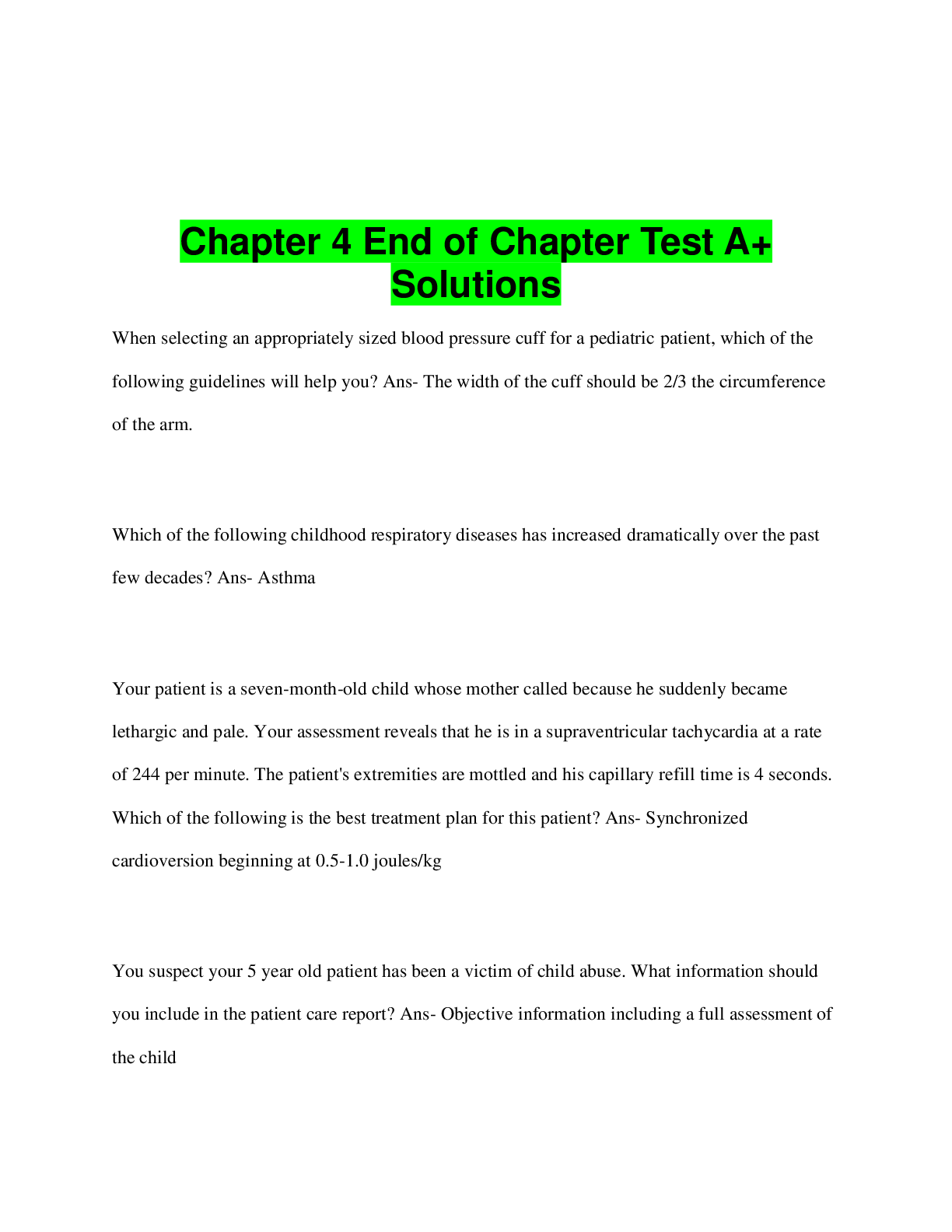
When selecting an appropriately sized blood pressure cuff for a pediatric patient, which of the following guidelines will help you? Ans- The width of the cuff should be 2/3 the circumference of th ... e arm. Which of the following childhood respiratory diseases has increased dramatically over the past few decades? Ans- Asthma Your patient is a seven-month-old child whose mother called because he suddenly became lethargic and pale. Your assessment reveals that he is in a supraventricular tachycardia at a rate of 244 per minute. The patient's extremities are mottled and his capillary refill time is 4 seconds. Which of the following is the best treatment plan for this patient? Ans- Synchronized cardioversion beginning at 0.5-1.0 joules/kg You suspect your 5 year old patient has been a victim of child abuse. What information should you include in the patient care report? Ans- Objective information including a full assessment of the child Your patient is a 13 year-old male drowning victim. He was initially in cardiac arrest with a pulseless, wide-complex bradycardia. He is intubated and being ventilated with supplemental oxygen. After CPR and intubation, the patient is now in ventricular tachycardia with a weak radial pulse. Which of the following would be an appropriate treatment for this patient? AnsSynchronized cardioversion starting at 0.5-1.0 joules/kg The most common cardiac dysrhythmias in pediatric patients are: Ans- Bradyarrhythmias Your patient is a four-year-old male with a history of asthma. He ran out of his inhaled bronchodilator while visiting his grandparent's farm. On your arrival, you learn that the patient has been having increasing respiratory distress for 20 minutes. The patient has pale, cool, moist skin with cyanosis of his nail beds. He is sitting on the edge of a kitchen chair, leaning forward to breathe. He has a respiratory rate of 50 with the use of accessory muscles and a heart rate of 130. He is anxious and unable to speak more than one or two words at a time. Auscultation of the chest reveals scattered wheezing. As you prepare to treat the patient, he becomes drowsy and his respiratory rate decreases to 12. You can no longer auscultate his wheezes. Which of the following best explains the significance of the change in your patient's status? Ans- Because of decreased respiratory, cardiovascular, and stored energy reserves, the child's muscles have fatigued and he is now in respiratory failure. Your 12-month-old patient has burns covering the full length of both lower extremities circumferentially. Which of the following is the most accurate estimate of the percentage of total body surface area involved? Ans- 28 percent Your patient is a nine-year-old female who was struck by a vehicle as she ran across the street. She is unresponsive and has a hematoma over the left parietal area and an open, depressed skull fracture on the right parietal area. She has bruising on the left flank and hip. She is breathing irregularly at 8 times per minute and has a heart rate of 56. She has a faint carotid pulse but no radial pulse. Which of the following is/are most likely to account for your patient's heart rate? 1. Normal range for a healthy, fit, nine-year-old child 2. Hypoxia due to impaired respiratory status secondary to traumatic brain injury 3. Increasing intracranial pressure due to traumatic brain injury exacerbated by hypoxia 4. Myocardial contusion Ans- 2 and 3 If unable to establish an airway by any other means, in which of the following patients would needle cricothyrotomy be contraindicated? Ans- Neither of the above Your patient is a two-year-old male who has ingested approximately 30 tablets of children's chewable acetaminophen tablets anywhere from 15 to 30 minutes before your arrival. He is awake and appears stable, but he is intermittently crying. You have a 20-minute transport time to the hospital. The child weighs 18 pounds. Which of the following would be the best prehospital treatment option for this child? Ans- Activated charcoal mixed in a slurry with sorbitol Which one of the following statements regarding ventilation of the pediatric patient is TRUE? Ans- The bag valve device should not have a pop-off valve. Your patient is a nine-year-old female who was injured when her hand slipped into a hole in the ground while she was turning a cartwheel. She is upset and has an obvious deformity of her left humerus. She asks you if her arm is broken. Which of the following is the best response? Ans- "It looks that way, but an X-ray at the hospital will let us know for sure." In which of the following ways can paramedics help identify the need for more pediatric services or specialized pediatric services in their areas? Ans- Carefully document pediatric emergency calls Which of the following is NOT a sign of respiratory distress in the pediatric patient? AnsCentral cyanosis At which of the following ages does the risk of foreign body airway obstruction become a significant concern in the normally developing infant? Ans- Six months Which of the following is NOT part of the pediatric assessment triangle when forming your general impression of the patient's condition? Ans- Blood g [Show More]

Last updated: 2 years ago

Preview 1 out of 18 pages

Buy Now

Instant download

We Accept:

Payment methods accepted on Scholarfriends (We Accept)
Preview image of Chapter 4 End of Chapter Test A+ Solutions document

Buy this document to get the full access instantly

Instant Download Access after purchase

Buy Now

Instant download

We Accept:

Payment methods accepted on Scholarfriends (We Accept)

Reviews( 0 )

$9.00

Buy Now

We Accept:

Payment methods accepted on Scholarfriends (We Accept)

Instant download

Can't find what you want? Try our AI powered Search

92
0

Document information


Connected school, study & course


About the document


Uploaded On

Feb 12, 2023

Number of pages

18

Written in

All

Seller


Profile illustration for Native
Native

Member since 3 years

7 Documents Sold

Reviews Received
0
0
0
0
1
Additional information

This document has been written for:

Uploaded

Feb 12, 2023

Downloads

 0

Views

 92

Document Keyword Tags

Recommended For You

Get more on EXAMs »

$9.00
What is Scholarfriends

Scholarfriends.com Online Platform by Browsegrades Inc. 651N South Broad St, Middletown DE. United States.

We are here to help

We're available through e-mail, Twitter, Facebook, and live chat.
 FAQ
 Questions? Leave a message!

Follow us on
 Twitter

Copyright © Scholarfriends · High quality services·