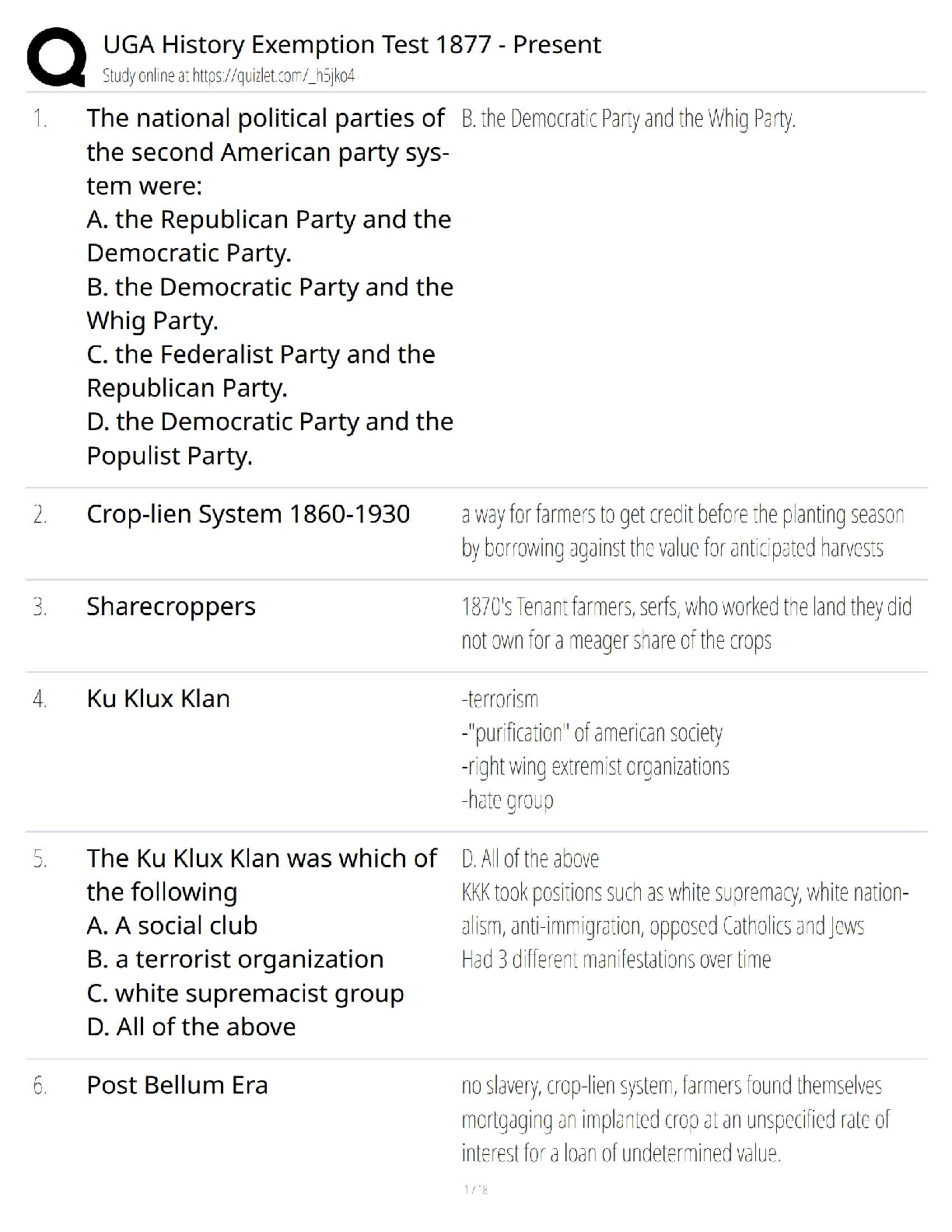
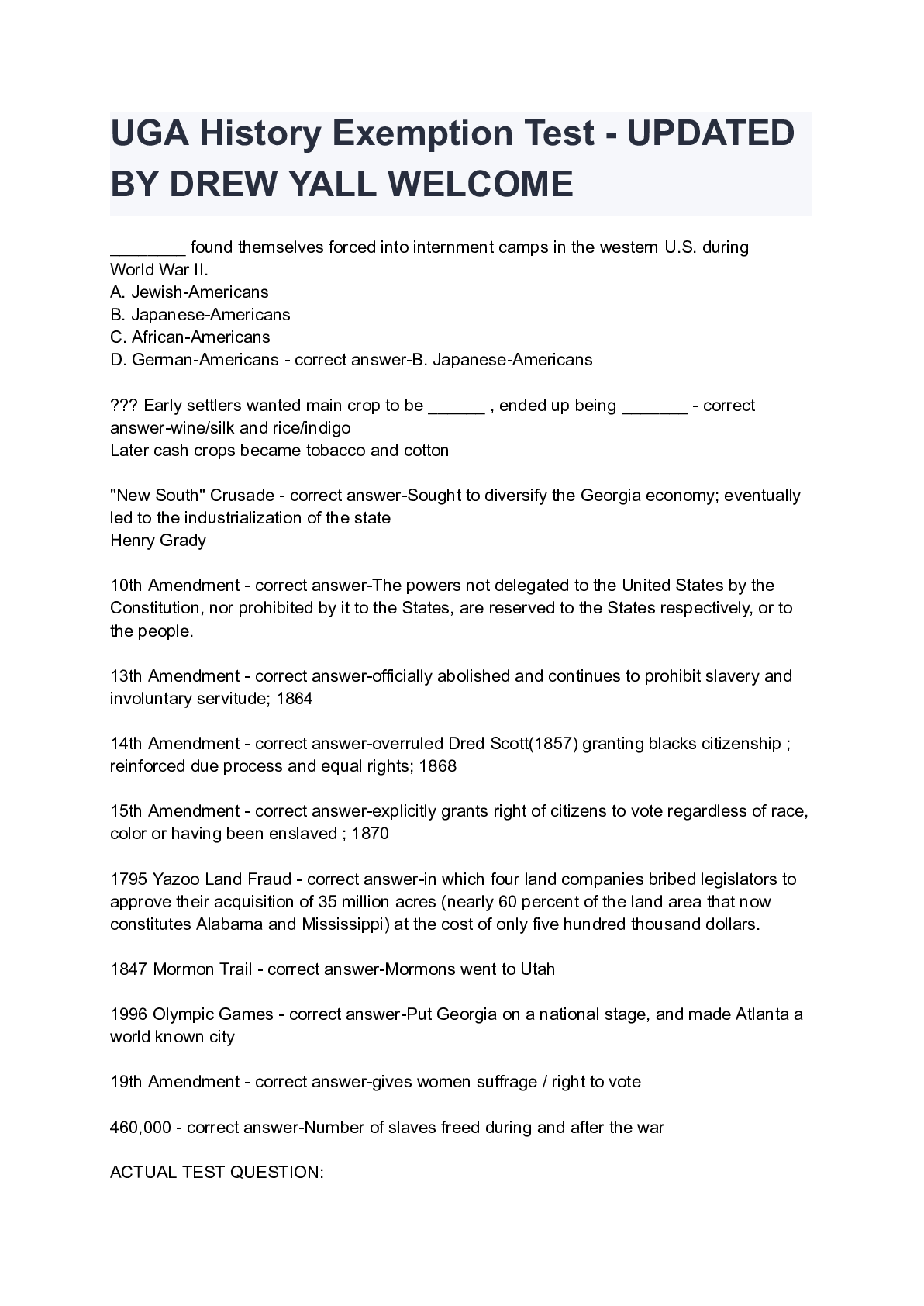
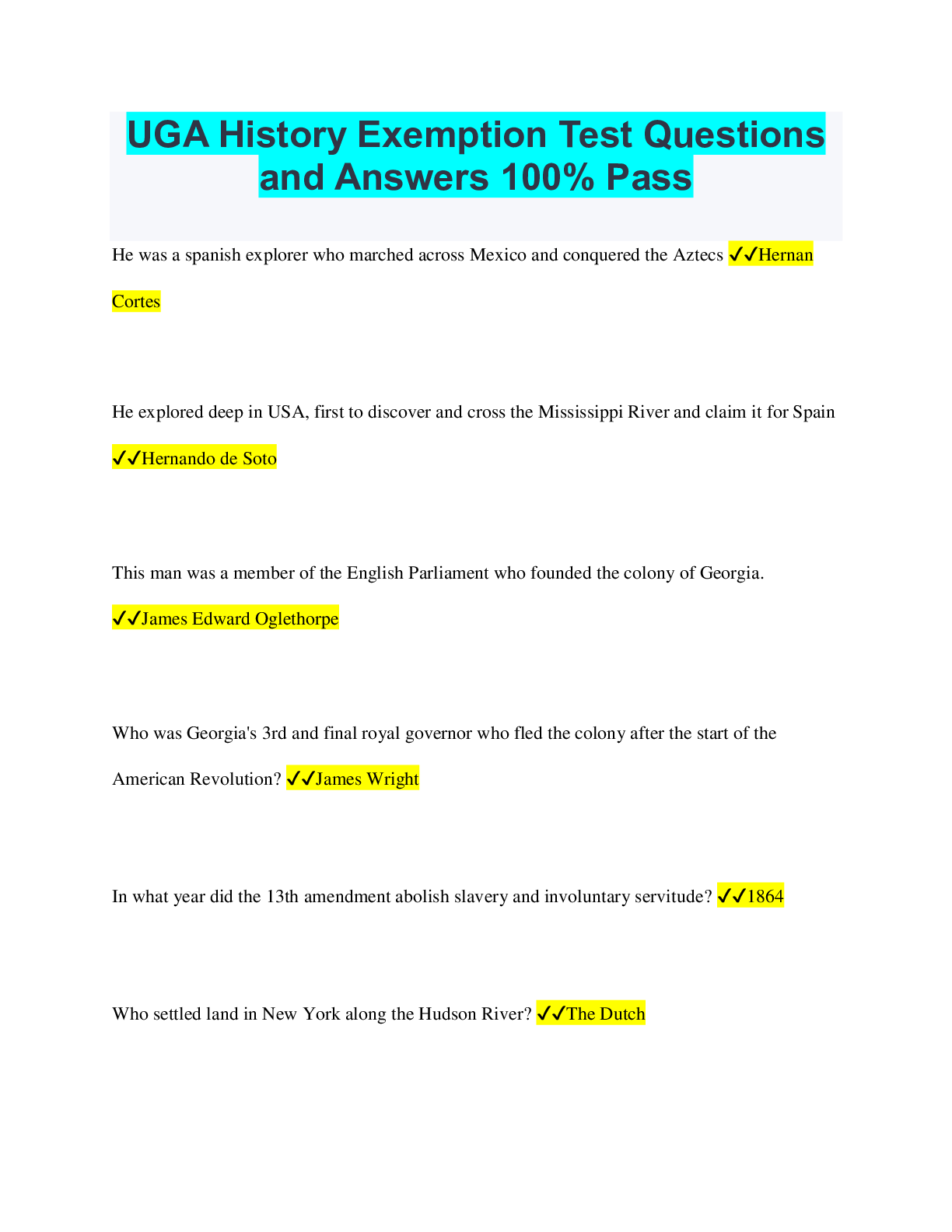
UGA History Exemption Test 2022/2023
Georgia Already Passed
Human history in Georgia dates back to the _______ era which took place ____ years ago.
Paleoindian, 13,000
The _____ Period took place from AD 800-1600. Co
...
UGA History Exemption Test 2022/2023
Georgia Already Passed
Human history in Georgia dates back to the _______ era which took place ____ years ago.
Paleoindian, 13,000
The _____ Period took place from AD 800-1600. Complex native cultures organized as ____
emerged.
Mississippian, chiefdoms
With the arrival of European explorers and settlers, ______ cultures began to ______.
Mississippian, decline
The _____ and _____ Indian tribes played significant roles in the colonial history of Georgia.
Creek, cherokee
The earliest Europeans in Georgia were the ______.
Spanish
Established in _____, with settlement in Savannah in _____, Georgia was the ______ of the
thirteen colonies to be founded.
1732, 1733, last
Georgia was the only colony founded and ruled by a _____ _____ ____ , which was based in
London, England, with no _______ within the colony itself for the first two decades of its
existence
Board of trustees, governor
Georgia was the only one of the colonies in which ____ was banned at its beginning, along with
_____, _____, and _____.
Slavery, rum, lawyers, catholics
Slavery was legalized in Georgia in ____.
1751
The colony was governed by ____ _____ instead of the Board of Trustees from ______-______,
ending with the outbreak of the Revolutionary War.
royal governors, 1752-1776
_______ _____ founded Georgia, and envisioned the colony as a refuge for the _______ who
crowded London prisons; however, no such prisoners were among the initial settlers.
James Oglethorpe, debtors
The British military wanted Georgia to be a buffer zone to protect ____ ___ and its other
southern colonies from the _____ in Florida.
South Carolina, Spanish
The Battle of Bloody Marsh on ____ ____ ____ was a conflict between the British troops (that
were commanded and financed by Oglethorpe) and the Spanish, which ended in a _____ victory.
St. Simons Island, British
During the Revolutionary war Georgia resisted British trade regulation, but they tended to _____
with British interests because royal rule had brought prosperity for many colonists and because
they desired the presence of British troops to stem the threat of ______ attacks.
sympathize, Indian
At the Second Continental Congress in Philadelphia, three Georgians— _____ ____, _____
_____, and _____ _____ signed the Declaration of Independence on July 4, 1776.
Button Gwinnett, Lyman Hall, George Walton
In _____ two Georgians, ____ ____ and ____ ____ ____, signed the new U.S. Constitution at
the Constitutional Convention.
1787, Abraham Baldwin, William Few Jr.,
The Siege of Savannah in ____ was the most serious military confrontation between ___ and ___
troops.
1779, British, American
In 1779 the capital of Georgia was moved from ____ to ____.
Savannah, Augusta
_____ ___ was a female patriot and spy credited with killing several Tory soldiers at her home.
Nancy Hart
After the Trustees lifted the ban on slavery, Georgians moved quickly to establish a coastal
plantation economy based on _____ and ___ ____ _____.
Rice, Sea Island Cotton
In _____, Eli Whitney invented the ____ ____.
1793, cotton gin
The invention of the cotton gin led to the development of the ____ _____ region, a wide
geographical strip with a pronounced concentration of _____ and _____ cultivation.
Black Belt, slaves, cotton
The ___ ___ ___ dominated state politics for much of the 1790's.
Yazoo Land Fraud
The ____ ___ in the North Georgia Mountains spanned the 1830's.
gold rush
In 1785, the state chartered the very first university in the nation to be established by a state
government- the ____ ____ ______.
University of Georgia
Wesleyan College was established in _____ as the first degree-granting _____ college in the
world.
1836, women's
The forced exile of the ____ from Georgia from 1838-1839 was known as the ___ ___ ___.
Cherokees, Trail of Tears
In 1832, Georgia became the only southern state challenged over Indian sovereignty in a U.S.
Supreme Court case, ______ __ _____.
Worcester v. Georgia
The construction of ______ was another important development in Georgia during the 1830s,
and by the ______ Georgia had more miles of rail lines than any of its southern neighbors.
railroads, 1850's
Atlanta, originally named _______, was founded in _____ as the end of the rail system's line.
Terminus, 1837
As both an Atlantic seaboard state and a Deep South state, Georgia played an integral role in
_____ and the formation of the _______. It has the largest ____ and the largest number of both
____ and _____.
secession, confederacy, population, slaves, slaveholders
_____ ___ served as vice president of the Confederacy.
Alexander Stephens
_____ _____ was the secretary of state for the confederacy.
Robert Toombs
The most decisive military incursion into the Deep South occurred during Union general _____
___ _____ "March to the Sea" from Chattanooga, Tennessee, to Atlanta in the spring and
summer of 1864.
William T. Sherman
Located in Georgia during the civil war was the largest of the Confederate prison camps,
______.
Andersonville
Reconstruction for Georgia was filled with _____ _____, struggles over federal occupation, and
_____ _____.
political tension, racial violence
____ _____ _____, an entity created by the US congress, was the first organization of its kind, a
federal agency established solely for the purpose of ______ ____ . It was under the direction of
_____ ______.
The Freedmen's Bureau, social welfare, Oliver Howard
The ___ ___ ___ functioned as a loosely organized group of political and social terrorists. Their
goals included the political defeat of the _____ ___ and the maintenance of absolute ____
______.
Ku Klux Klan, Republican Party, white supramacy
I ___ the Georgia General Assembly expelled 27 elected black republican legislators.
1868
The ___ ____ which occurred in ____ left about a dozen black protestors dead and thirty
wounded.
Camilla Massacre, 1868
Because of the General Assembly expulsion and the Camilla Massacre, the US congress
reimposed _____ _____ to the state.
military rule
Georgia was the ___ of the confederate states to be readmitted to the _____.
last, union
Atlanta replaced ____ as the new capital of Georgia in ____.
Milledgeville, 1868
In the 1880's, ______ ______, the editor of the Atlanta Constitution, spearheaded a crusade to
build a prosperous "______ ______" centered around Atlanta.
Henry Grady, New South
The _____ ____ ____ was a credit system that became widely used by cotton farmers from the
1860s to the 1930s. _________ and _____ farmers, who did not own the land they worked,
obtained supplies and food on credit from local merchants.
crop-lien system, sharecroppers, tenant
Formally organized in 1892, the _____ _____, offered a platform of banking and railroad reform,
as well as cooperative farm exchange. It is known for ____ ____ , as black farmers were
encouraged to participate in the new third-party movement.
Populist Party, racial inclusiveness
Who was the leader of the Populist party?
Thomas E. Watson
Thomas Watson earned the Populist Party nomination for _____ ____ in ____, making him the
first Georgian to run on a national ticket since 1824
vice president, 1896
In ____, an amendment to the state constitution established literary and property requirements to
supplement the ___ ___, which basically barred blacks and many poor whites from ____.
1908, poll tax, voting
The ___ ___ __ was a time of curtailing black political power and formalizing the convention of
segregation.
Jim Crow Era
The most notorious lynching occurred in ____. ___ ___, was a jewish man taken from prison and
hanged near Marietta after being convicted of murdering ____ ____.
1915, Leo Frank, Mary Phagan
The 3 best selling books which tarnished Georgia's image in the 1930's
1. I Am A Fugitive from a Georgia Chain Gang
2. Tobacco Road
3. God's Little Acre
In ____, the boll weevil became a major problem that led to a detrimental decrease in cotton
production. Between 1910 and 1930, nearly ____ the state's agricultural workers abandoned
farming.
1915, half
The ____ ____ ___ was a federal law passed in 1933 as part of U.S. president Franklin D.
Roosevelt's ____ ____. The law offered farmers subsidies in exchange for limiting their
production of certain crops.
Agricultural Adjustment Act, New Deal
President _____ ___ ______ New Deal brought advances in rural electrification, education,
health care, housing, and highway construction.
Franklin D. Roosevelt's
___ ___ is considered to be the father of aviation in Georgia. He built and flew the first plane in
Georgia on a field in _____ in _____.
Ben Epps, Athens, 1907
In 1923 acclaimed aviator ____ _____ flew his first solo flight at Souther Field in Americus, and
two years later _____ ______, who later became mayor of Atlanta, established Hartsfield Airport
Charles Lindbergh, William Hartsfield
WWII brought the Great Depression to an end, and Georgia in particular felt major ____ _____
from Fort Benning, Bell Bomber, and the ports of Savannah and Brunswick.
economic benefits
After the war, Georgia continued to prosper, with Atlanta in particular experiencing a growth in
_____ and _______. The city was well positioned to accommodate this growth with the
development of ____ ____ into a national airport.
industry, population, Hartsfield Airport
The Civil rights era took place in the ____ and _____.
1950's, 1960's
The ___ ____ ___ system of allotting votes by county, with little regard for population
differences, allowed rural counties to control Georgia elections by minimizing the impact of the
growing urban centers, particularly Atlanta.
County Unit System
____ ____ won the governorship four times in the 1930's and 1940's and he dominated Georgia's
political scene until he died as governor-elect in 1946.
Eugene Talmadge
In 1954 the U.S. Supreme Court ruled in Brown v. Board of Education that the "____ ____
____" laws governing public education in Georgia and other southern states were
unconstitutional.
separate but equal,
The inclusion of the ______ flag into the state flag of Georgia occurred in 1956.
Confederate
Racial moderate ____ ____ was elected governor in 1962 and worked during his term in office to
bring Georgia into compliance with federal ____ ____ ___.
Carl Sanders, civil rights laws
Born in Atlanta, and President of the Southern Christian Leadership Conference, ____ ____ ___
___, was the most prominent African American Leader in the ____ ____ ___ of the 1950's and
1960's.
Martin Luther King Jr, civil rights movement
The Voting Rights Act of ____, was signed by President Lyndon Johnson.
1965
In 1966, ____ ___ won the election for governor which indicated a shift toward the Republican
Party.
Lester Maddox
In subsequent Presidential elections a majority of Georgia voters cast ballots for ______
candidates with the exception of _____ _____ who won the election in 1976, and carried the
state but lost to Ronal Reagan in 1980.
Republican, Jimmy Carter
_____ ____ won the majority of Georgia's black votes but not white in 1992.
Bill Clinton
During the last 3 decades of the 20th century ____ moved its headquarters to Atlanta, and other
companies which began in Georgia (_____ ___ , ____ ___ ___ , and _____ ____ ) thrived and
expanded beyond the state.
UPS, Coca Cola, The Hope Depot, Turner Broadcasting
In 1996 Atlanta hosted the ____ ___ ___ ___ .
Centennial Summer Olympic Games
In the late 20th century, the _____ and _____ industries of north Georgia achieved national
prominence as well, while the agricultural regions in the southern counties maintained the state's
reputation as a major producer of ____, ____, and ____ ____.
carpet, poultry, peaches, peanuts, Vidalia onions.
In 2003 ____ _____ became the first Republican governor since Reconstruction, and he easily
won reelection in 2006.
Sonny Perdue
By 2009 the ______ Party controlled both houses of the Georgia General Assembly, and both of
the state's U.S. senators were Republican, as were seven of its thirteen members of the U.S.
House of Representatives.
Republican
[Show More]
.png)
.png)