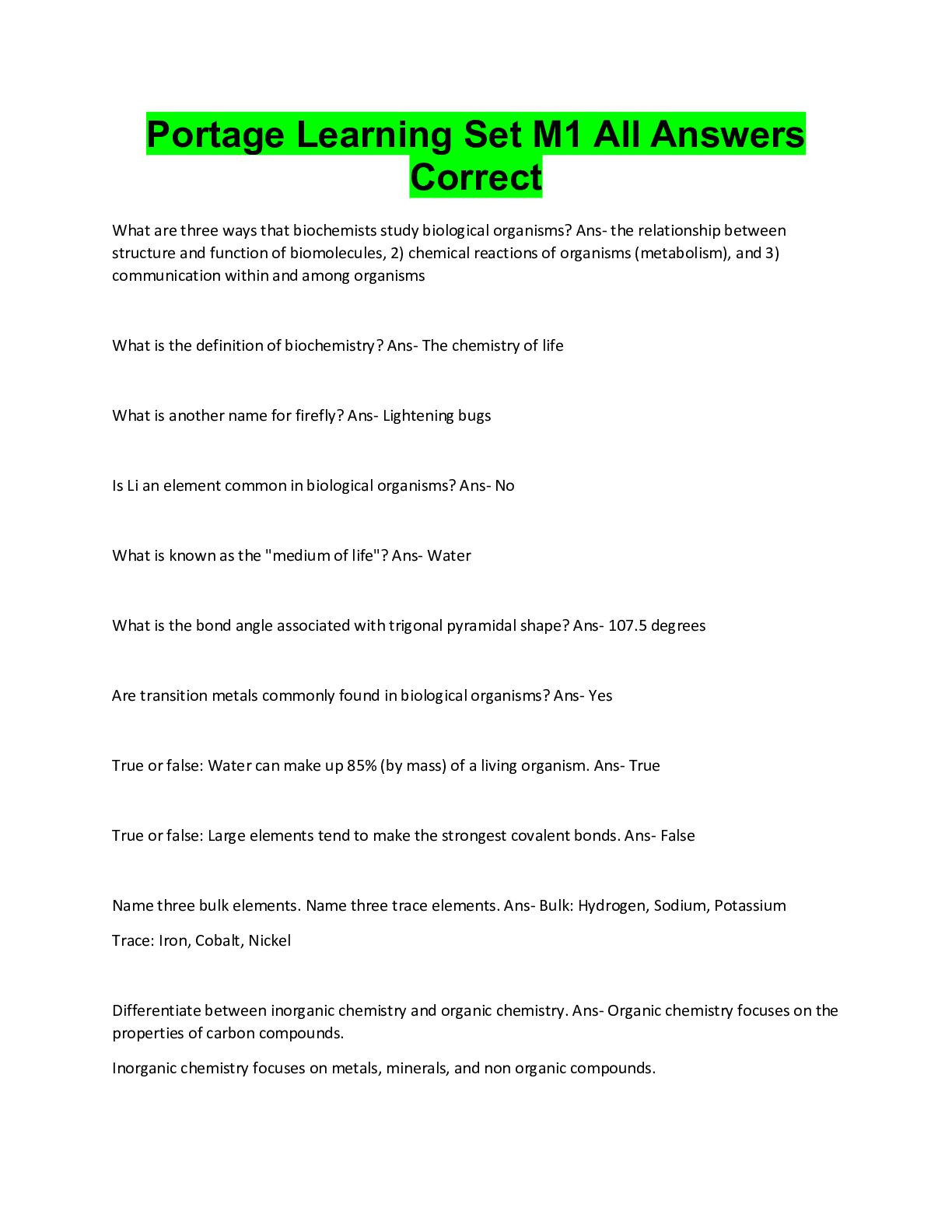
What are three ways that biochemists study biological organisms? Ans- the relationship between
structure and function of biomolecules, 2) chemical reactions of organisms (metabolism), and 3)
communication within and
...
What are three ways that biochemists study biological organisms? Ans- the relationship between
structure and function of biomolecules, 2) chemical reactions of organisms (metabolism), and 3)
communication within and among organisms
What is the definition of biochemistry? Ans- The chemistry of life
What is another name for firefly? Ans- Lightening bugs
Is Li an element common in biological organisms? Ans- No
What is known as the "medium of life"? Ans- Water
What is the bond angle associated with trigonal pyramidal shape? Ans- 107.5 degrees
Are transition metals commonly found in biological organisms? Ans- Yes
True or false: Water can make up 85% (by mass) of a living organism. Ans- True
True or false: Large elements tend to make the strongest covalent bonds. Ans- False
Name three bulk elements. Name three trace elements. Ans- Bulk: Hydrogen, Sodium, Potassium
Trace: Iron, Cobalt, Nickel
Differentiate between inorganic chemistry and organic chemistry. Ans- Organic chemistry focuses on the
properties of carbon compounds.
Inorganic chemistry focuses on metals, minerals, and non organic compounds.
Is H2O an organic molecule? How about CO2? C100H202? Ans- H2O is a inorganic compound
CO2 is an organic compound
C100H202 is an organic compound
The next row of Table 1 would be the 6-carbon alkane, hexane. Write out its chemical formula and
condensed formula. Ans- chemical formula: C6H14 Condensed formula: CH3CH2CH2CH2CH2CH3
On your own paper, draw the Kekule structures and line-bond formulas for both butane and hexane.
When you have drawn the structures, enter a note in the answer box indicating you have done so (e.g.,
"I completed these drawings." Or "I drew the structures for butane and hexane.") Ans- ...
How are the aldehyde and ketone functional groups similar? Different? Ans- Aldehdyes and ketones
both have a carbon double bond oxygen arrangement (C=O) in their structure. They differ in that the
other two bonds that the carbon forms are different. A ketone has both bonds connected to other
carbons. An aldehyde has one bond to hydrogen and the second bond to either another hydrogen or
carbon.
What functional groups are found in glycine? Ans- Carboxylic acid and amine
Retinal is found in the retina and helps with the absorption of light. What are two functional groups
found in Retinal? Ans- alkene and aldehyde
A cell wall is a combination of carbohydrates and proteins. What level of organization would this
indicate and why? Ans- Supramolecular complex. A cell wall is a combination of two types of
macromolecules to form a larger complex (through non-covalent interactions).
What is the monomer of proteins, carbohydrates, and DNA? Ans- The protein monomer is an amino
acid, a monosaccharide is the monomer for carbohydrates, and a nucleic acid is the monomer for DNA.
How are prokaryotes and eukaryotes different? (State your answer in two or more
complete sentences.) Ans- While they are both cells types, prokaryotes have a simple structure with no
organelles present. Eukaryotes have a true nucleus and organelle structures. As a result, the eukaryotes
are also considerably larger than prokaryotes.
How are Bacteria and Archaea different? (State your answer in two or more complete sentences.) Ans�Bacteria and Achaea are both simple cells with no organelle structure, and they lack a true nucleus.
Archaea live in extreme conditions, such as hot springs and in the artic; they are thought to be more
closely related to prokaryotes.
What is the function of mitochondria, lysosomes, and vacuoles? Ans- The mitochondria is the
powerhouse of the cell responsible for producing ATP. It also contains metabolic processes that yield
ATP in the end.
Lysosomes degrade macromolecules-protein, lipid, carbohydrate, nucleic acids-into smaller pieces.
These organelles have an acidic pH.
Vacuoles have digestive enzymes to degrade proteins, carbohydrates, and nucleic acids, plus vacuoles
function largely as storage centers.
What energy molecule is produced in the mitochondria? Ans- Adenosine triphosphate (ATP
[Show More]

.png)







.png)
.png)