WGU D169 Essential Practices for
Supporting Diverse Learners – Already
Passed
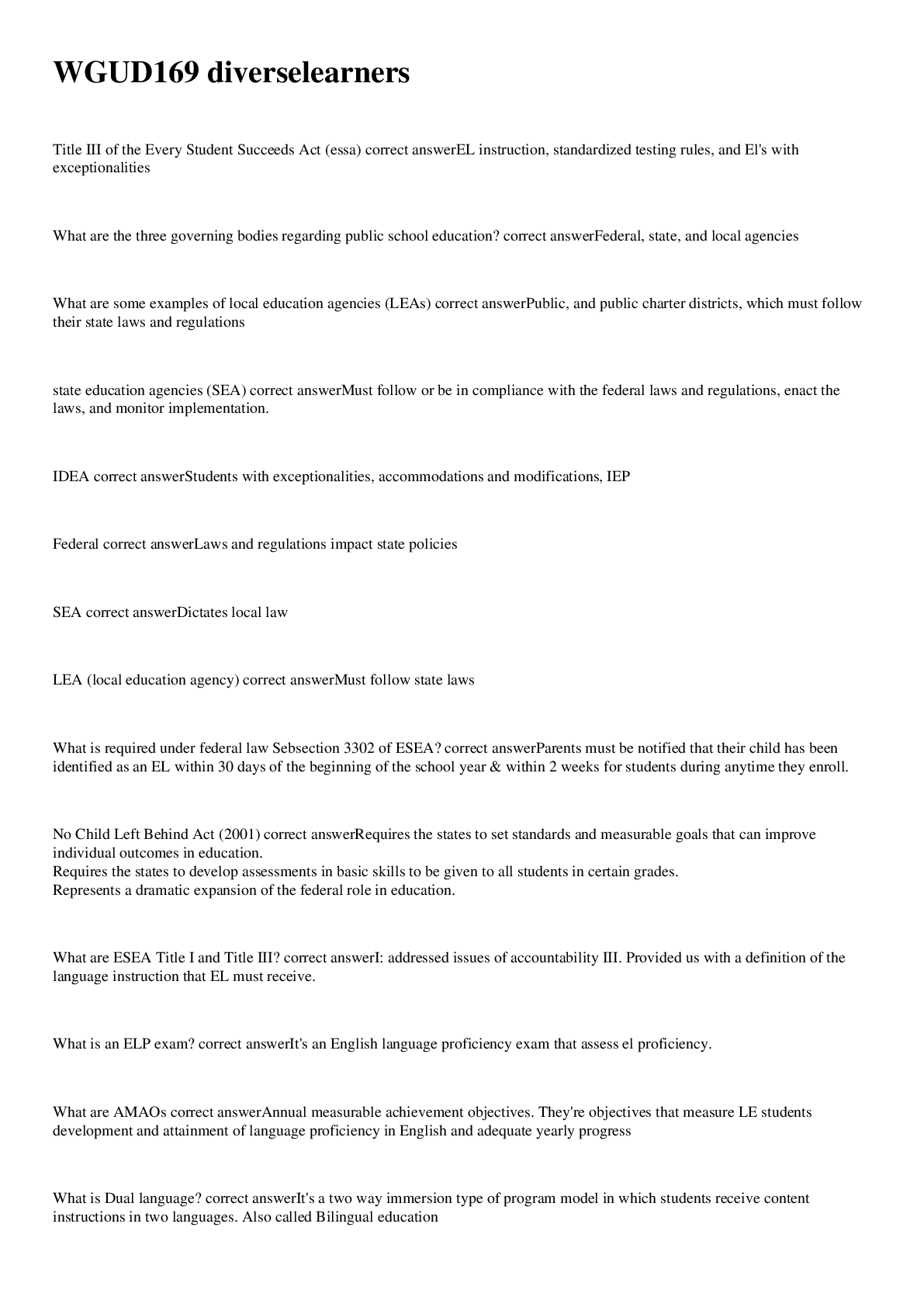
IDEA ✔✔Individuals with Disabilities Education Act
Title III ✔✔English learner instruction, Standardized testing rules ELs with exceptiona
...
WGU D169 Essential Practices for
Supporting Diverse Learners – Already
Passed
IDEA ✔✔Individuals with Disabilities Education Act
Title III ✔✔English learner instruction, Standardized testing rules ELs with exceptionalities
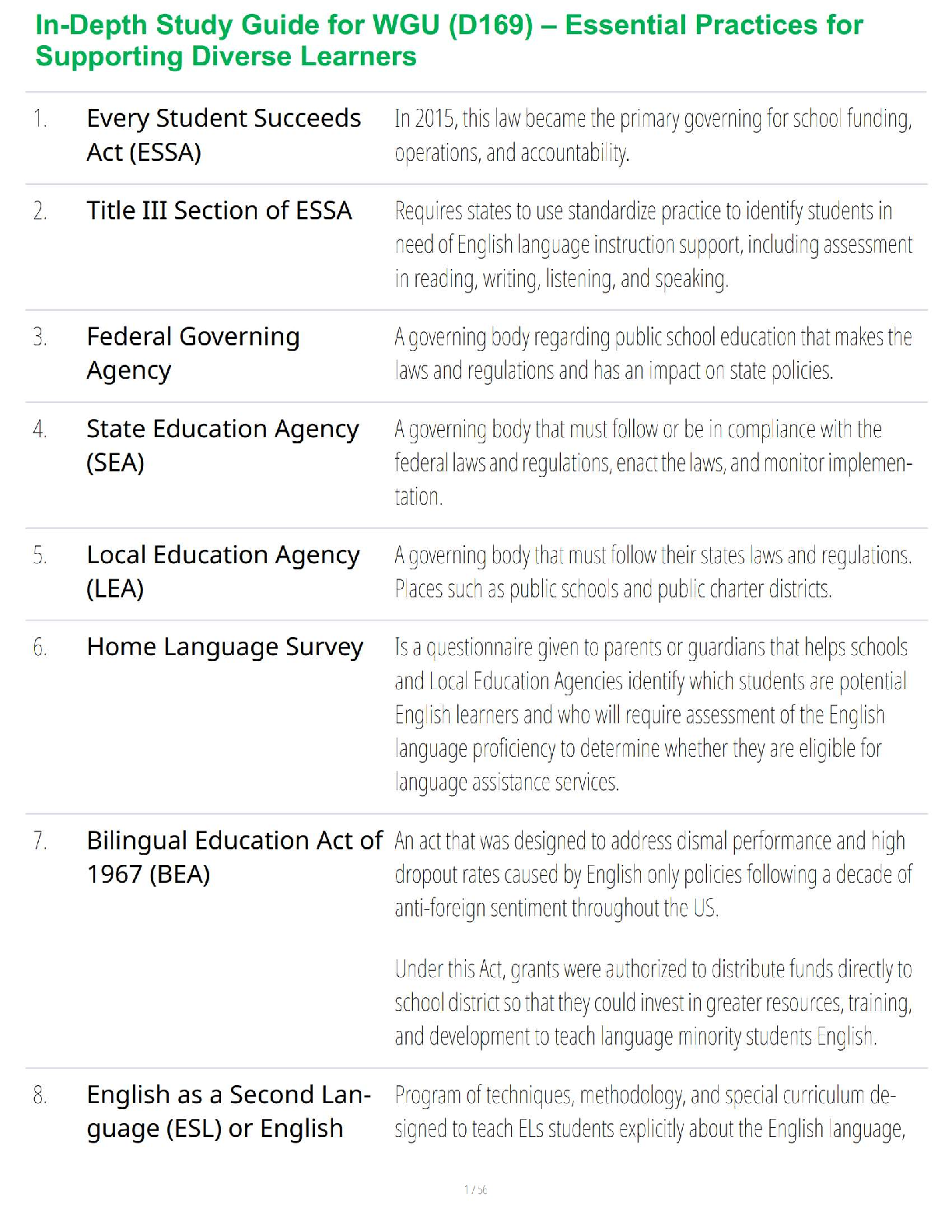
ESSA ✔✔Every Student Succeeds Act
Title III ✔✔Which law requires states to develop programs that meet the specialized needs that
students who are ELs may bring to the classroom?
English as a Second Language (ESL) or English Language Development (ELD) ✔✔Program of
techniques, methodology, and special curriculum designed to teach ELs explicitly about the
English language, including the academic vocabulary needed to access content instruction, and to
develop their English language proficiency in all four language domains (i.e., speaking, listening,
reading, and writing).
Structured English Immersion (SEI) ✔✔Program designed to impart English language skills so
that the ELs can transition and succeed in an English-only mainstream classroom once proficient.
language proficiency and content knowledge ✔✔Title III requires schools to report on the
number of ELs receiving services and their progress toward ________ and _________
Dual Language ✔✔What is another name for two-way immersion programs?
Consider the student's native literacy and language ✔✔Which practice may reduce inappropriate
over or under-identification of ELs for special education services?
1st year in the country ✔✔ESSA permits native language testing if it is necessary, and students
can be exempted from the reading assessment during ___________
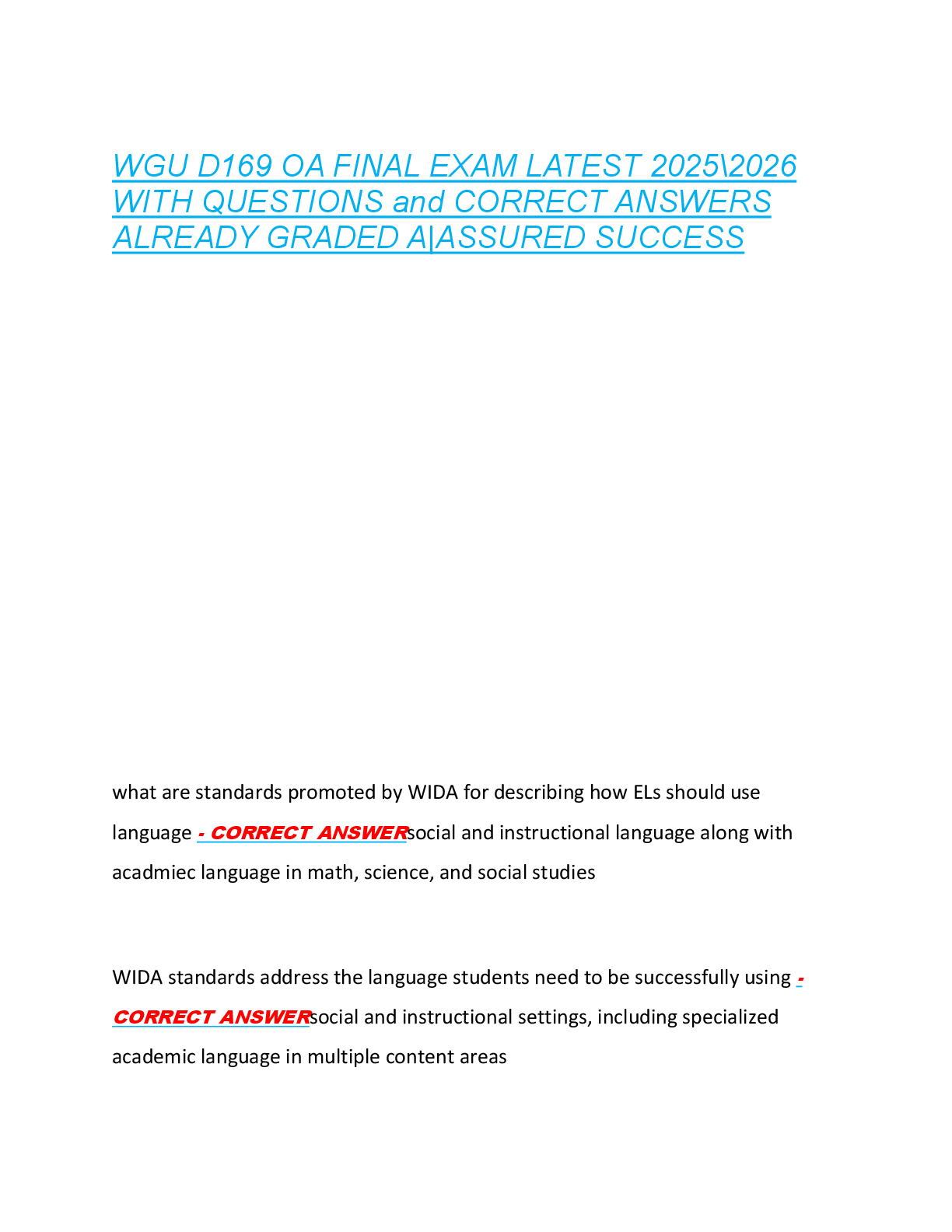
World-Class Instructional Design and Assessment ✔✔What is WIDA?
Social and instructional language along with academic language in mathematics, science, and
social studies ✔✔What areas includes standards promoted by WIDA for describing how ELs
should use language?
Individuals with Disabilities Act (IDEA) ✔✔This education law requires public schools to meet
the unique needs of eligible K-12 students with disabilities. Schools do this by providing
services.
Section 504 of the Rehabilitation Act ✔✔This civil rights law prohibits disability discrimination
at schools that get federal funding. Schools meet these requirements by removing barriers to
learning.
Americans with Disabilities Act (ADA) ✔✔This civil rights law prohibits disability
discrimination by schools, employers, and anyone who offers goods and services to the public.
IDEA ✔✔Which law provides special education?
Section 504 ✔✔Which law provides 504 plans for eligible K-12 studetns?
ADA ✔✔Which law provides freedom from discrimination at work?
FERPA ✔✔What law governs who can see documents and files related to students?
an individualized education program ✔✔What is an IEP?
Least Restrictive Environment ✔✔What is a LRE?
IDEA ✔✔What is the only law of these three to provide funding for school districts to offer
special education services to students with disabilities?
IEP ✔✔What is a foundational component of IDEA?
goals, testing accommodations, present levels of performance, services, modifications, and
placement information ✔✔What must an IEP include?
IEP is governed by special education law. 504 plan is governed by civil rights law. ✔✔What is
the difference between an IEP and 504 plan?
mainstreaming and inclusion ✔✔When LRE comes up, what two words come up also?
Accommodations or modifications due to a disability ✔✔What is a resource provided by Section
504?
pullout instruction ✔✔What is an instruction is a type of program model in which an English
language teacher works with ELs in small groups to provide English language instruction,
pulling them out of their regular classroom to do so.
Specific Learning Disability ✔✔What is SLD?
read, write, listen, speak, reason, or do math. ✔✔SLD affect a child's ability to ________
anxiety, bipolar, OCD, schizophrenia, depression ✔✔Emotional Disturbance includes
_____________
Specific Learning Disability ✔✔What category of disabilities does Dyslexia, dysgraphia, and
dyscalculia fall under?
Specific Learning Disability (SLD) ✔✔What disability category has the highest percentage of
children served under IDEA?
Modified general education class ✔✔A high school special education student diagnosed with
autism received special education services and related support for social pragmatic (social skills)
therapy from a speech-language pathologist. He requires some academic support, primarily in
written expression and task management, which happens within the general education
environment in a co-taught English class with an English teacher and his assigned special
education teacher. He also receives speech-language therapy twice per week. This student's time
out of the general education environment is minimal. Which type of educational placement
would this student receive, given his needs and the supports and services he receives?
Auditory Processing Disorder (APD) ✔✔may have difficulty comprehending lectures or
understanding verbal directions.
dyslexia ✔✔difficulty reading and recalling or using words
Dysgraphia ✔✔A learning disability that involves difficulty in handwriting and spelling
Dyscalculia ✔✔A learning disability that involves difficulty understanding or expressing
number- and math-related ideas
Dyspraxia ✔✔difficulty with coordination—primarily physical but social skills can also be
affected—that originates in the brain
Dysgraphia ✔✔A student in your fourth-grade classroom has a very difficult time writing. She is
slow to formulate letters, and she often writes the letters in an unusual way. Her ability to answer
questions orally is outstanding. In class, a teacher's assistant often acts as her scribe. Which type
of learning disability does this student display characteristics of?
nonverbal learning disorder ✔✔Difficulty following a classroom demonstration, causing
confusion and difficulty with understanding conclusions and replication
dyslexia ✔✔Difficulty reading text independently, despite comprehending information read to
them, which could impact their ability to access and engage in meaningful classroom discussions
and activities
Language Processing Disorders ✔✔Difficulty participating in classroom discussions and
activities, but often has many related and relevant thoughts on the topic at hand
IDEA ✔✔Funding for school districts is only available for students who qualify for _______ to
help with the additional costs of educating students with special needs.
3-12 ✔✔IDEA only covers students aged______ years during the years they are eligible for
public school services.
Section 504 ✔✔______________ covers students who have a physical or mental impairment
that impacts one or more major life activities but do not necessarily have an educational need as
covered by IDEA.
special education teacher ✔✔The team that writes IEPs or 504 plans must include a
________________.
twice-exceptional students ✔✔gifted students with disabilities
subjective ✔✔What kind of assessments are often in the form of a questionnaire and could have
more than one correct answer. These types of assessments are often completed to obtain a variety
of perspectives on the potentially gifted and talented student and to make note of any differences
between behavior and functioning at home and in school.
Ability tests, or IQ tests ✔✔What tests are often used as one measurement in determining
whether a student qualifies as gifted and talented. These tests are administered by a qualified
professional.
Achievement tests ✔✔What tests are often standardized assessments that measure knowledge
and skills at a particular grade level.
off-level testing ✔✔What testing is when an assessment standardized for a particular grade level
is provided to a student in a different grade. For the gifted and talented, this can be used to
determine their skill growth over time in relation to their peers.
Product based assessment ✔✔Which type of assessment evaluates a student's holistic
understanding of learning through a specific outcome or project, instead of assessing the process
of learning at each stage?
Tiering ✔✔What instruction strategy provides an opportunity for advanced students to extend
their learning, while students at other levels can consolidate their knowledge or build skills.
Mixed-ability grouping ✔✔What instruction strategy provides opportunities for students to
support one another and to get individual instruction from peers.
Tier 1 ✔✔Which tier from MTSS framework? Whole class instruction using evidence-based,
general education strategies.
Tier 3 ✔✔Which tier from MTSS framework? The most intensive level of support provided (in
addition to tier 1 instruction). This intervention is geared toward skill growth and acquisition
much more narrowly focused.
Tier 2 ✔✔Which tier from MTSS framework? Small group intervention provided to students in
addition to tier 1 support, targeting areas of need.
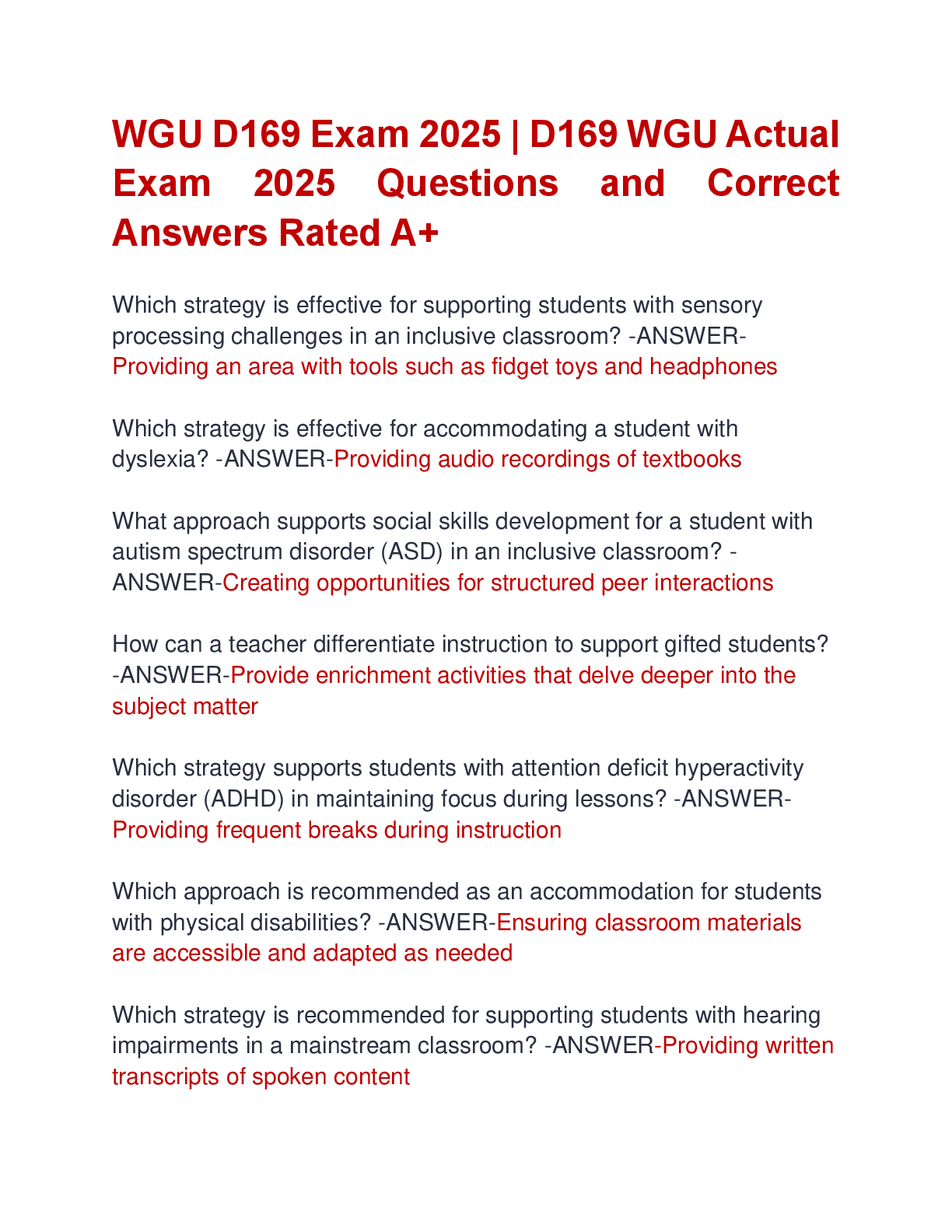
False ✔✔TRUE OR FALSE Students receiving special education services do not participate in
tiered supports in schools that implement a school-wide MTSS framework.
to intervene early so students can catch up with their peers ✔✔What is the goal of MTSS?
MTSS ✔✔What is the framework that many schools use to provide targeted support to
struggling students. Focuses on whole child.
Tier 1 ✔✔The whole class
Tier 2 ✔✔Small group interventions
Tier 3 ✔✔Intensive, Individualized Support
Universal screening, progress monitoring, data-based decision-making, school-wide support, and
family involvement ✔✔What are the key elements of an MTSS framework?
False ✔✔TRUE OR FALSE If a special education student's schedule does not allow time to
access his or her related services, by default it is appropriate to place the student in a general
education classroom co-taught with a special education teacher.
positive behavior intervention support ✔✔What is PBIS?
Student participation in PBIS-related activities, such as transition mapping, allow students to
take ownership over their education and have a voice in addressing their needs from their
perspective. ✔✔How does student participation in PBIS-related activities support educational
outcomes?
Preproduction ✔✔What Language Acquisition Stage: Minimal comprehension. Does not
verbalize. Uses nonverbal means of communication (nods, draws, points).
Early Production ✔✔What Language Acquisition Stage: Limited comprehension. Produces oneor two-word responses. Uses key or familiar phrases and mostly present tense verbs.
Speech Emergence ✔✔What Language Acquisition Stage: Decent comprehension. Produces
simple sentences with grammatical and pronunciation errors. Does not often understand jokes.
Intermediate Fluency ✔✔What Language Acquisition Stage: Excellent comprehension with
limited grammar and pronunciation errors.
Advanced Fluency ✔✔What Language Acquisition Stage: Near native comprehension and
communication.
Speaking and Listening ✔✔Which skills are most important to embed in instruction aimed at
fostering language growth?
Acculturation ✔✔What is an individual's adjustment to a new culture, while also retaining
important cultural beliefs, customs, and the native language?
Bias ✔✔(conscious) (prejudice)What is a particular preference or point of view that is personal,
rather than scientific?
implicit bias ✔✔(unconscious) What refers to the attitudes or stereotypes that affect our
understanding, actions, and decisions in an unconscious manner?
Make connections with people from cultures other than your own. Model how to talk about
culture and diversity in a positive way. ✔✔How can a teacher intentionally lessen implicit
biases?
co-teaching ✔✔What is the methodology where two teachers use their expertise through equal
responsibility with regards to students in a classroom?
Alternate co-teaching ✔✔What kind of co-teaching allows the teacher to specifically target the
terminology or concepts that might be challenging?
False ✔✔TRUE OR FALSE: Students with medical diagnoses automatically qualify for special
education services under one of the 13 categories of disability listed in IDEA.
Multitiered systems of supports ✔✔PBIS is an example of which type of school-wide support
framework?
Specific Learning Disability (SLD) ✔✔What is the most common educational disability under
IDEA and is characterized by difficulty reading, writing, listening, speaking, and reasoning?
Differentiated ✔✔Flexible instruction and mixed-ability grouping are foundations of which type
of instruction?
universal design for learning ✔✔What is UDL mean?
Universal Design for Learning (UDL) ✔✔What is an instructional framework for challenging,
supporting, and engaging learners?
multiple means of representation, engagement, and action and expression ✔✔What are three
core principles of UDL?
Plasticity ✔✔What means that the brain can grow and develop?
Variability ✔✔What requires that learning experiences be designed to meet the needs of all
diverse learners—even when those needs are different?
goals, barriers to learning, student traits ✔✔What are 3 important elements to consider in the
UDL-based lesson-planning process?
Differentiation ✔✔What means tailoring instruction to meet individual needs?
content, process, product, environment ✔✔What are 4 elements of a lesson can teachers
differentiate to meet the needs of their students?
True ✔✔TRUE OR FALSE: Explicit instruction includes teacher feedback in some form.
[Show More]
.png)
.png)