WGU C963 politics OA test questions
and answers with complete solutions
• I can identify areas of the Constitution that are influenced by the enlightenment. ✔✔The
Constitution makes justice more important than liberty
...
WGU C963 politics OA test questions
and answers with complete solutions
• I can identify areas of the Constitution that are influenced by the enlightenment. ✔✔The
Constitution makes justice more important than liberty. more concerned with controlling rather
than expressing the popular will. Property rights republicanism separation of powers
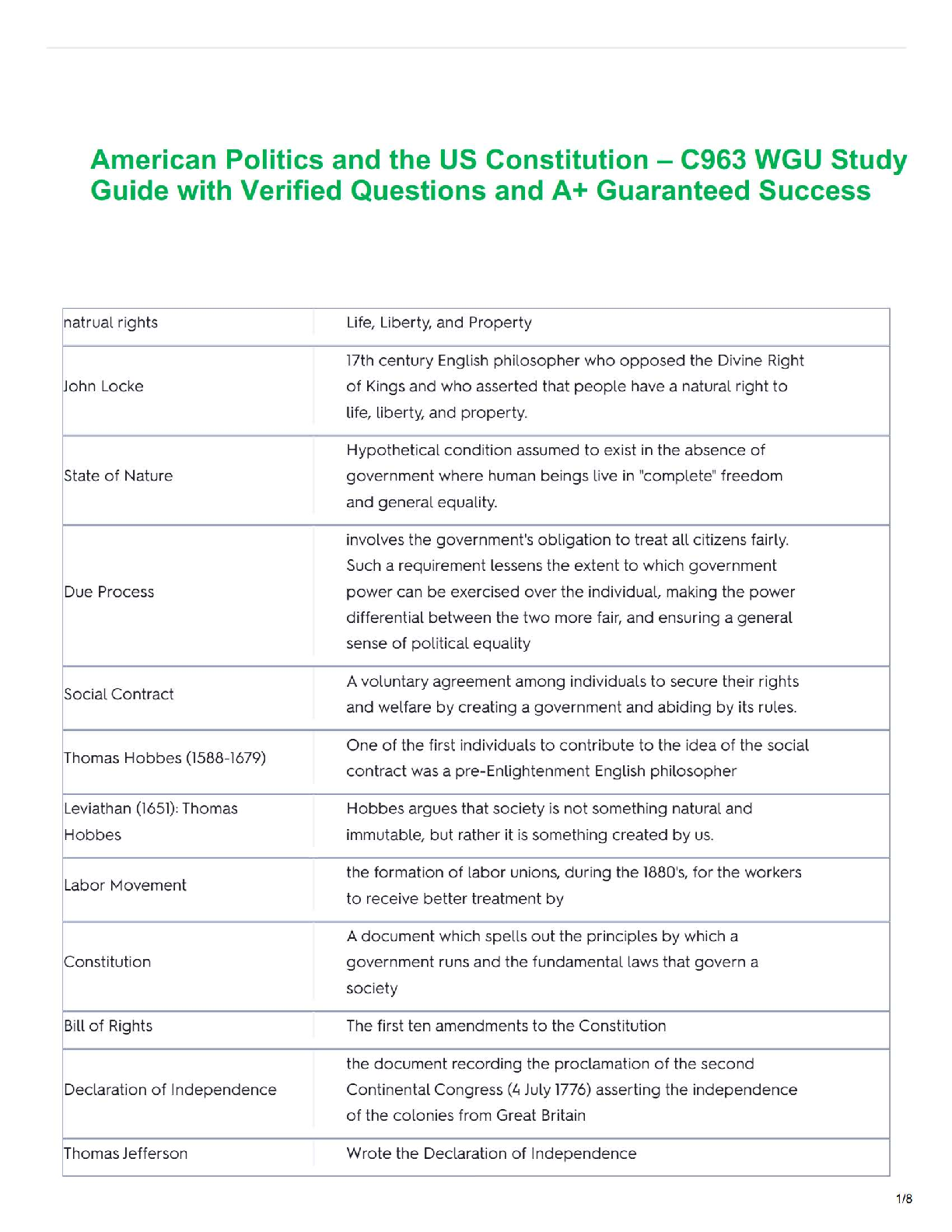
• I can identify areas of the Bill of Rights that are influenced by the enlightenment ✔✔natural
rights and procedural rights.1st amendment
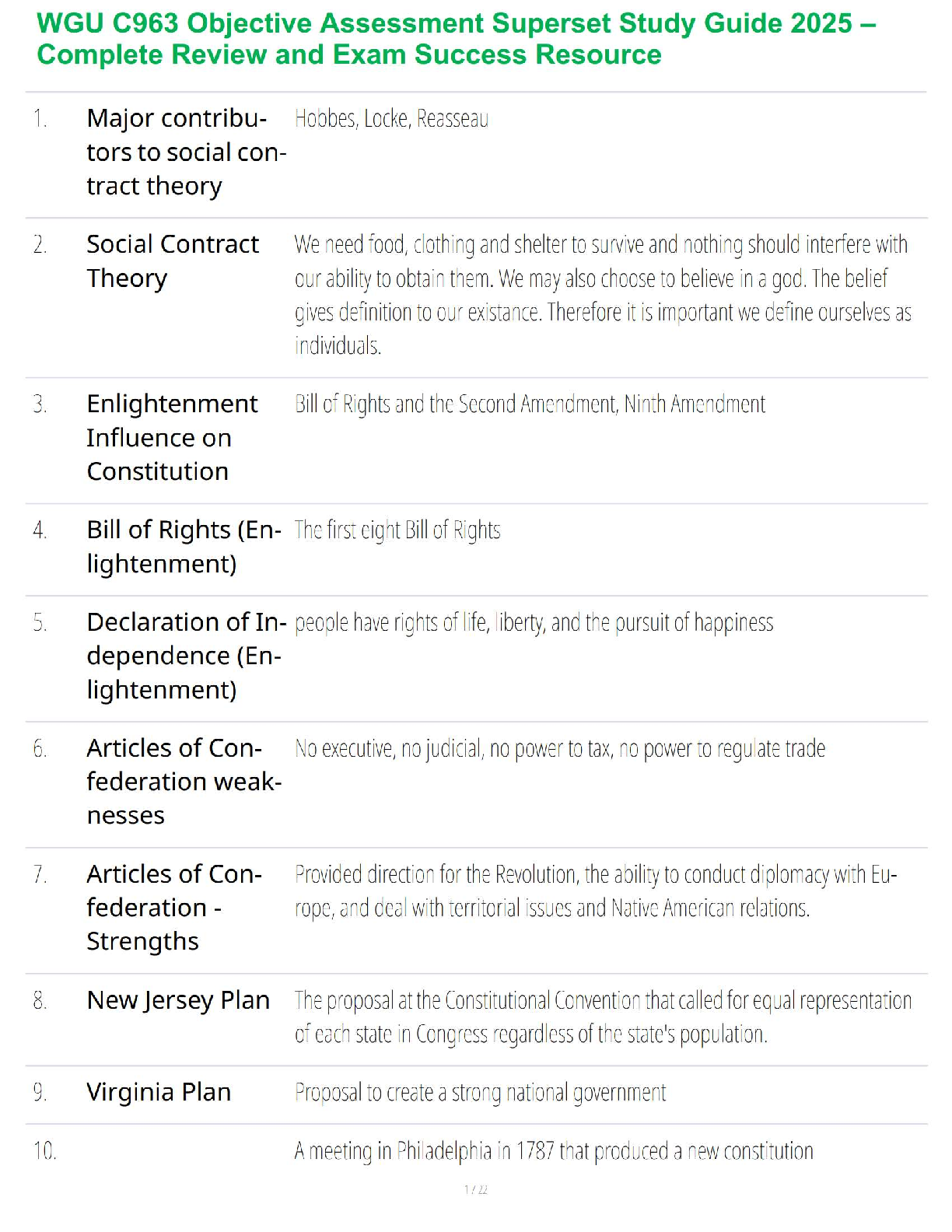
• I can list several weaknesses of the Articles of Confederations. ✔✔, the states had more power
than the national government, which served to weaken the national government and prevent it
from making effective decisions
• I can list several characteristics of the New Jersey Plan. ✔✔. Equal representation all SMALL
state, unicameral, state base, Articles of Confederation
• I can list several characteristics of the Virginia Plan ✔✔Greater representation LARGE state,
strong national government ,bicameral, population base
I can describe the major compromises that occurred during the Constitutional Convention.
✔✔The Great Compromise settled the debate between the large states and small states over state
representation in the legislative branch.
legislature ✔✔A group of people who have the power to make laws, Power to approve treaties,
deal with international trade
executive ✔✔Commander-in-chief of the armed forces, power to carry out the laws of the land,
power to pardon
judicaiary ✔✔Power to ensure that laws agree with the Constitution
Federalist's views ✔✔Federalists favored a strong central government
Anti-Federalist's views ✔✔favored strong state governments.
Federalist #10. ✔✔The diverse interests of the people would prevent the development of
powerful political parties.
Federalist #51. ✔✔checks and balances and separation of powers .
• I can explain how laws are made and enforced using the separation of powers. ✔✔Congress
makes the laws, but the President can veto them and the Supreme Court can declare them
unconstitutional.
• I can list several checks the legislative branch has on the judicial and executive branches.
✔✔To carry out laws of the land
• I can list several checks the executive branch has on the legislative and judicial branches
✔✔Power to pardon
Implied powers ✔✔powers used by the government not written in constitution. Ex. Congress
imposing draft in time of war, raising min wage
Enumerated/Expressed Powers ✔✔power explicitly stated in the Constitution, military, foreign
trade, judicary boundary
inherent power ✔✔national goverment has the power, regular immigration
How the Legislative Branch Makes Laws ✔✔To become a law, it is essential for a bill to pass
both the House and the Senate in identical form.
Gerrymandering ✔✔means drawing electoral boundaries to favor a (particular political) party or
group.
Miller v. Johnson. ✔✔racial gerrymandering where racial( minority-majority)
• I am aware of term limits for the President ✔✔2 terms 4 years each term
• I can describe how presidential powers are limited by the system of checks and balances
✔✔The Senate must confirm the president's Supreme Court nominees.
Marbury vs Madison ✔✔judicial review
McCulloch v. Maryland. ✔✔implied powers
stare decisis ✔✔Miranda vs arizona
• I can distinguish between civil and criminal court cases. ✔✔Criminal offenses and civil
offenses are generally different in terms of their punishment. The standard of proof is also very
different in a criminal case versus a civil case. Criminal cases almost always allow for a trial by
jury. A defendant in a criminal case is entitled to an attorney.
currently serving on the Supreme Court ✔✔9
concurrent powers ✔✔federal and state tax, borrowing, making laws ex. infracture project
Gibbons v. Ogden and McCulloch v. Maryland ✔✔LOOSE CONSTRUCTION the Supremacy
Clause, and the expressed power of Congress to regulate commerce.
• I can identify some of the differences of the House of Representatives and Senate, including
eligibility, term lengths, and numbers of members. ✔✔House of Representatives = two-year
term lengths, senators = six-year terms. however, as one-third of the Senate is up for reelection
every two years
• I can explain what a candidate must do to win the general election. ✔✔To win the election, a
candidate must receive a majority of electoral votes.
various types of interest groups ✔✔National Right to Life, an anti-abortion interest group,
lobbies to encourage government
Citizens United v. Federal Election ✔✔political spending is a form of free speech that's
protected under the First Amendment,
• I can explain how some voter registration requirements have historically disenfranchise African
Americans. ✔✔literacy test
• I can describe various factors that affect voter registration in the United States ✔✔frequent
elections, voter registration laws
• I can describe factors that decrease voter turnout. ✔✔. socioeconomic status, age, race, and
gender.
• I can contrast civil rights from civil liberties. ✔✔Civil liberties are protections from the
government, while civil rights are protections by the government.
Brandenburg v. Ohio. ✔✔KKK, was convicted under Ohio's Criminal Syndicalism statute,
which prohibits advocating violence for political reform, ohio violated first amendment
Lemon v. Kurtzman ✔✔was whether the First Amendment prohibited government from
providing funds to church-run schools.
Minersville School District v. Gobitis. ✔✔favor of the school policy, ruling that the government
could require respect for the flag as a key symbol of national unity and a means of preserving
national security.
West Virginia v. Barnette. ✔✔landmark decision by the United States Supreme Court holding
that the Free Speech Clause of the First Amendment protects students from being forced to salute
the American flag or say the Pledge of Allegiance in public school.
Sherbert v. Verner.. ✔✔Free Exercise Clause of the First Amendment r
Oregon HR v. Smith ✔✔United States Supreme Court case that held that the state could deny
unemployment benefits to a person fired for violating a state prohibition on the use of peyote,
even though the use of the drug was part of a religious ritual
Burwell v. Hobby Lobby ✔✔US Supreme Court ruled that the contraceptive mandate
promulgated under the Patient Protection and Affordable Care Act violated privately held, forprofit corporations' right to religious freedom.
Obergefell v. Hodges ✔✔fundamental right to marry is guaranteed to same-sex couples by both
the Due Process Clause .
Texas v. Johnson ✔✔flag burning political speech
Tinker v. Des Moines ✔✔First Amendment rights of students in U.S. public schools.
Cohen v. California. ✔✔Symbolic Speech poltical option- Offensive jacket is protected speech
Miller v. California ✔✔landmark decision by the United States Supreme Court wherein the court
redefined its definition of obscenity from that of "utterly without socially redeeming value" to
that which lacks "serious literary, artistic, political, or scientific value".
Plessy v. Ferguson ✔✔Separate but equal
Brown v. Board of Education ✔✔"separate but equal" has no place
Defense of Marriage Act (DOMA) and related cases law that, among other things, prohibited
married same-sex couples from collecting federal benefits. ... ✔✔United States v. Windsor and
Obergefell v. Hodges.
Roe vs. Wade ✔✔woman's decision to have an abortion. Up until the third trimester the state
allows abortion.
the woman appealed to the Supreme Court, arguing that the Constitution provides women the
right to terminate an abortion ✔✔Episodic framing occurs when a story focuses on isolated
details or specifics rather than looking broadly at a whole issue.
priming: ✔✔when media coverage predisposes the viewer or reader to a particular perspective
on a subject or issue.
articles of confederation and constitution ✔✔articles didn't national judiciary
virgian plan and new jersery plan ✔✔2 chamber congresss
federalist ✔✔national government better national defense and economic growth
federalist #51 ✔✔seperation of power and check and balances
judcial check executive branch ✔✔supreme court declare unconsitutional
Dual Federalism ✔✔state and national goverment CLEARLY DEFINED JURISDICTION
implied powers ✔✔raising minimal wage
president ✔✔appt judges
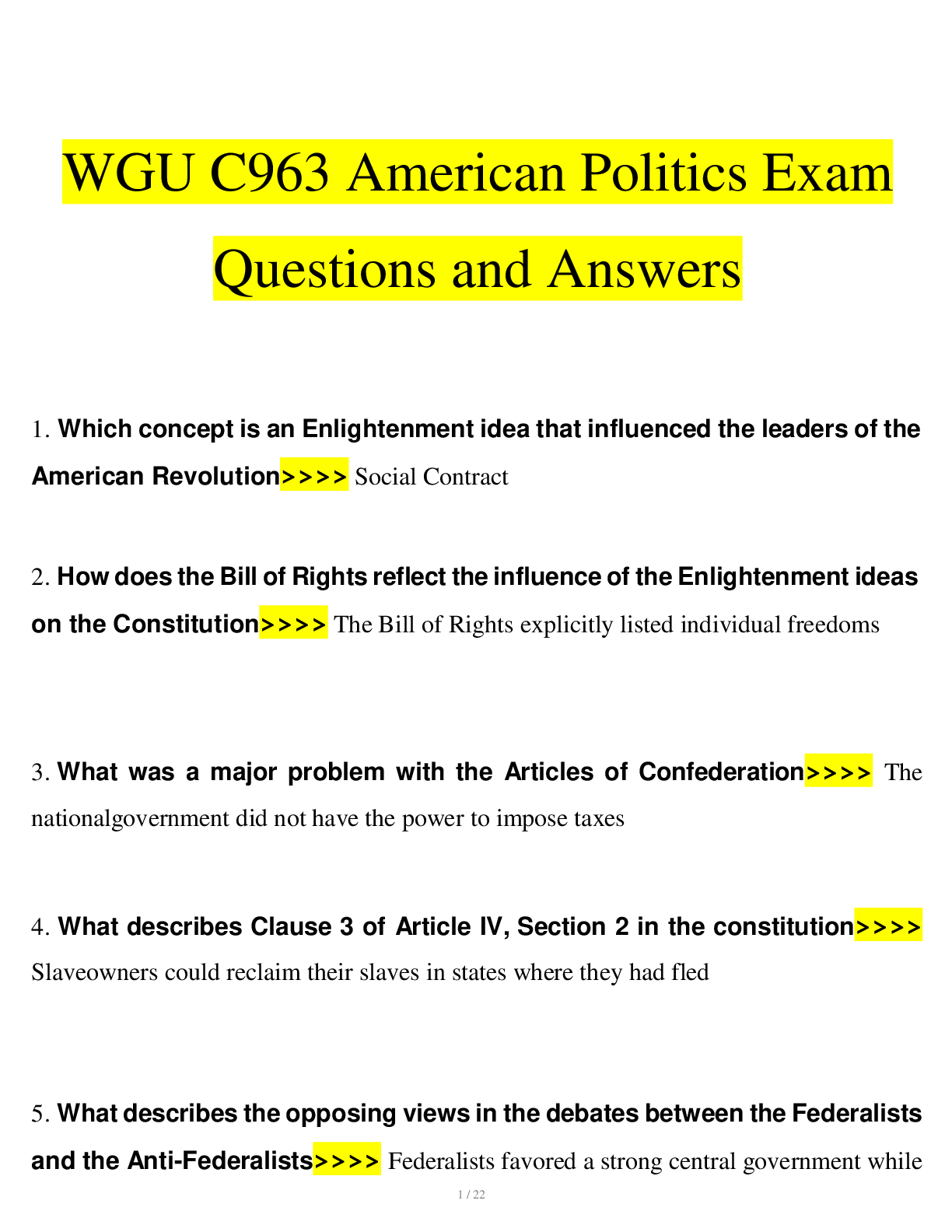
concept englightment idea ✔✔social contract
BOR influence enlgihtment idea const. ✔✔indiviudal freedom
U.S. gov under AOC ✔✔Alliance independence state under limited central government
major problem with AOC ✔✔national government did not have power to impose tax
major compromise made const. convention ✔✔represenation of enslaved person
primary effect census functing of congress ✔✔used to determin numer of House of Rep. of each
state
purpose of congress appt committees ✔✔spec. funds are allocated
power is assign to house under const. ✔✔congress spending bills
appointment influence make up of congress ✔✔deter alloc. seat of house of rep. based equal
prop. methods
pres. power can be directly restricted by congress ✔✔appointing cabinet members
president was impreachedby house of rep ✔✔andrew john firing sec. of war
purpose recess appt ✔✔fill cabint vancies while passing sneate approval
supreme court use of judical principal stare deicisis ✔✔supreme court precedent treated est.
LAW
8th amendment ✔✔No cruel or unusual punishment
Buckley vs. Valeo ✔✔political campaign 1st amendmend
[Show More]
.png)
.png)





 5e William Bianco David Canon.png)